%20--%3e%3csvg%20version='1.0'%20id='Layer_1'%20xmlns='http://www.w3.org/2000/svg'%20xmlns:xlink='http://www.w3.org/1999/xlink'%20x='0px'%20y='0px'%20viewBox='0%200%20755.52%20814.35'%20style='enable-background:new%200%200%20755.52%20814.35;'%20xml:space='preserve'%3e%3cstyle%20type='text/css'%3e%20.st0{fill:%231ae5ce;stroke:%231ae5ce;stroke-width:7;stroke-miterlimit:10;}%20.st1{fill:%23FFFFFF;stroke:%231ae5ce;stroke-width:7;stroke-miterlimit:10;}%20.st2{fill:%231ae5ce;stroke:%23FFFFFF;stroke-width:7;stroke-miterlimit:10;}%20.st3{fill:%23FFFFFF;stroke:%23FFFFFF;stroke-width:6;stroke-miterlimit:10;}%20%3c/style%3e%3cg%20id='Dark_Logo_00000159431215648494653180000015900878925932721032_'%3e%3cpath%20id='shield_00000152259091539869183100000001926543869452564382_'%20class='st0'%20d='M711.13,173.42%20c-3.37-49.07-38.92-44.9-75.96-52.18c-67.4-13.25-130.47-34.47-192.36-63.92c-22.48-10.7-41.88-25.74-65.05-26.28%20c-23.17,0.54-42.58,15.59-65.05,26.28c-61.89,29.45-124.95,50.68-192.36,63.92c-37.04,7.28-72.59,3.11-75.96,52.18%20c-1.55,22.6,0.34,46.4,1.05,68.92c5.99,190.78,52.91,345.39,206.27,466.46c29.71,23.46,74.51,55.8,108.84,70.75%20c5.99,2.61,11.7,3.73,17.21,3.75c5.51-0.02,11.22-1.14,17.21-3.75c34.33-14.95,79.12-47.3,108.84-70.75%20c153.37-121.07,200.28-275.68,206.27-466.46C710.79,219.82,712.68,196.02,711.13,173.42z'/%3e%3cpath%20id='magnifyingglass_00000073685934697636024790000000342567780940956808_'%20class='st1'%20d='M648.78,624.21l-96.64-104.65%20c34.89-40.63,55.98-93.46,55.98-151.21c0-128.27-103.98-232.24-232.24-232.24S143.63,240.08,143.63,368.35%20s103.98,232.24,232.24,232.24c48.87,0,94.21-15.11,131.62-40.89l97.18,105.24c11.25,12.18,30.24,12.93,42.42,1.69l0,0%20C659.27,655.38,660.03,636.39,648.78,624.21z'/%3e%3ccircle%20id='ellipse_00000129904010550392394720000017056154833629780114_'%20class='st2'%20cx='375.87'%20cy='368.35'%20r='181.21'/%3e%3cpath%20id='dollarsign_00000057140127156649725250000003772530148495155891_'%20class='st3'%20d='M362.91,492.03v-23.91%20c0-2.01-1.58-3.69-3.59-3.77c-18.49-0.78-37.12-5.4-49.4-11.83c-1.75-0.92-2.53-3.01-1.76-4.84l5.87-13.89%20c0.86-2.02,3.23-2.88,5.2-1.89c12.94,6.52,30.45,11.44,49.18,11.44c26.02,0,43.6-12.73,43.6-30.43c0-17.08-14.29-27.63-41.4-36.95%20c-37.37-12.42-60.46-26.7-60.46-53.72c0-24.97,20.29-44.11,52.22-49.51c1.8-0.31,3.11-1.89,3.11-3.72v-24.35%20c0-2.09,1.69-3.78,3.78-3.78h15.16c2.09,0,3.78,1.69,3.78,3.78v22.71c0,2.01,1.58,3.67,3.58,3.77c17.85,0.92,30.88,4.75,40.61,9.1%20c1.92,0.86,2.79,3.09,1.94,5.01l-6.08,13.6c-0.85,1.91-3.09,2.77-4.99,1.91c-8.37-3.8-22.38-8.95-42.75-8.95%20c-28.21,0-38.84,14.28-38.84,26.7c0,16.15,13.56,24.22,45.44,35.4c37.74,13.04,56.79,29.19,56.79,56.82%20c0,23.85-19.05,46.23-54.78,52.3c-1.8,0.31-3.11,1.89-3.11,3.72v25.28c0,2.09-1.69,3.78-3.78,3.78h-15.53%20C364.6,495.81,362.91,494.12,362.91,492.03z'/%3e%3c/g%3e%3c/svg%3e)
Ambulance Transport (emergency local) Ems Transportation
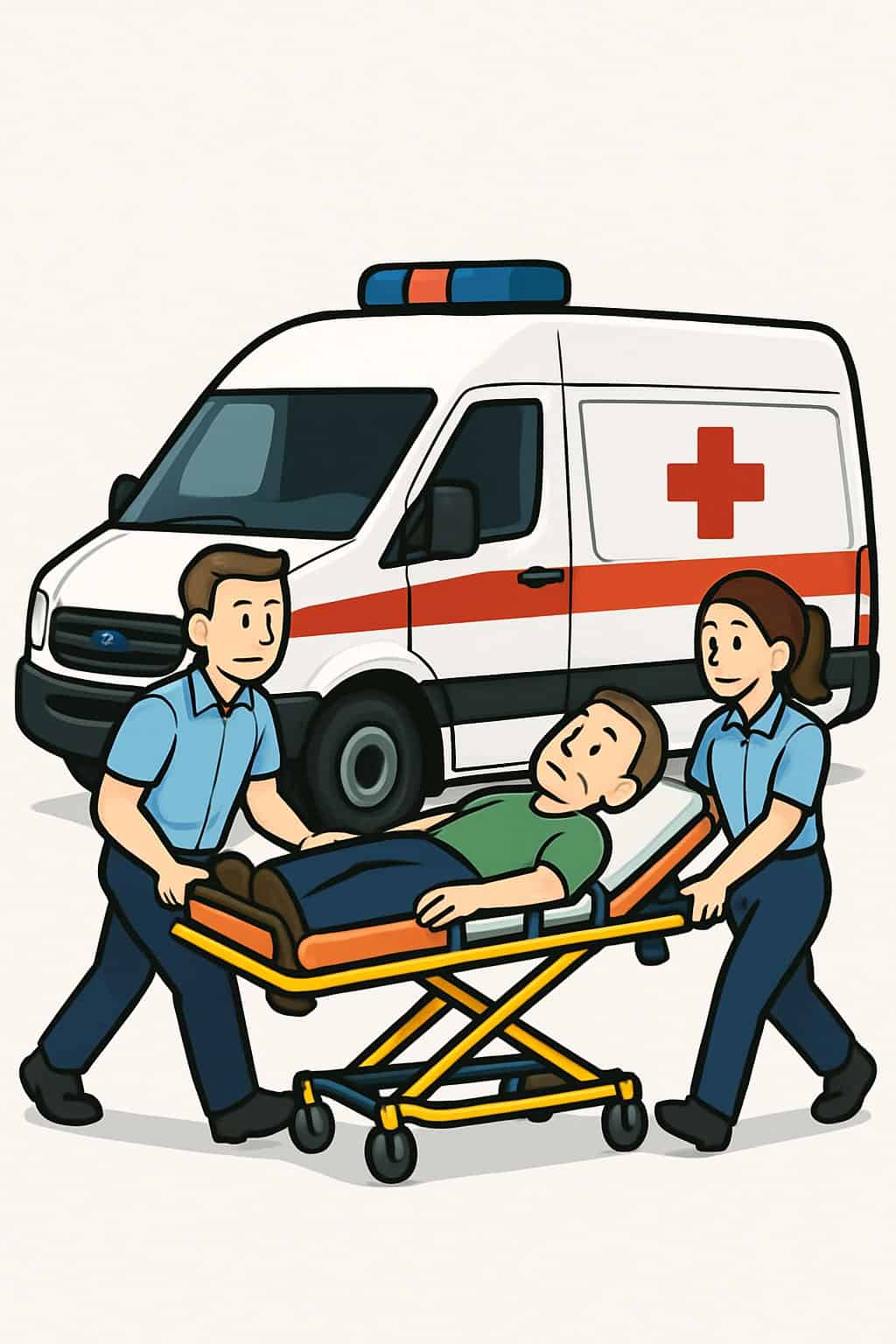
Emergency local ambulance transport is a 911-initiated response where emergency medical services arrive, assess the situation, start stabilizing care if needed, and take a person to the nearest appropriate hospital.
Overview
Emergency local ambulance transport is a 911-initiated response where emergency medical services arrive, assess the situation, start stabilizing care if needed, and take a person to the nearest appropriate hospital. Local generally means transport within the service area to a facility that can provide the required level of care. Ambulances are staffed by emergency medical technicians and paramedics who can monitor vital signs, give basic or advanced life support, communicate with medical control, and transport safely while care continues en route.
Also known as: 911 ambulance transport, Emergency medical transport, EMS transport, BLS/ALS ambulance
Preparation & Next Steps
Everything you need to know before and after your procedure
Before Care
- If contacting 911, be ready to share your exact location, phone number, the main problem, and any hazards
- Keep a current list of medicines, allergies, medical conditions, and your emergency contacts in an easy-to-find place
- Have ID, insurance information, and important documents accessible; bring them if safe to do so
- Make entry easy by unlocking doors, turning on lights, and safely securing pets if possible
- Gather essential personal items such as glasses, hearing aids, mobility aids, and device chargers if time allows
- Have recent care documents available, such as advance directives or do-not-resuscitate forms, if you use them
- Follow instructions from the emergency dispatcher and keep the phone line available until help arrives
- Avoid bringing large amounts of cash or valuables; take only items needed for identification and care
- If others are present, designate someone to guide the crew to the scene and share key information
- Consider preparing a small emergency go-bag in advance with basics and copies of medical information
After Care
- Keep any paperwork provided by EMS, including the incident or run number and agency contact information
- Confirm which hospital you were taken to and the unit caring for you so family or caregivers can coordinate
- Request a copy of the EMS patient care report from the ambulance agency if you need it for records
- Review hospital discharge instructions and keep your medication list updated with any changes
- Arrange retrieval of personal items or vehicles left behind and make a plan for transportation home
- Contact your health insurance to ask about ambulance coverage, required documentation, and claim steps
- Request an itemized ambulance bill and verify mileage, level of service, and any supplies or procedures listed
- If a charge seems incorrect or unaffordable, ask the ambulance provider about review, appeals, payment plans, or financial assistance
- Track dates, times, and contacts related to the transport and hospital stay for your records
- If symptoms change or new concerning symptoms appear, contact a clinician or emergency services
Clinical Information
Important medical details about this procedure
Indications
- Severe chest pain or signs of a heart attack
- Trouble breathing or severe asthma attack
- Signs of stroke such as face droop, arm weakness, or speech difficulty
- Major injury or trauma
- Heavy or uncontrolled bleeding
- Seizure or not waking up as usual
- Severe allergic reaction with swelling or trouble breathing
- Severe burns or electric injury
- Serious pregnancy complications or active labor with concerns
- Sudden confusion or altered mental state
Alternatives
- Personal vehicle ride to an emergency department for non-urgent situations
- Urgent care center for minor injuries or illnesses
- Telehealth visit for non-emergency concerns
- Primary care or same-day clinic for non-urgent needs
- Non-emergency medical transport services for planned visits
- Nurse advice line for general guidance
Risks
- Out-of-pocket costs if coverage is limited or the trip is not deemed medically necessary
- Delays from traffic, weather, or resource availability
- Limited choice of destination based on protocols or medical need
- Exposure to noise, vibration, or motion sickness during transport
- Possible exposure to infections despite standard precautions
- Discomfort from immobilization devices or lifting and moving
Recovery Timeline
What to expect during your recovery
The transport itself usually does not require recovery time. Any limits on activity depend on the medical condition that prompted the emergency trip.
Typical Range
Same day
Return to Work
Same day
Recovery Milestones
Keep EMS and hospital paperwork together and note key contacts
Request EMS patient care report if needed and review hospital instructions
Review insurance explanation of benefits and compare with the itemized ambulance bill
Follow up on any billing questions, appeals, or payment plans
Frequently Asked Questions
Common questions and expert answers about this procedure
What does emergency local ambulance transport mean?
What does emergency local ambulance transport mean?
It refers to a 911 response and transport to the nearest appropriate facility within the service area, based on medical need and local protocols.
Who will care for me in the ambulance?
Who will care for me in the ambulance?
Emergency medical technicians and paramedics provide basic or advanced life support, monitor you, and communicate with medical control during transport.
Do I get to choose the hospital?
Do I get to choose the hospital?
Requests may be considered, but the crew usually goes to the closest appropriate hospital or a specialty center when protocols or medical need require it.
Can a family member ride in the ambulance?
Can a family member ride in the ambulance?
Policies vary. Space and safety come first, so ride-alongs are not always possible. Staff will explain options at the scene.
Why do ambulances use lights and sirens?
Why do ambulances use lights and sirens?
They are used for time-sensitive situations to improve safety and move through traffic. Use follows local policy and medical judgment.
How is the level of service decided?
How is the level of service decided?
Based on your condition and protocols, the crew provides basic life support or advanced life support. Supplies and procedures are documented in the patient care report.
Will insurance cover the ambulance ride?
Will insurance cover the ambulance ride?
Coverage depends on medical necessity, plan rules, and network. Medicare covers emergency ambulance transport to the nearest appropriate facility when criteria are met.
Can I refuse ambulance transport?
Can I refuse ambulance transport?
A person who can make decisions may decline transport. Agencies document refusals and provide information about risks and alternatives when possible.
References
Medical literature and sources