%20--%3e%3csvg%20version='1.0'%20id='Layer_1'%20xmlns='http://www.w3.org/2000/svg'%20xmlns:xlink='http://www.w3.org/1999/xlink'%20x='0px'%20y='0px'%20viewBox='0%200%20755.52%20814.35'%20style='enable-background:new%200%200%20755.52%20814.35;'%20xml:space='preserve'%3e%3cstyle%20type='text/css'%3e%20.st0{fill:%231ae5ce;stroke:%231ae5ce;stroke-width:7;stroke-miterlimit:10;}%20.st1{fill:%23FFFFFF;stroke:%231ae5ce;stroke-width:7;stroke-miterlimit:10;}%20.st2{fill:%231ae5ce;stroke:%23FFFFFF;stroke-width:7;stroke-miterlimit:10;}%20.st3{fill:%23FFFFFF;stroke:%23FFFFFF;stroke-width:6;stroke-miterlimit:10;}%20%3c/style%3e%3cg%20id='Dark_Logo_00000159431215648494653180000015900878925932721032_'%3e%3cpath%20id='shield_00000152259091539869183100000001926543869452564382_'%20class='st0'%20d='M711.13,173.42%20c-3.37-49.07-38.92-44.9-75.96-52.18c-67.4-13.25-130.47-34.47-192.36-63.92c-22.48-10.7-41.88-25.74-65.05-26.28%20c-23.17,0.54-42.58,15.59-65.05,26.28c-61.89,29.45-124.95,50.68-192.36,63.92c-37.04,7.28-72.59,3.11-75.96,52.18%20c-1.55,22.6,0.34,46.4,1.05,68.92c5.99,190.78,52.91,345.39,206.27,466.46c29.71,23.46,74.51,55.8,108.84,70.75%20c5.99,2.61,11.7,3.73,17.21,3.75c5.51-0.02,11.22-1.14,17.21-3.75c34.33-14.95,79.12-47.3,108.84-70.75%20c153.37-121.07,200.28-275.68,206.27-466.46C710.79,219.82,712.68,196.02,711.13,173.42z'/%3e%3cpath%20id='magnifyingglass_00000073685934697636024790000000342567780940956808_'%20class='st1'%20d='M648.78,624.21l-96.64-104.65%20c34.89-40.63,55.98-93.46,55.98-151.21c0-128.27-103.98-232.24-232.24-232.24S143.63,240.08,143.63,368.35%20s103.98,232.24,232.24,232.24c48.87,0,94.21-15.11,131.62-40.89l97.18,105.24c11.25,12.18,30.24,12.93,42.42,1.69l0,0%20C659.27,655.38,660.03,636.39,648.78,624.21z'/%3e%3ccircle%20id='ellipse_00000129904010550392394720000017056154833629780114_'%20class='st2'%20cx='375.87'%20cy='368.35'%20r='181.21'/%3e%3cpath%20id='dollarsign_00000057140127156649725250000003772530148495155891_'%20class='st3'%20d='M362.91,492.03v-23.91%20c0-2.01-1.58-3.69-3.59-3.77c-18.49-0.78-37.12-5.4-49.4-11.83c-1.75-0.92-2.53-3.01-1.76-4.84l5.87-13.89%20c0.86-2.02,3.23-2.88,5.2-1.89c12.94,6.52,30.45,11.44,49.18,11.44c26.02,0,43.6-12.73,43.6-30.43c0-17.08-14.29-27.63-41.4-36.95%20c-37.37-12.42-60.46-26.7-60.46-53.72c0-24.97,20.29-44.11,52.22-49.51c1.8-0.31,3.11-1.89,3.11-3.72v-24.35%20c0-2.09,1.69-3.78,3.78-3.78h15.16c2.09,0,3.78,1.69,3.78,3.78v22.71c0,2.01,1.58,3.67,3.58,3.77c17.85,0.92,30.88,4.75,40.61,9.1%20c1.92,0.86,2.79,3.09,1.94,5.01l-6.08,13.6c-0.85,1.91-3.09,2.77-4.99,1.91c-8.37-3.8-22.38-8.95-42.75-8.95%20c-28.21,0-38.84,14.28-38.84,26.7c0,16.15,13.56,24.22,45.44,35.4c37.74,13.04,56.79,29.19,56.79,56.82%20c0,23.85-19.05,46.23-54.78,52.3c-1.8,0.31-3.11,1.89-3.11,3.72v25.28c0,2.09-1.69,3.78-3.78,3.78h-15.53%20C364.6,495.81,362.91,494.12,362.91,492.03z'/%3e%3c/g%3e%3c/svg%3e)
Cochlear implant surgery (inner ear implant) Ent Surgery
Cochlear implant surgery places an electronic device that helps provide a sense of sound to people with severe to profound sensorineural hearing loss.
Overview
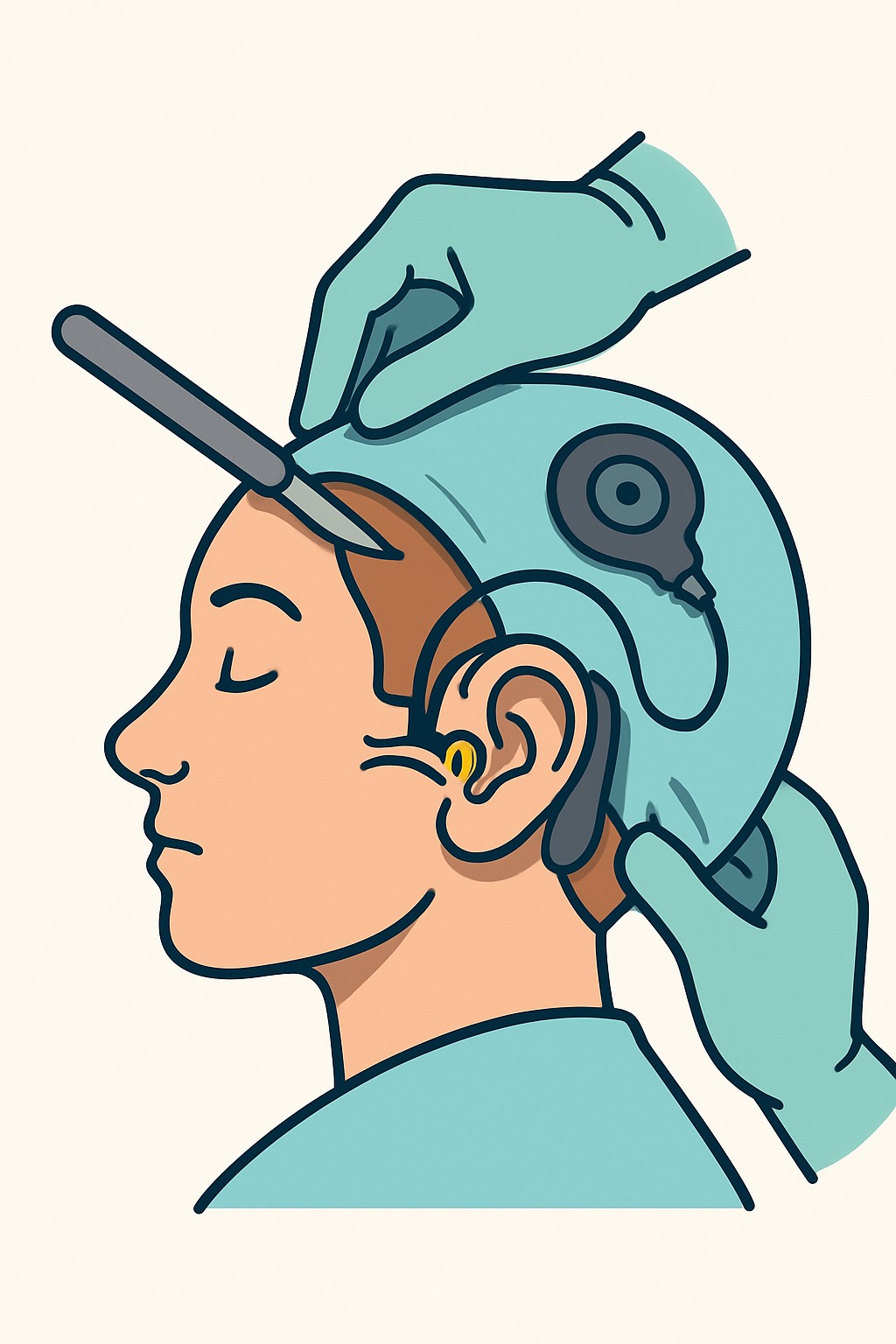
Cochlear implant surgery places an electronic device that helps provide a sense of sound to people with severe to profound sensorineural hearing loss. A small receiver is placed under the skin behind the ear, and a thin electrode is threaded into the cochlea, the inner ear organ for hearing. An external sound processor worn on the ear sends signals to the implant. This procedure is done to improve access to speech and environmental sounds when hearing aids no longer provide enough benefit. Hearing with a cochlear implant is different from natural hearing, and results vary. Progress continues over months with device programming and listening practice.
Also known as: Cochlear implantation, CI surgery, Inner ear implant surgery
Preparation & Next Steps
Everything you need to know before and after your procedure
Before Care
- Expect a full evaluation that may include hearing tests, speech testing, and imaging such as CT or MRI
- Review your current medicines and supplements with the care team, including blood thinners
- Follow any fasting or shower instructions you receive for anesthesia and skin prep
- Arrange an adult to take you home and stay nearby the first day
- Plan time off from work or school and arrange help at home if needed
- Tell the team about recent colds, fever, or ear infections before the surgery date
- Discuss vaccination plans to reduce meningitis risk as recommended for cochlear implant candidates
- Confirm how your external sound processor will be ordered and when you will receive it
- Bring your ID, insurance information, and any prior imaging or test results to pre-op visits
After Care
- Keep the incision clean and dry as instructed; avoid submerging the site until cleared
- Use pain control and other medicines only as directed by your care team
- Avoid heavy lifting, straining, or contact sports until your clinician says it is safe
- Protect the ear from bumps and avoid pressure changes such as forceful nose blowing
- Expect a head bandage for a short time and some swelling or numbness around the ear
- Dizziness, taste changes, or tinnitus can occur and often improve over days to weeks
- Do not attach or use the external sound processor until the activation visit
- Attend follow-up visits for incision check, device activation, and programming sessions
- Contact your care team for fever, increasing redness, drainage with odor, worsening pain, severe dizziness, bad headache, or any facial weakness
Clinical Information
Important medical details about this procedure
Indications
- Severe to profound sensorineural hearing loss with limited benefit from well-fitted hearing aids
- Very poor speech understanding despite hearing aids
- Single-sided deafness or asymmetric hearing loss in some cases
- Hearing loss from inner ear or auditory nerve problems that meet candidacy criteria
Alternatives
- Conventional hearing aids
- Bone-anchored hearing systems for certain types of hearing loss
- Assistive listening devices and captioning services
- Aural rehabilitation and communication strategies
Risks
- Infection, bleeding, or pain at the incision site
- Dizziness or balance changes
- Tinnitus or changes in taste
- Injury to the facial nerve
- Loss of remaining natural hearing in the implanted ear
- Device or electrode problems that may need revision surgery
- Small increased risk of meningitis; vaccines are commonly recommended
Contraindications
- Active ear or middle ear infection
- Inability to undergo general anesthesia safely
- Absent or severely damaged auditory nerve for standard cochlear implants
- Medical or logistical barriers to follow-up programming and rehabilitation
Recovery Timeline
What to expect during your recovery
Most people go home the same day or the next day. Soreness and tiredness improve over several days. Many return to light work or school in 1 to 2 weeks. Device activation usually occurs 2 to 6 weeks after surgery, followed by months of programming and listening practice.
Typical Range
7–14 days
Return to Work
7–14 days
Recovery Milestones
Rest at home and take short walks indoors; keep the head bandage as directed
Light daily activities; keep the incision dry and protected
Return to desk work or school if cleared by your care team
Implant activation and first programming visit
Ongoing programming sessions and listening practice
Frequently Asked Questions
Common questions and expert answers about this procedure
How is cochlear implant surgery performed?
How is cochlear implant surgery performed?
Under general anesthesia, a small incision is made behind the ear. A receiver is placed under the skin, and a thin electrode is gently inserted into the cochlea. The incision is closed and a dressing is applied.
How long does the surgery take and is it outpatient?
How long does the surgery take and is it outpatient?
The operation usually takes a few hours. Many centers do it as outpatient surgery, though some people stay one night.
When will the implant be turned on?
When will the implant be turned on?
Activation commonly happens 2 to 6 weeks after surgery, once the incision has healed. Several programming visits fine-tune the device settings.
What results can I expect?
What results can I expect?
Hearing with a cochlear implant is different from natural hearing. Many people improve in speech understanding over weeks to months, with practice and programming visits.
Will I lose any remaining natural hearing?
Will I lose any remaining natural hearing?
Some people lose part or all of their remaining hearing in the implanted ear. This is a known risk that is discussed during evaluation.
Can I get an MRI with a cochlear implant?
Can I get an MRI with a cochlear implant?
Many modern implants are MRI-conditional at certain strengths. Always check your device model and follow the manufacturer and radiology guidelines.
Is there an age limit for cochlear implants?
Is there an age limit for cochlear implants?
Both children and adults may be candidates. Candidacy depends on hearing tests, health status, and the ability to participate in follow-up care.
References
Medical literature and sources