%20--%3e%3csvg%20version='1.0'%20id='Layer_1'%20xmlns='http://www.w3.org/2000/svg'%20xmlns:xlink='http://www.w3.org/1999/xlink'%20x='0px'%20y='0px'%20viewBox='0%200%20755.52%20814.35'%20style='enable-background:new%200%200%20755.52%20814.35;'%20xml:space='preserve'%3e%3cstyle%20type='text/css'%3e%20.st0{fill:%231ae5ce;stroke:%231ae5ce;stroke-width:7;stroke-miterlimit:10;}%20.st1{fill:%23FFFFFF;stroke:%231ae5ce;stroke-width:7;stroke-miterlimit:10;}%20.st2{fill:%231ae5ce;stroke:%23FFFFFF;stroke-width:7;stroke-miterlimit:10;}%20.st3{fill:%23FFFFFF;stroke:%23FFFFFF;stroke-width:6;stroke-miterlimit:10;}%20%3c/style%3e%3cg%20id='Dark_Logo_00000159431215648494653180000015900878925932721032_'%3e%3cpath%20id='shield_00000152259091539869183100000001926543869452564382_'%20class='st0'%20d='M711.13,173.42%20c-3.37-49.07-38.92-44.9-75.96-52.18c-67.4-13.25-130.47-34.47-192.36-63.92c-22.48-10.7-41.88-25.74-65.05-26.28%20c-23.17,0.54-42.58,15.59-65.05,26.28c-61.89,29.45-124.95,50.68-192.36,63.92c-37.04,7.28-72.59,3.11-75.96,52.18%20c-1.55,22.6,0.34,46.4,1.05,68.92c5.99,190.78,52.91,345.39,206.27,466.46c29.71,23.46,74.51,55.8,108.84,70.75%20c5.99,2.61,11.7,3.73,17.21,3.75c5.51-0.02,11.22-1.14,17.21-3.75c34.33-14.95,79.12-47.3,108.84-70.75%20c153.37-121.07,200.28-275.68,206.27-466.46C710.79,219.82,712.68,196.02,711.13,173.42z'/%3e%3cpath%20id='magnifyingglass_00000073685934697636024790000000342567780940956808_'%20class='st1'%20d='M648.78,624.21l-96.64-104.65%20c34.89-40.63,55.98-93.46,55.98-151.21c0-128.27-103.98-232.24-232.24-232.24S143.63,240.08,143.63,368.35%20s103.98,232.24,232.24,232.24c48.87,0,94.21-15.11,131.62-40.89l97.18,105.24c11.25,12.18,30.24,12.93,42.42,1.69l0,0%20C659.27,655.38,660.03,636.39,648.78,624.21z'/%3e%3ccircle%20id='ellipse_00000129904010550392394720000017056154833629780114_'%20class='st2'%20cx='375.87'%20cy='368.35'%20r='181.21'/%3e%3cpath%20id='dollarsign_00000057140127156649725250000003772530148495155891_'%20class='st3'%20d='M362.91,492.03v-23.91%20c0-2.01-1.58-3.69-3.59-3.77c-18.49-0.78-37.12-5.4-49.4-11.83c-1.75-0.92-2.53-3.01-1.76-4.84l5.87-13.89%20c0.86-2.02,3.23-2.88,5.2-1.89c12.94,6.52,30.45,11.44,49.18,11.44c26.02,0,43.6-12.73,43.6-30.43c0-17.08-14.29-27.63-41.4-36.95%20c-37.37-12.42-60.46-26.7-60.46-53.72c0-24.97,20.29-44.11,52.22-49.51c1.8-0.31,3.11-1.89,3.11-3.72v-24.35%20c0-2.09,1.69-3.78,3.78-3.78h15.16c2.09,0,3.78,1.69,3.78,3.78v22.71c0,2.01,1.58,3.67,3.58,3.77c17.85,0.92,30.88,4.75,40.61,9.1%20c1.92,0.86,2.79,3.09,1.94,5.01l-6.08,13.6c-0.85,1.91-3.09,2.77-4.99,1.91c-8.37-3.8-22.38-8.95-42.75-8.95%20c-28.21,0-38.84,14.28-38.84,26.7c0,16.15,13.56,24.22,45.44,35.4c37.74,13.04,56.79,29.19,56.79,56.82%20c0,23.85-19.05,46.23-54.78,52.3c-1.8,0.31-3.11,1.89-3.11,3.72v25.28c0,2.09-1.69,3.78-3.78,3.78h-15.53%20C364.6,495.81,362.91,494.12,362.91,492.03z'/%3e%3c/g%3e%3c/svg%3e)
Ear tube placement (for ear infections) Ent Surgery
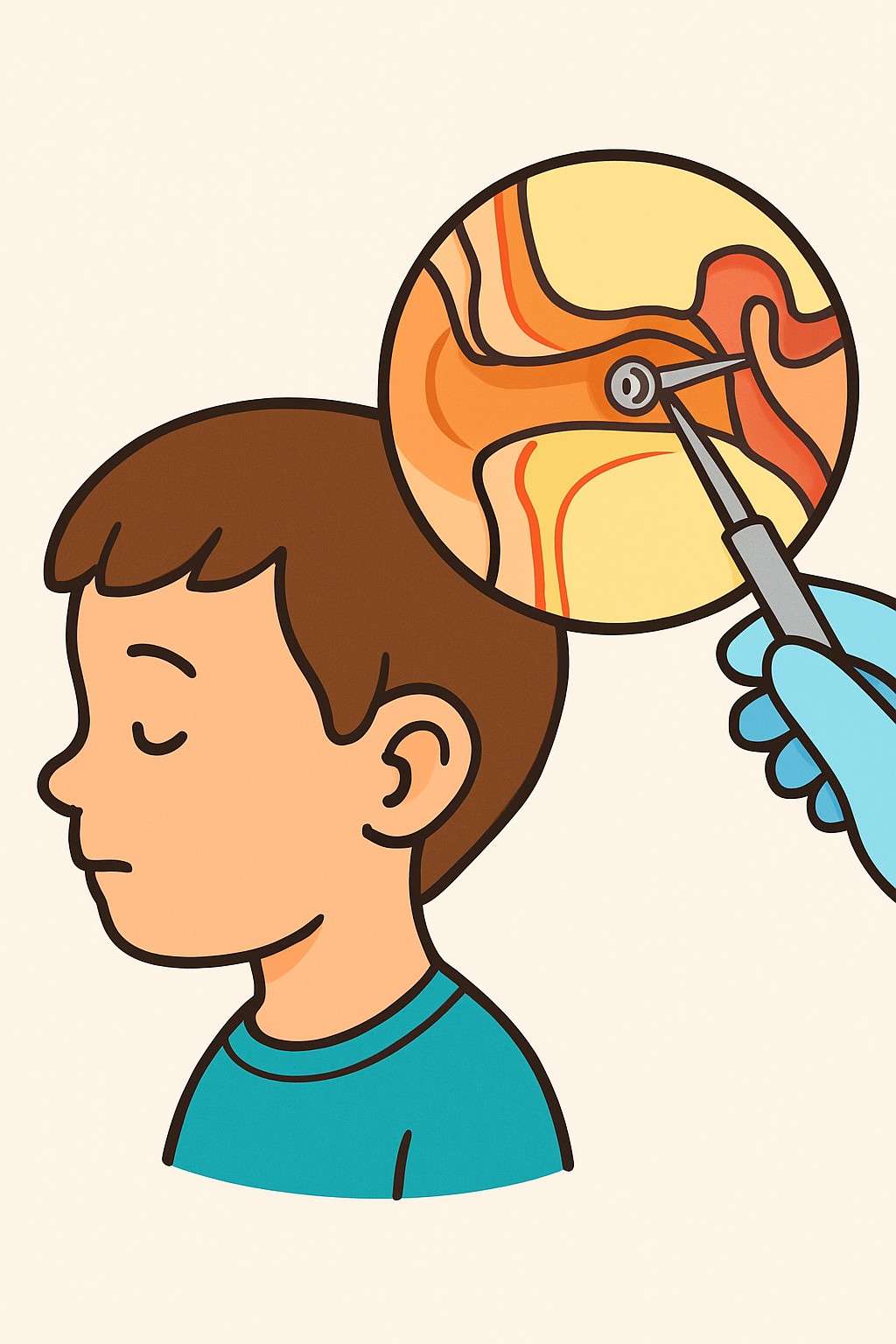
Ear tube placement is a short procedure where a clinician makes a tiny opening in the eardrum and places a small tube.
Overview
Ear tube placement is a short procedure where a clinician makes a tiny opening in the eardrum and places a small tube. The tube lets air into the middle ear and allows fluid to drain. It is often done for children who have frequent ear infections or fluid behind the eardrum that does not clear. The goal is to reduce infections, improve hearing, and lower the chance of fluid building up again.
Also known as: Ear tubes, Tympanostomy tubes, Myringotomy with tubes
Preparation & Next Steps
Everything you need to know before and after your procedure
Before Care
- Follow the surgery center’s fasting instructions for anesthesia if provided
- Share a complete list of medicines, supplements, and allergies with the team
- Ask the team about plans for any blood thinners or herbal supplements
- Arrange an adult to drive home and stay nearby the first day
- If there is fever, cough, or a new cold before surgery, notify the surgery team
- Remove earrings or ear accessories and dress in comfortable clothing
- Bring ID, insurance card, and any required consent forms
- Plan for a short day off school or work for the procedure and recovery
- Do not put cotton swabs or objects into the ear canal before surgery
After Care
- Expect mild ear discomfort and a small amount of drainage for a day or two
- Use prescribed ear drops only as directed if they are provided
- Resume normal eating and light activity once fully awake and alert
- Avoid inserting cotton swabs or objects into the ear canal
- Ask the care team about bathing and swimming; water precautions can vary
- Keep track of any drainage, fever, or worsening pain and contact a clinician with concerns
- Schedule the recommended follow-up visit and hearing check to confirm tube position
- Most children return to school or daycare within 1 to 2 days when feeling well
- If a tube falls out and is seen, keep it in a small container and mention it at follow-up
Clinical Information
Important medical details about this procedure
Indications
- Recurrent acute ear infections
- Persistent middle ear fluid (otitis media with effusion) lasting several months
- Hearing loss or speech delay related to middle ear fluid
- Eustachian tube dysfunction causing repeated fluid buildup
- Ear infections not responding well to usual treatments
Alternatives
- Watchful waiting with periodic hearing checks
- Treating infections with medicines when they occur
- Managing allergies or nasal congestion when relevant
- Autoinflation devices to help open the Eustachian tube in select cases
- Hearing monitoring and school accommodations if needed
Risks
- Anesthesia effects like nausea or grogginess
- Ear drainage or infection after placement
- Persistent hole in the eardrum after the tube comes out
- Scarring of the eardrum (tympanosclerosis)
- Tubes falling out early or staying in longer than expected
- Need for another procedure if problems return
- Rare risk of injury to the ear canal or middle ear
Contraindications
- Active ear canal infection that needs treatment first
- Uncontrolled bleeding disorders
- Medical conditions that make anesthesia unsafe at that time
Recovery Timeline
What to expect during your recovery
Most people feel better within 1 to 3 days after ear tube placement. Many children return to normal activities the next day. Follow-up is typically within a few weeks to check hearing and tube position.
Typical Range
1–3 days
Return to Work
1–2 days
Recovery Milestones
Go home the same day after recovery from anesthesia
Expect mild ear discomfort or light drainage
Return to school, daycare, or light work when alert and comfortable
Resume usual daily activities; ask about water exposure if unsure
Attend follow-up visit and hearing check
Frequently Asked Questions
Common questions and expert answers about this procedure
What happens during ear tube placement?
What happens during ear tube placement?
A small opening is made in the eardrum to suction fluid, and a tiny tube is placed to let air in and fluid out. It usually takes about 10 to 20 minutes.
What type of anesthesia is used?
What type of anesthesia is used?
Children usually have general anesthesia so they sleep during the procedure. Some adults may have local anesthesia with sedation.
How long do ear tubes stay in?
How long do ear tubes stay in?
Most tubes fall out on their own in 6 to 18 months. The eardrum usually heals after the tube comes out.
Will ear infections stop after tubes?
Will ear infections stop after tubes?
Infections can still occur, but they are often fewer, less painful, and may be treated with ear drops instead of oral antibiotics.
Are water precautions needed with ear tubes?
Are water precautions needed with ear tubes?
Advice varies. Many people can bathe and swim in clean water without ear plugs. Check the plan you receive from your care team.
Will hearing improve?
Will hearing improve?
If hearing loss was due to middle ear fluid, hearing often improves after the fluid is cleared and the ear is ventilated.
Can a hole remain in the eardrum?
Can a hole remain in the eardrum?
Most eardrums heal after the tube comes out. A small number of cases have a persistent hole that may need a patch procedure.
Could another set of tubes be needed?
Could another set of tubes be needed?
Some children need another set if fluid or infections return after the first tubes come out.
References
Medical literature and sources