%20--%3e%3csvg%20version='1.0'%20id='Layer_1'%20xmlns='http://www.w3.org/2000/svg'%20xmlns:xlink='http://www.w3.org/1999/xlink'%20x='0px'%20y='0px'%20viewBox='0%200%20755.52%20814.35'%20style='enable-background:new%200%200%20755.52%20814.35;'%20xml:space='preserve'%3e%3cstyle%20type='text/css'%3e%20.st0{fill:%231ae5ce;stroke:%231ae5ce;stroke-width:7;stroke-miterlimit:10;}%20.st1{fill:%23FFFFFF;stroke:%231ae5ce;stroke-width:7;stroke-miterlimit:10;}%20.st2{fill:%231ae5ce;stroke:%23FFFFFF;stroke-width:7;stroke-miterlimit:10;}%20.st3{fill:%23FFFFFF;stroke:%23FFFFFF;stroke-width:6;stroke-miterlimit:10;}%20%3c/style%3e%3cg%20id='Dark_Logo_00000159431215648494653180000015900878925932721032_'%3e%3cpath%20id='shield_00000152259091539869183100000001926543869452564382_'%20class='st0'%20d='M711.13,173.42%20c-3.37-49.07-38.92-44.9-75.96-52.18c-67.4-13.25-130.47-34.47-192.36-63.92c-22.48-10.7-41.88-25.74-65.05-26.28%20c-23.17,0.54-42.58,15.59-65.05,26.28c-61.89,29.45-124.95,50.68-192.36,63.92c-37.04,7.28-72.59,3.11-75.96,52.18%20c-1.55,22.6,0.34,46.4,1.05,68.92c5.99,190.78,52.91,345.39,206.27,466.46c29.71,23.46,74.51,55.8,108.84,70.75%20c5.99,2.61,11.7,3.73,17.21,3.75c5.51-0.02,11.22-1.14,17.21-3.75c34.33-14.95,79.12-47.3,108.84-70.75%20c153.37-121.07,200.28-275.68,206.27-466.46C710.79,219.82,712.68,196.02,711.13,173.42z'/%3e%3cpath%20id='magnifyingglass_00000073685934697636024790000000342567780940956808_'%20class='st1'%20d='M648.78,624.21l-96.64-104.65%20c34.89-40.63,55.98-93.46,55.98-151.21c0-128.27-103.98-232.24-232.24-232.24S143.63,240.08,143.63,368.35%20s103.98,232.24,232.24,232.24c48.87,0,94.21-15.11,131.62-40.89l97.18,105.24c11.25,12.18,30.24,12.93,42.42,1.69l0,0%20C659.27,655.38,660.03,636.39,648.78,624.21z'/%3e%3ccircle%20id='ellipse_00000129904010550392394720000017056154833629780114_'%20class='st2'%20cx='375.87'%20cy='368.35'%20r='181.21'/%3e%3cpath%20id='dollarsign_00000057140127156649725250000003772530148495155891_'%20class='st3'%20d='M362.91,492.03v-23.91%20c0-2.01-1.58-3.69-3.59-3.77c-18.49-0.78-37.12-5.4-49.4-11.83c-1.75-0.92-2.53-3.01-1.76-4.84l5.87-13.89%20c0.86-2.02,3.23-2.88,5.2-1.89c12.94,6.52,30.45,11.44,49.18,11.44c26.02,0,43.6-12.73,43.6-30.43c0-17.08-14.29-27.63-41.4-36.95%20c-37.37-12.42-60.46-26.7-60.46-53.72c0-24.97,20.29-44.11,52.22-49.51c1.8-0.31,3.11-1.89,3.11-3.72v-24.35%20c0-2.09,1.69-3.78,3.78-3.78h15.16c2.09,0,3.78,1.69,3.78,3.78v22.71c0,2.01,1.58,3.67,3.58,3.77c17.85,0.92,30.88,4.75,40.61,9.1%20c1.92,0.86,2.79,3.09,1.94,5.01l-6.08,13.6c-0.85,1.91-3.09,2.77-4.99,1.91c-8.37-3.8-22.38-8.95-42.75-8.95%20c-28.21,0-38.84,14.28-38.84,26.7c0,16.15,13.56,24.22,45.44,35.4c37.74,13.04,56.79,29.19,56.79,56.82%20c0,23.85-19.05,46.23-54.78,52.3c-1.8,0.31-3.11,1.89-3.11,3.72v25.28c0,2.09-1.69,3.78-3.78,3.78h-15.53%20C364.6,495.81,362.91,494.12,362.91,492.03z'/%3e%3c/g%3e%3c/svg%3e)
Ear Tube Placement (Myringotomy) Ent Surgery
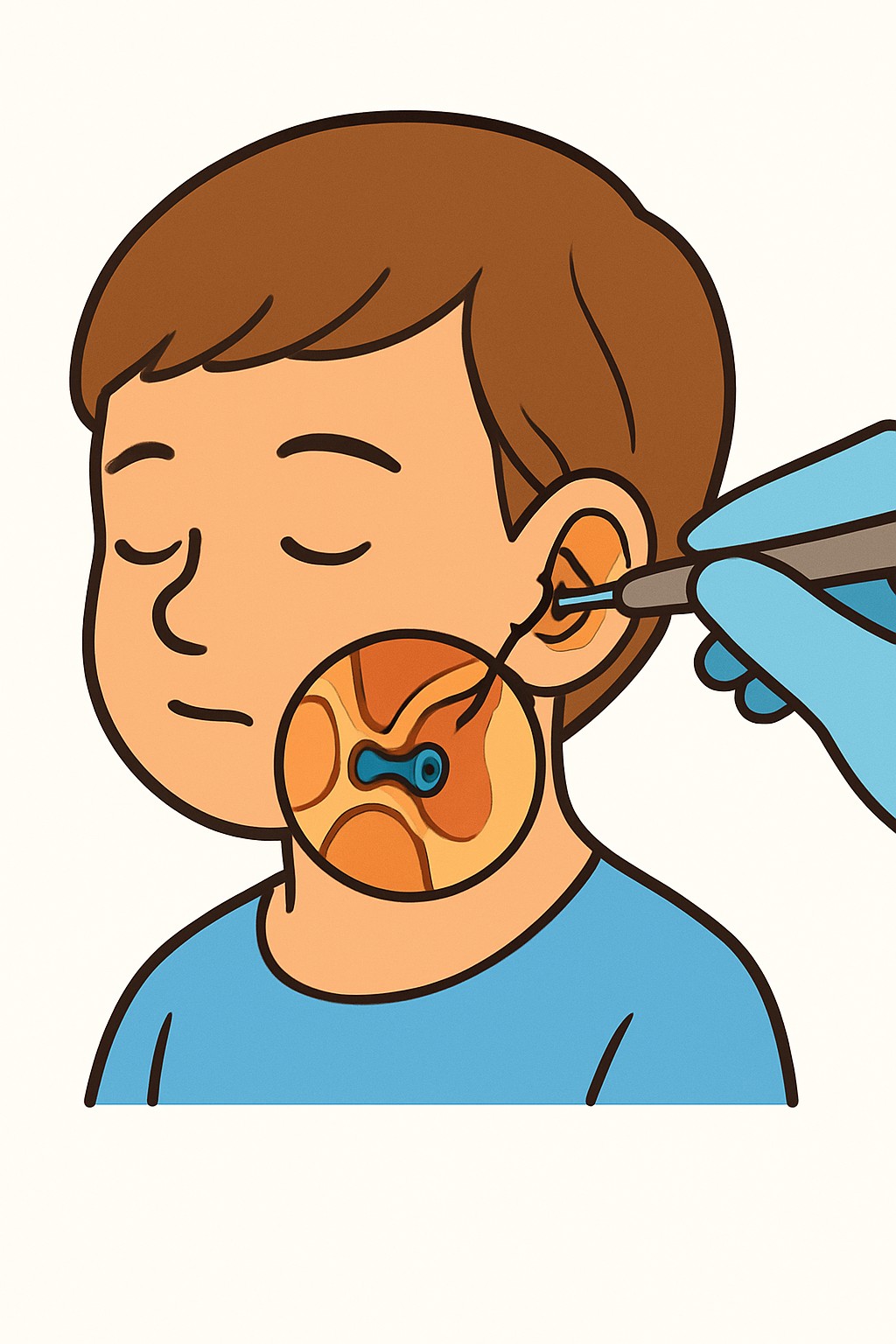
Ear tube placement, also called myringotomy with tympanostomy tubes, is a short procedure where a tiny opening is made in the eardrum and a small tube is placed.
Overview
Ear tube placement, also called myringotomy with tympanostomy tubes, is a short procedure where a tiny opening is made in the eardrum and a small tube is placed. The tube helps drain fluid and equalize pressure in the middle ear. This procedure is commonly done for children with frequent ear infections or long-lasting middle ear fluid that affects hearing. Adults may also get ear tubes for ongoing eustachian tube problems or barotrauma (pressure injuries), such as with flying or diving.
Also known as: Ear tubes, Tympanostomy tube insertion, Myringotomy with tubes
Preparation & Next Steps
Everything you need to know before and after your procedure
Before Care
- Confirm arrival time, check-in process, and any fasting instructions for anesthesia with the surgery center
- Arrange a responsible adult to drive the patient home and stay the first day after anesthesia
- Bring a current list of medicines, supplements, and allergies; ask which medicines to pause or continue
- Tell the team about recent colds, cough, fever, or exposure to illness; surgery policies may require rescheduling
- Bring ID, insurance card, and any legal guardianship or consent documents if applicable
- Plan for the day off from work or school on the procedure day
- Pack comfort items for a child (favorite toy or blanket) and a spare shirt in case of ear drainage
- Share details of recent ear infections, antibiotics, and hearing or speech evaluations
- Follow pre-op hygiene and no jewelry policies as instructed by the facility
- Use the patient portal to review consent forms and submit questions in advance
After Care
- Expect mild ear drainage or a small amount of blood-tinged fluid for a day or two; use prescribed ear drops if provided
- Resume light activities when fully awake and steady after anesthesia; many return to normal routines within 1–2 days
- Use pain relief only as directed by the care team; avoid inserting cotton swabs or objects into the ear canal
- Follow the facility’s guidance about water exposure; some people are advised to avoid dirty or high-pressure water in the ears
- Keep follow-up appointments to confirm tube position and hearing status
- Watch for fever, worsening pain, foul-smelling drainage, or drainage that lasts beyond a few days and contact the clinic if these occur
- If ear drainage increases after a cold or swimming, notify the clinic; they may recommend drops or a check
- Tubes often fall out on their own over time; the clinic will monitor and advise if removal is needed later
- Continue any recommended hearing or speech evaluations to track progress
- Review discharge instructions in the portal and call the clinic with questions about activities or school/daycare forms
Clinical Information
Important medical details about this procedure
Indications
- Recurrent acute ear infections
- Persistent middle ear fluid (otitis media with effusion) lasting months
- Hearing difficulties linked to middle ear fluid
- Ear pressure or pain from eustachian tube dysfunction
- Barotrauma from flying or diving
- Balance or speech concerns related to chronic ear fluid
Alternatives
- Watchful waiting with follow-up hearing checks
- Medical treatment for infections when needed
- Allergy and nasal symptom management
- Autoinflation devices to help open the eustachian tube
- Hearing monitoring and classroom accommodations
- Adenoid evaluation or removal in select cases
Risks
- Risks of anesthesia (such as breathing or heart reactions)
- Ear drainage or infection after tube placement
- Bleeding or pain
- Tube blockage or early tube loss
- Scarring of the eardrum
- A small hole in the eardrum that does not close after the tube falls out
- Need for repeat tubes
Contraindications
- Medical conditions that make anesthesia unsafe
- Bleeding disorders not well controlled
- Active external ear canal infection that requires treatment first
- Abnormal eardrum or middle ear anatomy where tubes are not appropriate
Recovery Timeline
What to expect during your recovery
Most people feel better within 1–2 days. Mild ear discomfort and light drainage are common early on. Normal routines often resume quickly, while tubes stay in place for months to help with drainage and pressure.
Typical Range
1–3 days
Return to Work
1–2 days
Recovery Milestones
Rest at home and drink fluids while recovering from anesthesia
Return to school, daycare, or work if feeling well
Resume regular activities; follow any clinic-specific water guidance
Attend the first follow-up visit to check tube position and hearing
Frequently Asked Questions
Common questions and expert answers about this procedure
What are ear tubes and what do they do?
What are ear tubes and what do they do?
They are tiny hollow tubes placed in the eardrum to let air in and fluid drain from the middle ear. This helps reduce infections, pressure, and hearing problems caused by trapped fluid.
How long do ear tubes stay in?
How long do ear tubes stay in?
Most tubes fall out on their own as the eardrum heals, often within 6 to 18 months. The clinic monitors their position at routine visits.
Is general anesthesia used?
Is general anesthesia used?
Yes, the procedure is usually done under brief general anesthesia so the patient stays still and comfortable.
Will hearing improve after tubes?
Will hearing improve after tubes?
If fluid was reducing hearing, many people notice clearer hearing once the middle ear is ventilated. Hearing is checked during follow-up.
Can you swim or bathe with ear tubes?
Can you swim or bathe with ear tubes?
Many people do normal bathing and swimming at the surface. Recommendations about ear protection vary; follow the specific guidance from your care team.
Do tubes need to be removed?
Do tubes need to be removed?
They usually come out on their own. If a tube stays in a long time or causes problems, a clinician may recommend removal.
What are signs of a problem after tube placement?
What are signs of a problem after tube placement?
Fever, severe pain, foul-smelling or persistent drainage, blocked tubes, or hearing changes are reasons to contact the clinic.
How long does the procedure take?
How long does the procedure take?
The surgery itself is brief, often minutes. The total visit is longer due to check-in, anesthesia, and recovery time.