%20--%3e%3csvg%20version='1.0'%20id='Layer_1'%20xmlns='http://www.w3.org/2000/svg'%20xmlns:xlink='http://www.w3.org/1999/xlink'%20x='0px'%20y='0px'%20viewBox='0%200%20755.52%20814.35'%20style='enable-background:new%200%200%20755.52%20814.35;'%20xml:space='preserve'%3e%3cstyle%20type='text/css'%3e%20.st0{fill:%231ae5ce;stroke:%231ae5ce;stroke-width:7;stroke-miterlimit:10;}%20.st1{fill:%23FFFFFF;stroke:%231ae5ce;stroke-width:7;stroke-miterlimit:10;}%20.st2{fill:%231ae5ce;stroke:%23FFFFFF;stroke-width:7;stroke-miterlimit:10;}%20.st3{fill:%23FFFFFF;stroke:%23FFFFFF;stroke-width:6;stroke-miterlimit:10;}%20%3c/style%3e%3cg%20id='Dark_Logo_00000159431215648494653180000015900878925932721032_'%3e%3cpath%20id='shield_00000152259091539869183100000001926543869452564382_'%20class='st0'%20d='M711.13,173.42%20c-3.37-49.07-38.92-44.9-75.96-52.18c-67.4-13.25-130.47-34.47-192.36-63.92c-22.48-10.7-41.88-25.74-65.05-26.28%20c-23.17,0.54-42.58,15.59-65.05,26.28c-61.89,29.45-124.95,50.68-192.36,63.92c-37.04,7.28-72.59,3.11-75.96,52.18%20c-1.55,22.6,0.34,46.4,1.05,68.92c5.99,190.78,52.91,345.39,206.27,466.46c29.71,23.46,74.51,55.8,108.84,70.75%20c5.99,2.61,11.7,3.73,17.21,3.75c5.51-0.02,11.22-1.14,17.21-3.75c34.33-14.95,79.12-47.3,108.84-70.75%20c153.37-121.07,200.28-275.68,206.27-466.46C710.79,219.82,712.68,196.02,711.13,173.42z'/%3e%3cpath%20id='magnifyingglass_00000073685934697636024790000000342567780940956808_'%20class='st1'%20d='M648.78,624.21l-96.64-104.65%20c34.89-40.63,55.98-93.46,55.98-151.21c0-128.27-103.98-232.24-232.24-232.24S143.63,240.08,143.63,368.35%20s103.98,232.24,232.24,232.24c48.87,0,94.21-15.11,131.62-40.89l97.18,105.24c11.25,12.18,30.24,12.93,42.42,1.69l0,0%20C659.27,655.38,660.03,636.39,648.78,624.21z'/%3e%3ccircle%20id='ellipse_00000129904010550392394720000017056154833629780114_'%20class='st2'%20cx='375.87'%20cy='368.35'%20r='181.21'/%3e%3cpath%20id='dollarsign_00000057140127156649725250000003772530148495155891_'%20class='st3'%20d='M362.91,492.03v-23.91%20c0-2.01-1.58-3.69-3.59-3.77c-18.49-0.78-37.12-5.4-49.4-11.83c-1.75-0.92-2.53-3.01-1.76-4.84l5.87-13.89%20c0.86-2.02,3.23-2.88,5.2-1.89c12.94,6.52,30.45,11.44,49.18,11.44c26.02,0,43.6-12.73,43.6-30.43c0-17.08-14.29-27.63-41.4-36.95%20c-37.37-12.42-60.46-26.7-60.46-53.72c0-24.97,20.29-44.11,52.22-49.51c1.8-0.31,3.11-1.89,3.11-3.72v-24.35%20c0-2.09,1.69-3.78,3.78-3.78h15.16c2.09,0,3.78,1.69,3.78,3.78v22.71c0,2.01,1.58,3.67,3.58,3.77c17.85,0.92,30.88,4.75,40.61,9.1%20c1.92,0.86,2.79,3.09,1.94,5.01l-6.08,13.6c-0.85,1.91-3.09,2.77-4.99,1.91c-8.37-3.8-22.38-8.95-42.75-8.95%20c-28.21,0-38.84,14.28-38.84,26.7c0,16.15,13.56,24.22,45.44,35.4c37.74,13.04,56.79,29.19,56.79,56.82%20c0,23.85-19.05,46.23-54.78,52.3c-1.8,0.31-3.11,1.89-3.11,3.72v25.28c0,2.09-1.69,3.78-3.78,3.78h-15.53%20C364.6,495.81,362.91,494.12,362.91,492.03z'/%3e%3c/g%3e%3c/svg%3e)
Endoscopic Sinus Surgery (ethmoidectomy) Ent Surgery
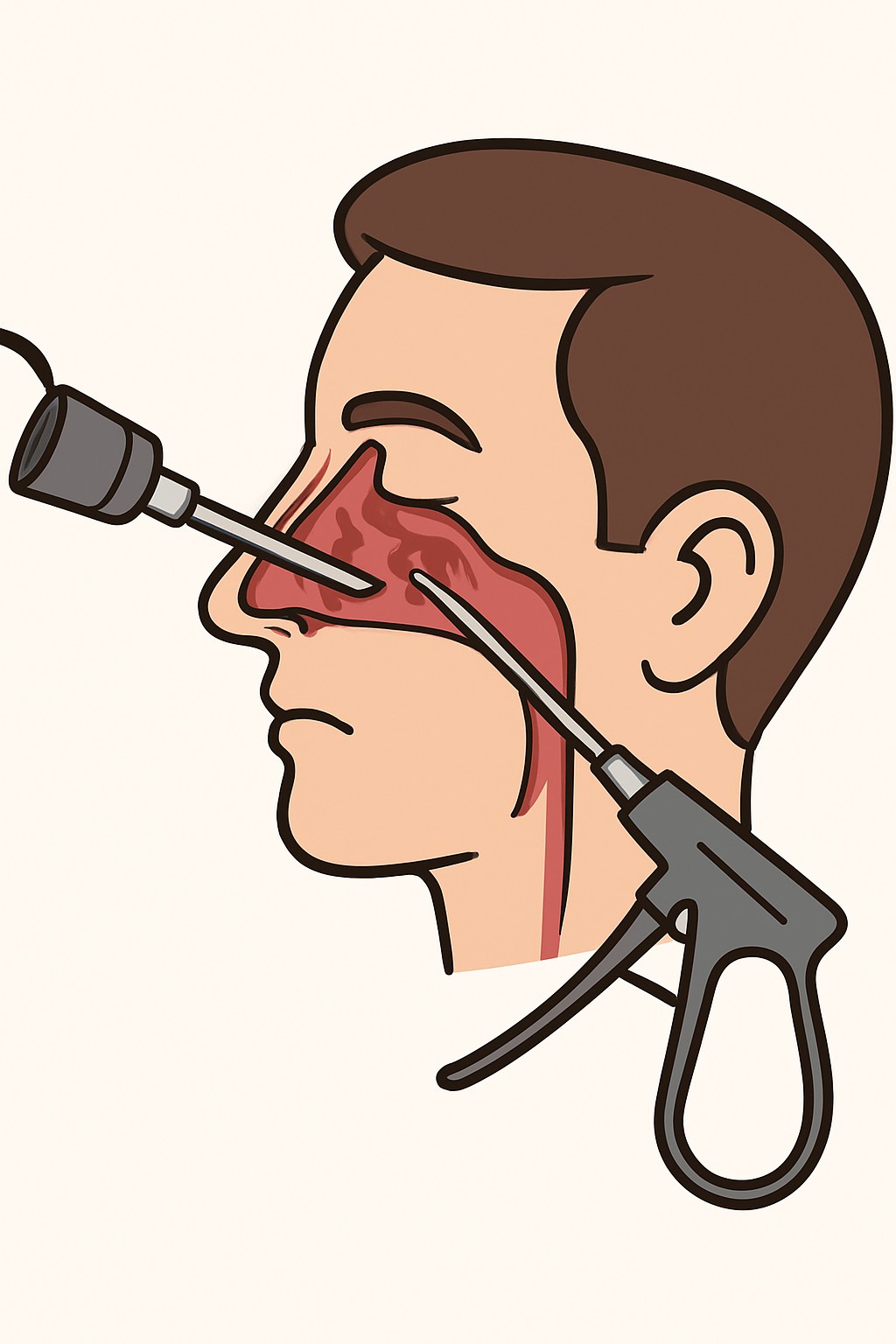
Endoscopic sinus surgery with ethmoidectomy is a minimally invasive procedure that uses a thin camera and small instruments through the nostrils to open blocked sinus pathways.
Overview
Endoscopic sinus surgery with ethmoidectomy is a minimally invasive procedure that uses a thin camera and small instruments through the nostrils to open blocked sinus pathways. In an ethmoidectomy, thin partitions of bone and inflamed tissue are removed from the ethmoid sinuses to improve drainage and airflow. This surgery is done to reduce symptoms such as nasal blockage, facial pressure, recurrent infections, or polyps when medicines have not provided enough relief. There are no external cuts, and most people go home the same day.
Also known as: FESS, Functional endoscopic sinus surgery, Ethmoidectomy, Sinus surgery
Preparation & Next Steps
Everything you need to know before and after your procedure
Before Care
- Confirm which sinuses will be treated and whether an ethmoidectomy, septoplasty, or turbinate reduction is planned
- Complete any requested pre-op tests such as nasal endoscopy, imaging (often a CT scan), and routine labs
- Share an up-to-date list of all medicines and supplements, including blood thinners and NSAIDs
- Follow the surgery center’s instructions about eating and drinking before anesthesia
- Follow instructions you receive about holding blood thinners, aspirin, NSAIDs, and certain supplements
- Arrange a responsible adult to drive you home and stay with you the first night
- Pick up saline rinse supplies and any prescribed medicines in advance if possible
- Plan time off work and avoid travel in the first 1–2 weeks after surgery
- Ask about timing for resuming CPAP or other airway devices if you use them
- Avoid smoking or vaping and limit alcohol in the days before surgery as instructed
After Care
- Expect congestion, drainage, and small amounts of bleeding for several days; rest with your head elevated
- Begin saline nasal irrigations as instructed to reduce crusting and promote healing
- Use pain medicines and any prescribed antibiotics or steroids exactly as directed on the label
- Avoid blowing your nose, heavy lifting, bending, and strenuous exercise until your clinician says it is safe
- Sneeze with your mouth open to reduce pressure in the nose
- Do not insert cotton swabs or ointments into the nose unless instructed
- Use a cool-mist humidifier and stay well hydrated to keep nasal passages moist
- Keep all scheduled follow-up visits for endoscopic checks and cleaning (debridement) if planned
- Contact the clinic for heavy or persistent bleeding, fever, worsening facial pain, severe headache, swelling around the eyes, changes in vision, or clear watery drainage from the nose
- Avoid swimming and hot tubs until cleared; many people return to desk work in about a week, depending on recovery and job demands
Clinical Information
Important medical details about this procedure
Indications
- Chronic rhinosinusitis not well controlled with medicines
- Recurrent acute sinus infections
- Nasal polyps and polyp-related blockage
- Anatomical blockage of the ethmoid sinuses
- Fungal sinus disease (selected cases)
- Mucoceles or trapped sinus secretions
- Complications or persistent symptoms after prior sinus surgery
Alternatives
- Saline nasal irrigations
- Intranasal corticosteroid sprays
- Short courses of oral steroids when appropriate
- Antibiotics for confirmed bacterial infections
- Allergy management, including avoidance and immunotherapy
- Watchful waiting with symptom control
- Balloon sinus dilation in selected cases
Risks
- Bleeding or need for nasal packing
- Infection
- Scar tissue or adhesions inside the nose
- Persistent symptoms or need for revision surgery
- Decreased or altered sense of smell
- Injury to tissues around the eye, vision changes, or double vision (rare)
- Cerebrospinal fluid leak from skull base injury (rare)
- Anesthesia-related risks
Contraindications
- Uncontrolled bleeding disorders
- Severe medical conditions that make anesthesia unsafe
- Inability to follow postoperative care or keep follow-up visits
- Active, severe sinus or systemic infection not yet stabilized
- Pregnancy when surgery is elective and can be postponed
Recovery Timeline
What to expect during your recovery
Most people feel notably better within 1 to 2 weeks, though nasal congestion and crusting can last several weeks. Activity levels increase gradually as healing progresses.
Typical Range
7–14 days
Return to Work
3–7 days
Recovery Milestones
Rest at home with head elevated; short indoor walks
Perform saline nasal irrigations as instructed
Light household activities; avoid heavy lifting and straining
Many can return to desk work if symptoms are controlled
Gradual return to exercise; avoid high-impact activities until cleared
Frequently Asked Questions
Common questions and expert answers about this procedure
What is an ethmoidectomy?
What is an ethmoidectomy?
It is the removal of thin bone partitions and inflamed tissue from the ethmoid sinuses between the eyes to open drainage pathways.
How is endoscopic sinus surgery performed?
How is endoscopic sinus surgery performed?
A small camera and instruments are placed through the nostrils to open blocked sinus pathways without external incisions.
Is this an outpatient procedure?
Is this an outpatient procedure?
Yes, most people go home the same day after a short recovery period in the surgery center.
Will I have nasal packing or splints?
Will I have nasal packing or splints?
Some surgeons use dissolvable packing or small splints to support healing; others do not. It depends on the details of your surgery.
How painful is recovery?
How painful is recovery?
Discomfort is usually mild to moderate and often feels like pressure or congestion. Over-the-counter or prescribed pain medicines are commonly used for a few days.
How long will bleeding and congestion last?
How long will bleeding and congestion last?
Light bleeding and drainage are common for several days. Congestion and crusting may last a few weeks as the nose heals.
Will I still need sinus medicines after surgery?
Will I still need sinus medicines after surgery?
Many people continue saline irrigations and nasal steroid sprays to maintain results. The plan depends on your condition and your clinician’s guidance.
What are the chances of needing another surgery?
What are the chances of needing another surgery?
Some people need revision surgery if symptoms return or polyps regrow. Ongoing medical management helps reduce this risk.