%20--%3e%3csvg%20version='1.0'%20id='Layer_1'%20xmlns='http://www.w3.org/2000/svg'%20xmlns:xlink='http://www.w3.org/1999/xlink'%20x='0px'%20y='0px'%20viewBox='0%200%20755.52%20814.35'%20style='enable-background:new%200%200%20755.52%20814.35;'%20xml:space='preserve'%3e%3cstyle%20type='text/css'%3e%20.st0{fill:%231ae5ce;stroke:%231ae5ce;stroke-width:7;stroke-miterlimit:10;}%20.st1{fill:%23FFFFFF;stroke:%231ae5ce;stroke-width:7;stroke-miterlimit:10;}%20.st2{fill:%231ae5ce;stroke:%23FFFFFF;stroke-width:7;stroke-miterlimit:10;}%20.st3{fill:%23FFFFFF;stroke:%23FFFFFF;stroke-width:6;stroke-miterlimit:10;}%20%3c/style%3e%3cg%20id='Dark_Logo_00000159431215648494653180000015900878925932721032_'%3e%3cpath%20id='shield_00000152259091539869183100000001926543869452564382_'%20class='st0'%20d='M711.13,173.42%20c-3.37-49.07-38.92-44.9-75.96-52.18c-67.4-13.25-130.47-34.47-192.36-63.92c-22.48-10.7-41.88-25.74-65.05-26.28%20c-23.17,0.54-42.58,15.59-65.05,26.28c-61.89,29.45-124.95,50.68-192.36,63.92c-37.04,7.28-72.59,3.11-75.96,52.18%20c-1.55,22.6,0.34,46.4,1.05,68.92c5.99,190.78,52.91,345.39,206.27,466.46c29.71,23.46,74.51,55.8,108.84,70.75%20c5.99,2.61,11.7,3.73,17.21,3.75c5.51-0.02,11.22-1.14,17.21-3.75c34.33-14.95,79.12-47.3,108.84-70.75%20c153.37-121.07,200.28-275.68,206.27-466.46C710.79,219.82,712.68,196.02,711.13,173.42z'/%3e%3cpath%20id='magnifyingglass_00000073685934697636024790000000342567780940956808_'%20class='st1'%20d='M648.78,624.21l-96.64-104.65%20c34.89-40.63,55.98-93.46,55.98-151.21c0-128.27-103.98-232.24-232.24-232.24S143.63,240.08,143.63,368.35%20s103.98,232.24,232.24,232.24c48.87,0,94.21-15.11,131.62-40.89l97.18,105.24c11.25,12.18,30.24,12.93,42.42,1.69l0,0%20C659.27,655.38,660.03,636.39,648.78,624.21z'/%3e%3ccircle%20id='ellipse_00000129904010550392394720000017056154833629780114_'%20class='st2'%20cx='375.87'%20cy='368.35'%20r='181.21'/%3e%3cpath%20id='dollarsign_00000057140127156649725250000003772530148495155891_'%20class='st3'%20d='M362.91,492.03v-23.91%20c0-2.01-1.58-3.69-3.59-3.77c-18.49-0.78-37.12-5.4-49.4-11.83c-1.75-0.92-2.53-3.01-1.76-4.84l5.87-13.89%20c0.86-2.02,3.23-2.88,5.2-1.89c12.94,6.52,30.45,11.44,49.18,11.44c26.02,0,43.6-12.73,43.6-30.43c0-17.08-14.29-27.63-41.4-36.95%20c-37.37-12.42-60.46-26.7-60.46-53.72c0-24.97,20.29-44.11,52.22-49.51c1.8-0.31,3.11-1.89,3.11-3.72v-24.35%20c0-2.09,1.69-3.78,3.78-3.78h15.16c2.09,0,3.78,1.69,3.78,3.78v22.71c0,2.01,1.58,3.67,3.58,3.77c17.85,0.92,30.88,4.75,40.61,9.1%20c1.92,0.86,2.79,3.09,1.94,5.01l-6.08,13.6c-0.85,1.91-3.09,2.77-4.99,1.91c-8.37-3.8-22.38-8.95-42.75-8.95%20c-28.21,0-38.84,14.28-38.84,26.7c0,16.15,13.56,24.22,45.44,35.4c37.74,13.04,56.79,29.19,56.79,56.82%20c0,23.85-19.05,46.23-54.78,52.3c-1.8,0.31-3.11,1.89-3.11,3.72v25.28c0,2.09-1.69,3.78-3.78,3.78h-15.53%20C364.6,495.81,362.91,494.12,362.91,492.03z'/%3e%3c/g%3e%3c/svg%3e)
Foreign body removal - external ear Ent Surgery
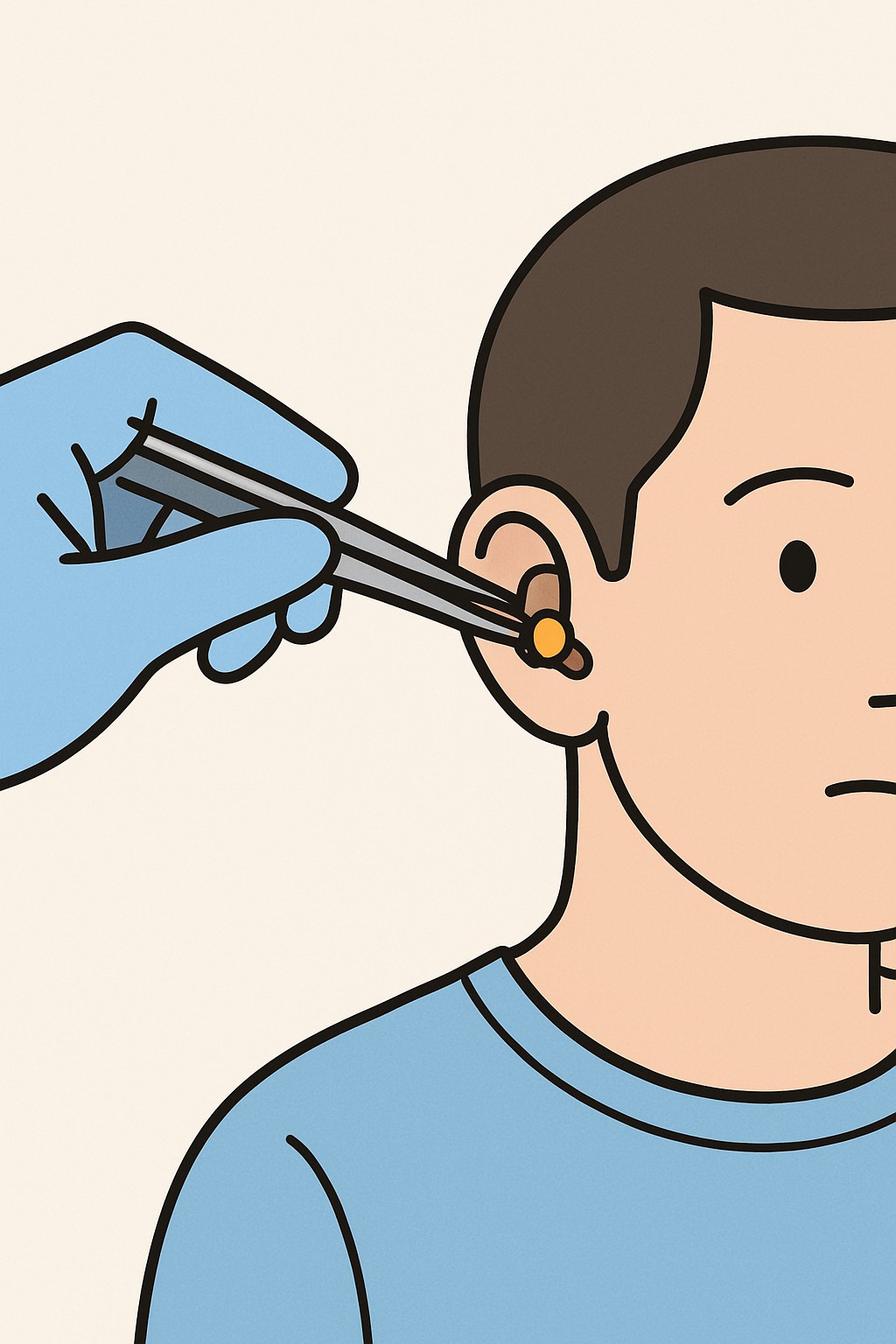
Foreign body removal from the external ear is a procedure to take out an object stuck in the ear canal, such as a bead, cotton tip, insect, or small battery.
Overview
Foreign body removal from the external ear is a procedure to take out an object stuck in the ear canal, such as a bead, cotton tip, insect, or small battery. It is commonly done in a clinic, urgent care, emergency department, or an ear, nose, and throat (ENT) office. A clinician examines the ear with a light or microscope. Depending on the object, they may use suction, small instruments, or gentle water irrigation. Numbing drops or sedation may be used, especially for children or when the object is deep or difficult to remove. The goal is to remove the object safely and lower the chance of injury or infection.
Also known as: Ear foreign body removal, Removal of object from ear, External auditory canal foreign body removal
Preparation & Next Steps
Everything you need to know before and after your procedure
Before Care
- Avoid putting cotton swabs, oils, or tools into the ear before the visit.
- Tell the clinic when scheduling if a button battery or magnet may be involved.
- Note what the object is and when it entered the ear, if known.
- Bring a list of current medicines, allergies, and past ear conditions or surgeries.
- Do not eat or drink for several hours beforehand if sedation might be used.
- Arrange a ride home in case medicines used during the procedure cause drowsiness or dizziness.
- If the patient is a child, bring a caregiver and comfort items to help with cooperation.
- Bring hearing aids or ear molds if you use them, and a case to store them.
- Wear a top that can get damp in case irrigation is used.
- Confirm insurance, ID, and any paperwork the clinic requests.
After Care
- Mild soreness, muffled hearing, or a small amount of blood-tinged drainage can occur for 1–2 days.
- Keep the ear dry as instructed; avoid swimming until the clinic says it is okay.
- If ear drops or medicines were prescribed, use them only as directed on the label.
- Do not insert cotton swabs, earbuds, or fingers into the ear canal.
- If packing or a wick was placed, return for removal as scheduled.
- Contact the clinic for increasing pain, persistent drainage with odor, fever, worsening hearing, or new dizziness.
- Follow any water precautions if the eardrum was injured or repaired.
- Schedule follow-up if recommended to recheck the ear or hearing.
- Resume normal activities when feeling well; avoid activities that risk head immersion until cleared.
- Keep any removed battery or object away from children and show it to the clinician if requested.
Clinical Information
Important medical details about this procedure
Indications
- Visible object in the ear canal
- Ear pain, fullness, or irritation
- Muffled or reduced hearing
- Ear drainage or bad odor
- Buzzing or movement sensation from an insect
- Unsuccessful prior removal attempt
Alternatives
- Observation with repeat exam if the object is superficial and not hazardous
- Removal in an ENT clinic with a microscope and specialized tools
- Removal with procedural sedation when office removal is not tolerated
- Removal in the operating room when deep, sharp, or multiple objects are present
Risks
- Ear canal abrasion or bleeding
- Outer ear infection (otitis externa)
- Perforation of the eardrum
- Temporary dizziness or nausea
- Temporary hearing changes or ringing (tinnitus)
- Retained fragments requiring another removal attempt
- Need for sedation or operating room procedure
Contraindications
- Suspected eardrum perforation for irrigation techniques
- Button battery or multiple magnets requiring urgent specialty management
- Plant materials (seeds, beans) that can swell with irrigation
- Uncooperative patient where restraint would be unsafe
- Abnormal ear anatomy or prior ear surgery requiring specialist setting
Recovery Timeline
What to expect during your recovery
Most people feel relief right after removal. Mild soreness or muffled hearing usually improves within 1–2 days. Recovery may take longer if the canal was scraped or the eardrum was injured.
Typical Range
0–3 days
Return to Work
0–1 days
Recovery Milestones
Resume light daily activities
Keep ear dry if advised; avoid swimming
Any brief dizziness resolves
Ear soreness and muffled hearing improve
Follow-up if symptoms persist or a recheck was planned
Frequently Asked Questions
Common questions and expert answers about this procedure
What happens during ear foreign body removal?
What happens during ear foreign body removal?
The clinician examines the ear with a light or microscope and removes the object using suction, small instruments, or gentle irrigation, depending on the type and location.
Will it hurt?
Will it hurt?
Many objects can be removed with brief discomfort. Numbing drops or other methods are sometimes used to make the process more comfortable.
How long does the procedure take?
How long does the procedure take?
Simple removals can take a few minutes. Deep, sharp, or fragile objects can take longer and may require a specialist or sedation.
When is sedation or anesthesia used?
When is sedation or anesthesia used?
It may be used for young children, anxious patients, or when the object is deep or difficult to remove safely while awake.
Can I remove the object at home?
Can I remove the object at home?
Home attempts with cotton swabs or tools often push objects deeper or cause injury. Many removals are safer when done by trained clinicians.
What if the object is a battery or magnet?
What if the object is a battery or magnet?
These can cause tissue damage. Clinics typically treat them as urgent and may involve an ENT specialist for prompt removal.
Will I need antibiotics or ear drops?
Will I need antibiotics or ear drops?
Drops are sometimes used after difficult removals or if there is irritation or infection. They are not needed in every case.
Could this affect my hearing?
Could this affect my hearing?
Hearing often improves after removal. Temporary changes can occur from swelling or irritation. Further evaluation may be suggested if hearing does not feel normal later.