%20--%3e%3csvg%20version='1.0'%20id='Layer_1'%20xmlns='http://www.w3.org/2000/svg'%20xmlns:xlink='http://www.w3.org/1999/xlink'%20x='0px'%20y='0px'%20viewBox='0%200%20755.52%20814.35'%20style='enable-background:new%200%200%20755.52%20814.35;'%20xml:space='preserve'%3e%3cstyle%20type='text/css'%3e%20.st0{fill:%231ae5ce;stroke:%231ae5ce;stroke-width:7;stroke-miterlimit:10;}%20.st1{fill:%23FFFFFF;stroke:%231ae5ce;stroke-width:7;stroke-miterlimit:10;}%20.st2{fill:%231ae5ce;stroke:%23FFFFFF;stroke-width:7;stroke-miterlimit:10;}%20.st3{fill:%23FFFFFF;stroke:%23FFFFFF;stroke-width:6;stroke-miterlimit:10;}%20%3c/style%3e%3cg%20id='Dark_Logo_00000159431215648494653180000015900878925932721032_'%3e%3cpath%20id='shield_00000152259091539869183100000001926543869452564382_'%20class='st0'%20d='M711.13,173.42%20c-3.37-49.07-38.92-44.9-75.96-52.18c-67.4-13.25-130.47-34.47-192.36-63.92c-22.48-10.7-41.88-25.74-65.05-26.28%20c-23.17,0.54-42.58,15.59-65.05,26.28c-61.89,29.45-124.95,50.68-192.36,63.92c-37.04,7.28-72.59,3.11-75.96,52.18%20c-1.55,22.6,0.34,46.4,1.05,68.92c5.99,190.78,52.91,345.39,206.27,466.46c29.71,23.46,74.51,55.8,108.84,70.75%20c5.99,2.61,11.7,3.73,17.21,3.75c5.51-0.02,11.22-1.14,17.21-3.75c34.33-14.95,79.12-47.3,108.84-70.75%20c153.37-121.07,200.28-275.68,206.27-466.46C710.79,219.82,712.68,196.02,711.13,173.42z'/%3e%3cpath%20id='magnifyingglass_00000073685934697636024790000000342567780940956808_'%20class='st1'%20d='M648.78,624.21l-96.64-104.65%20c34.89-40.63,55.98-93.46,55.98-151.21c0-128.27-103.98-232.24-232.24-232.24S143.63,240.08,143.63,368.35%20s103.98,232.24,232.24,232.24c48.87,0,94.21-15.11,131.62-40.89l97.18,105.24c11.25,12.18,30.24,12.93,42.42,1.69l0,0%20C659.27,655.38,660.03,636.39,648.78,624.21z'/%3e%3ccircle%20id='ellipse_00000129904010550392394720000017056154833629780114_'%20class='st2'%20cx='375.87'%20cy='368.35'%20r='181.21'/%3e%3cpath%20id='dollarsign_00000057140127156649725250000003772530148495155891_'%20class='st3'%20d='M362.91,492.03v-23.91%20c0-2.01-1.58-3.69-3.59-3.77c-18.49-0.78-37.12-5.4-49.4-11.83c-1.75-0.92-2.53-3.01-1.76-4.84l5.87-13.89%20c0.86-2.02,3.23-2.88,5.2-1.89c12.94,6.52,30.45,11.44,49.18,11.44c26.02,0,43.6-12.73,43.6-30.43c0-17.08-14.29-27.63-41.4-36.95%20c-37.37-12.42-60.46-26.7-60.46-53.72c0-24.97,20.29-44.11,52.22-49.51c1.8-0.31,3.11-1.89,3.11-3.72v-24.35%20c0-2.09,1.69-3.78,3.78-3.78h15.16c2.09,0,3.78,1.69,3.78,3.78v22.71c0,2.01,1.58,3.67,3.58,3.77c17.85,0.92,30.88,4.75,40.61,9.1%20c1.92,0.86,2.79,3.09,1.94,5.01l-6.08,13.6c-0.85,1.91-3.09,2.77-4.99,1.91c-8.37-3.8-22.38-8.95-42.75-8.95%20c-28.21,0-38.84,14.28-38.84,26.7c0,16.15,13.56,24.22,45.44,35.4c37.74,13.04,56.79,29.19,56.79,56.82%20c0,23.85-19.05,46.23-54.78,52.3c-1.8,0.31-3.11,1.89-3.11,3.72v25.28c0,2.09-1.69,3.78-3.78,3.78h-15.53%20C364.6,495.81,362.91,494.12,362.91,492.03z'/%3e%3c/g%3e%3c/svg%3e)
Foreign body removal - nose Ent Surgery
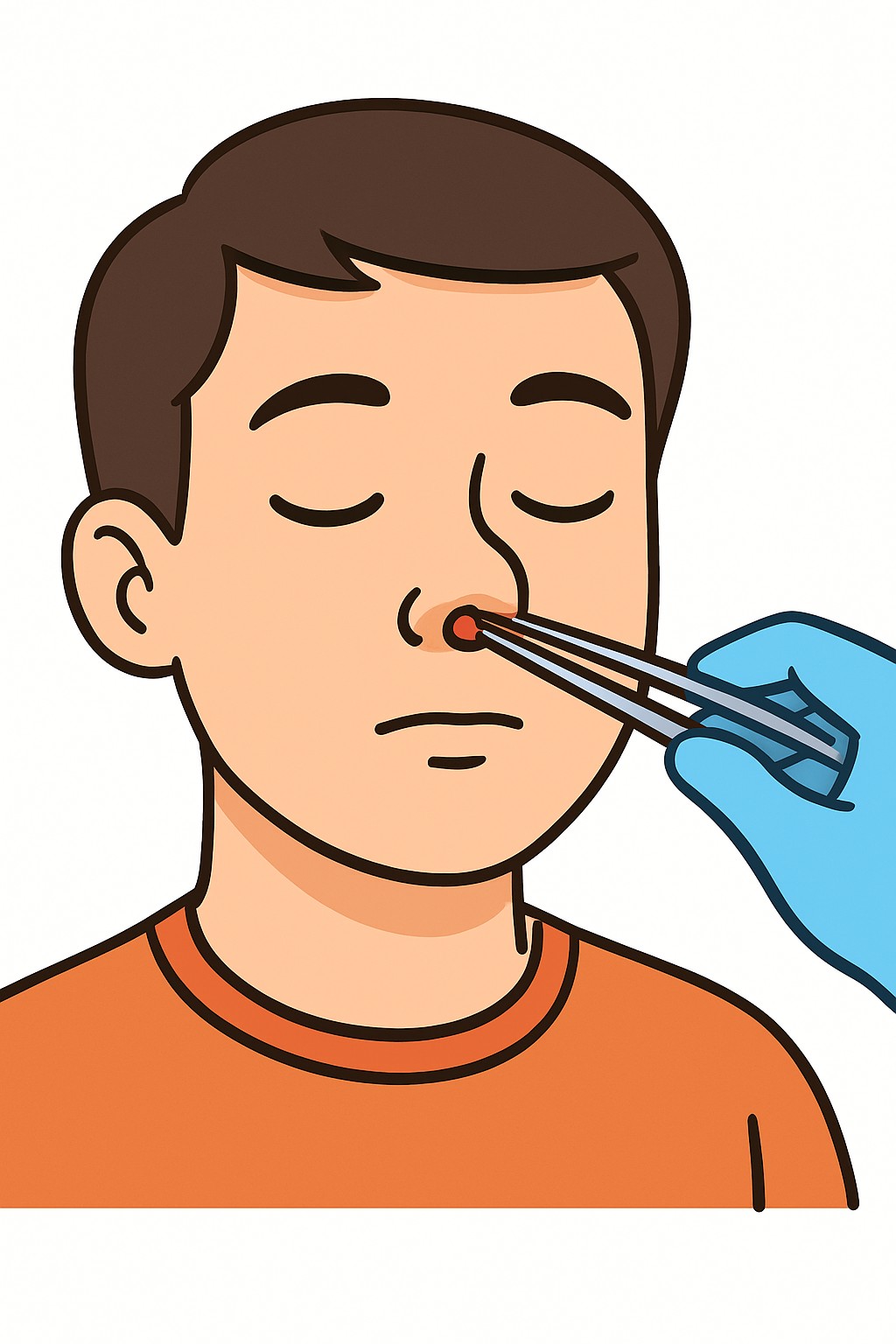
Foreign body removal - nose is a procedure to take out an object that is stuck in a nostril.
Overview
Foreign body removal - nose is a procedure to take out an object that is stuck in a nostril. Common items include beads, pebbles, paper, food, or small toy parts. A clinician examines the nose and uses techniques such as positive pressure, suction, or small tools to remove the object. This procedure is done to relieve blockage, pain, bad odor, or bleeding, and to prevent complications. Button batteries and strong magnets can damage tissue quickly and are treated as urgent situations.
Also known as: Nasal foreign body removal, Removal of nasal foreign object, Nasal object extraction
Preparation & Next Steps
Everything you need to know before and after your procedure
Before Care
- If known, note what the object is and when it went into the nose
- Avoid pushing the object deeper with cotton swabs or tools
- Do not rinse the nose if the object could be a button battery, magnet, or material that swells (like beans)
- Follow any fasting instructions provided by the clinic in case sedation is planned
- Bring a list of medicines, allergies, and relevant health history
- Bring a comfort item and a support person for a young child
- Plan a safe ride home if sedation or procedural medicine may be used
- Wear clothing that allows easy access for monitoring equipment if needed
- Share prior nose or sinus surgeries and bleeding history with the care team
After Care
- Expect mild soreness or a small amount of bleeding; use gentle pressure with tissue if needed
- Avoid inserting cotton swabs, fingers, or objects into the nose
- Do not forcefuly blow the nose right away; follow the clinic’s timing for normal blowing
- Use saline spray or drops if recommended by your clinician
- Take medicines exactly as prescribed if any are given
- Keep the area clean and avoid dusty or smoky environments while healing
- Arrange follow-up if symptoms continue or if the clinician requested a recheck
- Contact a clinician if bleeding does not stop, pain worsens, bad odor or discharge returns, fever develops, or breathing becomes difficult
Clinical Information
Important medical details about this procedure
Indications
- Known or suspected object lodged in a nostril
- One-sided nasal blockage or drainage, especially foul smelling
- Nose pain, irritation, or bleeding on one side
- Whistling sound when breathing
- History of a child playing with small objects near the nose
Alternatives
- Nose blowing while the other nostril is gently closed
- Positive-pressure method (a caregiver gives a short puff of air into the child’s mouth while the other nostril is closed)
- Suction removal in clinic
- Referral to an ear, nose, and throat specialist for endoscopic removal
- Removal under sedation or anesthesia if office techniques are not possible
Risks
- Nose bleeding
- Pain or irritation inside the nose
- Small cuts to the lining of the nose
- Object moving backward into the throat with risk of choking
- Infection or sinus irritation
- Septal damage with corrosive objects like button batteries
- Need for sedation or a second attempt
Contraindications
- Suspected or confirmed button battery in the nose for irrigation or delay
- Paired magnets across the nasal septum
- Sharp or hooked objects where blind probing may cause injury
- Uncooperative child when safe restraint or sedation is not available
- Significant bleeding, suspected inhalation, or airway compromise requiring a higher level of care
Recovery Timeline
What to expect during your recovery
Most people feel better soon after the object is removed. Minor soreness or spotting often improves within 1 to 2 days. Recovery can take longer if the lining of the nose was irritated or if a corrosive object was involved.
Typical Range
0–3 days
Return to Work
0–1 days
Recovery Milestones
Go home the same day and resume light activities
Breathe more comfortably as blockage clears; mild soreness improves
Return to usual nose blowing if no bleeding and as advised by the clinic
Complete any follow-up visit if symptoms persist or if tissue was injured
Frequently Asked Questions
Common questions and expert answers about this procedure
How do I know if something is stuck in the nose?
How do I know if something is stuck in the nose?
Common signs are one-sided blockage, a bad smell or discharge from one nostril, nose pain, or a child admitting to putting something in the nose.
Is this an emergency?
Is this an emergency?
Button batteries and strong magnets can harm tissue quickly and are treated as urgent. Other objects are usually managed the same day in a clinic.
What methods are used to remove the object?
What methods are used to remove the object?
Clinicians may use positive pressure, suction, or small tools like forceps or a hook. A light and sometimes a small scope help them see clearly.
Will my child need sedation?
Will my child need sedation?
Some children tolerate removal with local numbing and gentle support. Sedation or anesthesia may be used if the child cannot stay still or if tools are needed deep in the nose.
Will imaging be needed?
Will imaging be needed?
X-rays are not usually needed unless a button battery, magnet, or unknown object is suspected, or if there are signs it moved into the airway.
Can it come out on its own?
Can it come out on its own?
Some objects can be blown out or removed with positive pressure. Many still require removal by a clinician to avoid injury and to confirm the nose is clear.
What are possible complications?
What are possible complications?
Possible issues include bleeding, cuts to the nasal lining, infection, or the object moving backward toward the throat. Corrosive objects can cause tissue damage.
How long does recovery take?
How long does recovery take?
Most people feel normal the same day or within a couple of days. Healing may take longer if the nose lining was irritated.
References
Medical literature and sources