%20--%3e%3csvg%20version='1.0'%20id='Layer_1'%20xmlns='http://www.w3.org/2000/svg'%20xmlns:xlink='http://www.w3.org/1999/xlink'%20x='0px'%20y='0px'%20viewBox='0%200%20755.52%20814.35'%20style='enable-background:new%200%200%20755.52%20814.35;'%20xml:space='preserve'%3e%3cstyle%20type='text/css'%3e%20.st0{fill:%231ae5ce;stroke:%231ae5ce;stroke-width:7;stroke-miterlimit:10;}%20.st1{fill:%23FFFFFF;stroke:%231ae5ce;stroke-width:7;stroke-miterlimit:10;}%20.st2{fill:%231ae5ce;stroke:%23FFFFFF;stroke-width:7;stroke-miterlimit:10;}%20.st3{fill:%23FFFFFF;stroke:%23FFFFFF;stroke-width:6;stroke-miterlimit:10;}%20%3c/style%3e%3cg%20id='Dark_Logo_00000159431215648494653180000015900878925932721032_'%3e%3cpath%20id='shield_00000152259091539869183100000001926543869452564382_'%20class='st0'%20d='M711.13,173.42%20c-3.37-49.07-38.92-44.9-75.96-52.18c-67.4-13.25-130.47-34.47-192.36-63.92c-22.48-10.7-41.88-25.74-65.05-26.28%20c-23.17,0.54-42.58,15.59-65.05,26.28c-61.89,29.45-124.95,50.68-192.36,63.92c-37.04,7.28-72.59,3.11-75.96,52.18%20c-1.55,22.6,0.34,46.4,1.05,68.92c5.99,190.78,52.91,345.39,206.27,466.46c29.71,23.46,74.51,55.8,108.84,70.75%20c5.99,2.61,11.7,3.73,17.21,3.75c5.51-0.02,11.22-1.14,17.21-3.75c34.33-14.95,79.12-47.3,108.84-70.75%20c153.37-121.07,200.28-275.68,206.27-466.46C710.79,219.82,712.68,196.02,711.13,173.42z'/%3e%3cpath%20id='magnifyingglass_00000073685934697636024790000000342567780940956808_'%20class='st1'%20d='M648.78,624.21l-96.64-104.65%20c34.89-40.63,55.98-93.46,55.98-151.21c0-128.27-103.98-232.24-232.24-232.24S143.63,240.08,143.63,368.35%20s103.98,232.24,232.24,232.24c48.87,0,94.21-15.11,131.62-40.89l97.18,105.24c11.25,12.18,30.24,12.93,42.42,1.69l0,0%20C659.27,655.38,660.03,636.39,648.78,624.21z'/%3e%3ccircle%20id='ellipse_00000129904010550392394720000017056154833629780114_'%20class='st2'%20cx='375.87'%20cy='368.35'%20r='181.21'/%3e%3cpath%20id='dollarsign_00000057140127156649725250000003772530148495155891_'%20class='st3'%20d='M362.91,492.03v-23.91%20c0-2.01-1.58-3.69-3.59-3.77c-18.49-0.78-37.12-5.4-49.4-11.83c-1.75-0.92-2.53-3.01-1.76-4.84l5.87-13.89%20c0.86-2.02,3.23-2.88,5.2-1.89c12.94,6.52,30.45,11.44,49.18,11.44c26.02,0,43.6-12.73,43.6-30.43c0-17.08-14.29-27.63-41.4-36.95%20c-37.37-12.42-60.46-26.7-60.46-53.72c0-24.97,20.29-44.11,52.22-49.51c1.8-0.31,3.11-1.89,3.11-3.72v-24.35%20c0-2.09,1.69-3.78,3.78-3.78h15.16c2.09,0,3.78,1.69,3.78,3.78v22.71c0,2.01,1.58,3.67,3.58,3.77c17.85,0.92,30.88,4.75,40.61,9.1%20c1.92,0.86,2.79,3.09,1.94,5.01l-6.08,13.6c-0.85,1.91-3.09,2.77-4.99,1.91c-8.37-3.8-22.38-8.95-42.75-8.95%20c-28.21,0-38.84,14.28-38.84,26.7c0,16.15,13.56,24.22,45.44,35.4c37.74,13.04,56.79,29.19,56.79,56.82%20c0,23.85-19.05,46.23-54.78,52.3c-1.8,0.31-3.11,1.89-3.11,3.72v25.28c0,2.09-1.69,3.78-3.78,3.78h-15.53%20C364.6,495.81,362.91,494.12,362.91,492.03z'/%3e%3c/g%3e%3c/svg%3e)
Nasal endoscopy (diagnostic sinus endoscopy) Ent Surgery
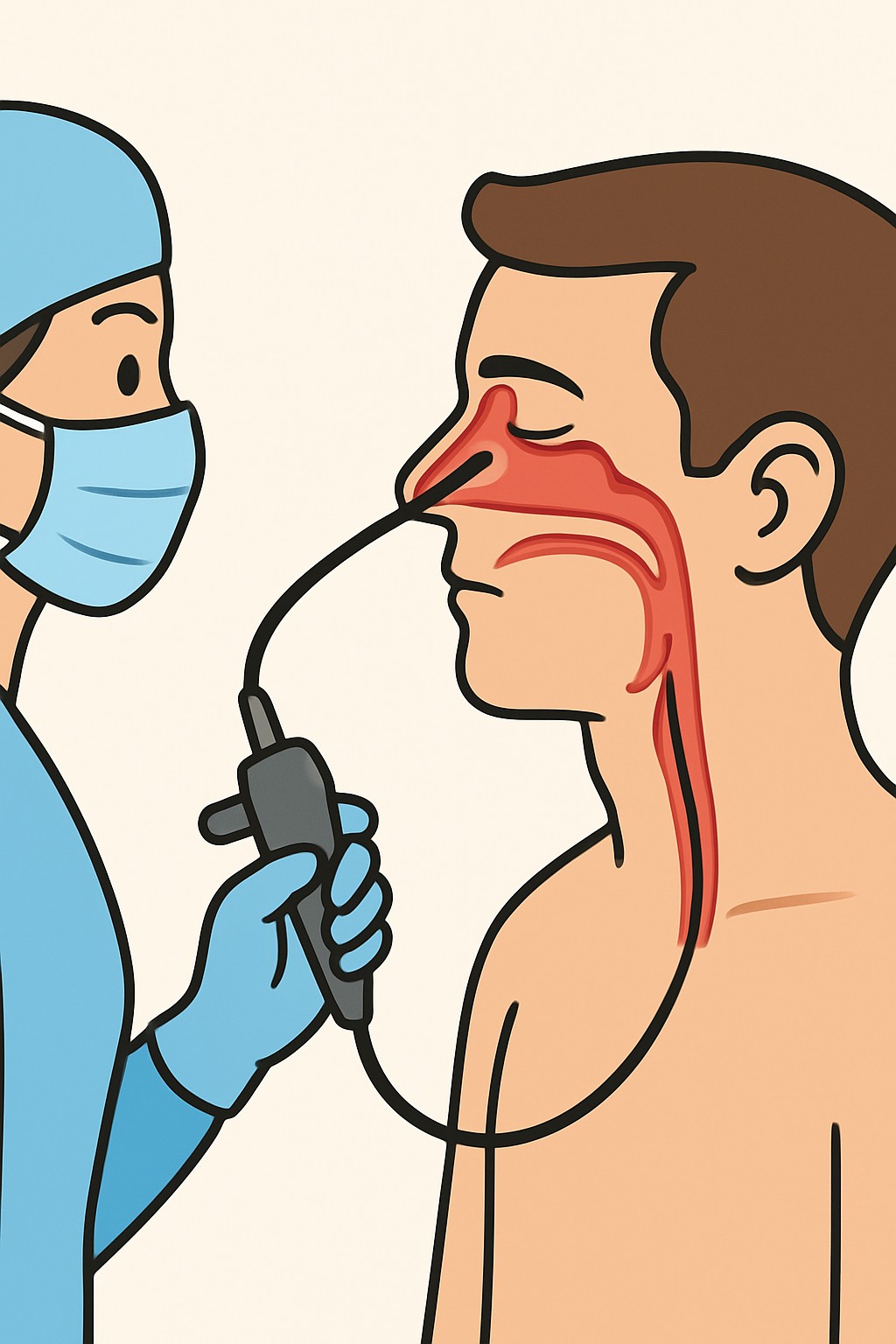
Nasal endoscopy is an in-office exam that uses a thin, flexible tube with a light and camera to look inside the nose and the openings of the sinuses.
Overview
Nasal endoscopy is an in-office exam that uses a thin, flexible tube with a light and camera to look inside the nose and the openings of the sinuses. A decongestant and a numbing spray are often used so the scope can pass comfortably. Clinicians use nasal endoscopy to find causes of nasal blockage, drainage, sinus infections, nosebleeds, and other problems. It can also help guide swabs for culture, check healing after sinus surgery, and take small tissue samples if needed.
Also known as: Rhinoscopy, Nasoendoscopy, Nasal scope
Preparation & Next Steps
Everything you need to know before and after your procedure
Before Care
- Bring a list of your current medicines, including blood thinners and nasal sprays
- Tell the clinic about allergies, especially to numbing medicines or decongestants
- Report any recent nosebleeds, facial trauma, or major nasal surgery
- Blow your nose gently before the visit to clear mucus if you can
- Avoid heavy fragrances or smoke exposure before the appointment, which can irritate the nose
- Arrive a bit early in case consent forms are needed
- Have a light snack and stay hydrated; fasting is usually not required
- Follow any clinic-specific instructions about nasal sprays before the exam
- Arrange a ride if you tend to feel faint with medical procedures
After Care
- Expect mild stuffiness, a brief sore nose, or small spots of blood-tinged mucus
- Avoid forceful nose blowing for the rest of the day to reduce bleeding risk
- If your nose was numbed, wait until normal feeling returns before hot foods or drinks
- Use saline mist or rinses if they were part of your usual care or clinic instructions
- Resume normal activities as you feel comfortable unless told otherwise by your clinic
- Keep tissues handy for light drainage; this should fade within a day
- Follow up to review any culture or biopsy results if samples were taken
- Contact the clinic if you have heavy bleeding, severe pain, fever, worsening swelling, vision changes, or a bad-smelling discharge
Clinical Information
Important medical details about this procedure
Indications
- Chronic or recurrent sinusitis
- Nasal congestion or blockage
- Persistent nasal drainage or postnasal drip
- Loss of smell or reduced smell
- Nosebleeds
- Suspected nasal polyps or septal deviation
- Facial pressure or pain thought to be sinus related
- Follow-up after sinus or nasal surgery
Alternatives
- Anterior rhinoscopy with a nasal speculum and light
- Sinus CT scan to view sinus anatomy and inflammation
- Medical therapy trial for rhinitis or sinusitis
- Watchful waiting when symptoms are mild and improving
- Endoscopic exam at a later date if active bleeding or severe swelling is present
Risks
- Temporary discomfort, watering eyes, or sneezing
- Minor nosebleed
- Irritation or burning from decongestant or numbing spray
- Vasovagal episode such as lightheadedness or fainting
- Very rare infection
- Allergic reaction to topical medicines used during the exam
Contraindications
- Uncontrolled bleeding disorder or use of blood thinners without a plan from the clinician
- Recent severe nosebleed
- Significant facial or nasal trauma with blockage of the nasal passage
- Known allergy to topical anesthetics or decongestants used for the exam
- Inability to cooperate with the procedure
Recovery Timeline
What to expect during your recovery
Most people return to normal activities the same day. Mild nose irritation or light spotting may last up to 1 to 2 days.
Typical Range
0–2 days
Return to Work
0–1 days
Recovery Milestones
Resume light daily activities
Avoid forceful nose blowing
Eat and drink as usual once numbness fades
Increase activity, including exercise, if no nosebleed or significant discomfort
Frequently Asked Questions
Common questions and expert answers about this procedure
What happens during nasal endoscopy?
What happens during nasal endoscopy?
A clinician sprays your nose with a decongestant and a numbing medicine, then gently passes a thin camera to view the nasal passages and sinus openings.
Does nasal endoscopy hurt?
Does nasal endoscopy hurt?
Most people feel pressure or brief discomfort rather than pain. The numbing spray helps. Your eyes may water and you might sneeze.
How long does it take?
How long does it take?
The exam itself usually takes a few minutes. The whole visit may be longer to allow for preparation and discussion.
Will I bleed after the exam?
Will I bleed after the exam?
Light spotting can happen and usually stops on its own. Heavy or persistent bleeding is uncommon and should be reported to the clinic.
Can I drive or go back to work afterward?
Can I drive or go back to work afterward?
Most people can return to normal activities right away. If you feel lightheaded or anxious after procedures, consider arranging a ride.
Why would I need nasal endoscopy instead of a CT scan?
Why would I need nasal endoscopy instead of a CT scan?
Endoscopy shows the lining and drainage pathways in real time and can guide swabs or minor procedures. CT shows detailed anatomy and sinus opacification.
Is sedation used?
Is sedation used?
Sedation is not typical. A topical decongestant and numbing spray are commonly used to make the exam more comfortable.
References
Medical literature and sources