%20--%3e%3csvg%20version='1.0'%20id='Layer_1'%20xmlns='http://www.w3.org/2000/svg'%20xmlns:xlink='http://www.w3.org/1999/xlink'%20x='0px'%20y='0px'%20viewBox='0%200%20755.52%20814.35'%20style='enable-background:new%200%200%20755.52%20814.35;'%20xml:space='preserve'%3e%3cstyle%20type='text/css'%3e%20.st0{fill:%231ae5ce;stroke:%231ae5ce;stroke-width:7;stroke-miterlimit:10;}%20.st1{fill:%23FFFFFF;stroke:%231ae5ce;stroke-width:7;stroke-miterlimit:10;}%20.st2{fill:%231ae5ce;stroke:%23FFFFFF;stroke-width:7;stroke-miterlimit:10;}%20.st3{fill:%23FFFFFF;stroke:%23FFFFFF;stroke-width:6;stroke-miterlimit:10;}%20%3c/style%3e%3cg%20id='Dark_Logo_00000159431215648494653180000015900878925932721032_'%3e%3cpath%20id='shield_00000152259091539869183100000001926543869452564382_'%20class='st0'%20d='M711.13,173.42%20c-3.37-49.07-38.92-44.9-75.96-52.18c-67.4-13.25-130.47-34.47-192.36-63.92c-22.48-10.7-41.88-25.74-65.05-26.28%20c-23.17,0.54-42.58,15.59-65.05,26.28c-61.89,29.45-124.95,50.68-192.36,63.92c-37.04,7.28-72.59,3.11-75.96,52.18%20c-1.55,22.6,0.34,46.4,1.05,68.92c5.99,190.78,52.91,345.39,206.27,466.46c29.71,23.46,74.51,55.8,108.84,70.75%20c5.99,2.61,11.7,3.73,17.21,3.75c5.51-0.02,11.22-1.14,17.21-3.75c34.33-14.95,79.12-47.3,108.84-70.75%20c153.37-121.07,200.28-275.68,206.27-466.46C710.79,219.82,712.68,196.02,711.13,173.42z'/%3e%3cpath%20id='magnifyingglass_00000073685934697636024790000000342567780940956808_'%20class='st1'%20d='M648.78,624.21l-96.64-104.65%20c34.89-40.63,55.98-93.46,55.98-151.21c0-128.27-103.98-232.24-232.24-232.24S143.63,240.08,143.63,368.35%20s103.98,232.24,232.24,232.24c48.87,0,94.21-15.11,131.62-40.89l97.18,105.24c11.25,12.18,30.24,12.93,42.42,1.69l0,0%20C659.27,655.38,660.03,636.39,648.78,624.21z'/%3e%3ccircle%20id='ellipse_00000129904010550392394720000017056154833629780114_'%20class='st2'%20cx='375.87'%20cy='368.35'%20r='181.21'/%3e%3cpath%20id='dollarsign_00000057140127156649725250000003772530148495155891_'%20class='st3'%20d='M362.91,492.03v-23.91%20c0-2.01-1.58-3.69-3.59-3.77c-18.49-0.78-37.12-5.4-49.4-11.83c-1.75-0.92-2.53-3.01-1.76-4.84l5.87-13.89%20c0.86-2.02,3.23-2.88,5.2-1.89c12.94,6.52,30.45,11.44,49.18,11.44c26.02,0,43.6-12.73,43.6-30.43c0-17.08-14.29-27.63-41.4-36.95%20c-37.37-12.42-60.46-26.7-60.46-53.72c0-24.97,20.29-44.11,52.22-49.51c1.8-0.31,3.11-1.89,3.11-3.72v-24.35%20c0-2.09,1.69-3.78,3.78-3.78h15.16c2.09,0,3.78,1.69,3.78,3.78v22.71c0,2.01,1.58,3.67,3.58,3.77c17.85,0.92,30.88,4.75,40.61,9.1%20c1.92,0.86,2.79,3.09,1.94,5.01l-6.08,13.6c-0.85,1.91-3.09,2.77-4.99,1.91c-8.37-3.8-22.38-8.95-42.75-8.95%20c-28.21,0-38.84,14.28-38.84,26.7c0,16.15,13.56,24.22,45.44,35.4c37.74,13.04,56.79,29.19,56.79,56.82%20c0,23.85-19.05,46.23-54.78,52.3c-1.8,0.31-3.11,1.89-3.11,3.72v25.28c0,2.09-1.69,3.78-3.78,3.78h-15.53%20C364.6,495.81,362.91,494.12,362.91,492.03z'/%3e%3c/g%3e%3c/svg%3e)
Septoplasty (nasal septum repair) Ent Surgery
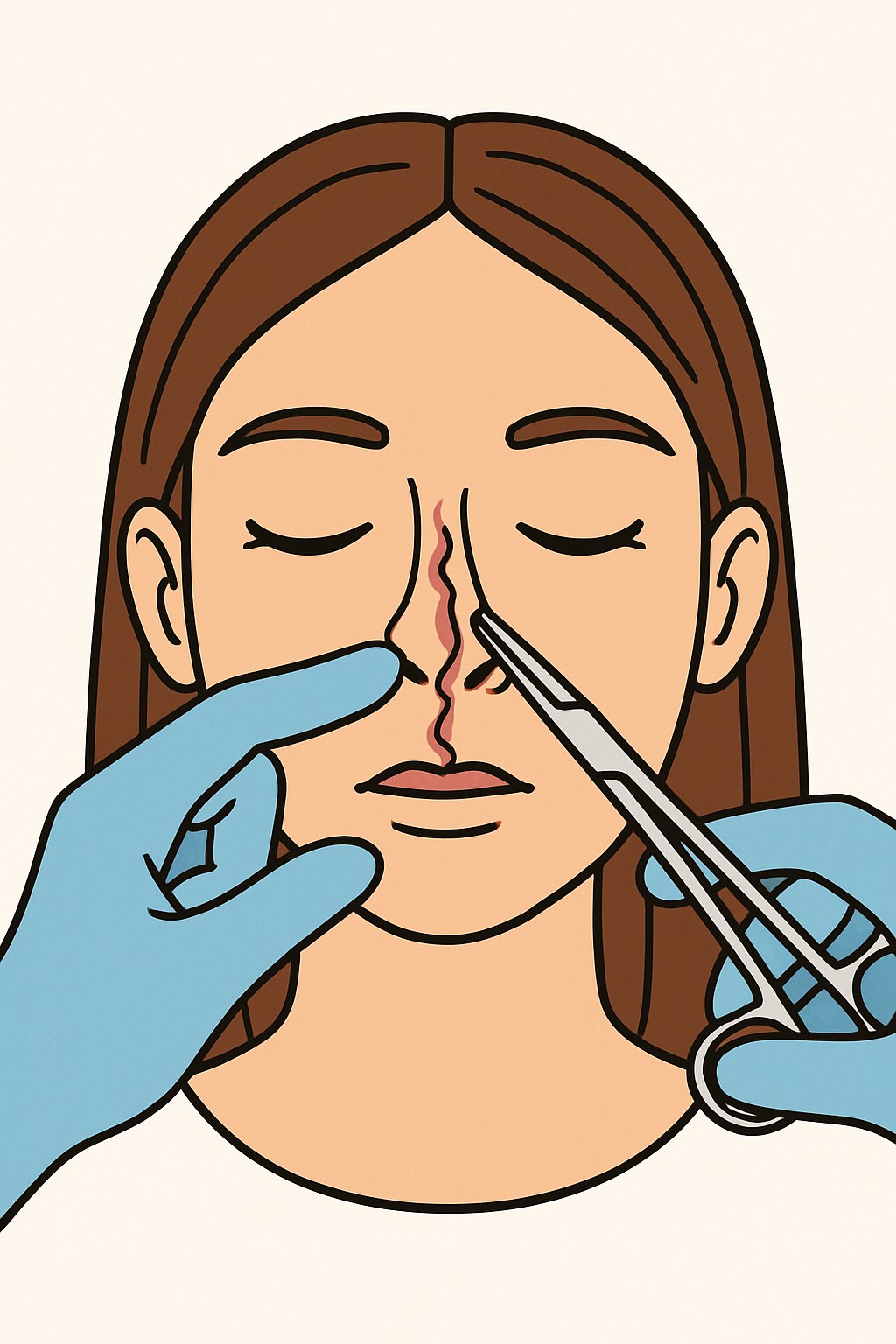
Septoplasty is surgery to straighten or reshape the wall between the nostrils, called the nasal septum.
Overview
Septoplasty is surgery to straighten or reshape the wall between the nostrils, called the nasal septum. A bent or deviated septum can block airflow and make it hard to breathe through the nose. The goal is to improve nasal airflow and reduce problems linked to blockage. It does not usually change the outside shape of the nose unless combined with cosmetic nasal surgery.
Also known as: Deviated septum surgery, Nasal septum surgery, Septal deviation repair
Preparation & Next Steps
Everything you need to know before and after your procedure
Before Care
- Complete a preoperative visit to review health history, medicines, and allergies
- Ask how to handle blood thinners, aspirin, and supplements that can affect bleeding
- Follow fasting instructions for anesthesia and confirm arrival time and location
- Arrange a responsible adult to drive you home and stay nearby the first night
- Stop smoking or vaping as early as possible to support healing
- Plan for time off work, school, and exercise during early recovery
- Prepare saline spray or rinse supplies if recommended for after surgery
- Set up your home with extra pillows to rest with your head elevated
- Confirm insurance requirements, prior authorization, and any cost estimates
- If you use CPAP, bring your mask or settings information to discuss use after surgery
After Care
- Expect stuffiness, mild bleeding, and drainage for a few days; use a drip pad if provided
- Keep your head elevated when resting or sleeping to reduce swelling
- Use saline sprays or rinses as instructed to keep the nose moist and clear crusts
- Do not blow your nose until your surgeon says it is safe; sneeze with your mouth open
- Avoid heavy lifting, bending, strenuous exercise, and contact sports for a period of time
- Take pain medicine only as directed on the label or by your clinician
- If splints or packing were placed, keep follow-up to have them checked or removed
- Limit smoking and alcohol, which can slow healing and increase bleeding
- Call the clinic if you have heavy bleeding that soaks dressings, fever, worsening pain, or trouble breathing
- Attend scheduled follow-up visits to check healing and airflow improvement
Clinical Information
Important medical details about this procedure
Indications
- Trouble breathing through the nose due to a deviated septum
- Chronic nasal blockage not improved with medicines
- Recurrent nosebleeds related to septal deformity
- Frequent sinus infections linked to poor drainage
- Facial pressure or headaches related to septal contact points
- Snoring or sleep-disordered breathing worsened by nasal obstruction
Alternatives
- Saline nasal rinses or sprays
- Intranasal steroid sprays
- Allergy evaluation and treatment
- Short-term decongestants (when appropriate)
- Nasal adhesive strips or internal dilators
- Watchful waiting if symptoms are mild
Risks
- Bleeding or need for packing
- Infection
- Septal hematoma or perforation (a hole in the septum)
- Persistent or recurrent nasal obstruction
- Change in sense of smell or taste
- Temporary numbness of upper teeth or lip
- Change in nasal shape (uncommon if septoplasty alone)
- Adhesions (scar bands) inside the nose
- Anesthesia-related risks
Contraindications
- Active nasal or sinus infection
- Uncontrolled bleeding disorder
- Poor overall health that makes anesthesia unsafe
- Ongoing intranasal cocaine use or heavy smoking that impairs healing
- Unrealistic expectations about results
Recovery Timeline
What to expect during your recovery
Most people have noticeable congestion and mild discomfort for several days. Many return to desk work within about a week. Internal healing continues for several weeks.
Typical Range
7–21 days
Return to Work
3–7 days
Recovery Milestones
Rest with head elevated; short indoor walks for circulation
Light daily activities; avoid nose blowing and strenuous effort
Return to desk work if congestion and pain are manageable
Resume moderate activity if bleeding and swelling have resolved
Gradually return to vigorous exercise and contact sports when cleared
Frequently Asked Questions
Common questions and expert answers about this procedure
Is septoplasty the same as rhinoplasty?
Is septoplasty the same as rhinoplasty?
No. Septoplasty corrects the internal septum to improve breathing. Rhinoplasty changes the external shape of the nose. They can be done together in some cases.
Will my nose look different after septoplasty?
Will my nose look different after septoplasty?
Septoplasty alone usually does not change the outside appearance. External changes are more typical when rhinoplasty is performed at the same time.
How long does the surgery take?
How long does the surgery take?
Many septoplasties take about 30 to 90 minutes, depending on the anatomy and whether other procedures are added.
Will I have packing or splints?
Will I have packing or splints?
Some surgeons use soft packing or small internal splints to support the septum. If used, they are usually removed at an early follow-up visit.
What kind of anesthesia is used?
What kind of anesthesia is used?
Septoplasty is commonly done with general anesthesia. Some centers use local anesthesia with sedation for selected cases.
When will breathing improve?
When will breathing improve?
Airflow often improves after swelling goes down, typically within 1 to 2 weeks. Full healing and final airflow changes can take several weeks.
Can septoplasty stop snoring or sleep apnea?
Can septoplasty stop snoring or sleep apnea?
It may help snoring or CPAP comfort if nasal blockage is a factor. It is not a stand-alone cure for obstructive sleep apnea.
Are there stitches?
Are there stitches?
Dissolvable stitches are often used inside the nose. They usually fall out on their own as healing progresses.
References
Medical literature and sources