%20--%3e%3csvg%20version='1.0'%20id='Layer_1'%20xmlns='http://www.w3.org/2000/svg'%20xmlns:xlink='http://www.w3.org/1999/xlink'%20x='0px'%20y='0px'%20viewBox='0%200%20755.52%20814.35'%20style='enable-background:new%200%200%20755.52%20814.35;'%20xml:space='preserve'%3e%3cstyle%20type='text/css'%3e%20.st0{fill:%231ae5ce;stroke:%231ae5ce;stroke-width:7;stroke-miterlimit:10;}%20.st1{fill:%23FFFFFF;stroke:%231ae5ce;stroke-width:7;stroke-miterlimit:10;}%20.st2{fill:%231ae5ce;stroke:%23FFFFFF;stroke-width:7;stroke-miterlimit:10;}%20.st3{fill:%23FFFFFF;stroke:%23FFFFFF;stroke-width:6;stroke-miterlimit:10;}%20%3c/style%3e%3cg%20id='Dark_Logo_00000159431215648494653180000015900878925932721032_'%3e%3cpath%20id='shield_00000152259091539869183100000001926543869452564382_'%20class='st0'%20d='M711.13,173.42%20c-3.37-49.07-38.92-44.9-75.96-52.18c-67.4-13.25-130.47-34.47-192.36-63.92c-22.48-10.7-41.88-25.74-65.05-26.28%20c-23.17,0.54-42.58,15.59-65.05,26.28c-61.89,29.45-124.95,50.68-192.36,63.92c-37.04,7.28-72.59,3.11-75.96,52.18%20c-1.55,22.6,0.34,46.4,1.05,68.92c5.99,190.78,52.91,345.39,206.27,466.46c29.71,23.46,74.51,55.8,108.84,70.75%20c5.99,2.61,11.7,3.73,17.21,3.75c5.51-0.02,11.22-1.14,17.21-3.75c34.33-14.95,79.12-47.3,108.84-70.75%20c153.37-121.07,200.28-275.68,206.27-466.46C710.79,219.82,712.68,196.02,711.13,173.42z'/%3e%3cpath%20id='magnifyingglass_00000073685934697636024790000000342567780940956808_'%20class='st1'%20d='M648.78,624.21l-96.64-104.65%20c34.89-40.63,55.98-93.46,55.98-151.21c0-128.27-103.98-232.24-232.24-232.24S143.63,240.08,143.63,368.35%20s103.98,232.24,232.24,232.24c48.87,0,94.21-15.11,131.62-40.89l97.18,105.24c11.25,12.18,30.24,12.93,42.42,1.69l0,0%20C659.27,655.38,660.03,636.39,648.78,624.21z'/%3e%3ccircle%20id='ellipse_00000129904010550392394720000017056154833629780114_'%20class='st2'%20cx='375.87'%20cy='368.35'%20r='181.21'/%3e%3cpath%20id='dollarsign_00000057140127156649725250000003772530148495155891_'%20class='st3'%20d='M362.91,492.03v-23.91%20c0-2.01-1.58-3.69-3.59-3.77c-18.49-0.78-37.12-5.4-49.4-11.83c-1.75-0.92-2.53-3.01-1.76-4.84l5.87-13.89%20c0.86-2.02,3.23-2.88,5.2-1.89c12.94,6.52,30.45,11.44,49.18,11.44c26.02,0,43.6-12.73,43.6-30.43c0-17.08-14.29-27.63-41.4-36.95%20c-37.37-12.42-60.46-26.7-60.46-53.72c0-24.97,20.29-44.11,52.22-49.51c1.8-0.31,3.11-1.89,3.11-3.72v-24.35%20c0-2.09,1.69-3.78,3.78-3.78h15.16c2.09,0,3.78,1.69,3.78,3.78v22.71c0,2.01,1.58,3.67,3.58,3.77c17.85,0.92,30.88,4.75,40.61,9.1%20c1.92,0.86,2.79,3.09,1.94,5.01l-6.08,13.6c-0.85,1.91-3.09,2.77-4.99,1.91c-8.37-3.8-22.38-8.95-42.75-8.95%20c-28.21,0-38.84,14.28-38.84,26.7c0,16.15,13.56,24.22,45.44,35.4c37.74,13.04,56.79,29.19,56.79,56.82%20c0,23.85-19.05,46.23-54.78,52.3c-1.8,0.31-3.11,1.89-3.11,3.72v25.28c0,2.09-1.69,3.78-3.78,3.78h-15.53%20C364.6,495.81,362.91,494.12,362.91,492.03z'/%3e%3c/g%3e%3c/svg%3e)
Tonsillectomy Ent Surgery
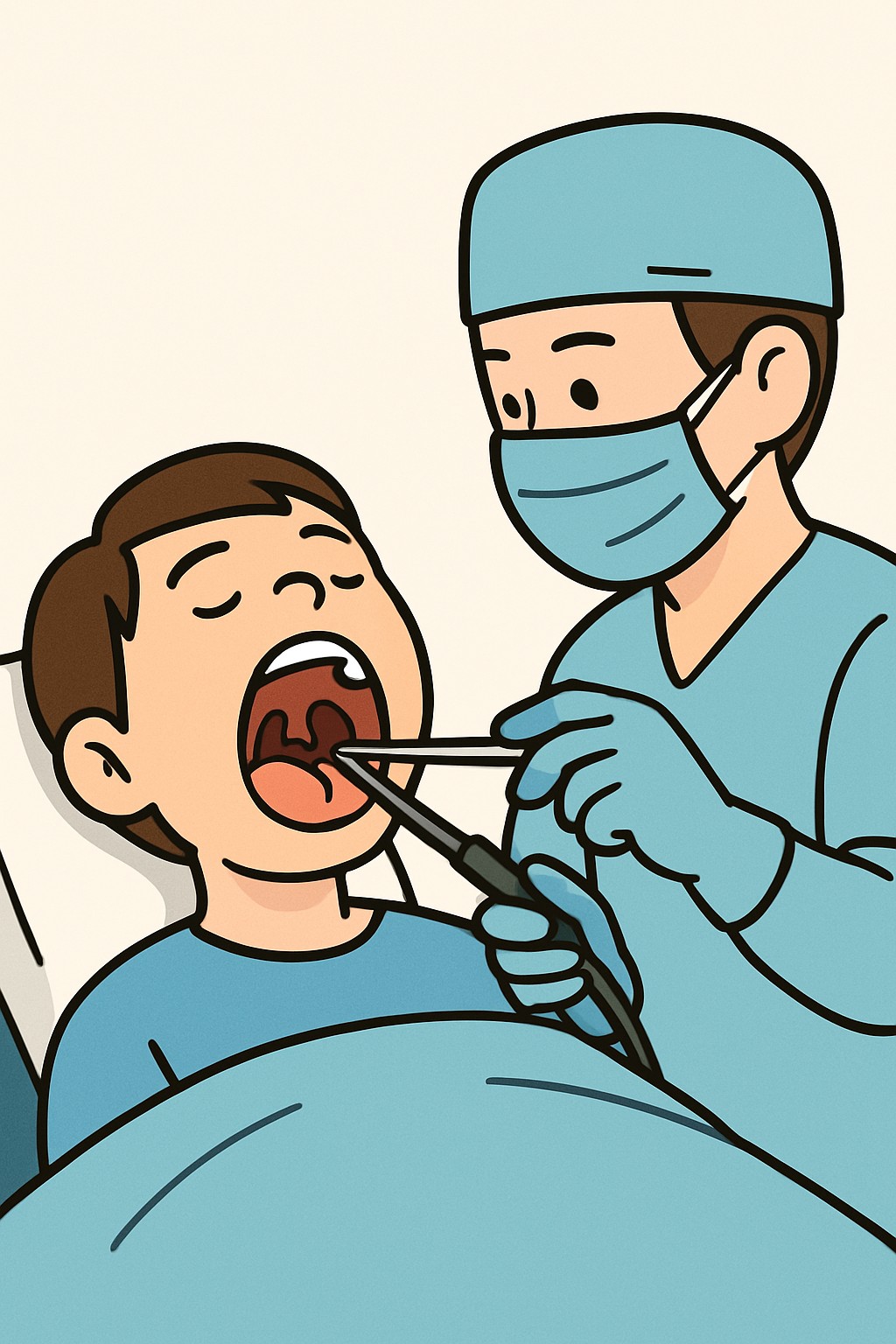
Tonsillectomy is surgery to remove the tonsils, which are two small glands of lymph tissue at the back of the throat.
Overview
Tonsillectomy is surgery to remove the tonsils, which are two small glands of lymph tissue at the back of the throat. It is done through the mouth under general anesthesia, so there are no cuts on the skin. People have this procedure to reduce throat infections, improve breathing or sleep, or treat other tonsil problems. Recovery usually takes about 1 to 2 weeks, with throat pain and low energy common in the first days.
Also known as: Tonsil removal, Tonsil surgery
Preparation & Next Steps
Everything you need to know before and after your procedure
Before Care
- Complete any preoperative visit or phone screening to review your health history, allergies, and medicines.
- Ask the surgical team which medicines to pause or continue before surgery, especially blood thinners and anti-inflammatory drugs.
- Follow anesthesia fasting instructions about when to stop eating and drinking before the procedure.
- Arrange a responsible adult to drive you home and stay with you the first night.
- Plan time off from work, school, and caregiving for about 1 to 2 weeks.
- Set up your home with cool fluids, soft foods, a thermometer, and any supplies listed by your care team.
- Consider using a cool-mist humidifier to keep the air moist during recovery if recommended by your team.
- Confirm insurance authorization, copays, and any required preoperative tests or medical clearance.
- If you use CPAP for sleep apnea and expect an overnight stay, bring your machine and mask.
- For children, arrange school notes, transportation, and home support for the first several days.
After Care
- Use the written aftercare plan from your surgeon for pain control, hydration, and diet progression.
- Drink fluids often throughout the day to reduce the risk of dehydration.
- Start with cool, soft foods and advance to a normal diet as swallowing becomes more comfortable.
- Avoid hard, sharp, spicy, or very hot foods in the early recovery period.
- Take medicines only as directed and keep a simple schedule or reminders to avoid missed doses.
- Expect throat and ear pain, bad breath, and white or gray patches where the tonsils were removed; these are common during healing.
- Limit strenuous activity, heavy lifting, sports, and travel for about 2 weeks unless your surgeon advises otherwise.
- Do short, frequent walks to support circulation and reduce stiffness.
- Keep follow-up appointments and review when to restart regular activities, work, school, or exercise.
- Contact the surgical team for bright red bleeding from the mouth or nose, vomiting blood, trouble breathing, signs of dehydration such as very dark urine or not urinating, fever that is not improving, severe uncontrolled pain, persistent vomiting, or inability to keep fluids down.
Clinical Information
Important medical details about this procedure
Indications
- Recurrent tonsillitis or strep throat
- Enlarged tonsils causing snoring or sleep-disordered breathing
- Obstructive sleep apnea related to tonsil enlargement
- Peritonsillar abscess with recurrence or failure of medical treatment
- Persistent bad breath or tonsil stones with symptoms
- Suspicion of a tumor or cancer of the tonsil
- Difficulty swallowing related to enlarged tonsils
Alternatives
- Watchful waiting for mild or infrequent infections
- Antibiotic treatment for bacterial throat infections
- Sleep apnea management such as continuous positive airway pressure (CPAP) in adults
- Nasal steroid sprays or allergy management for mild snoring
- Weight management and positional therapy for sleep-disordered breathing
- Partial tonsil removal (tonsillotomy) in selected cases
- Adenoidectomy alone when adenoids are the main issue
Risks
- Bleeding during or after surgery
- Throat and ear pain
- Dehydration
- Infection
- Nausea or vomiting from anesthesia or pain medicines
- Temporary changes in voice, taste, or swallowing
- Dental, lip, or tongue irritation from surgical instruments
- Airway swelling or breathing problems after anesthesia
- Need for additional treatment if bleeding or other issues occur
Contraindications
- Uncontrolled bleeding or clotting disorders
- Serious medical conditions not optimized for anesthesia
- Active mouth or throat infection requiring postponement
- Inadequate home support for immediate postoperative care in young children
Recovery Timeline
What to expect during your recovery
Most people need about 1 to 2 weeks to recover. Sore throat and low energy are common, and pain may briefly worsen around days 5 to 7 when scabs begin to loosen.
Typical Range
10–14 days
Return to Work
7–14 days
Recovery Milestones
Rest at home; sip cool fluids frequently
Short indoor walks and light daily tasks
Increase light activity; avoid strenuous exercise
Return to school or desk work if pain is manageable and no bleeding
Gradual return to normal diet and activities if recovery is uncomplicated
Frequently Asked Questions
Common questions and expert answers about this procedure
What is a tonsillectomy?
What is a tonsillectomy?
It is surgery to remove the tonsils through the mouth under general anesthesia. There are no external cuts.
Is it done as an outpatient procedure?
Is it done as an outpatient procedure?
Many tonsillectomies are outpatient. Some people, such as very young children or those with medical conditions, may stay overnight for monitoring.
How long does recovery take?
How long does recovery take?
Recovery typically takes 1 to 2 weeks. Throat pain and lower energy are common in the first several days.
When can I eat normally again?
When can I eat normally again?
Most people start with cool, soft foods and return to a normal diet gradually over 1 to 2 weeks as swallowing becomes easier.
What are the main risks?
What are the main risks?
The main risks include bleeding, pain, dehydration, infection, nausea or vomiting, and temporary changes in voice or taste.
Will removing tonsils stop snoring or sleep apnea?
Will removing tonsils stop snoring or sleep apnea?
If enlarged tonsils are a main cause, breathing and sleep can improve. Results vary when other factors contribute.
Can tonsils grow back?
Can tonsils grow back?
Rarely, small pieces of tonsil tissue can regrow, but significant regrowth is uncommon.
Will there be a scar?
Will there be a scar?
The surgery is done through the mouth, so there is no scar on the skin.
References
Medical literature and sources