%20--%3e%3csvg%20version='1.0'%20id='Layer_1'%20xmlns='http://www.w3.org/2000/svg'%20xmlns:xlink='http://www.w3.org/1999/xlink'%20x='0px'%20y='0px'%20viewBox='0%200%20755.52%20814.35'%20style='enable-background:new%200%200%20755.52%20814.35;'%20xml:space='preserve'%3e%3cstyle%20type='text/css'%3e%20.st0{fill:%231ae5ce;stroke:%231ae5ce;stroke-width:7;stroke-miterlimit:10;}%20.st1{fill:%23FFFFFF;stroke:%231ae5ce;stroke-width:7;stroke-miterlimit:10;}%20.st2{fill:%231ae5ce;stroke:%23FFFFFF;stroke-width:7;stroke-miterlimit:10;}%20.st3{fill:%23FFFFFF;stroke:%23FFFFFF;stroke-width:6;stroke-miterlimit:10;}%20%3c/style%3e%3cg%20id='Dark_Logo_00000159431215648494653180000015900878925932721032_'%3e%3cpath%20id='shield_00000152259091539869183100000001926543869452564382_'%20class='st0'%20d='M711.13,173.42%20c-3.37-49.07-38.92-44.9-75.96-52.18c-67.4-13.25-130.47-34.47-192.36-63.92c-22.48-10.7-41.88-25.74-65.05-26.28%20c-23.17,0.54-42.58,15.59-65.05,26.28c-61.89,29.45-124.95,50.68-192.36,63.92c-37.04,7.28-72.59,3.11-75.96,52.18%20c-1.55,22.6,0.34,46.4,1.05,68.92c5.99,190.78,52.91,345.39,206.27,466.46c29.71,23.46,74.51,55.8,108.84,70.75%20c5.99,2.61,11.7,3.73,17.21,3.75c5.51-0.02,11.22-1.14,17.21-3.75c34.33-14.95,79.12-47.3,108.84-70.75%20c153.37-121.07,200.28-275.68,206.27-466.46C710.79,219.82,712.68,196.02,711.13,173.42z'/%3e%3cpath%20id='magnifyingglass_00000073685934697636024790000000342567780940956808_'%20class='st1'%20d='M648.78,624.21l-96.64-104.65%20c34.89-40.63,55.98-93.46,55.98-151.21c0-128.27-103.98-232.24-232.24-232.24S143.63,240.08,143.63,368.35%20s103.98,232.24,232.24,232.24c48.87,0,94.21-15.11,131.62-40.89l97.18,105.24c11.25,12.18,30.24,12.93,42.42,1.69l0,0%20C659.27,655.38,660.03,636.39,648.78,624.21z'/%3e%3ccircle%20id='ellipse_00000129904010550392394720000017056154833629780114_'%20class='st2'%20cx='375.87'%20cy='368.35'%20r='181.21'/%3e%3cpath%20id='dollarsign_00000057140127156649725250000003772530148495155891_'%20class='st3'%20d='M362.91,492.03v-23.91%20c0-2.01-1.58-3.69-3.59-3.77c-18.49-0.78-37.12-5.4-49.4-11.83c-1.75-0.92-2.53-3.01-1.76-4.84l5.87-13.89%20c0.86-2.02,3.23-2.88,5.2-1.89c12.94,6.52,30.45,11.44,49.18,11.44c26.02,0,43.6-12.73,43.6-30.43c0-17.08-14.29-27.63-41.4-36.95%20c-37.37-12.42-60.46-26.7-60.46-53.72c0-24.97,20.29-44.11,52.22-49.51c1.8-0.31,3.11-1.89,3.11-3.72v-24.35%20c0-2.09,1.69-3.78,3.78-3.78h15.16c2.09,0,3.78,1.69,3.78,3.78v22.71c0,2.01,1.58,3.67,3.58,3.77c17.85,0.92,30.88,4.75,40.61,9.1%20c1.92,0.86,2.79,3.09,1.94,5.01l-6.08,13.6c-0.85,1.91-3.09,2.77-4.99,1.91c-8.37-3.8-22.38-8.95-42.75-8.95%20c-28.21,0-38.84,14.28-38.84,26.7c0,16.15,13.56,24.22,45.44,35.4c37.74,13.04,56.79,29.19,56.79,56.82%20c0,23.85-19.05,46.23-54.78,52.3c-1.8,0.31-3.11,1.89-3.11,3.72v25.28c0,2.09-1.69,3.78-3.78,3.78h-15.53%20C364.6,495.81,362.91,494.12,362.91,492.03z'/%3e%3c/g%3e%3c/svg%3e)
Tracheostomy tube change (outpatient) Ent Surgery
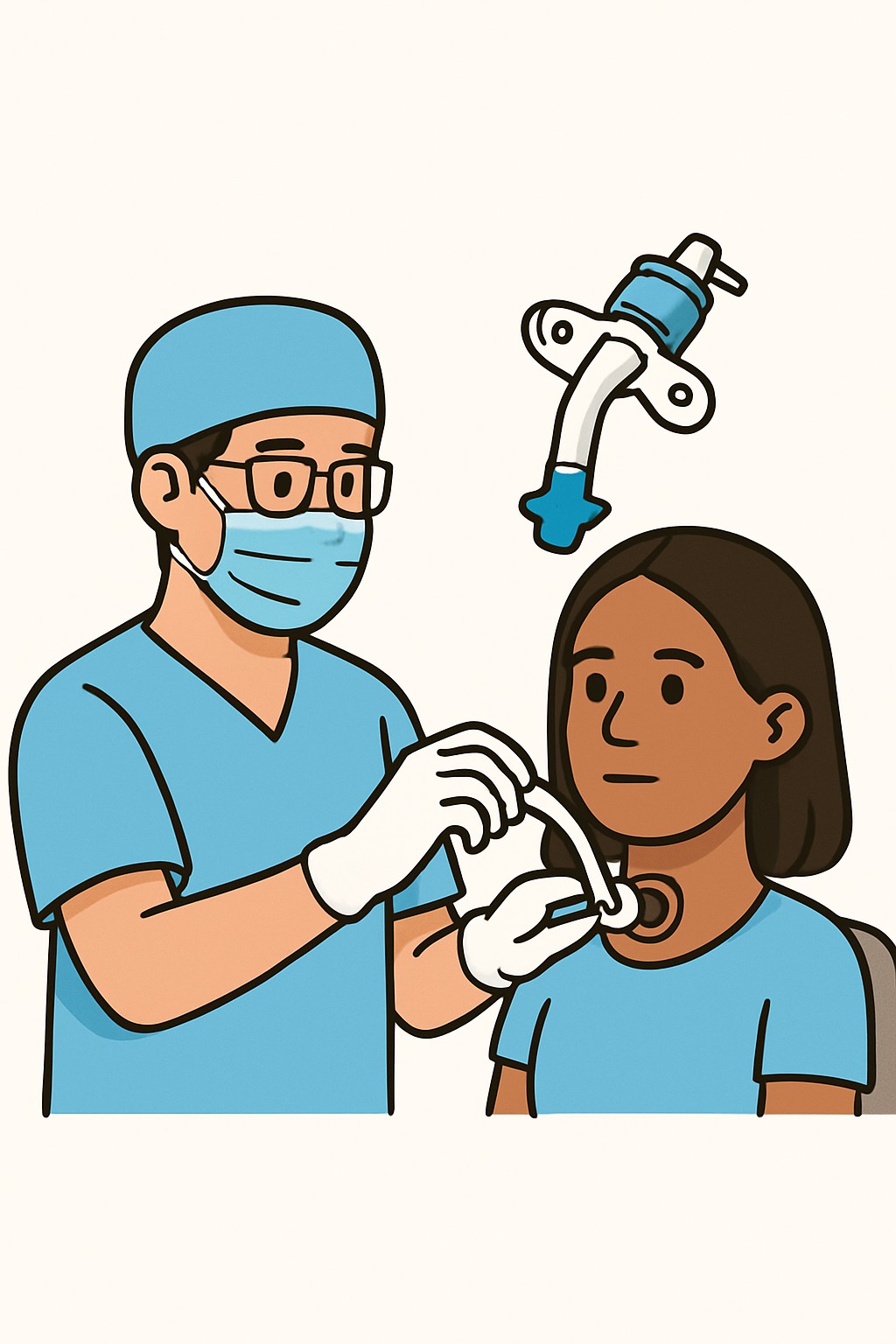
An outpatient tracheostomy tube change is a planned visit to replace the tube that sits in the windpipe through a neck opening.
Overview
An outpatient tracheostomy tube change is a planned visit to replace the tube that sits in the windpipe through a neck opening. The clinician removes the old tube and places a new, clean tube of the same or a different size or type. This is done to keep the airway clear, reduce infection risk, replace worn parts, or adjust the fit. The visit is usually brief. Breathing, comfort, and tube position are checked before you leave.
Also known as: Trach tube change, Tracheostomy tube exchange, Outpatient trach tube change
Preparation & Next Steps
Everything you need to know before and after your procedure
Before Care
- Confirm the appointment location and who will perform the change (clinic, ENT, pulmonary, RT).
- Bring your tracheostomy supplies: spare tube of the same size, one size smaller, obturator, ties, inner cannulas, and dressings.
- Carry a list of current medicines, allergies, and relevant device settings (ventilator or oxygen).
- Ask if sedation or numbing medicine is planned; follow any fasting instructions if told in advance.
- Arrange transportation if sedation is planned or if you do not feel safe traveling alone.
- Wear a shirt with a loose collar and remove necklaces that may get in the way.
- Use humidification and suction as usual before the visit to clear secretions if instructed by your care team.
- If you have new fever, thick secretions, or bleeding at the stoma, notify the clinic before the visit.
- Bring your insurance card, ID, and any clinic forms or home care logs.
- Plan a little extra time for observation after the change in case adjustments are needed.
After Care
- Expect mild coughing and small amounts of blood-tinged mucus for a short time after the change.
- Check that the ties are snug and the tube is secure; keep the obturator and a spare tube nearby.
- Keep the stoma clean and dry; change the dressing if it becomes wet or soiled.
- Resume your usual humidification, suctioning, and inner cannula care as taught by your care team.
- Avoid heavy lifting, vigorous exercise, or submerging the site in water for 24 hours unless cleared by your clinician.
- Watch for increasing pain, redness, swelling, foul drainage, fever, or persistent bleeding and contact the clinic if these occur.
- Monitor breathing for noisy airflow, difficulty moving air, or dislodgement; contact the clinic if you notice problems.
- Confirm follow-up timing for the next routine tube change or any planned size adjustments.
- Keep emergency contact numbers and your equipment checklist in an easy-to-find place.
- Store replacement supplies in a clean, dry area and check expiration dates if applicable.
Clinical Information
Important medical details about this procedure
Indications
- Routine scheduled tube replacement
- Blocked or thick secretions that do not clear
- Worn, cracked, or discolored tube
- Skin or stoma irritation or infection
- Size change to improve airflow or speech
- Preparation for speaking valve, capping, or weaning
- Granulation tissue or leakage around the tube
Alternatives
- Cleaning or replacing the inner cannula without changing the outer tube
- In-home tube change by a trained caregiver when appropriate
- Inpatient tube change for complex airways or if extra monitoring is needed
- Suctioning, humidification, and airway clearance to relieve mild blockage
Risks
- Bleeding at the stoma
- Discomfort or coughing during the change
- Tube misplacement or creation of a false passage
- Short-term breathing difficulty
- Infection of the stoma or airway
- Airway injury or swelling
- Accidental decannulation
Contraindications
- Unstable breathing or uncontrolled low oxygen
- Very new or immature stoma that is not healed enough for routine change
- Active neck infection or significant swelling at the stoma
- Uncontrolled bleeding or blood clotting problems
- Inability to cooperate without needed supports or equipment
Recovery Timeline
What to expect during your recovery
Most people return to normal activities the same day after an outpatient tracheostomy tube change. Mild soreness or coughing may occur for a day or two.
Typical Range
0–2 days
Return to Work
0–2 days
Recovery Milestones
Resume light activities and routine tracheostomy care
Avoid heavy lifting and vigorous exercise
Monitor the stoma for bleeding or irritation
Use humidification and suction to keep secretions thin and clear
Return to typical daily routine if breathing is comfortable
Frequently Asked Questions
Common questions and expert answers about this procedure
How long does an outpatient tracheostomy tube change take?
How long does an outpatient tracheostomy tube change take?
The procedure itself is usually brief, often minutes. Extra time is used for setup, checking tube position, and observation.
Will it hurt?
Will it hurt?
You may feel pressure, coughing, or brief discomfort. Numbing medicine may be used. Soreness often improves within a day or two.
Who performs the tube change?
Who performs the tube change?
An ENT or pulmonary clinician often performs it, sometimes with a respiratory therapist or nurse assisting.
How often are tracheostomy tubes changed?
How often are tracheostomy tubes changed?
Timing varies by tube type, airway needs, and clinician preference. Many people have regular scheduled changes; your care team sets the plan.
What should I bring to the visit?
What should I bring to the visit?
Bring spare tubes (same size and one smaller), obturator, ties, dressings, your medication list, and any ventilator or oxygen information.
Can I eat or drink before the appointment?
Can I eat or drink before the appointment?
If no sedation is planned, eating is often allowed. If sedation may be used, the clinic may give fasting instructions.
How do clinicians make sure the tube is in the right place?
How do clinicians make sure the tube is in the right place?
They check airflow and breathing, secure the tube, and may use suction, cap, or valve checks. If needed, a scope may be used to confirm position.
What are warning signs after a tube change?
What are warning signs after a tube change?
Increasing trouble breathing, persistent bleeding, fever, redness or foul drainage at the stoma, or a loose tube are reasons to contact the clinic.
References
Medical literature and sources