%20--%3e%3csvg%20version='1.0'%20id='Layer_1'%20xmlns='http://www.w3.org/2000/svg'%20xmlns:xlink='http://www.w3.org/1999/xlink'%20x='0px'%20y='0px'%20viewBox='0%200%20755.52%20814.35'%20style='enable-background:new%200%200%20755.52%20814.35;'%20xml:space='preserve'%3e%3cstyle%20type='text/css'%3e%20.st0{fill:%231ae5ce;stroke:%231ae5ce;stroke-width:7;stroke-miterlimit:10;}%20.st1{fill:%23FFFFFF;stroke:%231ae5ce;stroke-width:7;stroke-miterlimit:10;}%20.st2{fill:%231ae5ce;stroke:%23FFFFFF;stroke-width:7;stroke-miterlimit:10;}%20.st3{fill:%23FFFFFF;stroke:%23FFFFFF;stroke-width:6;stroke-miterlimit:10;}%20%3c/style%3e%3cg%20id='Dark_Logo_00000159431215648494653180000015900878925932721032_'%3e%3cpath%20id='shield_00000152259091539869183100000001926543869452564382_'%20class='st0'%20d='M711.13,173.42%20c-3.37-49.07-38.92-44.9-75.96-52.18c-67.4-13.25-130.47-34.47-192.36-63.92c-22.48-10.7-41.88-25.74-65.05-26.28%20c-23.17,0.54-42.58,15.59-65.05,26.28c-61.89,29.45-124.95,50.68-192.36,63.92c-37.04,7.28-72.59,3.11-75.96,52.18%20c-1.55,22.6,0.34,46.4,1.05,68.92c5.99,190.78,52.91,345.39,206.27,466.46c29.71,23.46,74.51,55.8,108.84,70.75%20c5.99,2.61,11.7,3.73,17.21,3.75c5.51-0.02,11.22-1.14,17.21-3.75c34.33-14.95,79.12-47.3,108.84-70.75%20c153.37-121.07,200.28-275.68,206.27-466.46C710.79,219.82,712.68,196.02,711.13,173.42z'/%3e%3cpath%20id='magnifyingglass_00000073685934697636024790000000342567780940956808_'%20class='st1'%20d='M648.78,624.21l-96.64-104.65%20c34.89-40.63,55.98-93.46,55.98-151.21c0-128.27-103.98-232.24-232.24-232.24S143.63,240.08,143.63,368.35%20s103.98,232.24,232.24,232.24c48.87,0,94.21-15.11,131.62-40.89l97.18,105.24c11.25,12.18,30.24,12.93,42.42,1.69l0,0%20C659.27,655.38,660.03,636.39,648.78,624.21z'/%3e%3ccircle%20id='ellipse_00000129904010550392394720000017056154833629780114_'%20class='st2'%20cx='375.87'%20cy='368.35'%20r='181.21'/%3e%3cpath%20id='dollarsign_00000057140127156649725250000003772530148495155891_'%20class='st3'%20d='M362.91,492.03v-23.91%20c0-2.01-1.58-3.69-3.59-3.77c-18.49-0.78-37.12-5.4-49.4-11.83c-1.75-0.92-2.53-3.01-1.76-4.84l5.87-13.89%20c0.86-2.02,3.23-2.88,5.2-1.89c12.94,6.52,30.45,11.44,49.18,11.44c26.02,0,43.6-12.73,43.6-30.43c0-17.08-14.29-27.63-41.4-36.95%20c-37.37-12.42-60.46-26.7-60.46-53.72c0-24.97,20.29-44.11,52.22-49.51c1.8-0.31,3.11-1.89,3.11-3.72v-24.35%20c0-2.09,1.69-3.78,3.78-3.78h15.16c2.09,0,3.78,1.69,3.78,3.78v22.71c0,2.01,1.58,3.67,3.58,3.77c17.85,0.92,30.88,4.75,40.61,9.1%20c1.92,0.86,2.79,3.09,1.94,5.01l-6.08,13.6c-0.85,1.91-3.09,2.77-4.99,1.91c-8.37-3.8-22.38-8.95-42.75-8.95%20c-28.21,0-38.84,14.28-38.84,26.7c0,16.15,13.56,24.22,45.44,35.4c37.74,13.04,56.79,29.19,56.79,56.82%20c0,23.85-19.05,46.23-54.78,52.3c-1.8,0.31-3.11,1.89-3.11,3.72v25.28c0,2.09-1.69,3.78-3.78,3.78h-15.53%20C364.6,495.81,362.91,494.12,362.91,492.03z'/%3e%3c/g%3e%3c/svg%3e)
Vocal cord injection (voice therapy procedure) Ent Surgery
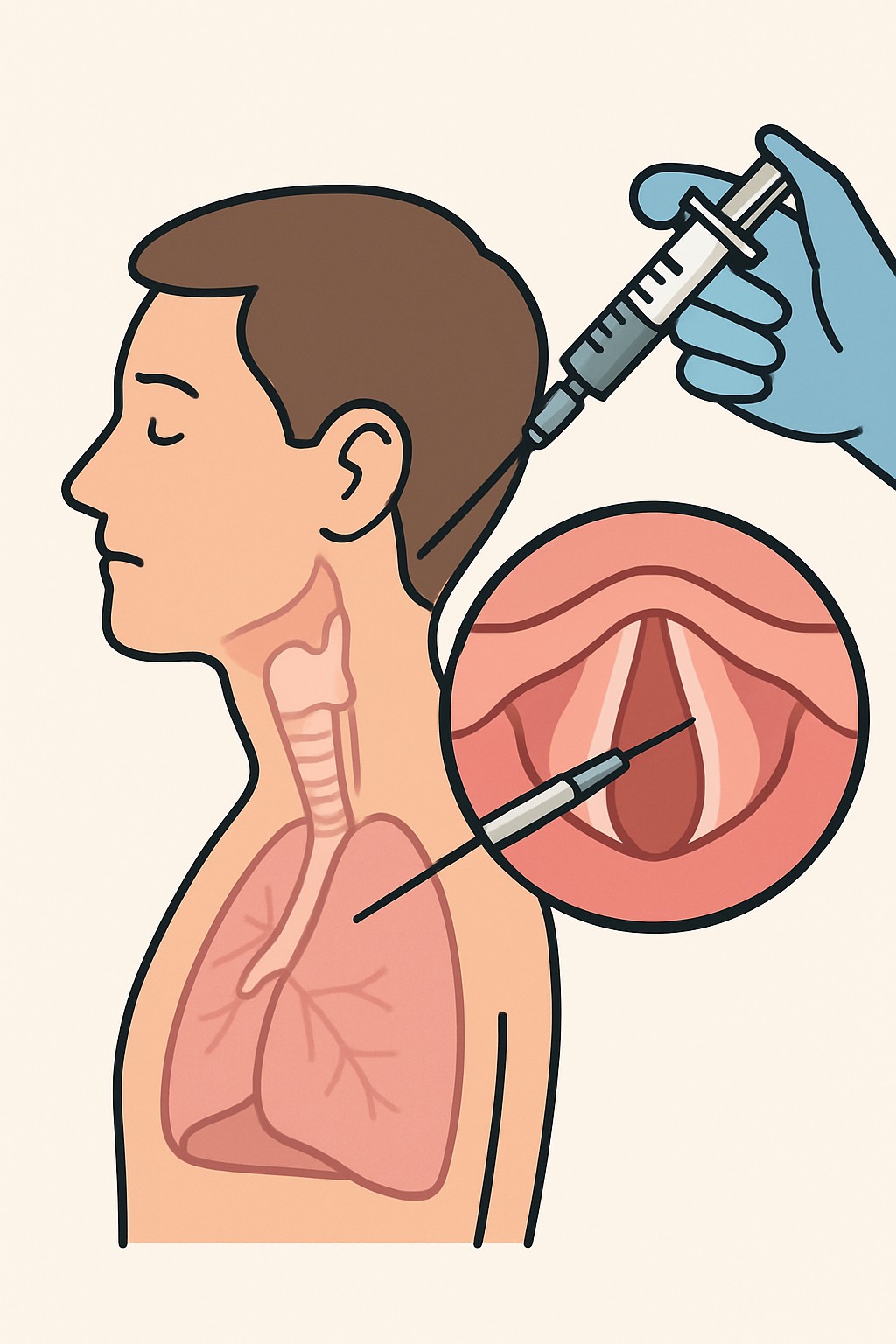
Vocal cord injection is a procedure that adds a small amount of filler into one or both vocal folds to help them close more completely.
Overview
Vocal cord injection is a procedure that adds a small amount of filler into one or both vocal folds to help them close more completely. This can improve voice strength, reduce breathiness, and may lessen coughing or choking with swallowing when incomplete closure is the cause. The injection can be done in a clinic with local anesthesia using a flexible scope, or in an operating room with sedation or general anesthesia. Some fillers are temporary and absorb over time; others last longer. Injections are often used while nerves recover, to test how medialization might help, or as a stand-alone treatment.
Also known as: Injection laryngoplasty, Vocal fold injection, Medialization injection
Preparation & Next Steps
Everything you need to know before and after your procedure
Before Care
- Expect a laryngoscopy and voice assessment to confirm the cause of hoarseness and plan the injection approach.
- Share a current list of all medicines and supplements, especially blood thinners and antiplatelet drugs; ask how they will be managed before the procedure.
- Tell the team about any allergies to anesthetics (like lidocaine), epinephrine, or filler materials.
- Follow facility instructions about eating and drinking if sedation or anesthesia is planned.
- Arrange transportation if sedation is used or if throat numbing could affect safe swallowing after the visit.
- Plan to limit heavy voice use for the first day or two after the injection.
- Bring prior scope videos, operative notes, or imaging reports if available.
- Discuss work and performance demands so the team can time the procedure around voice needs.
- Review the follow-up schedule and any planned voice therapy.
After Care
- Expect temporary throat numbness or mild soreness; cool fluids and rest can help while the numbing wears off.
- Follow the voice rest plan given by your care team for the first day or two; avoid shouting, straining, and whispering.
- Resume voice gradually as guided by your clinician or speech-language pathologist.
- Stay hydrated and try to avoid frequent throat clearing; a sip of water or gentle swallow can reduce the urge.
- Use pain relief only as instructed by your clinician if discomfort occurs.
- Some change in voice quality is common in the first few days as swelling settles; improvement may continue over several weeks.
- Contact the clinic promptly for trouble breathing, worsening swallowing problems, fever, significant bleeding, or severe pain.
- Keep follow-up appointments for a scope check and to adjust therapy if needed.
- Ask when it is appropriate to return to heavy voice tasks such as singing, teaching, or call-center work.
Clinical Information
Important medical details about this procedure
Indications
- Breathy or weak voice from vocal fold paralysis or paresis
- Age-related vocal fold thinning (presbyphonia)
- Glottic insufficiency causing poor closure
- Vocal fold bowing or atrophy
- Voice problems after neck or thyroid surgery affecting the nerve
- Mild aspiration related to incomplete vocal fold closure
- Trial before permanent medialization surgery
Alternatives
- Voice therapy with a speech-language pathologist
- Watchful waiting for potential nerve recovery
- Medialization thyroplasty (Type I framework surgery)
- Arytenoid adduction
- Laryngeal reinnervation procedures
- Voice amplification and pacing strategies
Risks
- Temporary hoarseness or voice change
- Over- or under-correction requiring adjustment or repeat injection
- Bleeding, infection, or swelling at the injection site
- Allergic or foreign body reaction to the filler
- Granuloma or nodule formation
- Temporary swallowing difficulty or cough
- Rare breathing problems or airway compromise
Contraindications
- Known allergy to the planned filler or local anesthetic
- Active infection of the upper airway
- Uncontrolled bleeding disorder or anticoagulation that cannot be managed
- Significant airway narrowing where added swelling could be risky
- Inability to tolerate laryngoscopy or anesthesia required for the setting
Recovery Timeline
What to expect during your recovery
Most people go home the same day and return to light activity within 24 hours. Voice often improves quickly but can continue to change for days to weeks as swelling resolves and the filler settles.
Typical Range
1–14 days
Return to Work
1–3 days
Recovery Milestones
Rest voice and do light at‑home activities
Resume desk work and routine tasks if throat comfort allows
Gradually increase voice use per therapy plan
Follow-up laryngoscopy to assess filler position and effect
Voice quality approaches a new baseline as swelling subsides
Frequently Asked Questions
Common questions and expert answers about this procedure
What materials are used for a vocal cord injection?
What materials are used for a vocal cord injection?
Common fillers include hyaluronic acid gels, collagen-based materials, carboxymethylcellulose, and calcium hydroxyapatite. Some are temporary and others last longer.
How long does the injection last?
How long does the injection last?
Effects vary by material and individual factors. Many temporary fillers last a few months, while longer-lasting options can persist for a year or more.
Is it done in the office or the operating room?
Is it done in the office or the operating room?
Many injections are done in the clinic with local anesthesia using a flexible scope. Some are done in the operating room if better exposure or sedation is needed.
Will I need repeat injections?
Will I need repeat injections?
Repeat injections are common with temporary fillers. Some people later choose a more permanent procedure like medialization thyroplasty if the trial helps.
What does the procedure feel like?
What does the procedure feel like?
You may feel pressure, brief stinging, or a sensation of fullness. Local anesthesia reduces discomfort. A sore throat is common for a short time afterward.
Can it help with coughing or choking when I swallow?
Can it help with coughing or choking when I swallow?
Improving vocal fold closure can reduce aspiration risk in some cases, but results vary based on the cause and severity.
What are the differences between injection and thyroplasty?
What are the differences between injection and thyroplasty?
Injection adds filler inside the vocal fold and is often temporary. Thyroplasty places an implant through the cartilage framework and is designed to be longer lasting.
References
Medical literature and sources