%20--%3e%3csvg%20version='1.0'%20id='Layer_1'%20xmlns='http://www.w3.org/2000/svg'%20xmlns:xlink='http://www.w3.org/1999/xlink'%20x='0px'%20y='0px'%20viewBox='0%200%20755.52%20814.35'%20style='enable-background:new%200%200%20755.52%20814.35;'%20xml:space='preserve'%3e%3cstyle%20type='text/css'%3e%20.st0{fill:%231ae5ce;stroke:%231ae5ce;stroke-width:7;stroke-miterlimit:10;}%20.st1{fill:%23FFFFFF;stroke:%231ae5ce;stroke-width:7;stroke-miterlimit:10;}%20.st2{fill:%231ae5ce;stroke:%23FFFFFF;stroke-width:7;stroke-miterlimit:10;}%20.st3{fill:%23FFFFFF;stroke:%23FFFFFF;stroke-width:6;stroke-miterlimit:10;}%20%3c/style%3e%3cg%20id='Dark_Logo_00000159431215648494653180000015900878925932721032_'%3e%3cpath%20id='shield_00000152259091539869183100000001926543869452564382_'%20class='st0'%20d='M711.13,173.42%20c-3.37-49.07-38.92-44.9-75.96-52.18c-67.4-13.25-130.47-34.47-192.36-63.92c-22.48-10.7-41.88-25.74-65.05-26.28%20c-23.17,0.54-42.58,15.59-65.05,26.28c-61.89,29.45-124.95,50.68-192.36,63.92c-37.04,7.28-72.59,3.11-75.96,52.18%20c-1.55,22.6,0.34,46.4,1.05,68.92c5.99,190.78,52.91,345.39,206.27,466.46c29.71,23.46,74.51,55.8,108.84,70.75%20c5.99,2.61,11.7,3.73,17.21,3.75c5.51-0.02,11.22-1.14,17.21-3.75c34.33-14.95,79.12-47.3,108.84-70.75%20c153.37-121.07,200.28-275.68,206.27-466.46C710.79,219.82,712.68,196.02,711.13,173.42z'/%3e%3cpath%20id='magnifyingglass_00000073685934697636024790000000342567780940956808_'%20class='st1'%20d='M648.78,624.21l-96.64-104.65%20c34.89-40.63,55.98-93.46,55.98-151.21c0-128.27-103.98-232.24-232.24-232.24S143.63,240.08,143.63,368.35%20s103.98,232.24,232.24,232.24c48.87,0,94.21-15.11,131.62-40.89l97.18,105.24c11.25,12.18,30.24,12.93,42.42,1.69l0,0%20C659.27,655.38,660.03,636.39,648.78,624.21z'/%3e%3ccircle%20id='ellipse_00000129904010550392394720000017056154833629780114_'%20class='st2'%20cx='375.87'%20cy='368.35'%20r='181.21'/%3e%3cpath%20id='dollarsign_00000057140127156649725250000003772530148495155891_'%20class='st3'%20d='M362.91,492.03v-23.91%20c0-2.01-1.58-3.69-3.59-3.77c-18.49-0.78-37.12-5.4-49.4-11.83c-1.75-0.92-2.53-3.01-1.76-4.84l5.87-13.89%20c0.86-2.02,3.23-2.88,5.2-1.89c12.94,6.52,30.45,11.44,49.18,11.44c26.02,0,43.6-12.73,43.6-30.43c0-17.08-14.29-27.63-41.4-36.95%20c-37.37-12.42-60.46-26.7-60.46-53.72c0-24.97,20.29-44.11,52.22-49.51c1.8-0.31,3.11-1.89,3.11-3.72v-24.35%20c0-2.09,1.69-3.78,3.78-3.78h15.16c2.09,0,3.78,1.69,3.78,3.78v22.71c0,2.01,1.58,3.67,3.58,3.77c17.85,0.92,30.88,4.75,40.61,9.1%20c1.92,0.86,2.79,3.09,1.94,5.01l-6.08,13.6c-0.85,1.91-3.09,2.77-4.99,1.91c-8.37-3.8-22.38-8.95-42.75-8.95%20c-28.21,0-38.84,14.28-38.84,26.7c0,16.15,13.56,24.22,45.44,35.4c37.74,13.04,56.79,29.19,56.79,56.82%20c0,23.85-19.05,46.23-54.78,52.3c-1.8,0.31-3.11,1.89-3.11,3.72v25.28c0,2.09-1.69,3.78-3.78,3.78h-15.53%20C364.6,495.81,362.91,494.12,362.91,492.03z'/%3e%3c/g%3e%3c/svg%3e)
Care plan oversight (home health - monthly) Evaluation Management
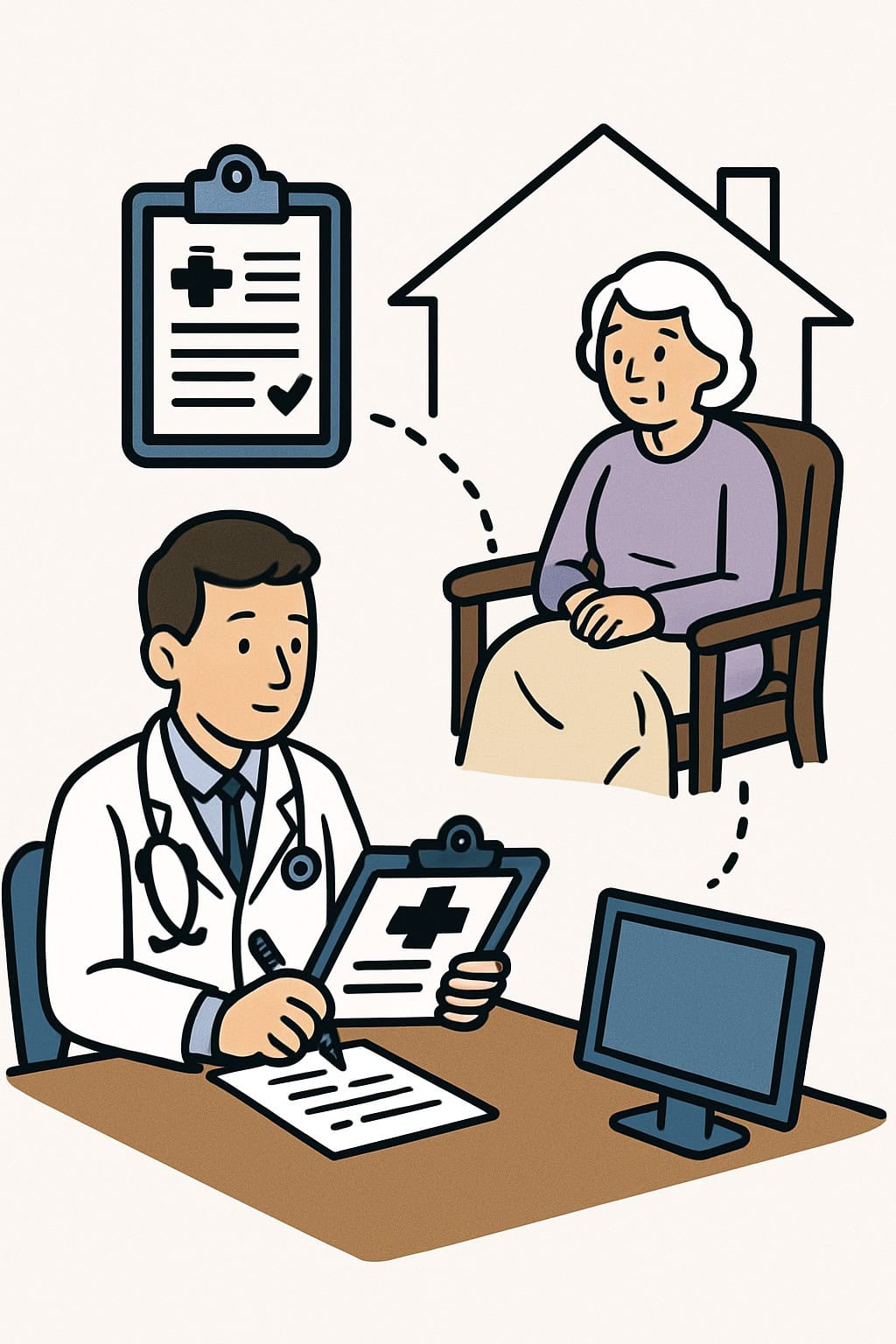
Care plan oversight is a monthly service where a clinician supervises and coordinates a patient’s home health plan of care.
Overview
Care plan oversight is a monthly service where a clinician supervises and coordinates a patient’s home health plan of care. It typically involves reviewing home health reports, communicating with the home health agency, responding to changes, and updating orders as needed. This service supports people receiving skilled home health care by helping keep all parts of the care plan aligned. It focuses on coordination and documentation, not an in-person visit.
Also known as: CPO, Home health care plan oversight, Monthly care plan oversight
Preparation & Next Steps
Everything you need to know before and after your procedure
Before Care
- Confirm which clinician is responsible for overseeing the home health plan of care
- Share signed consent forms so the home health agency and clinicians can exchange information
- Provide an up-to-date medication list, including doses and over-the-counter items
- Give the home health agency and clinician accurate contact details and preferred communication methods
- Keep recent hospital or clinic summaries, test results, and therapy notes organized for review
- Track symptoms, vitals, and any changes in function using a simple log or app
- List home medical equipment and supplies with delivery contacts and refill schedules
- Know the schedule of home health visits and any upcoming appointments
- Identify a primary caregiver contact, if applicable, for coordination
- Ask the agency how care plan changes are communicated and documented
After Care
- Follow the home health visit schedule and share updates from each visit with your care team
- Report new or worsening symptoms, side effects, or safety concerns to the home health team
- Keep medication lists current when prescriptions are added, stopped, or changed
- Review any care plan updates or new orders provided by the clinician or home health agency
- Attend scheduled clinic or telehealth visits that support ongoing oversight
- Store important documents such as plan of care, visit notes, and discharge summaries
- Use one main contact channel (portal, phone) to reduce duplicated messages
- Confirm delivery or refills of needed supplies and equipment before they run low
- Track labs, imaging, or therapy goals and note when they are completed
- Review insurance explanations of benefits and ask billing questions if something seems unclear
Clinical Information
Important medical details about this procedure
Indications
- Active home health plan of care with skilled nursing or therapy
- Recent hospital or rehab discharge with ongoing needs at home
- Multiple conditions or medicines requiring close coordination
- Frequent updates to orders, equipment, or services
- Need for regular review of test results, vitals, or symptom logs
- Communication needs between the home health team and clinicians
Alternatives
- Routine office or telehealth follow-up visits
- Chronic care management or care coordination programs
- Case management through insurer or community programs
- Direct communication between patient, caregiver, and home health without formal monthly oversight
Risks
- Delays in communication or updates to the plan of care
- Confusion about roles among multiple clinicians or agencies
- Privacy risks when sharing health information across organizations
- Potential out-of-pocket costs depending on coverage and eligibility
- Administrative errors that could affect scheduling or supplies
Contraindications
- Not applicable when there is no active home health plan of care
- Not used for care provided in facility settings instead of home health
- Not applicable when only minimal coordination is needed in a month
Recovery Timeline
What to expect during your recovery
There is no medical recovery period because this is a coordination and documentation service, not a procedure or visit.
Typical Range
Same day
Return to Work
Same day
Recovery Milestones
Resume normal daily activities
Confirm how the home health team and clinician will communicate updates
Expect coordination tasks such as plan adjustments and review of reports
Review progress and plan for the next month of home health services
Frequently Asked Questions
Common questions and expert answers about this procedure
What is care plan oversight for home health?
What is care plan oversight for home health?
It is a monthly service where a clinician coordinates and supervises your home health plan, reviews reports, and updates orders when needed.
Who provides care plan oversight?
Who provides care plan oversight?
Usually the clinician responsible for the home health plan of care, such as a primary care clinician or specialist.
How is it different from a home health visit?
How is it different from a home health visit?
Home health visits are done by nurses or therapists in the home. Oversight is the clinician’s non–face-to-face work coordinating those services.
What activities count toward oversight?
What activities count toward oversight?
Typical tasks include reviewing home health notes, discussing changes with the agency, adjusting orders, and documenting the plan of care.
How often does it occur?
How often does it occur?
It is structured as a monthly service when the clinical need and documentation support it.
Does it replace office or telehealth visits?
Does it replace office or telehealth visits?
No. It supports home health care between visits. In-person or virtual visits may still be scheduled.
Can more than one clinician bill for oversight in the same month?
Can more than one clinician bill for oversight in the same month?
Usually one overseeing clinician manages the monthly plan of care. Others may contribute notes or recommendations.
Will there be a cost to me?
Will there be a cost to me?
Costs depend on insurance coverage and eligibility rules. Check your benefits and any explanations of benefits you receive.
References
Medical literature and sources