%20--%3e%3csvg%20version='1.0'%20id='Layer_1'%20xmlns='http://www.w3.org/2000/svg'%20xmlns:xlink='http://www.w3.org/1999/xlink'%20x='0px'%20y='0px'%20viewBox='0%200%20755.52%20814.35'%20style='enable-background:new%200%200%20755.52%20814.35;'%20xml:space='preserve'%3e%3cstyle%20type='text/css'%3e%20.st0{fill:%231ae5ce;stroke:%231ae5ce;stroke-width:7;stroke-miterlimit:10;}%20.st1{fill:%23FFFFFF;stroke:%231ae5ce;stroke-width:7;stroke-miterlimit:10;}%20.st2{fill:%231ae5ce;stroke:%23FFFFFF;stroke-width:7;stroke-miterlimit:10;}%20.st3{fill:%23FFFFFF;stroke:%23FFFFFF;stroke-width:6;stroke-miterlimit:10;}%20%3c/style%3e%3cg%20id='Dark_Logo_00000159431215648494653180000015900878925932721032_'%3e%3cpath%20id='shield_00000152259091539869183100000001926543869452564382_'%20class='st0'%20d='M711.13,173.42%20c-3.37-49.07-38.92-44.9-75.96-52.18c-67.4-13.25-130.47-34.47-192.36-63.92c-22.48-10.7-41.88-25.74-65.05-26.28%20c-23.17,0.54-42.58,15.59-65.05,26.28c-61.89,29.45-124.95,50.68-192.36,63.92c-37.04,7.28-72.59,3.11-75.96,52.18%20c-1.55,22.6,0.34,46.4,1.05,68.92c5.99,190.78,52.91,345.39,206.27,466.46c29.71,23.46,74.51,55.8,108.84,70.75%20c5.99,2.61,11.7,3.73,17.21,3.75c5.51-0.02,11.22-1.14,17.21-3.75c34.33-14.95,79.12-47.3,108.84-70.75%20c153.37-121.07,200.28-275.68,206.27-466.46C710.79,219.82,712.68,196.02,711.13,173.42z'/%3e%3cpath%20id='magnifyingglass_00000073685934697636024790000000342567780940956808_'%20class='st1'%20d='M648.78,624.21l-96.64-104.65%20c34.89-40.63,55.98-93.46,55.98-151.21c0-128.27-103.98-232.24-232.24-232.24S143.63,240.08,143.63,368.35%20s103.98,232.24,232.24,232.24c48.87,0,94.21-15.11,131.62-40.89l97.18,105.24c11.25,12.18,30.24,12.93,42.42,1.69l0,0%20C659.27,655.38,660.03,636.39,648.78,624.21z'/%3e%3ccircle%20id='ellipse_00000129904010550392394720000017056154833629780114_'%20class='st2'%20cx='375.87'%20cy='368.35'%20r='181.21'/%3e%3cpath%20id='dollarsign_00000057140127156649725250000003772530148495155891_'%20class='st3'%20d='M362.91,492.03v-23.91%20c0-2.01-1.58-3.69-3.59-3.77c-18.49-0.78-37.12-5.4-49.4-11.83c-1.75-0.92-2.53-3.01-1.76-4.84l5.87-13.89%20c0.86-2.02,3.23-2.88,5.2-1.89c12.94,6.52,30.45,11.44,49.18,11.44c26.02,0,43.6-12.73,43.6-30.43c0-17.08-14.29-27.63-41.4-36.95%20c-37.37-12.42-60.46-26.7-60.46-53.72c0-24.97,20.29-44.11,52.22-49.51c1.8-0.31,3.11-1.89,3.11-3.72v-24.35%20c0-2.09,1.69-3.78,3.78-3.78h15.16c2.09,0,3.78,1.69,3.78,3.78v22.71c0,2.01,1.58,3.67,3.58,3.77c17.85,0.92,30.88,4.75,40.61,9.1%20c1.92,0.86,2.79,3.09,1.94,5.01l-6.08,13.6c-0.85,1.91-3.09,2.77-4.99,1.91c-8.37-3.8-22.38-8.95-42.75-8.95%20c-28.21,0-38.84,14.28-38.84,26.7c0,16.15,13.56,24.22,45.44,35.4c37.74,13.04,56.79,29.19,56.79,56.82%20c0,23.85-19.05,46.23-54.78,52.3c-1.8,0.31-3.11,1.89-3.11,3.72v25.28c0,2.09-1.69,3.78-3.78,3.78h-15.53%20C364.6,495.81,362.91,494.12,362.91,492.03z'/%3e%3c/g%3e%3c/svg%3e)
Comprehensive Eye Exam (Established Patient) Evaluation Management
A comprehensive eye exam for an established patient is a full check of vision and eye health by an eye care professional who already has your records.
Overview
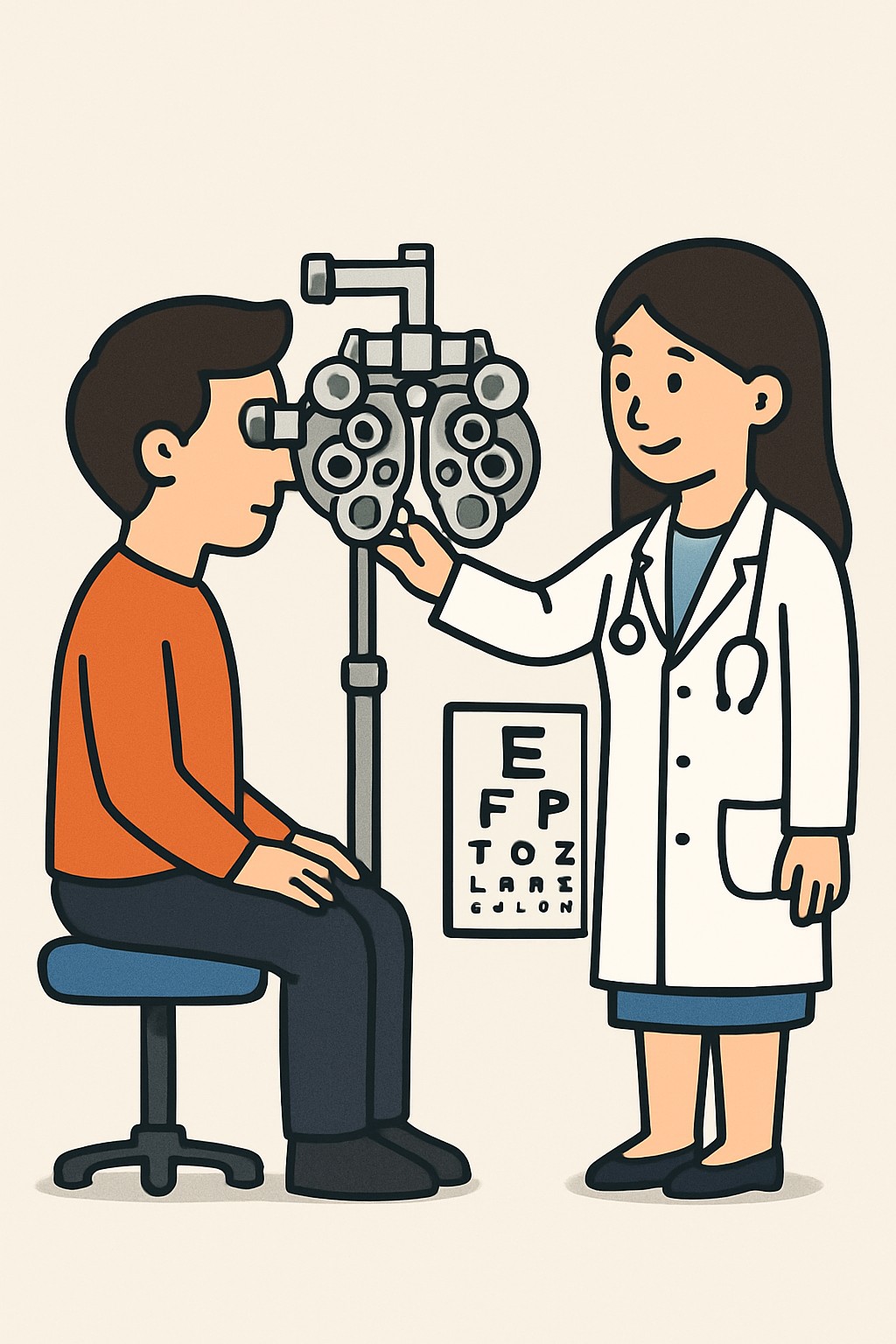
A comprehensive eye exam for an established patient is a full check of vision and eye health by an eye care professional who already has your records. Established means you have been seen by the same practice or specialty in the past. The visit often includes a review of your history and symptoms, vision testing, a refraction to update glasses or contact lens prescription, eye pressure measurement, a slit-lamp exam of the front of the eye, and a dilated exam of the retina when appropriate. Additional tests may be done based on findings.
Also known as: Comprehensive eye exam, Routine dilated eye exam, Established patient eye exam, Annual eye exam
Preparation & Next Steps
Everything you need to know before and after your procedure
Before Care
- Bring your current glasses, contact lenses, and your last prescription if available
- Carry a list of your medicines and eye drops, including over-the-counter products and supplements
- Note any vision changes, eye symptoms, injuries, or family history of eye disease
- Bring your photo ID, insurance card, and a payment method if a copay applies
- Wear or bring sunglasses in case dilation is performed
- Plan extra time for the visit if dilation or additional testing may be done
- Arrange a ride if you prefer not to drive after dilation
- Avoid heavy eye makeup that could interfere with testing
- Follow any clinic instructions about contact lens wear before the exam
- Have your preferred pharmacy information ready for any prescriptions
After Care
- Expect light sensitivity and some blurry near vision for a few hours if your pupils were dilated
- Use sunglasses outdoors until your pupils return to normal
- Delay activities that require sharp near focus until blur from dilation improves
- Follow instructions provided for any prescribed drops or medicines
- Do not reinsert contact lenses until advised by the clinic if drops were used
- Keep a copy of your glasses or contact lens prescription for your records
- Schedule recommended follow-up or additional testing if ordered
- Contact the clinic if you have increasing eye pain, worsening vision, new flashes of light, or many new floaters
Clinical Information
Important medical details about this procedure
Indications
- Routine vision and eye health check
- Updating glasses or contact lens prescription
- Follow-up for conditions like glaucoma, diabetic eye disease, or macular degeneration
- New vision changes such as blurred vision or eye strain
- Headaches possibly related to vision
- Monitoring after eye procedures or surgery
- Screening due to risk factors (diabetes, high refractive error, family history of eye disease)
Alternatives
- Vision screening (brief check, not a full exam)
- Refraction-only visit for glasses prescription
- Telehealth triage for simple questions or follow-up where a physical exam is not required
- Primary care or community screening events for basic vision checks
Risks
- Temporary light sensitivity and blurry near vision after dilation
- Mild stinging or irritation from eye drops
- Rare allergic reaction to diagnostic drops
- Temporary difficulty driving or reading after dilation
- Contact lens discomfort if lenses are reinserted too soon after drops
Contraindications
- Symptoms of an eye emergency (such as sudden severe eye pain or sudden vision loss) that need urgent care
- History of narrow angles or angle-closure risk where dilation needs clinician assessment
- Active eye infection when contact lens fitting or certain testing may be deferred
- Known allergy to specific diagnostic drops used for dilation or numbing
Recovery Timeline
What to expect during your recovery
Most people resume normal activities the same day. If dilation is used, light sensitivity and blurry near vision can last several hours.
Typical Range
Same day
Return to Work
Same day
Recovery Milestones
Resume routine activities as comfortable
Use sunglasses and limit prolonged near work until dilation effects fade
Return to usual reading, screen time, and night driving when vision is clear
Frequently Asked Questions
Common questions and expert answers about this procedure
What happens during a comprehensive eye exam?
What happens during a comprehensive eye exam?
It includes a review of your history, vision testing, refraction for a prescription, eye pressure check, a microscope exam of the front of the eye, and often a dilated retinal exam.
How long does the exam take?
How long does the exam take?
Most visits take 45 to 90 minutes. It can be longer if dilation or extra tests are needed.
Will my eyes be dilated?
Will my eyes be dilated?
Dilation is common to allow a detailed view of the retina. Your clinician decides based on your age, risks, symptoms, and prior findings.
Can I drive after dilation?
Can I drive after dilation?
Many people feel comfortable driving in daylight with sunglasses, but sensitivity and blur can make driving harder. Consider arranging a ride if unsure.
Is this different from a vision screening?
Is this different from a vision screening?
Yes. A screening is brief and may miss problems. A comprehensive exam evaluates both vision and eye health in detail.
Will I get a glasses or contact lens prescription?
Will I get a glasses or contact lens prescription?
A refraction is usually done to update your prescription. Contact lens fitting or updates may require extra measurements and time.
Who performs the exam?
Who performs the exam?
Optometrists and ophthalmologists perform comprehensive exams. Technicians may assist with tests.
Are there risks from the drops?
Are there risks from the drops?
Temporary stinging, light sensitivity, and blur are common. Allergic reactions are rare. Tell the clinic about any prior reactions.
References
Medical literature and sources