%20--%3e%3csvg%20version='1.0'%20id='Layer_1'%20xmlns='http://www.w3.org/2000/svg'%20xmlns:xlink='http://www.w3.org/1999/xlink'%20x='0px'%20y='0px'%20viewBox='0%200%20755.52%20814.35'%20style='enable-background:new%200%200%20755.52%20814.35;'%20xml:space='preserve'%3e%3cstyle%20type='text/css'%3e%20.st0{fill:%231ae5ce;stroke:%231ae5ce;stroke-width:7;stroke-miterlimit:10;}%20.st1{fill:%23FFFFFF;stroke:%231ae5ce;stroke-width:7;stroke-miterlimit:10;}%20.st2{fill:%231ae5ce;stroke:%23FFFFFF;stroke-width:7;stroke-miterlimit:10;}%20.st3{fill:%23FFFFFF;stroke:%23FFFFFF;stroke-width:6;stroke-miterlimit:10;}%20%3c/style%3e%3cg%20id='Dark_Logo_00000159431215648494653180000015900878925932721032_'%3e%3cpath%20id='shield_00000152259091539869183100000001926543869452564382_'%20class='st0'%20d='M711.13,173.42%20c-3.37-49.07-38.92-44.9-75.96-52.18c-67.4-13.25-130.47-34.47-192.36-63.92c-22.48-10.7-41.88-25.74-65.05-26.28%20c-23.17,0.54-42.58,15.59-65.05,26.28c-61.89,29.45-124.95,50.68-192.36,63.92c-37.04,7.28-72.59,3.11-75.96,52.18%20c-1.55,22.6,0.34,46.4,1.05,68.92c5.99,190.78,52.91,345.39,206.27,466.46c29.71,23.46,74.51,55.8,108.84,70.75%20c5.99,2.61,11.7,3.73,17.21,3.75c5.51-0.02,11.22-1.14,17.21-3.75c34.33-14.95,79.12-47.3,108.84-70.75%20c153.37-121.07,200.28-275.68,206.27-466.46C710.79,219.82,712.68,196.02,711.13,173.42z'/%3e%3cpath%20id='magnifyingglass_00000073685934697636024790000000342567780940956808_'%20class='st1'%20d='M648.78,624.21l-96.64-104.65%20c34.89-40.63,55.98-93.46,55.98-151.21c0-128.27-103.98-232.24-232.24-232.24S143.63,240.08,143.63,368.35%20s103.98,232.24,232.24,232.24c48.87,0,94.21-15.11,131.62-40.89l97.18,105.24c11.25,12.18,30.24,12.93,42.42,1.69l0,0%20C659.27,655.38,660.03,636.39,648.78,624.21z'/%3e%3ccircle%20id='ellipse_00000129904010550392394720000017056154833629780114_'%20class='st2'%20cx='375.87'%20cy='368.35'%20r='181.21'/%3e%3cpath%20id='dollarsign_00000057140127156649725250000003772530148495155891_'%20class='st3'%20d='M362.91,492.03v-23.91%20c0-2.01-1.58-3.69-3.59-3.77c-18.49-0.78-37.12-5.4-49.4-11.83c-1.75-0.92-2.53-3.01-1.76-4.84l5.87-13.89%20c0.86-2.02,3.23-2.88,5.2-1.89c12.94,6.52,30.45,11.44,49.18,11.44c26.02,0,43.6-12.73,43.6-30.43c0-17.08-14.29-27.63-41.4-36.95%20c-37.37-12.42-60.46-26.7-60.46-53.72c0-24.97,20.29-44.11,52.22-49.51c1.8-0.31,3.11-1.89,3.11-3.72v-24.35%20c0-2.09,1.69-3.78,3.78-3.78h15.16c2.09,0,3.78,1.69,3.78,3.78v22.71c0,2.01,1.58,3.67,3.58,3.77c17.85,0.92,30.88,4.75,40.61,9.1%20c1.92,0.86,2.79,3.09,1.94,5.01l-6.08,13.6c-0.85,1.91-3.09,2.77-4.99,1.91c-8.37-3.8-22.38-8.95-42.75-8.95%20c-28.21,0-38.84,14.28-38.84,26.7c0,16.15,13.56,24.22,45.44,35.4c37.74,13.04,56.79,29.19,56.79,56.82%20c0,23.85-19.05,46.23-54.78,52.3c-1.8,0.31-3.11,1.89-3.11,3.72v25.28c0,2.09-1.69,3.78-3.78,3.78h-15.53%20C364.6,495.81,362.91,494.12,362.91,492.03z'/%3e%3c/g%3e%3c/svg%3e)
Comprehensive eye exam (new patient) Evaluation Management
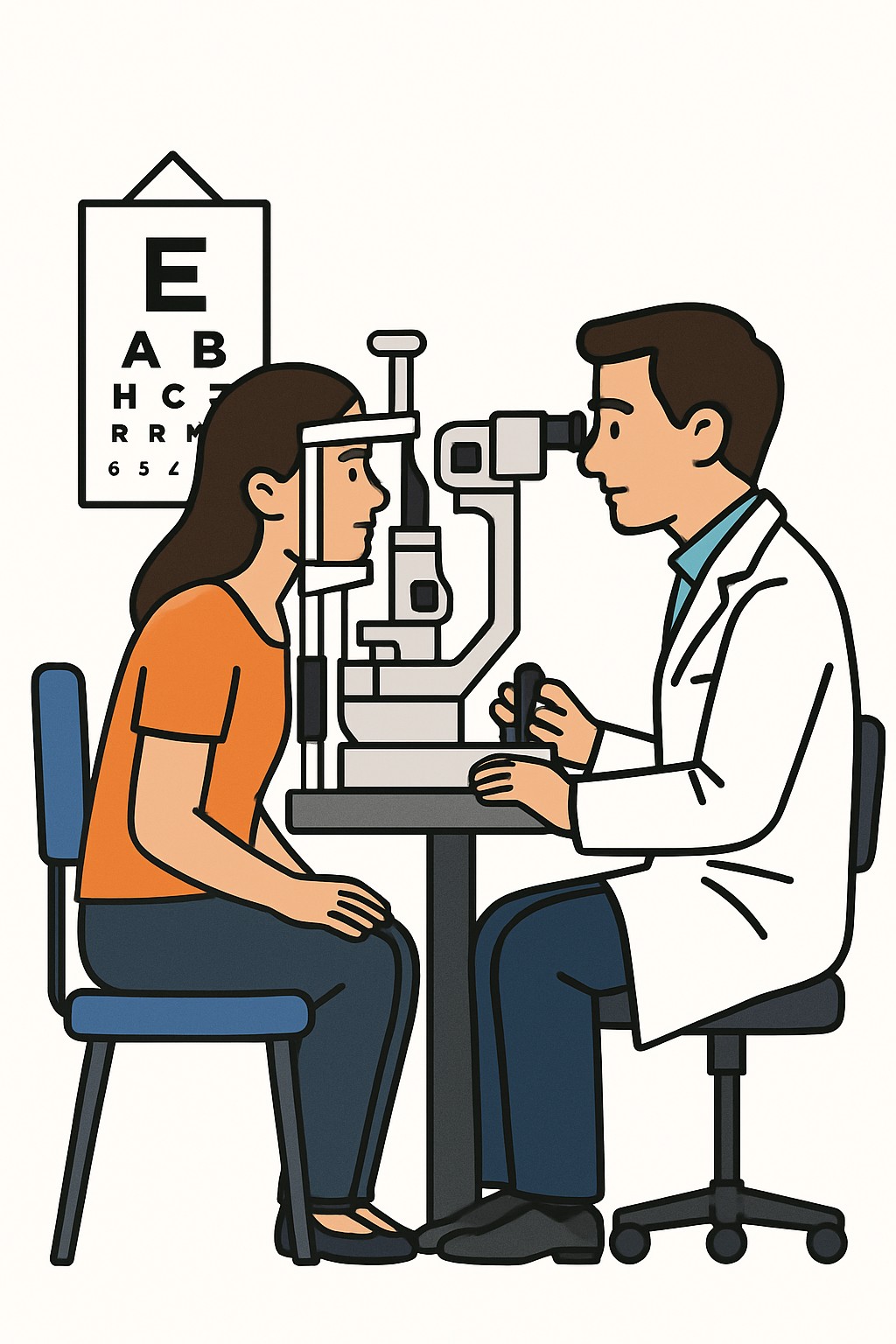
A comprehensive eye exam (new patient) is a full check of your vision and eye health when you visit an eye care clinic for the first time.
Overview
A comprehensive eye exam (new patient) is a full check of your vision and eye health when you visit an eye care clinic for the first time. It usually includes a review of your health and vision history, vision testing, a refraction to measure your glasses prescription, eye pressure measurement, a slit-lamp exam (microscope exam), and a dilated exam of the retina and optic nerve. This exam helps find vision problems and eye diseases early, such as glaucoma, diabetic eye disease, and macular degeneration. The clinician may suggest photos, visual field testing, or scans if needed.
Also known as: Comprehensive dilated eye exam, New patient eye exam, Full eye exam
Preparation & Next Steps
Everything you need to know before and after your procedure
Before Care
- Bring a photo ID, insurance card, and a payment method if a copay applies
- Bring your current glasses, contact lenses, and any past prescriptions
- Carry a list of all medicines and supplements, including eye drops and allergies
- Know your personal and family history of eye problems (for example, glaucoma or macular degeneration)
- Plan extra time in case your pupils are dilated, which can blur near vision for several hours
- Arrange a ride if you are unsure about driving after dilation or work in bright light
- Bring sunglasses to reduce glare after dilation; most clinics offer disposable shades
- Avoid wearing contact lenses to the visit if asked, or bring a case and solution to remove them
- Have names of your primary care and referring clinicians, if any
- Prepare a short list of vision concerns and how long they have been present
After Care
- Expect light sensitivity and blurry near vision for several hours if dilated; effects fade as drops wear off
- Use sunglasses outdoors until your pupils return to normal size
- Follow the plan given for glasses or contact lenses, including any measurements or fittings
- If tests or imaging were ordered, schedule them and keep copies of results
- Note any changes in vision after the visit and share them at follow-up
- Use artificial tears or lubricating drops only if recommended by your eye care clinician
- Store your new eyewear prescription in a safe place or patient portal
- Contact the clinic about new floaters, flashes, sudden vision loss, severe eye pain, or worsening redness
- Confirm the timing for your next routine eye exam based on the clinician’s recommendations
- Check your benefits if additional tests or specialty visits were suggested
Clinical Information
Important medical details about this procedure
Indications
- Blurry vision or trouble seeing at distance or near
- Headaches or eye strain with reading or screen use
- Updating or getting a glasses or contact lens prescription
- Diabetes, high blood pressure, or other conditions that can affect eyes
- Family history of glaucoma, macular degeneration, or other eye diseases
- Floaters, flashes of light, or changes in side (peripheral) vision
- Dry, itchy, or uncomfortable eyes
- Baseline eye health check if you have not had a recent exam
Alternatives
- Basic vision screening at school, work, or a community event
- Refraction-only visit for eyeglass prescription at optical shops
- Online vision tests or apps for simple screening (limited accuracy)
- Tele-ophthalmology screening programs for specific conditions (for example, diabetic eye photos)
- Evaluation at urgent care or emergency care for new, severe eye symptoms
Risks
- Temporary stinging from eye drops
- Light sensitivity and blurry near vision for several hours after dilation
- Rare allergic reaction to drops
- Short-term rise in eye pressure after dilation in some people
- Temporary discomfort from bright lights during the exam
- Incidental findings that may lead to further tests or visits
Contraindications
- Known allergy to dilating or anesthetic eye drops
- Certain angle-closure risks or very narrow angles that may change dilation plans
- Recent eye surgery or injury that may limit parts of the exam
- Inability to cooperate with testing without a support person
Recovery Timeline
What to expect during your recovery
Most people resume normal activities the same day. If dilation is used, near vision and light sensitivity typically improve within several hours.
Typical Range
0–1 days
Return to Work
0–1 days
Recovery Milestones
Resume routine daily tasks; allow extra time if vision is blurry from dilation
Do reading and screen work as vision allows while dilation wears off
Spend time in shaded or indoor areas if light sensitivity persists
Frequently Asked Questions
Common questions and expert answers about this procedure
What happens during a comprehensive eye exam?
What happens during a comprehensive eye exam?
You will review your health history, check vision and refraction for glasses, measure eye pressure, have a microscope exam, and usually a dilated retinal exam. Extra tests may be added if needed.
How long does the exam take?
How long does the exam take?
Many visits take about an hour, and can take longer if dilation or additional testing is done.
Will my eyes be dilated?
Will my eyes be dilated?
Dilation is common so the clinician can examine the retina and optic nerve. It helps detect problems that are not visible through an undilated pupil.
How long do dilation drops last?
How long do dilation drops last?
Effects often last 4 to 6 hours and sometimes longer, causing light sensitivity and blurry near vision.
Can I drive after the exam?
Can I drive after the exam?
Many people find driving difficult until dilation wears off. If you are unsure, arrange transportation.
Do I need to bring my glasses or contacts?
Do I need to bring my glasses or contacts?
Yes. Bring your current eyewear and any past prescriptions to help with refraction and comparisons.
What is the difference between a vision screening and this exam?
What is the difference between a vision screening and this exam?
Screenings are brief checks that find possible problems. A comprehensive exam is a full evaluation by an eye care professional to diagnose and plan care.
Will insurance cover the visit?
Will insurance cover the visit?
Coverage varies by plan and whether the exam is for routine vision or a medical issue. Check your benefits and ask the clinic about expected charges.
References
Medical literature and sources