%20--%3e%3csvg%20version='1.0'%20id='Layer_1'%20xmlns='http://www.w3.org/2000/svg'%20xmlns:xlink='http://www.w3.org/1999/xlink'%20x='0px'%20y='0px'%20viewBox='0%200%20755.52%20814.35'%20style='enable-background:new%200%200%20755.52%20814.35;'%20xml:space='preserve'%3e%3cstyle%20type='text/css'%3e%20.st0{fill:%231ae5ce;stroke:%231ae5ce;stroke-width:7;stroke-miterlimit:10;}%20.st1{fill:%23FFFFFF;stroke:%231ae5ce;stroke-width:7;stroke-miterlimit:10;}%20.st2{fill:%231ae5ce;stroke:%23FFFFFF;stroke-width:7;stroke-miterlimit:10;}%20.st3{fill:%23FFFFFF;stroke:%23FFFFFF;stroke-width:6;stroke-miterlimit:10;}%20%3c/style%3e%3cg%20id='Dark_Logo_00000159431215648494653180000015900878925932721032_'%3e%3cpath%20id='shield_00000152259091539869183100000001926543869452564382_'%20class='st0'%20d='M711.13,173.42%20c-3.37-49.07-38.92-44.9-75.96-52.18c-67.4-13.25-130.47-34.47-192.36-63.92c-22.48-10.7-41.88-25.74-65.05-26.28%20c-23.17,0.54-42.58,15.59-65.05,26.28c-61.89,29.45-124.95,50.68-192.36,63.92c-37.04,7.28-72.59,3.11-75.96,52.18%20c-1.55,22.6,0.34,46.4,1.05,68.92c5.99,190.78,52.91,345.39,206.27,466.46c29.71,23.46,74.51,55.8,108.84,70.75%20c5.99,2.61,11.7,3.73,17.21,3.75c5.51-0.02,11.22-1.14,17.21-3.75c34.33-14.95,79.12-47.3,108.84-70.75%20c153.37-121.07,200.28-275.68,206.27-466.46C710.79,219.82,712.68,196.02,711.13,173.42z'/%3e%3cpath%20id='magnifyingglass_00000073685934697636024790000000342567780940956808_'%20class='st1'%20d='M648.78,624.21l-96.64-104.65%20c34.89-40.63,55.98-93.46,55.98-151.21c0-128.27-103.98-232.24-232.24-232.24S143.63,240.08,143.63,368.35%20s103.98,232.24,232.24,232.24c48.87,0,94.21-15.11,131.62-40.89l97.18,105.24c11.25,12.18,30.24,12.93,42.42,1.69l0,0%20C659.27,655.38,660.03,636.39,648.78,624.21z'/%3e%3ccircle%20id='ellipse_00000129904010550392394720000017056154833629780114_'%20class='st2'%20cx='375.87'%20cy='368.35'%20r='181.21'/%3e%3cpath%20id='dollarsign_00000057140127156649725250000003772530148495155891_'%20class='st3'%20d='M362.91,492.03v-23.91%20c0-2.01-1.58-3.69-3.59-3.77c-18.49-0.78-37.12-5.4-49.4-11.83c-1.75-0.92-2.53-3.01-1.76-4.84l5.87-13.89%20c0.86-2.02,3.23-2.88,5.2-1.89c12.94,6.52,30.45,11.44,49.18,11.44c26.02,0,43.6-12.73,43.6-30.43c0-17.08-14.29-27.63-41.4-36.95%20c-37.37-12.42-60.46-26.7-60.46-53.72c0-24.97,20.29-44.11,52.22-49.51c1.8-0.31,3.11-1.89,3.11-3.72v-24.35%20c0-2.09,1.69-3.78,3.78-3.78h15.16c2.09,0,3.78,1.69,3.78,3.78v22.71c0,2.01,1.58,3.67,3.58,3.77c17.85,0.92,30.88,4.75,40.61,9.1%20c1.92,0.86,2.79,3.09,1.94,5.01l-6.08,13.6c-0.85,1.91-3.09,2.77-4.99,1.91c-8.37-3.8-22.38-8.95-42.75-8.95%20c-28.21,0-38.84,14.28-38.84,26.7c0,16.15,13.56,24.22,45.44,35.4c37.74,13.04,56.79,29.19,56.79,56.82%20c0,23.85-19.05,46.23-54.78,52.3c-1.8,0.31-3.11,1.89-3.11,3.72v25.28c0,2.09-1.69,3.78-3.78,3.78h-15.53%20C364.6,495.81,362.91,494.12,362.91,492.03z'/%3e%3c/g%3e%3c/svg%3e)
Comprehensive hearing test (diagnostic audiometry) Evaluation Management
A comprehensive hearing test, also called diagnostic audiometry, is a detailed evaluation of how well you hear different tones and understand speech.
Overview
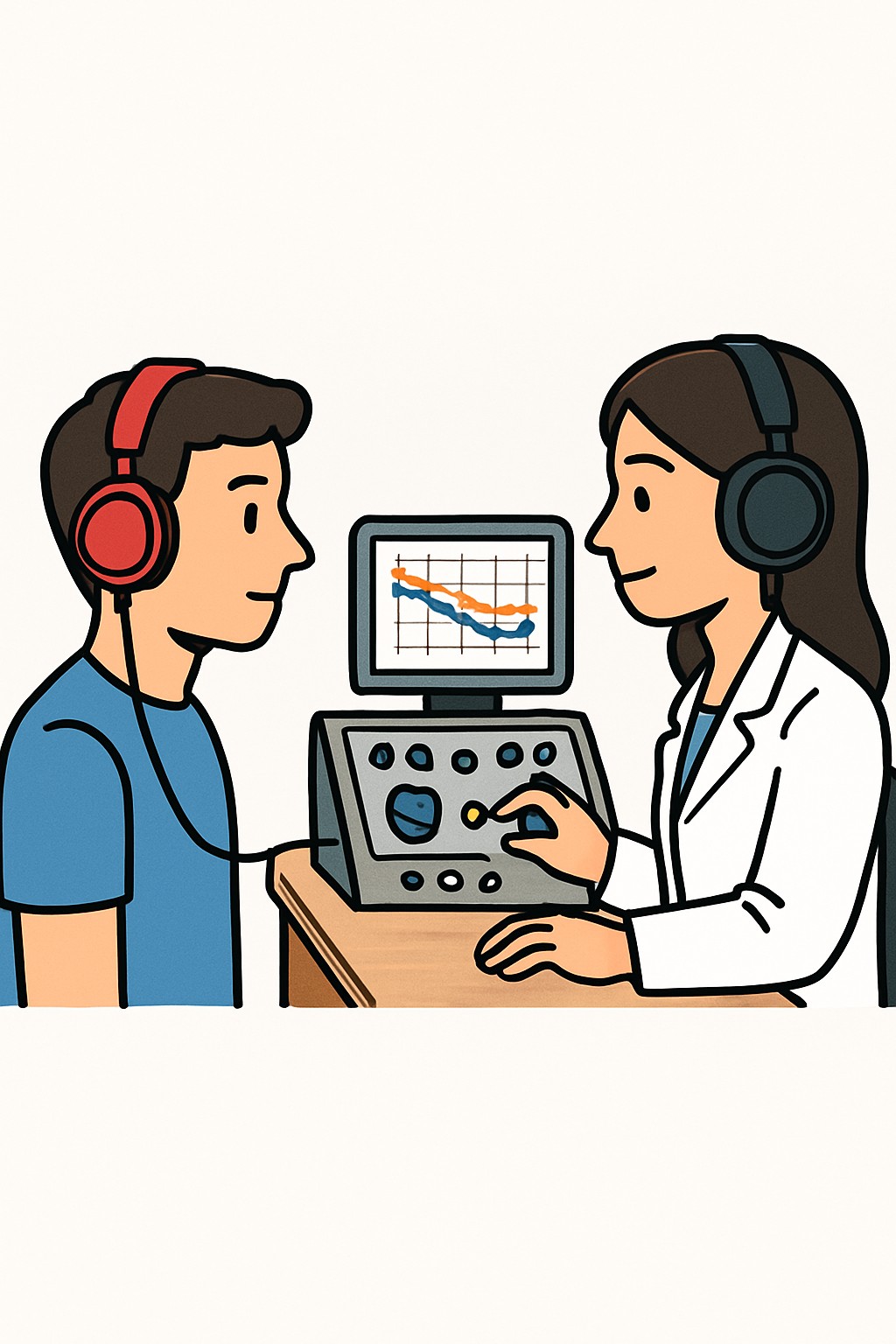
A comprehensive hearing test, also called diagnostic audiometry, is a detailed evaluation of how well you hear different tones and understand speech. It often includes pure-tone testing with headphones and a bone vibrator, speech tests, and middle ear checks like tympanometry. Clinicians use this test to identify the type and degree of hearing loss, check how the middle and inner ear are working, and help guide treatment options such as medical care, hearing protection, or hearing aids.
Also known as: Diagnostic audiometry, Comprehensive audiologic evaluation, Full hearing evaluation, Audiogram test
Preparation & Next Steps
Everything you need to know before and after your procedure
Before Care
- Bring a photo ID, insurance card, and any referral if required by your plan
- Bring your hearing aids, earmolds, and chargers so they can be checked with the test
- Carry a list of current medicines and any loud-noise exposures or ear surgeries
- Bring prior hearing test results or ear-related imaging if available
- Avoid inserting cotton swabs or objects into your ears before the visit
- Tell the clinic ahead of time if you need an interpreter or have mobility or sensory needs
- Remove large earrings, hats, or hair accessories that could interfere with headphones
- Plan for about 45–90 minutes, including check-in and testing in a quiet booth
- For young children, schedule when they are fed and rested, and bring a comfort item
After Care
- Resume normal activities; hearing tests are noninvasive
- Review your results and audiogram with the clinician and note any next steps
- Keep copies of the report for your records, school, or workplace if needed
- Protect your ears from loud sounds and consider hearing protection in noisy settings
- Contact a clinician if you notice new or worsening ear pain, drainage, sudden hearing change, severe dizziness, or persistent ringing
- If additional tests, earwax removal, or a hearing aid evaluation were recommended, schedule them
- Ask how to access your results through the patient portal
- For children, share results with school or early intervention programs if relevant
Clinical Information
Important medical details about this procedure
Indications
- Trouble hearing or understanding speech, especially in noise
- Tinnitus (ringing or buzzing in the ears)
- Ear fullness or pressure
- History of loud noise exposure
- Monitoring for medicines that can affect hearing
- Recurrent ear infections or fluid behind the eardrum
- Speech or language delay concerns
- Baseline or work-related hearing check when risk factors exist
Alternatives
- Basic hearing screening at a clinic, school, or workplace
- At-home or app-based hearing screening tools
- Otoacoustic emissions (OAE) screening
- Auditory brainstem response (ABR) testing when behavioral responses are not reliable
- Tympanometry or acoustic reflex screening as targeted checks
- Watchful waiting with symptom tracking for minor, non-urgent concerns
Risks
- No known serious risks from standard hearing tests
- Temporary discomfort from loud tones or ear inserts
- Brief pressure sensation or lightheadedness during tympanometry
- Fatigue from sustained attention
- Rare skin irritation from headbands, probes, or electrodes if used
Contraindications
- Active ear infection or severe ear pain may limit parts of testing
- Recent ear surgery or known eardrum perforation may defer tympanometry
- Inability to sit still or follow simple instructions for behavioral testing
- Significant earwax blockage preventing proper earphone or probe seal
Recovery Timeline
What to expect during your recovery
There is no medical recovery period for a comprehensive hearing test. Most people return to normal activities right away.
Typical Range
Same day
Return to Work
Same day
Recovery Milestones
Resume normal daily activities
Review results and plan next steps with the clinic
Complete any additional tests or hearing aid evaluations if scheduled
Frequently Asked Questions
Common questions and expert answers about this procedure
What happens during a comprehensive hearing test?
What happens during a comprehensive hearing test?
You sit in a sound-treated room and listen to tones through headphones and sometimes a bone vibrator, responding when you hear them. Speech tests, tympanometry, and other measures may also be done. Results are shown on an audiogram.
How long does the test take?
How long does the test take?
Many evaluations take about 30–60 minutes, but timing varies with the number of test components and your needs.
Does the test hurt?
Does the test hurt?
No. The test is noninvasive. Some people feel brief pressure in the ear during tympanometry or find certain tones loud or uncomfortable.
Who performs the test?
Who performs the test?
Licensed audiologists commonly perform or supervise diagnostic audiometry. Trained technicians may assist under supervision.
Do I need to prepare for the test?
Do I need to prepare for the test?
Usually no special preparation is needed. Bring your hearing aids and past records, avoid putting objects in your ears, and arrive a little early for check-in.
Can children or people who cannot respond be tested?
Can children or people who cannot respond be tested?
Yes. Audiologists use age-appropriate behavioral methods or objective tests like otoacoustic emissions and ABR when responses are not reliable.
What is the difference between a screening and a diagnostic test?
What is the difference between a screening and a diagnostic test?
A screening is a quick pass or fail check. A diagnostic test measures hearing in detail across pitches and speech to guide care.
How are results shared?
How are results shared?
You may receive a printed or electronic report with an audiogram and summary. Ask how to access it through your patient portal.
References
Medical literature and sources