%20--%3e%3csvg%20version='1.0'%20id='Layer_1'%20xmlns='http://www.w3.org/2000/svg'%20xmlns:xlink='http://www.w3.org/1999/xlink'%20x='0px'%20y='0px'%20viewBox='0%200%20755.52%20814.35'%20style='enable-background:new%200%200%20755.52%20814.35;'%20xml:space='preserve'%3e%3cstyle%20type='text/css'%3e%20.st0{fill:%231ae5ce;stroke:%231ae5ce;stroke-width:7;stroke-miterlimit:10;}%20.st1{fill:%23FFFFFF;stroke:%231ae5ce;stroke-width:7;stroke-miterlimit:10;}%20.st2{fill:%231ae5ce;stroke:%23FFFFFF;stroke-width:7;stroke-miterlimit:10;}%20.st3{fill:%23FFFFFF;stroke:%23FFFFFF;stroke-width:6;stroke-miterlimit:10;}%20%3c/style%3e%3cg%20id='Dark_Logo_00000159431215648494653180000015900878925932721032_'%3e%3cpath%20id='shield_00000152259091539869183100000001926543869452564382_'%20class='st0'%20d='M711.13,173.42%20c-3.37-49.07-38.92-44.9-75.96-52.18c-67.4-13.25-130.47-34.47-192.36-63.92c-22.48-10.7-41.88-25.74-65.05-26.28%20c-23.17,0.54-42.58,15.59-65.05,26.28c-61.89,29.45-124.95,50.68-192.36,63.92c-37.04,7.28-72.59,3.11-75.96,52.18%20c-1.55,22.6,0.34,46.4,1.05,68.92c5.99,190.78,52.91,345.39,206.27,466.46c29.71,23.46,74.51,55.8,108.84,70.75%20c5.99,2.61,11.7,3.73,17.21,3.75c5.51-0.02,11.22-1.14,17.21-3.75c34.33-14.95,79.12-47.3,108.84-70.75%20c153.37-121.07,200.28-275.68,206.27-466.46C710.79,219.82,712.68,196.02,711.13,173.42z'/%3e%3cpath%20id='magnifyingglass_00000073685934697636024790000000342567780940956808_'%20class='st1'%20d='M648.78,624.21l-96.64-104.65%20c34.89-40.63,55.98-93.46,55.98-151.21c0-128.27-103.98-232.24-232.24-232.24S143.63,240.08,143.63,368.35%20s103.98,232.24,232.24,232.24c48.87,0,94.21-15.11,131.62-40.89l97.18,105.24c11.25,12.18,30.24,12.93,42.42,1.69l0,0%20C659.27,655.38,660.03,636.39,648.78,624.21z'/%3e%3ccircle%20id='ellipse_00000129904010550392394720000017056154833629780114_'%20class='st2'%20cx='375.87'%20cy='368.35'%20r='181.21'/%3e%3cpath%20id='dollarsign_00000057140127156649725250000003772530148495155891_'%20class='st3'%20d='M362.91,492.03v-23.91%20c0-2.01-1.58-3.69-3.59-3.77c-18.49-0.78-37.12-5.4-49.4-11.83c-1.75-0.92-2.53-3.01-1.76-4.84l5.87-13.89%20c0.86-2.02,3.23-2.88,5.2-1.89c12.94,6.52,30.45,11.44,49.18,11.44c26.02,0,43.6-12.73,43.6-30.43c0-17.08-14.29-27.63-41.4-36.95%20c-37.37-12.42-60.46-26.7-60.46-53.72c0-24.97,20.29-44.11,52.22-49.51c1.8-0.31,3.11-1.89,3.11-3.72v-24.35%20c0-2.09,1.69-3.78,3.78-3.78h15.16c2.09,0,3.78,1.69,3.78,3.78v22.71c0,2.01,1.58,3.67,3.58,3.77c17.85,0.92,30.88,4.75,40.61,9.1%20c1.92,0.86,2.79,3.09,1.94,5.01l-6.08,13.6c-0.85,1.91-3.09,2.77-4.99,1.91c-8.37-3.8-22.38-8.95-42.75-8.95%20c-28.21,0-38.84,14.28-38.84,26.7c0,16.15,13.56,24.22,45.44,35.4c37.74,13.04,56.79,29.19,56.79,56.82%20c0,23.85-19.05,46.23-54.78,52.3c-1.8,0.31-3.11,1.89-3.11,3.72v25.28c0,2.09-1.69,3.78-3.78,3.78h-15.53%20C364.6,495.81,362.91,494.12,362.91,492.03z'/%3e%3c/g%3e%3c/svg%3e)
Diabetes care: HbA1c > 9% (poor control) Evaluation Management
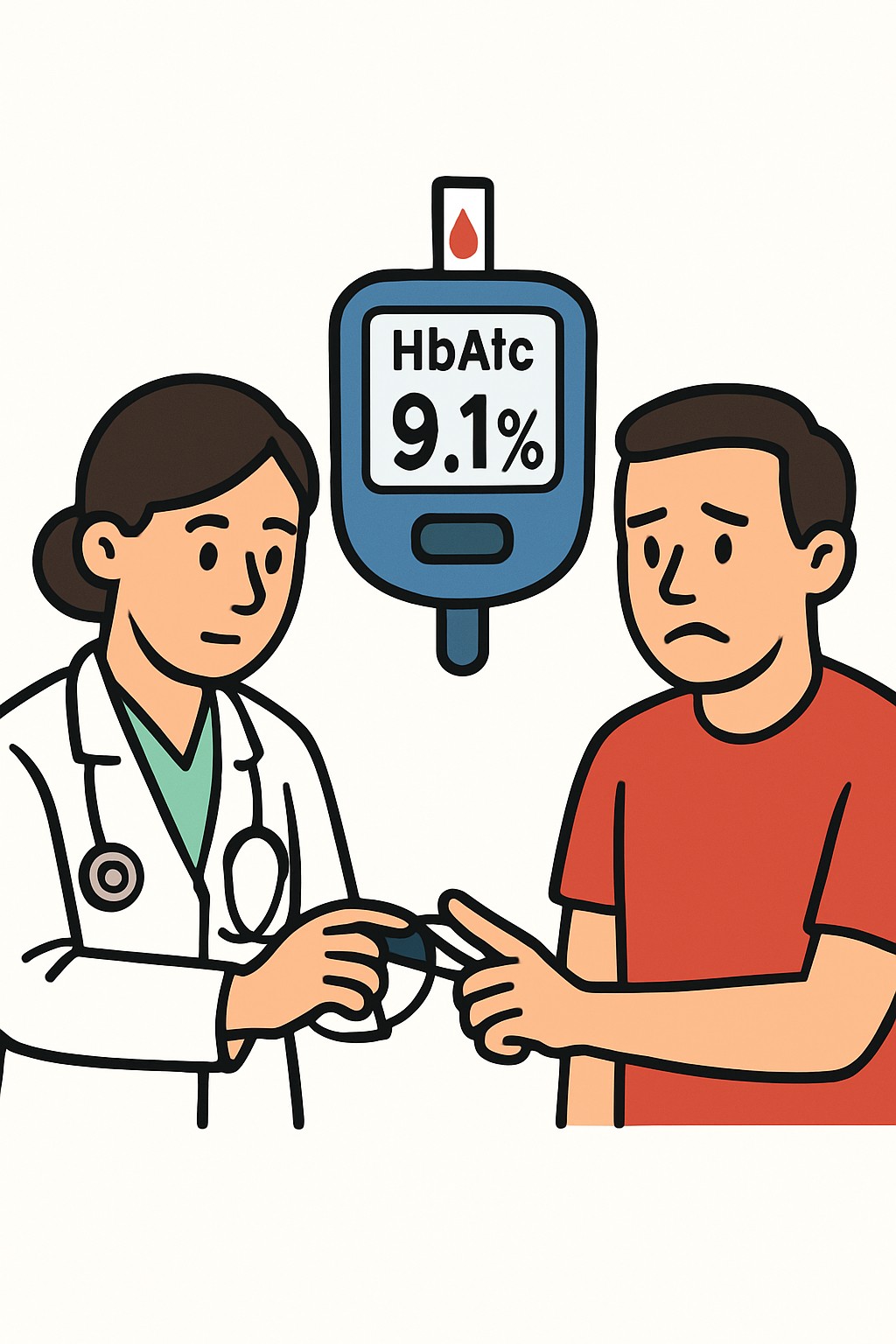
This page describes a care episode for diabetes when the hemoglobin A1C (HbA1c) is above 9%.
Overview
This page describes a care episode for diabetes when the hemoglobin A1C (HbA1c) is above 9%. A1C is a lab test that reflects average blood sugar over about the past 2 to 3 months. Values above 9% usually mean blood sugars have been high most of the time. Care at this level often includes a review of medicines, lifestyle, glucose data, and complications screening. The goal is to lower average glucose safely, reduce symptoms, and lower the risk of diabetes-related problems.
Also known as: A1C over 9%, Poorly controlled diabetes care, High A1C care
Preparation & Next Steps
Everything you need to know before and after your procedure
Before Care
- Bring your glucose meter or download reports from your continuous glucose monitor if you use one
- Bring a current list of all medicines and supplements, including doses and timing
- Have recent lab results available or give permission for the clinic to obtain them
- Write down recent symptoms, low or high readings, and any triggers you noticed
- List barriers you face, such as cost, side effects, food access, or schedule challenges
- Confirm insurance coverage and preferred pharmacy; ask about coverage for labs and supplies
- Follow any clinic or lab instructions about fasting or timed blood tests
- Consider bringing a support person who helps with your day-to-day care
- Ensure you have a way to take notes or access the patient portal
- If using devices, bring chargers, sensors, infusion sets, or pens for demonstration
After Care
- Review the care plan and any education materials provided by your care team
- Use medicines as prescribed and ask questions if instructions are unclear
- Track glucose readings and symptoms in a log or app; save reports for review
- Schedule follow-up; many plans check in within 1 to 4 weeks after changes
- Plan for repeat labs; A1C is commonly rechecked about every 3 months when not at goal
- Keep supplies on hand, including test strips or sensors, and check expiration dates
- Learn signs of low and high blood sugar and how your care team advises responding
- Complete routine screening that is often recommended, such as eye, foot, and kidney checks
- Contact a clinician about persistent very high or very low readings, ketones, vomiting, confusion, or trouble breathing
- Use secure messaging or phone calls to share concerns, barriers, or side effects
Clinical Information
Important medical details about this procedure
Indications
- Recent A1C lab result over 9%
- Frequent high home glucose readings
- Symptoms of high blood sugar such as thirst, frequent urination, or fatigue
- Diabetes complications or warnings (e.g., foot sores, vision changes)
- After illness, steroid treatment, or major life changes affecting glucose
- Missed doses or barriers to getting medicines or supplies
Alternatives
- Telehealth visits for medication review and education when appropriate
- Diabetes self-management education and support (DSMES) programs
- Medical nutrition therapy with a registered dietitian
- Medication adjustments or additions instead of device-based therapy
- Continuous glucose monitoring or more frequent fingerstick checks
- Group classes or peer support programs
Risks
- Low blood sugar episodes when treatment is intensified
- Side effects from diabetes medicines (such as stomach upset or weight changes)
- Injection site or sensor site irritation with devices
- Burden of frequent monitoring and appointments
- Potential costs for visits, labs, medicines, and supplies
Contraindications
- No absolute contraindications to receiving diabetes care
- Specific medicines may be unsuitable with severe kidney, liver, or heart conditions
- Treatment choices may differ during pregnancy
Recovery Timeline
What to expect during your recovery
There is no single recovery period. Diabetes management is ongoing. A1C reflects average glucose over the past 2 to 3 months, so changes in A1C typically appear over weeks to months.
Typical Range
Same day
Return to Work
Same day
Recovery Milestones
Set up glucose logging or device sharing; review the care plan
Follow-up visit or message to review glucose patterns and adjust the plan
Assess trends in average glucose; many plans target A1C recheck around 12 weeks
Frequently Asked Questions
Common questions and expert answers about this procedure
What does HbA1c over 9% mean?
What does HbA1c over 9% mean?
It indicates average blood sugar has been high for about the last 2 to 3 months. Many plans treat this as poor control that needs closer follow-up.
How is A1C different from daily glucose checks?
How is A1C different from daily glucose checks?
A1C is a long-term average. Fingersticks or continuous monitors show day-to-day and hour-to-hour changes.
How often is A1C checked when not at goal?
How often is A1C checked when not at goal?
It is commonly checked about every 3 months, especially when therapy changes or targets are not met.
What usually happens during a visit for A1C over 9%?
What usually happens during a visit for A1C over 9%?
The team reviews medicines, glucose data, lifestyle, and barriers, and may adjust treatment, provide education, and plan close follow-up.
Can lifestyle changes lower A1C?
Can lifestyle changes lower A1C?
Healthy eating patterns, physical activity, sleep, and stress management can help. Many people also need medication adjustments.
What is DSMES?
What is DSMES?
Diabetes self-management education and support. It teaches skills for daily care and problem-solving and can be delivered in person or virtually.
When is diabetes technology used?
When is diabetes technology used?
Continuous glucose monitors and, for some, insulin pumps are used to track patterns and adjust dosing. Coverage and suitability vary.
How quickly can A1C improve?
How quickly can A1C improve?
Because A1C reflects roughly 2 to 3 months, noticeable changes often appear after several weeks to a few months of consistent management.
References
Medical literature and sources