%20--%3e%3csvg%20version='1.0'%20id='Layer_1'%20xmlns='http://www.w3.org/2000/svg'%20xmlns:xlink='http://www.w3.org/1999/xlink'%20x='0px'%20y='0px'%20viewBox='0%200%20755.52%20814.35'%20style='enable-background:new%200%200%20755.52%20814.35;'%20xml:space='preserve'%3e%3cstyle%20type='text/css'%3e%20.st0{fill:%231ae5ce;stroke:%231ae5ce;stroke-width:7;stroke-miterlimit:10;}%20.st1{fill:%23FFFFFF;stroke:%231ae5ce;stroke-width:7;stroke-miterlimit:10;}%20.st2{fill:%231ae5ce;stroke:%23FFFFFF;stroke-width:7;stroke-miterlimit:10;}%20.st3{fill:%23FFFFFF;stroke:%23FFFFFF;stroke-width:6;stroke-miterlimit:10;}%20%3c/style%3e%3cg%20id='Dark_Logo_00000159431215648494653180000015900878925932721032_'%3e%3cpath%20id='shield_00000152259091539869183100000001926543869452564382_'%20class='st0'%20d='M711.13,173.42%20c-3.37-49.07-38.92-44.9-75.96-52.18c-67.4-13.25-130.47-34.47-192.36-63.92c-22.48-10.7-41.88-25.74-65.05-26.28%20c-23.17,0.54-42.58,15.59-65.05,26.28c-61.89,29.45-124.95,50.68-192.36,63.92c-37.04,7.28-72.59,3.11-75.96,52.18%20c-1.55,22.6,0.34,46.4,1.05,68.92c5.99,190.78,52.91,345.39,206.27,466.46c29.71,23.46,74.51,55.8,108.84,70.75%20c5.99,2.61,11.7,3.73,17.21,3.75c5.51-0.02,11.22-1.14,17.21-3.75c34.33-14.95,79.12-47.3,108.84-70.75%20c153.37-121.07,200.28-275.68,206.27-466.46C710.79,219.82,712.68,196.02,711.13,173.42z'/%3e%3cpath%20id='magnifyingglass_00000073685934697636024790000000342567780940956808_'%20class='st1'%20d='M648.78,624.21l-96.64-104.65%20c34.89-40.63,55.98-93.46,55.98-151.21c0-128.27-103.98-232.24-232.24-232.24S143.63,240.08,143.63,368.35%20s103.98,232.24,232.24,232.24c48.87,0,94.21-15.11,131.62-40.89l97.18,105.24c11.25,12.18,30.24,12.93,42.42,1.69l0,0%20C659.27,655.38,660.03,636.39,648.78,624.21z'/%3e%3ccircle%20id='ellipse_00000129904010550392394720000017056154833629780114_'%20class='st2'%20cx='375.87'%20cy='368.35'%20r='181.21'/%3e%3cpath%20id='dollarsign_00000057140127156649725250000003772530148495155891_'%20class='st3'%20d='M362.91,492.03v-23.91%20c0-2.01-1.58-3.69-3.59-3.77c-18.49-0.78-37.12-5.4-49.4-11.83c-1.75-0.92-2.53-3.01-1.76-4.84l5.87-13.89%20c0.86-2.02,3.23-2.88,5.2-1.89c12.94,6.52,30.45,11.44,49.18,11.44c26.02,0,43.6-12.73,43.6-30.43c0-17.08-14.29-27.63-41.4-36.95%20c-37.37-12.42-60.46-26.7-60.46-53.72c0-24.97,20.29-44.11,52.22-49.51c1.8-0.31,3.11-1.89,3.11-3.72v-24.35%20c0-2.09,1.69-3.78,3.78-3.78h15.16c2.09,0,3.78,1.69,3.78,3.78v22.71c0,2.01,1.58,3.67,3.58,3.77c17.85,0.92,30.88,4.75,40.61,9.1%20c1.92,0.86,2.79,3.09,1.94,5.01l-6.08,13.6c-0.85,1.91-3.09,2.77-4.99,1.91c-8.37-3.8-22.38-8.95-42.75-8.95%20c-28.21,0-38.84,14.28-38.84,26.7c0,16.15,13.56,24.22,45.44,35.4c37.74,13.04,56.79,29.19,56.79,56.82%20c0,23.85-19.05,46.23-54.78,52.3c-1.8,0.31-3.11,1.89-3.11,3.72v25.28c0,2.09-1.69,3.78-3.78,3.78h-15.53%20C364.6,495.81,362.91,494.12,362.91,492.03z'/%3e%3c/g%3e%3c/svg%3e)
Domiciliary/rest home visit (high complexity) Evaluation Management
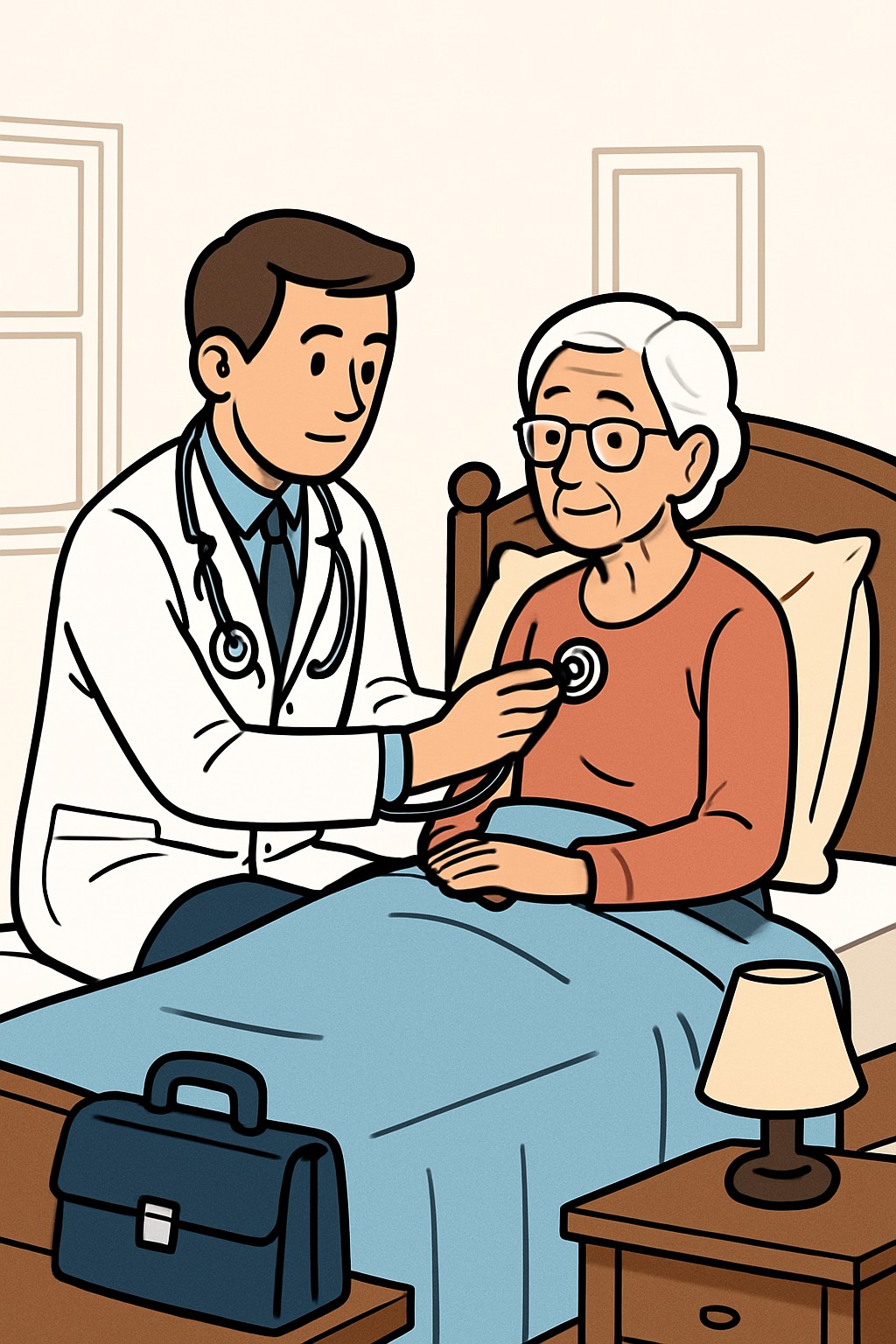
A domiciliary or rest home visit is a medical evaluation performed by a clinician at a patient’s residence, such as an assisted living facility, group home, or custodial care home.
Overview
A domiciliary or rest home visit is a medical evaluation performed by a clinician at a patient’s residence, such as an assisted living facility, group home, or custodial care home. High complexity refers to the level of medical decision making. It involves managing serious or multiple conditions, reviewing extensive data, and addressing higher risk treatments or decisions. During this visit, the clinician reviews concerns, checks vital signs, performs a focused exam, reviews medicines, communicates with caregivers or facility staff, and updates the care plan. Tests may be ordered if needed, and follow-up arrangements are discussed.
Also known as: Home or residence visit (high complexity), Domiciliary visit, Rest home visit, Home medical visit
Preparation & Next Steps
Everything you need to know before and after your procedure
Before Care
- Confirm the visit date, time, and location details with the clinic or facility
- Have an up-to-date list of all medicines and supplements with doses and schedules
- Write down your top questions and a brief timeline of key symptoms
- Gather recent test results, hospital discharge papers, and device readings like blood pressure or glucose logs
- Prepare allergy information and any prior reactions to medicines or vaccines
- Have ID, insurance details, preferred pharmacy, and caregiver contact information available
- Set up a quiet, well-lit space for the exam and secure pets to minimize interruptions
- Have hearing aids, glasses, mobility aids, and device chargers ready
- Bring advance directives or medical orders if available, such as a POLST form
- Follow any instructions provided by the clinic about fasting, timing of medicines, or vitals logs
After Care
- Review the visit summary and care plan, including any changes to medicines
- Arrange ordered tests, imaging, or referrals and note due dates
- Coordinate with facility staff or caregivers so the plan is carried out
- Track symptoms, side effects, and vital signs as requested and keep a simple log
- Use the patient portal or clinic phone for questions or clarifications
- Keep copies of new prescriptions, orders, and results with your health records
- Know who to contact for after-hours concerns related to the visit
- Contact a clinician if you notice medication side effects, rapid health changes, or new concerning symptoms
- Schedule follow-up visits as outlined in the plan
- Check your insurance benefits for any ordered services to understand potential costs
Clinical Information
Important medical details about this procedure
Indications
- Difficulty traveling to a clinic due to mobility or transportation limits
- Complex chronic conditions that need in-person assessment at the residence
- Recent hospital or rehab discharge requiring close follow-up
- Medication reconciliation and management with caregiver support
- Cognitive or functional limitations that affect clinic visits
- Care coordination with facility staff for safety or symptom changes
Alternatives
- Clinic office visit
- Telehealth video or phone visit when appropriate
- Urgent care or same-day clinic for time-sensitive but non-emergency issues
- Nursing visit through a home health agency for skilled nursing needs
- Remote monitoring programs for tracking vitals between visits
Risks
- Limited on-site diagnostics compared to a clinic
- Miscommunication if goals, medicines, or next steps are unclear
- Privacy concerns in shared living settings
- Scheduling delays or interruptions in the residence
- Potential out-of-pocket costs depending on coverage and benefits
Contraindications
- Severe or rapidly worsening symptoms that require emergency care
- Unsafe environment for a clinician to enter
- Active contagious illness without available infection control measures
- Patient unavailable or unwilling to participate and no authorized caregiver present
- Facility policies that restrict outside clinician visits
Recovery Timeline
What to expect during your recovery
There is no medical recovery period from the visit itself. Most people continue normal activities right away. Follow-up steps depend on the care plan and any tests or referrals.
Typical Range
Same day
Return to Work
Same day
Recovery Milestones
Resume normal daily activities
Complete any same-day or next-day labs or scheduling tasks if ordered
Review results, confirm follow-up appointments, and update the care plan with the clinician or facility staff
Frequently Asked Questions
Common questions and expert answers about this procedure
What is a domiciliary or rest home visit?
What is a domiciliary or rest home visit?
It is a medical evaluation done by a clinician at a person’s residence, such as an assisted living, group home, or custodial care facility.
What does high complexity mean?
What does high complexity mean?
High complexity means the clinician manages serious or multiple conditions, reviews extensive data, and addresses higher risk treatments or decisions.
Who performs this visit?
Who performs this visit?
Physicians, nurse practitioners, or physician assistants commonly perform these visits. Facility staff may help with information and coordination.
How long does the visit take?
How long does the visit take?
Time varies based on needs. It includes face-to-face evaluation plus related work like reviewing records and documenting the plan.
What happens during the visit?
What happens during the visit?
The clinician reviews concerns, checks vitals, does a focused exam, reviews medicines, coordinates with caregivers, and creates or updates a care plan.
Can this be done by telehealth?
Can this be done by telehealth?
Some follow-up and discussion can be done by video or phone. A physical exam or procedures may still require an in-person visit.
Will tests be done during the visit?
Will tests be done during the visit?
Basic point-of-care tests may be done if available. Other labs or imaging are usually ordered and completed later.
How are costs handled?
How are costs handled?
Costs depend on your insurance, the place of service, and any tests. Check your benefits and ask the clinic or facility about expected charges.