%20--%3e%3csvg%20version='1.0'%20id='Layer_1'%20xmlns='http://www.w3.org/2000/svg'%20xmlns:xlink='http://www.w3.org/1999/xlink'%20x='0px'%20y='0px'%20viewBox='0%200%20755.52%20814.35'%20style='enable-background:new%200%200%20755.52%20814.35;'%20xml:space='preserve'%3e%3cstyle%20type='text/css'%3e%20.st0{fill:%231ae5ce;stroke:%231ae5ce;stroke-width:7;stroke-miterlimit:10;}%20.st1{fill:%23FFFFFF;stroke:%231ae5ce;stroke-width:7;stroke-miterlimit:10;}%20.st2{fill:%231ae5ce;stroke:%23FFFFFF;stroke-width:7;stroke-miterlimit:10;}%20.st3{fill:%23FFFFFF;stroke:%23FFFFFF;stroke-width:6;stroke-miterlimit:10;}%20%3c/style%3e%3cg%20id='Dark_Logo_00000159431215648494653180000015900878925932721032_'%3e%3cpath%20id='shield_00000152259091539869183100000001926543869452564382_'%20class='st0'%20d='M711.13,173.42%20c-3.37-49.07-38.92-44.9-75.96-52.18c-67.4-13.25-130.47-34.47-192.36-63.92c-22.48-10.7-41.88-25.74-65.05-26.28%20c-23.17,0.54-42.58,15.59-65.05,26.28c-61.89,29.45-124.95,50.68-192.36,63.92c-37.04,7.28-72.59,3.11-75.96,52.18%20c-1.55,22.6,0.34,46.4,1.05,68.92c5.99,190.78,52.91,345.39,206.27,466.46c29.71,23.46,74.51,55.8,108.84,70.75%20c5.99,2.61,11.7,3.73,17.21,3.75c5.51-0.02,11.22-1.14,17.21-3.75c34.33-14.95,79.12-47.3,108.84-70.75%20c153.37-121.07,200.28-275.68,206.27-466.46C710.79,219.82,712.68,196.02,711.13,173.42z'/%3e%3cpath%20id='magnifyingglass_00000073685934697636024790000000342567780940956808_'%20class='st1'%20d='M648.78,624.21l-96.64-104.65%20c34.89-40.63,55.98-93.46,55.98-151.21c0-128.27-103.98-232.24-232.24-232.24S143.63,240.08,143.63,368.35%20s103.98,232.24,232.24,232.24c48.87,0,94.21-15.11,131.62-40.89l97.18,105.24c11.25,12.18,30.24,12.93,42.42,1.69l0,0%20C659.27,655.38,660.03,636.39,648.78,624.21z'/%3e%3ccircle%20id='ellipse_00000129904010550392394720000017056154833629780114_'%20class='st2'%20cx='375.87'%20cy='368.35'%20r='181.21'/%3e%3cpath%20id='dollarsign_00000057140127156649725250000003772530148495155891_'%20class='st3'%20d='M362.91,492.03v-23.91%20c0-2.01-1.58-3.69-3.59-3.77c-18.49-0.78-37.12-5.4-49.4-11.83c-1.75-0.92-2.53-3.01-1.76-4.84l5.87-13.89%20c0.86-2.02,3.23-2.88,5.2-1.89c12.94,6.52,30.45,11.44,49.18,11.44c26.02,0,43.6-12.73,43.6-30.43c0-17.08-14.29-27.63-41.4-36.95%20c-37.37-12.42-60.46-26.7-60.46-53.72c0-24.97,20.29-44.11,52.22-49.51c1.8-0.31,3.11-1.89,3.11-3.72v-24.35%20c0-2.09,1.69-3.78,3.78-3.78h15.16c2.09,0,3.78,1.69,3.78,3.78v22.71c0,2.01,1.58,3.67,3.58,3.77c17.85,0.92,30.88,4.75,40.61,9.1%20c1.92,0.86,2.79,3.09,1.94,5.01l-6.08,13.6c-0.85,1.91-3.09,2.77-4.99,1.91c-8.37-3.8-22.38-8.95-42.75-8.95%20c-28.21,0-38.84,14.28-38.84,26.7c0,16.15,13.56,24.22,45.44,35.4c37.74,13.04,56.79,29.19,56.79,56.82%20c0,23.85-19.05,46.23-54.78,52.3c-1.8,0.31-3.11,1.89-3.11,3.72v25.28c0,2.09-1.69,3.78-3.78,3.78h-15.53%20C364.6,495.81,362.91,494.12,362.91,492.03z'/%3e%3c/g%3e%3c/svg%3e)
Domiciliary visit (established patient - moderate) Evaluation Management
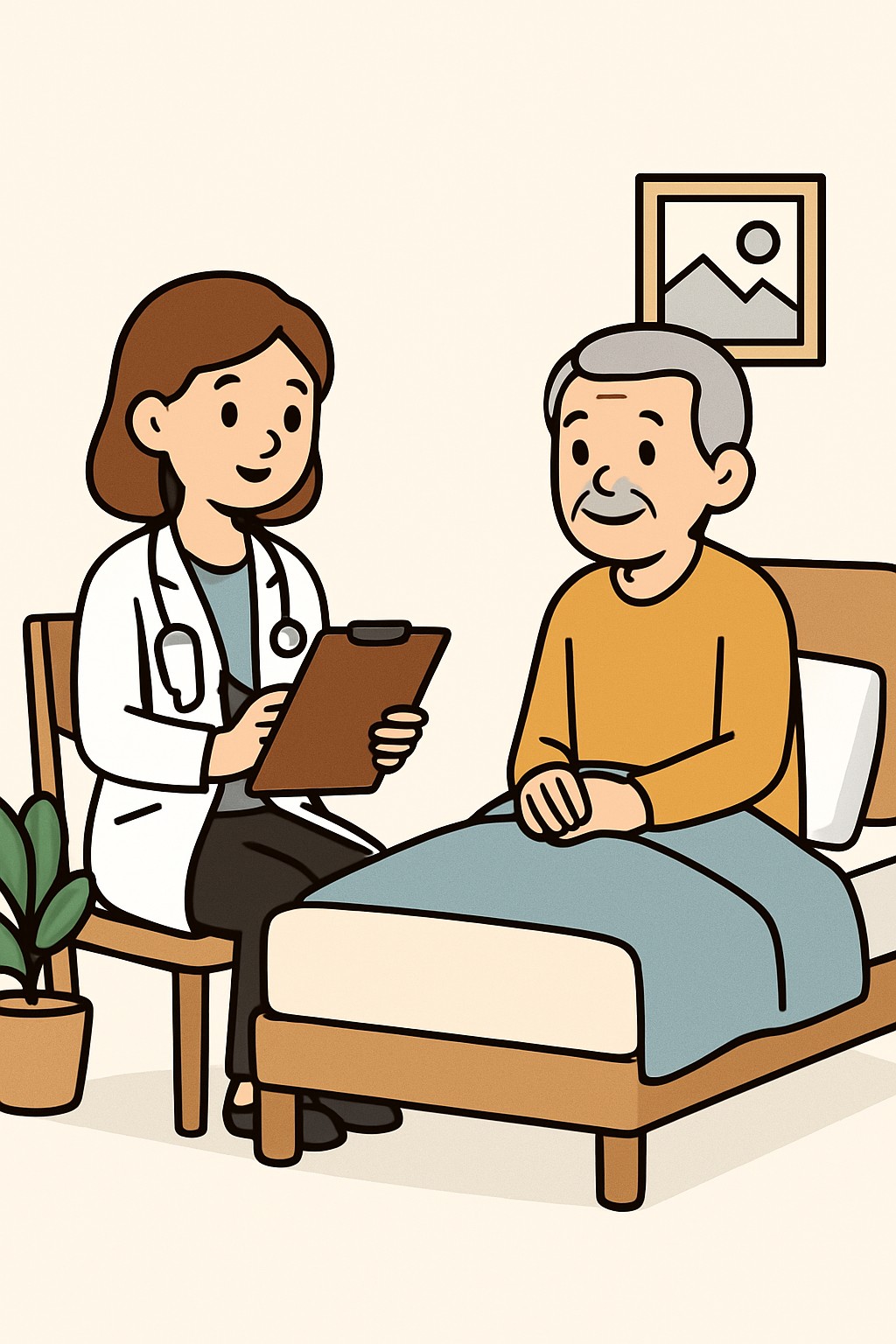
A domiciliary visit is a medical visit that happens where you live, such as a private home, assisted living, group home, or similar residence.
Overview
A domiciliary visit is a medical visit that happens where you live, such as a private home, assisted living, group home, or similar residence. It is designed for people who have trouble traveling or who benefit from care in their usual living setting. Established patient means you have been seen by the same practice and specialty within the last three years. Moderate describes the level of decision making and management typically needed, such as handling multiple conditions, adjusting medicines, and coordinating services.
Also known as: Home visit, Residence visit, House call, Rest home visit
Preparation & Next Steps
Everything you need to know before and after your procedure
Before Care
- Confirm the appointment window, address details, parking or entry instructions, and a reliable contact number
- Secure pets, clear pathways, and ensure good lighting and a chair or space for the exam
- Gather all medicines and supplements, or have bottles and an up-to-date medication list ready
- Prepare a short list of your top concerns, goals, and recent changes in symptoms
- Have recent hospital or rehab discharge papers, test results, and device readings available
- Identify a caregiver or support person who can join or be available by phone if needed
- List allergies and prior reactions to medicines or vaccines
- Have your photo ID, insurance card, and a payment method if a copay applies
- Set aside hearing aids, glasses, or mobility devices you use daily
- Follow any clinic instructions provided ahead of time, such as fasting if a lab draw is planned
After Care
- Review the visit summary and care plan and note any tests, referrals, or follow-up steps
- Update your medication list with any changes and keep it in an easy-to-find place
- Arrange lab work, imaging, or therapy visits as ordered
- Set reminders for follow-up appointments or phone check-ins
- Track symptoms, vital signs, and side effects to discuss at the next visit
- Keep home safety changes in place, such as clear walkways or grab bars
- Expect contact from home health or community services if they were ordered
- Contact the clinic about worsening symptoms, new concerning symptoms, or problems with medicines or equipment
- Keep copies of bills and receipts and check insurance benefits for any ordered services
Clinical Information
Important medical details about this procedure
Indications
- Difficulty traveling to a clinic due to mobility limits, frailty, or disability
- Ongoing management of chronic conditions
- Recent hospital or rehab discharge follow-up
- Medication review and reconciliation
- New or worsening symptoms in the home setting
- Home safety assessment or falls evaluation
- Cognitive impairment needing caregiver input
- Palliative or supportive care check-ins
Alternatives
- Clinic or office visit
- Telehealth video or phone visit when appropriate
- Urgent care center for minor, time-sensitive issues
- Nurse or therapist home health visit for specific services
Risks
- Limited on-site testing and procedures compared to a clinic
- Delays if records, medicines, or equipment are not available at home
- Privacy concerns in shared living spaces
- Potential out-of-pocket costs depending on coverage
- Care interruptions due to home distractions or environment
Contraindications
- Severe or life-threatening symptoms that require emergency care
- An unsafe environment for the care team
- Highly contagious illness without prior notice to the clinic
- Lack of consent from the patient or legal representative
Recovery Timeline
What to expect during your recovery
There is no medical recovery period for a domiciliary visit. Most people continue normal activities right away after the visit.
Typical Range
Same day
Return to Work
Same day
Recovery Milestones
Resume usual daily activities at home
Complete any same-day or next-day labs, referrals, or medication changes that were ordered
Review results and confirm the follow-up plan with the clinic if needed
Frequently Asked Questions
Common questions and expert answers about this procedure
What is a domiciliary visit?
What is a domiciliary visit?
It is a medical visit done at your place of residence, such as a private home, assisted living, or group home.
What does established patient mean?
What does established patient mean?
It generally means you were seen by a clinician in the same practice and specialty within the last 3 years.
What does moderate refer to?
What does moderate refer to?
It refers to a moderate level of medical decision making, such as managing multiple conditions, reviewing medicines, and coordinating care.
How long does a domiciliary visit usually take?
How long does a domiciliary visit usually take?
Visit length varies based on your needs and the clinician's assessment. The total time includes history, exam, counseling, and documentation.
Who can perform this visit?
Who can perform this visit?
Physicians, nurse practitioners, or physician assistants commonly provide home or residence visits. A care team member may assist.
What happens during the visit?
What happens during the visit?
The clinician reviews your concerns and history, checks vital signs and a focused exam, reconciles medicines, assesses home safety, and plans next steps.
Can tests or treatments be done at home?
Can tests or treatments be done at home?
Some basic tests and treatments can be done during a home visit. Others may be scheduled at a lab, imaging center, or clinic.
How are costs determined?
How are costs determined?
Costs depend on your insurance plan, network status, and any tests or services ordered. Ask the clinic and check your benefits.