%20--%3e%3csvg%20version='1.0'%20id='Layer_1'%20xmlns='http://www.w3.org/2000/svg'%20xmlns:xlink='http://www.w3.org/1999/xlink'%20x='0px'%20y='0px'%20viewBox='0%200%20755.52%20814.35'%20style='enable-background:new%200%200%20755.52%20814.35;'%20xml:space='preserve'%3e%3cstyle%20type='text/css'%3e%20.st0{fill:%231ae5ce;stroke:%231ae5ce;stroke-width:7;stroke-miterlimit:10;}%20.st1{fill:%23FFFFFF;stroke:%231ae5ce;stroke-width:7;stroke-miterlimit:10;}%20.st2{fill:%231ae5ce;stroke:%23FFFFFF;stroke-width:7;stroke-miterlimit:10;}%20.st3{fill:%23FFFFFF;stroke:%23FFFFFF;stroke-width:6;stroke-miterlimit:10;}%20%3c/style%3e%3cg%20id='Dark_Logo_00000159431215648494653180000015900878925932721032_'%3e%3cpath%20id='shield_00000152259091539869183100000001926543869452564382_'%20class='st0'%20d='M711.13,173.42%20c-3.37-49.07-38.92-44.9-75.96-52.18c-67.4-13.25-130.47-34.47-192.36-63.92c-22.48-10.7-41.88-25.74-65.05-26.28%20c-23.17,0.54-42.58,15.59-65.05,26.28c-61.89,29.45-124.95,50.68-192.36,63.92c-37.04,7.28-72.59,3.11-75.96,52.18%20c-1.55,22.6,0.34,46.4,1.05,68.92c5.99,190.78,52.91,345.39,206.27,466.46c29.71,23.46,74.51,55.8,108.84,70.75%20c5.99,2.61,11.7,3.73,17.21,3.75c5.51-0.02,11.22-1.14,17.21-3.75c34.33-14.95,79.12-47.3,108.84-70.75%20c153.37-121.07,200.28-275.68,206.27-466.46C710.79,219.82,712.68,196.02,711.13,173.42z'/%3e%3cpath%20id='magnifyingglass_00000073685934697636024790000000342567780940956808_'%20class='st1'%20d='M648.78,624.21l-96.64-104.65%20c34.89-40.63,55.98-93.46,55.98-151.21c0-128.27-103.98-232.24-232.24-232.24S143.63,240.08,143.63,368.35%20s103.98,232.24,232.24,232.24c48.87,0,94.21-15.11,131.62-40.89l97.18,105.24c11.25,12.18,30.24,12.93,42.42,1.69l0,0%20C659.27,655.38,660.03,636.39,648.78,624.21z'/%3e%3ccircle%20id='ellipse_00000129904010550392394720000017056154833629780114_'%20class='st2'%20cx='375.87'%20cy='368.35'%20r='181.21'/%3e%3cpath%20id='dollarsign_00000057140127156649725250000003772530148495155891_'%20class='st3'%20d='M362.91,492.03v-23.91%20c0-2.01-1.58-3.69-3.59-3.77c-18.49-0.78-37.12-5.4-49.4-11.83c-1.75-0.92-2.53-3.01-1.76-4.84l5.87-13.89%20c0.86-2.02,3.23-2.88,5.2-1.89c12.94,6.52,30.45,11.44,49.18,11.44c26.02,0,43.6-12.73,43.6-30.43c0-17.08-14.29-27.63-41.4-36.95%20c-37.37-12.42-60.46-26.7-60.46-53.72c0-24.97,20.29-44.11,52.22-49.51c1.8-0.31,3.11-1.89,3.11-3.72v-24.35%20c0-2.09,1.69-3.78,3.78-3.78h15.16c2.09,0,3.78,1.69,3.78,3.78v22.71c0,2.01,1.58,3.67,3.58,3.77c17.85,0.92,30.88,4.75,40.61,9.1%20c1.92,0.86,2.79,3.09,1.94,5.01l-6.08,13.6c-0.85,1.91-3.09,2.77-4.99,1.91c-8.37-3.8-22.38-8.95-42.75-8.95%20c-28.21,0-38.84,14.28-38.84,26.7c0,16.15,13.56,24.22,45.44,35.4c37.74,13.04,56.79,29.19,56.79,56.82%20c0,23.85-19.05,46.23-54.78,52.3c-1.8,0.31-3.11,1.89-3.11,3.72v25.28c0,2.09-1.69,3.78-3.78,3.78h-15.53%20C364.6,495.81,362.91,494.12,362.91,492.03z'/%3e%3c/g%3e%3c/svg%3e)
Emergency department visit (Level 3) Evaluation Management
An emergency department visit at Level 3 is a mid-level evaluation and treatment in a hospital emergency department.
Overview
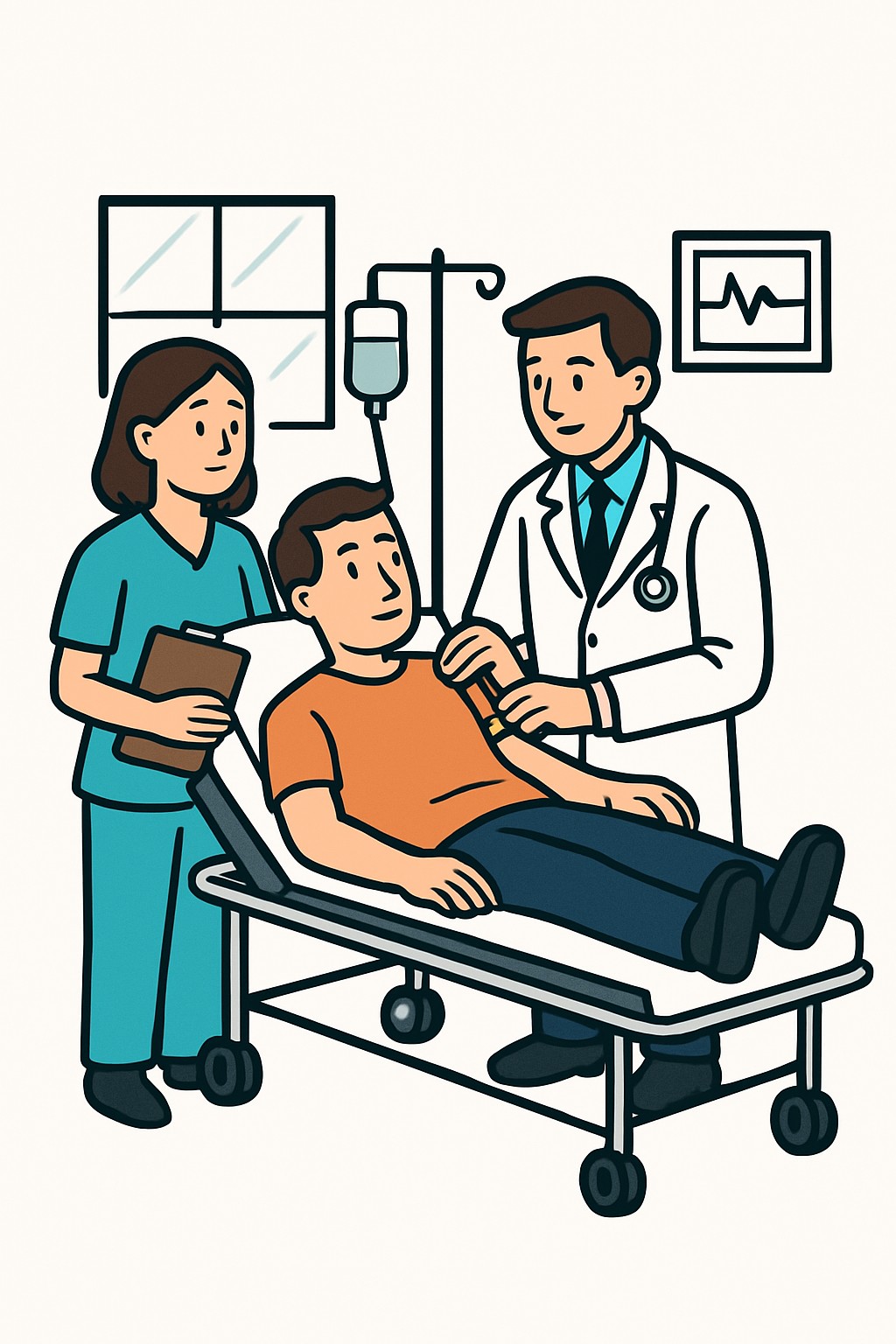
An emergency department visit at Level 3 is a mid-level evaluation and treatment in a hospital emergency department. It typically involves a focused history and exam, monitoring, and tests or treatments that go beyond very simple care but are not the most complex. People are seen for urgent problems that should be addressed the same day, such as moderate pain, injuries, breathing or dehydration concerns, or worsening symptoms of ongoing conditions. The level reflects the complexity of care documented by the clinical team, not the triage category or how long someone waited.
Also known as: ED visit level 3, ER visit level 3, Emergency room visit level 3
Preparation & Next Steps
Everything you need to know before and after your procedure
Before Care
- Bring a photo ID, insurance card, and a payment method if costs may apply
- Carry a current list of medicines and supplements with doses and timing
- List allergies and prior reactions to medicines, contrast, or latex
- Note key symptoms, when they started, and any triggers or treatments tried
- Bring recent test results, imaging reports, or discharge papers if available
- Have contact information for your primary care and specialists
- Bring a phone charger and essential personal items only
- Arrange safe transport and a way to get home after evaluation
- Bring emergency contacts and any advance directive documents
- Use the patient portal or keep notes to track what happens during the visit
After Care
- Review discharge instructions and the medication list provided by the emergency department
- Fill any new prescriptions and follow the written instructions from the visit
- Schedule follow up with your primary care or specialist as the paperwork suggests
- Complete any ordered tests or imaging that could not be done during the visit
- Track symptoms, temperature, and fluid intake if relevant, and bring notes to follow up
- Care for wounds or splints as instructed and keep materials clean and dry
- Use the portal or phone to ask the department or clinic to clarify instructions
- Contact a clinician if symptoms worsen, do not improve, or new concerning symptoms appear
- Keep copies of your visit summary, test results, and imaging reports
- Review insurance statements and ask the hospital about any billing questions
Clinical Information
Important medical details about this procedure
Indications
- Moderate abdominal pain, vomiting, or dehydration
- Asthma flare or breathing trouble without severe distress
- Cuts that may need stitches or wound care
- Sprains, possible fractures, or moderate injuries
- Urinary symptoms with fever or flank pain
- Migraine or severe headache not improved with home care
- Moderate allergic reaction without airway compromise
- Fever with concerning symptoms or underlying conditions
Alternatives
- Urgent care clinic for minor to moderate issues when available
- Primary care or same day clinic appointment
- Telehealth visit for evaluation when a physical exam is not required
- Nurse advice line for guidance on next steps
- Retail clinic for simple illnesses or minor injuries
- Self-care with over the counter medicines for mild, improving symptoms
Risks
- Long waits based on crowding and case severity
- Exposure to infectious illnesses in shared spaces
- Out of pocket costs including facility and professional fees
- Testing risks such as radiation from imaging or contrast reactions
- False positive or false negative test results
- Procedural discomfort from blood draws or IV placement
- Possible observation stay or admission with added costs
Recovery Timeline
What to expect during your recovery
There is usually no recovery period from the visit itself. Return to normal activities often depends on the underlying condition and any treatments received.
Typical Range
Same day
Return to Work
0–2 days
Recovery Milestones
Resume light daily activities as tolerated
Review discharge instructions and confirm follow up plans
Complete pending labs or imaging if ordered
Monitor symptoms and document changes to discuss at follow up
Frequently Asked Questions
Common questions and expert answers about this procedure
What does Level 3 mean in the emergency department?
What does Level 3 mean in the emergency department?
It indicates a mid-level visit based on the complexity of evaluation and treatment documented by the clinical team. It is more involved than the simplest visits but less complex than the highest levels.
Is the level based on triage or how long I waited?
Is the level based on triage or how long I waited?
No. Triage sorts arrivals by urgency. The billed level reflects the complexity of care provided and documented, not wait time.
What typically happens during a Level 3 visit?
What typically happens during a Level 3 visit?
A clinician reviews your history and symptoms, performs an exam, and may order tests such as labs or X rays. Treatment like medicines, fluids, or wound care may be given.
How long will a Level 3 visit take?
How long will a Level 3 visit take?
Time varies with crowding, test turnaround, and your condition. Many visits take several hours, especially if imaging or observation is needed.
Will I get tests or imaging?
Will I get tests or imaging?
Tests are ordered when they help answer the clinical question. Common examples include blood or urine tests and plain X rays.
Can a Level 3 visit become a higher level?
Can a Level 3 visit become a higher level?
Yes. If your condition changes or more complex care is required, the documented level may be higher. If it is simpler than expected, it may be lower.
How is the emergency department different from urgent care?
How is the emergency department different from urgent care?
Emergency departments are open 24 7, can handle severe or complex conditions, and offer advanced testing and specialists. Urgent care centers handle minor to moderate issues and have limited resources.
What costs should I expect?
What costs should I expect?
Charges often include a hospital facility fee and professional fees. Your out of pocket cost depends on your insurance benefits, network status, and any tests or treatments.
References
Medical literature and sources