%20--%3e%3csvg%20version='1.0'%20id='Layer_1'%20xmlns='http://www.w3.org/2000/svg'%20xmlns:xlink='http://www.w3.org/1999/xlink'%20x='0px'%20y='0px'%20viewBox='0%200%20755.52%20814.35'%20style='enable-background:new%200%200%20755.52%20814.35;'%20xml:space='preserve'%3e%3cstyle%20type='text/css'%3e%20.st0{fill:%231ae5ce;stroke:%231ae5ce;stroke-width:7;stroke-miterlimit:10;}%20.st1{fill:%23FFFFFF;stroke:%231ae5ce;stroke-width:7;stroke-miterlimit:10;}%20.st2{fill:%231ae5ce;stroke:%23FFFFFF;stroke-width:7;stroke-miterlimit:10;}%20.st3{fill:%23FFFFFF;stroke:%23FFFFFF;stroke-width:6;stroke-miterlimit:10;}%20%3c/style%3e%3cg%20id='Dark_Logo_00000159431215648494653180000015900878925932721032_'%3e%3cpath%20id='shield_00000152259091539869183100000001926543869452564382_'%20class='st0'%20d='M711.13,173.42%20c-3.37-49.07-38.92-44.9-75.96-52.18c-67.4-13.25-130.47-34.47-192.36-63.92c-22.48-10.7-41.88-25.74-65.05-26.28%20c-23.17,0.54-42.58,15.59-65.05,26.28c-61.89,29.45-124.95,50.68-192.36,63.92c-37.04,7.28-72.59,3.11-75.96,52.18%20c-1.55,22.6,0.34,46.4,1.05,68.92c5.99,190.78,52.91,345.39,206.27,466.46c29.71,23.46,74.51,55.8,108.84,70.75%20c5.99,2.61,11.7,3.73,17.21,3.75c5.51-0.02,11.22-1.14,17.21-3.75c34.33-14.95,79.12-47.3,108.84-70.75%20c153.37-121.07,200.28-275.68,206.27-466.46C710.79,219.82,712.68,196.02,711.13,173.42z'/%3e%3cpath%20id='magnifyingglass_00000073685934697636024790000000342567780940956808_'%20class='st1'%20d='M648.78,624.21l-96.64-104.65%20c34.89-40.63,55.98-93.46,55.98-151.21c0-128.27-103.98-232.24-232.24-232.24S143.63,240.08,143.63,368.35%20s103.98,232.24,232.24,232.24c48.87,0,94.21-15.11,131.62-40.89l97.18,105.24c11.25,12.18,30.24,12.93,42.42,1.69l0,0%20C659.27,655.38,660.03,636.39,648.78,624.21z'/%3e%3ccircle%20id='ellipse_00000129904010550392394720000017056154833629780114_'%20class='st2'%20cx='375.87'%20cy='368.35'%20r='181.21'/%3e%3cpath%20id='dollarsign_00000057140127156649725250000003772530148495155891_'%20class='st3'%20d='M362.91,492.03v-23.91%20c0-2.01-1.58-3.69-3.59-3.77c-18.49-0.78-37.12-5.4-49.4-11.83c-1.75-0.92-2.53-3.01-1.76-4.84l5.87-13.89%20c0.86-2.02,3.23-2.88,5.2-1.89c12.94,6.52,30.45,11.44,49.18,11.44c26.02,0,43.6-12.73,43.6-30.43c0-17.08-14.29-27.63-41.4-36.95%20c-37.37-12.42-60.46-26.7-60.46-53.72c0-24.97,20.29-44.11,52.22-49.51c1.8-0.31,3.11-1.89,3.11-3.72v-24.35%20c0-2.09,1.69-3.78,3.78-3.78h15.16c2.09,0,3.78,1.69,3.78,3.78v22.71c0,2.01,1.58,3.67,3.58,3.77c17.85,0.92,30.88,4.75,40.61,9.1%20c1.92,0.86,2.79,3.09,1.94,5.01l-6.08,13.6c-0.85,1.91-3.09,2.77-4.99,1.91c-8.37-3.8-22.38-8.95-42.75-8.95%20c-28.21,0-38.84,14.28-38.84,26.7c0,16.15,13.56,24.22,45.44,35.4c37.74,13.04,56.79,29.19,56.79,56.82%20c0,23.85-19.05,46.23-54.78,52.3c-1.8,0.31-3.11,1.89-3.11,3.72v25.28c0,2.09-1.69,3.78-3.78,3.78h-15.53%20C364.6,495.81,362.91,494.12,362.91,492.03z'/%3e%3c/g%3e%3c/svg%3e)
Emergency Department Visit (Moderate Severity) Evaluation Management
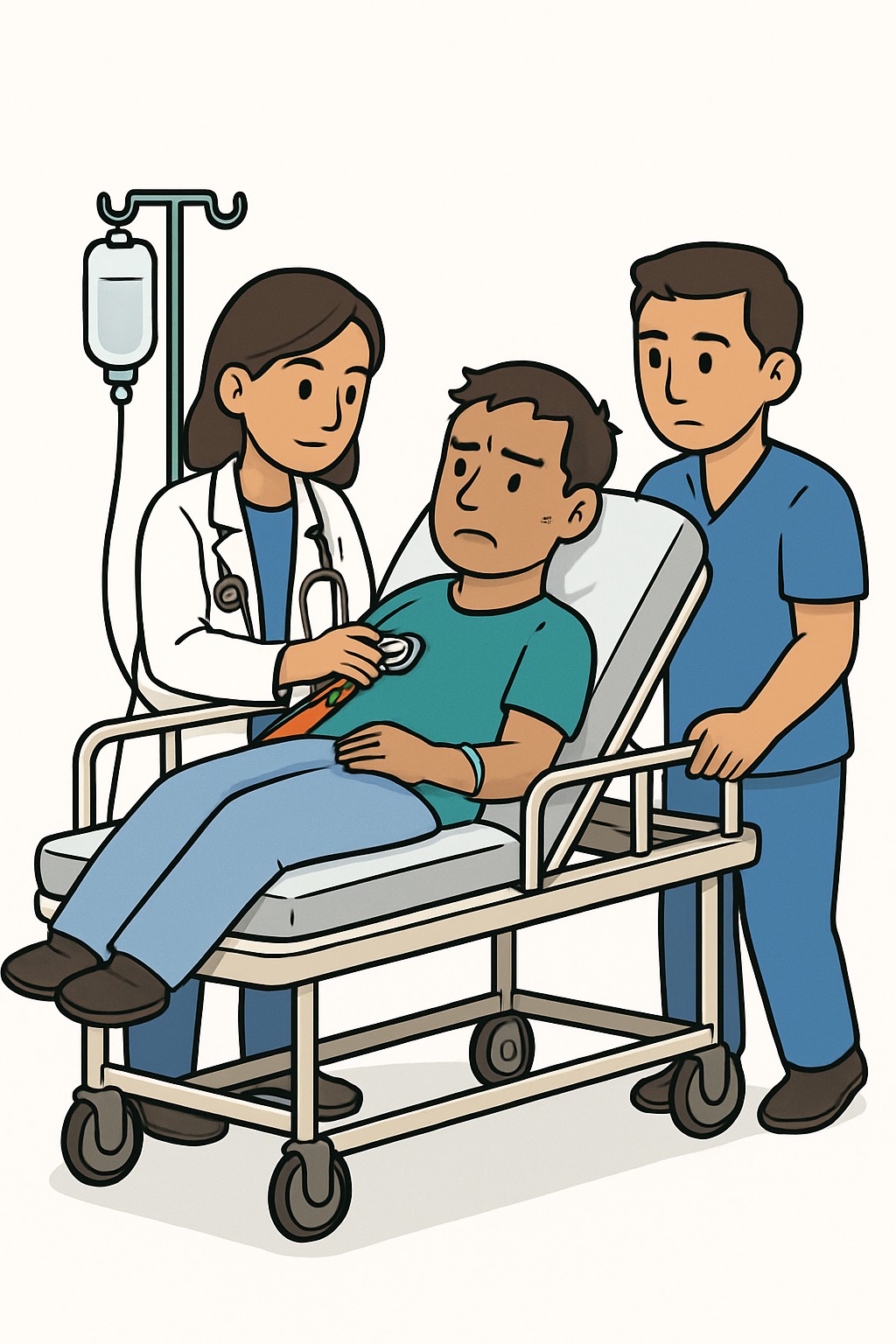
An emergency department visit for moderate severity is an unscheduled hospital-based evaluation for a problem that needs prompt attention but is not immediately life threatening.
Overview
An emergency department visit for moderate severity is an unscheduled hospital-based evaluation for a problem that needs prompt attention but is not immediately life threatening. Care usually includes triage, a focused history and physical exam, monitoring, and tests such as blood work, an ECG, or imaging. The goal is to identify or rule out serious causes, treat urgent symptoms, and decide on next steps. Many people go home the same day with instructions and follow-up plans; some may be observed longer or admitted if needed.
Also known as: ED visit, moderate, ER visit (moderate), Level 4 ED visit
Preparation & Next Steps
Everything you need to know before and after your procedure
Before Care
- Bring a photo ID, insurance card, and a payment method if copays apply
- Carry an up-to-date list of all medicines and supplements, including doses and timing
- List allergies, major conditions, surgeries, and your preferred pharmacy
- Note when symptoms began, what makes them better or worse, and any home treatments tried
- Bring recent test results, relevant imaging on a CD or via portal, and any advance directives
- Arrange safe transport and consider a support person for communication or mobility needs
- Have emergency contacts and your primary clinician's information available
- Bring needed items such as glasses, hearing aids, mobility aids, and a phone charger
- If you use a patient portal or wearable device, be ready to share recent readings
- Expect variability in wait times; bring essentials like necessary medicines and comfort items
After Care
- Review your discharge instructions and visit summary to understand the diagnosis, tests, and plan
- Fill any prescribed medicines and follow the instructions provided by the care team
- Schedule follow-up with your primary care clinician or specialist if recommended
- Track symptoms, side effects, or new concerns and share updates with your care team
- Keep the wound or affected area clean and protected as instructed; watch for signs of infection
- Complete any ordered labs or imaging and confirm how results will be shared
- Use your patient portal or provided phone numbers to ask clarifying questions
- Resume activities gradually based on the discharge plan and how you feel
- Store paperwork, test results, and medication changes in your personal health records
- Contact a clinician promptly if symptoms worsen or new concerning symptoms appear
Clinical Information
Important medical details about this procedure
Indications
- Moderate chest pain or shortness of breath without signs of collapse
- Moderate asthma flare or COPD symptoms
- Abdominal pain, nausea, or vomiting needing urgent evaluation
- Possible broken bone, sprain, or dislocation
- Fever with concerning symptoms such as dehydration or confusion
- Head injury without loss of consciousness or severe neurologic deficits
- Painful urinary infection or kidney stone symptoms
- Worsening symptoms from a known condition that cannot wait for routine care
Alternatives
- Urgent care clinic for non-emergency problems
- Same-day primary care visit when available
- Telehealth visit for triage and guidance when an in-person exam is not immediately required
- Nurse advice line or health plan triage line for next-step recommendations
Risks
- Radiation exposure from imaging such as X-ray or CT
- Allergic reactions to contrast dye or medicines
- False-positive or false-negative test results leading to extra testing or missed conditions
- Hospital-acquired infection risk in healthcare settings
- Bruising or soreness from IVs, injections, or blood draws
- Incidental findings that may require follow-up
- Out-of-pocket costs depending on tests, treatments, and insurance coverage
- Privacy risks if personal devices or unsecured networks are used
Recovery Timeline
What to expect during your recovery
There is usually no recovery period from the visit itself. Many people return to normal routines within 0 to 2 days, but timing depends on the condition evaluated and any treatments given.
Typical Range
0–2 days
Return to Work
Same day
Recovery Milestones
Travel home safely and rest
Start prescribed medicines and complete first follow-up tasks
Schedule and attend recommended follow-up visit
Review test results and confirm the care plan
Frequently Asked Questions
Common questions and expert answers about this procedure
What does moderate severity mean in the emergency department?
What does moderate severity mean in the emergency department?
It refers to problems that need urgent evaluation and may require tests or treatment, but are not showing immediate life-threatening signs at arrival.
How long will a moderate emergency department visit take?
How long will a moderate emergency department visit take?
Time varies. Testing, imaging, and observation can take several hours. Triage and room availability also affect timing.
What tests are common during this type of visit?
What tests are common during this type of visit?
Depending on symptoms, clinicians may order blood and urine tests, X-ray, ultrasound, CT, ECG, or monitoring. Not everyone needs all tests.
Will I be admitted to the hospital?
Will I be admitted to the hospital?
Many people go home with instructions. Admission depends on test results, exam findings, and how you are doing during observation.
Do I need an appointment or referral to go to the emergency department?
Do I need an appointment or referral to go to the emergency department?
No. EDs accept walk-ins and ambulance arrivals. By federal law (EMTALA), hospitals must provide an appropriate medical screening exam and stabilizing treatment regardless of ability to pay.
Can someone come with me to the ED?
Can someone come with me to the ED?
Often yes, but policies vary. Visitor limits can change based on safety or infection control rules. Check the facility's guidelines.
How can I help the team evaluate me faster?
How can I help the team evaluate me faster?
Bring your ID, insurance information, medicine list, allergies, and recent records. Be ready to describe your symptoms and timeline clearly.
How much will this visit cost?
How much will this visit cost?
Costs depend on your insurance, the facility, and any tests or treatments. Check your benefits and ask about estimates and itemized bills.
References
Medical literature and sources