%20--%3e%3csvg%20version='1.0'%20id='Layer_1'%20xmlns='http://www.w3.org/2000/svg'%20xmlns:xlink='http://www.w3.org/1999/xlink'%20x='0px'%20y='0px'%20viewBox='0%200%20755.52%20814.35'%20style='enable-background:new%200%200%20755.52%20814.35;'%20xml:space='preserve'%3e%3cstyle%20type='text/css'%3e%20.st0{fill:%231ae5ce;stroke:%231ae5ce;stroke-width:7;stroke-miterlimit:10;}%20.st1{fill:%23FFFFFF;stroke:%231ae5ce;stroke-width:7;stroke-miterlimit:10;}%20.st2{fill:%231ae5ce;stroke:%23FFFFFF;stroke-width:7;stroke-miterlimit:10;}%20.st3{fill:%23FFFFFF;stroke:%23FFFFFF;stroke-width:6;stroke-miterlimit:10;}%20%3c/style%3e%3cg%20id='Dark_Logo_00000159431215648494653180000015900878925932721032_'%3e%3cpath%20id='shield_00000152259091539869183100000001926543869452564382_'%20class='st0'%20d='M711.13,173.42%20c-3.37-49.07-38.92-44.9-75.96-52.18c-67.4-13.25-130.47-34.47-192.36-63.92c-22.48-10.7-41.88-25.74-65.05-26.28%20c-23.17,0.54-42.58,15.59-65.05,26.28c-61.89,29.45-124.95,50.68-192.36,63.92c-37.04,7.28-72.59,3.11-75.96,52.18%20c-1.55,22.6,0.34,46.4,1.05,68.92c5.99,190.78,52.91,345.39,206.27,466.46c29.71,23.46,74.51,55.8,108.84,70.75%20c5.99,2.61,11.7,3.73,17.21,3.75c5.51-0.02,11.22-1.14,17.21-3.75c34.33-14.95,79.12-47.3,108.84-70.75%20c153.37-121.07,200.28-275.68,206.27-466.46C710.79,219.82,712.68,196.02,711.13,173.42z'/%3e%3cpath%20id='magnifyingglass_00000073685934697636024790000000342567780940956808_'%20class='st1'%20d='M648.78,624.21l-96.64-104.65%20c34.89-40.63,55.98-93.46,55.98-151.21c0-128.27-103.98-232.24-232.24-232.24S143.63,240.08,143.63,368.35%20s103.98,232.24,232.24,232.24c48.87,0,94.21-15.11,131.62-40.89l97.18,105.24c11.25,12.18,30.24,12.93,42.42,1.69l0,0%20C659.27,655.38,660.03,636.39,648.78,624.21z'/%3e%3ccircle%20id='ellipse_00000129904010550392394720000017056154833629780114_'%20class='st2'%20cx='375.87'%20cy='368.35'%20r='181.21'/%3e%3cpath%20id='dollarsign_00000057140127156649725250000003772530148495155891_'%20class='st3'%20d='M362.91,492.03v-23.91%20c0-2.01-1.58-3.69-3.59-3.77c-18.49-0.78-37.12-5.4-49.4-11.83c-1.75-0.92-2.53-3.01-1.76-4.84l5.87-13.89%20c0.86-2.02,3.23-2.88,5.2-1.89c12.94,6.52,30.45,11.44,49.18,11.44c26.02,0,43.6-12.73,43.6-30.43c0-17.08-14.29-27.63-41.4-36.95%20c-37.37-12.42-60.46-26.7-60.46-53.72c0-24.97,20.29-44.11,52.22-49.51c1.8-0.31,3.11-1.89,3.11-3.72v-24.35%20c0-2.09,1.69-3.78,3.78-3.78h15.16c2.09,0,3.78,1.69,3.78,3.78v22.71c0,2.01,1.58,3.67,3.58,3.77c17.85,0.92,30.88,4.75,40.61,9.1%20c1.92,0.86,2.79,3.09,1.94,5.01l-6.08,13.6c-0.85,1.91-3.09,2.77-4.99,1.91c-8.37-3.8-22.38-8.95-42.75-8.95%20c-28.21,0-38.84,14.28-38.84,26.7c0,16.15,13.56,24.22,45.44,35.4c37.74,13.04,56.79,29.19,56.79,56.82%20c0,23.85-19.05,46.23-54.78,52.3c-1.8,0.31-3.11,1.89-3.11,3.72v25.28c0,2.09-1.69,3.78-3.78,3.78h-15.53%20C364.6,495.81,362.91,494.12,362.91,492.03z'/%3e%3c/g%3e%3c/svg%3e)
Emergency Dept Visit - High Severity Evaluation Management
A high severity emergency department (ED) visit is an urgent evaluation for symptoms that could be life-threatening or cause serious harm without rapid care.
Overview
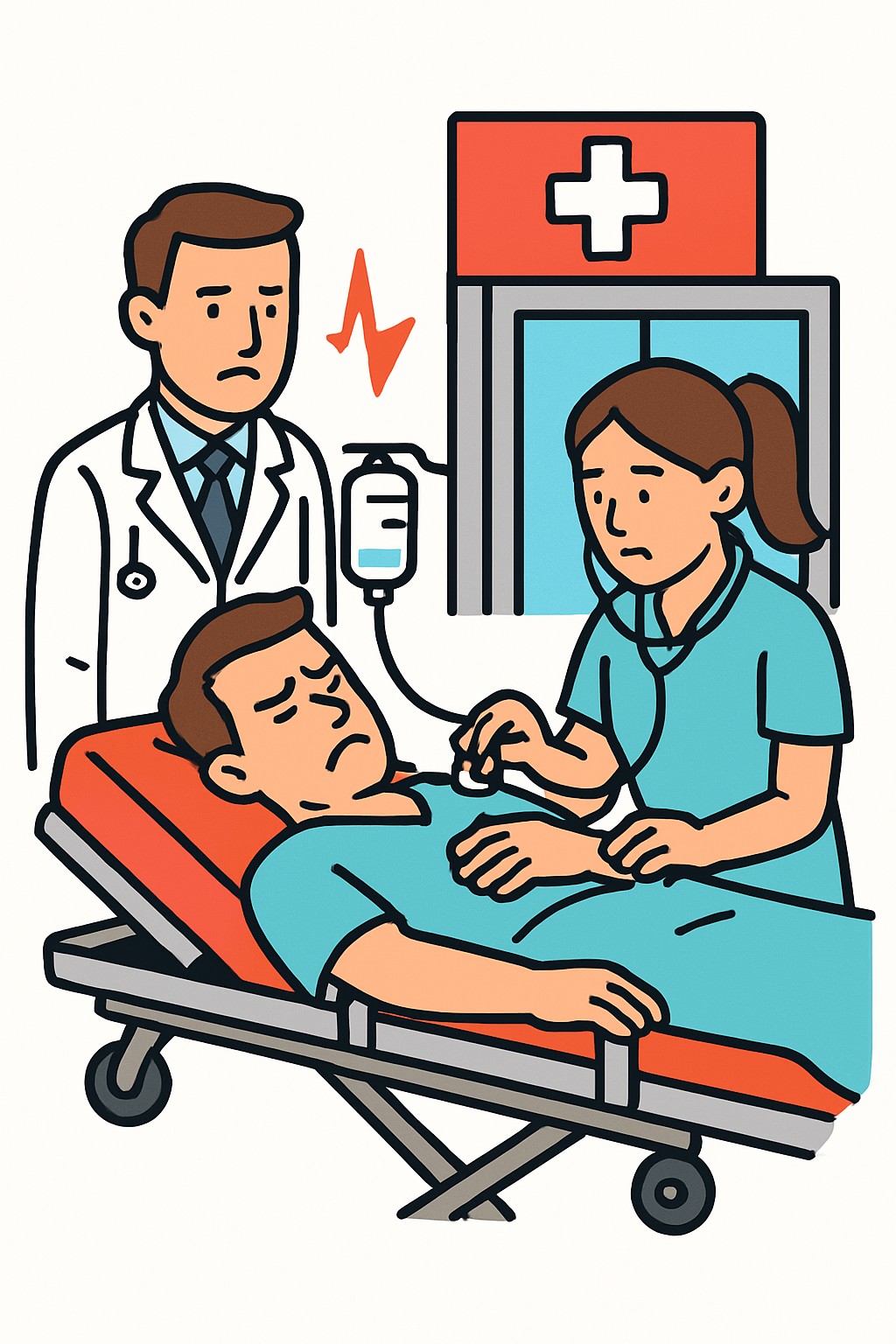
A high severity emergency department (ED) visit is an urgent evaluation for symptoms that could be life-threatening or cause serious harm without rapid care. The focus is on timely diagnosis, stabilization, and treatment. During this visit, the team may place monitors and IV lines, order labs and imaging, give medicines, and consult specialists. Some people go home after treatment; others are observed or admitted to the hospital if needed.
Also known as: ED visit high severity, Emergency room visit, high severity, Emergency department visit (severe)
Preparation & Next Steps
Everything you need to know before and after your procedure
Before Care
- Bring a photo ID, insurance card, and a list of your medicines and allergies
- Carry recent test results, imaging discs, or device readings if available
- Have emergency contact information and your preferred pharmacy details
- Bring glasses, hearing aids, mobility aids, and needed chargers
- Keep valuables to a minimum and wear easy-to-remove clothing
- Arrange safe transportation; you may not be able to drive after evaluation or treatment
- Bring a copy of any advance directive or healthcare proxy if you have one
- If allowed, consider a support person who can help share information
After Care
- Review the discharge instructions and summary of tests, treatments, and diagnoses
- Fill any new prescriptions and follow the directions provided by your care team
- Protect any IV or bandage sites and keep them clean and dry as instructed
- Use a simple symptom log to track changes, triggers, and any side effects
- Schedule recommended follow-up appointments or therapy
- Complete any ordered labs or imaging and confirm where results will be sent
- Plan for rest and hydration as appropriate for your condition and treatments received
- Contact a clinician promptly if symptoms worsen or new concerning symptoms appear
Clinical Information
Important medical details about this procedure
Indications
- Chest pain or pressure
- Shortness of breath or low oxygen
- Severe abdominal pain
- Sudden weakness, numbness, or trouble speaking
- Severe head injury or major trauma
- Uncontrolled bleeding
- Severe allergic reaction with swelling or wheezing
- High fever with confusion or stiff neck
- Seizure or new severe headache
Alternatives
- Urgent care clinic for minor injuries or mild illness
- Primary care visit for non-urgent concerns
- Telehealth visit for advice when a physical exam is not required
- Nurse advice line for basic guidance on next steps
Risks
- Delays due to crowding or high demand
- Exposure to infectious illnesses in waiting areas
- Radiation exposure from imaging tests
- Allergic reactions to contrast dye or medicines
- Pain, bruising, or infection at IV or injection sites
- Incidental findings that need more tests
- Unexpected hospital admission or transfer
- Out-of-pocket costs depending on coverage
Contraindications
- None specific to evaluation in the emergency department
- Minor, stable issues that can be safely managed in outpatient care
Recovery Timeline
What to expect during your recovery
Recovery depends on the underlying problem, not the visit itself. Many people resume normal activities the same day, while others need more time based on tests, treatments, or admission.
Typical Range
0–1 days
Return to Work
Same day
Recovery Milestones
Resume light daily activities as you feel able
Review discharge paperwork and set reminders for follow-up tasks
Complete ordered tests and schedule recommended follow-up visits
Discuss ongoing symptoms and next steps with your outpatient clinician
Frequently Asked Questions
Common questions and expert answers about this procedure
What does high severity mean in the emergency department?
What does high severity mean in the emergency department?
It describes problems that could be life-threatening or cause serious harm without rapid evaluation and treatment. Care is urgent and often involves multiple tests and close monitoring.
What happens during a high severity ED visit?
What happens during a high severity ED visit?
You will be triaged, monitored, and evaluated by clinicians. Tests like blood work, X-rays, CT scans, or ECGs may be ordered, and treatments or specialist consults may occur.
How long will I be in the ED?
How long will I be in the ED?
Time varies with your condition, needed tests, and crowding. High severity evaluations often take several hours and sometimes lead to observation or hospital admission.
Will I be admitted to the hospital?
Will I be admitted to the hospital?
Some people go home after treatment; others are admitted for monitoring, procedures, or advanced care. The decision depends on test results and clinical assessment.
What tests might be done?
What tests might be done?
Common tests include blood work, ECG, X-rays, CT or ultrasound, and sometimes advanced imaging or procedures. Testing depends on your symptoms and exam.
Who will care for me in the ED?
Who will care for me in the ED?
A team may include emergency physicians, advanced practice clinicians, nurses, technicians, and specialists. They work together to evaluate and treat urgent conditions.
Why might there be a wait even if my symptoms are serious?
Why might there be a wait even if my symptoms are serious?
Triage assigns priority based on risk. If other patients have time-critical needs, you may wait while still being monitored and reevaluated.
How are costs handled for an ED visit?
How are costs handled for an ED visit?
Charges can include the facility fee, clinician services, tests, medicines, and imaging. Out-of-pocket costs vary by insurance benefits and network status.