%20--%3e%3csvg%20version='1.0'%20id='Layer_1'%20xmlns='http://www.w3.org/2000/svg'%20xmlns:xlink='http://www.w3.org/1999/xlink'%20x='0px'%20y='0px'%20viewBox='0%200%20755.52%20814.35'%20style='enable-background:new%200%200%20755.52%20814.35;'%20xml:space='preserve'%3e%3cstyle%20type='text/css'%3e%20.st0{fill:%231ae5ce;stroke:%231ae5ce;stroke-width:7;stroke-miterlimit:10;}%20.st1{fill:%23FFFFFF;stroke:%231ae5ce;stroke-width:7;stroke-miterlimit:10;}%20.st2{fill:%231ae5ce;stroke:%23FFFFFF;stroke-width:7;stroke-miterlimit:10;}%20.st3{fill:%23FFFFFF;stroke:%23FFFFFF;stroke-width:6;stroke-miterlimit:10;}%20%3c/style%3e%3cg%20id='Dark_Logo_00000159431215648494653180000015900878925932721032_'%3e%3cpath%20id='shield_00000152259091539869183100000001926543869452564382_'%20class='st0'%20d='M711.13,173.42%20c-3.37-49.07-38.92-44.9-75.96-52.18c-67.4-13.25-130.47-34.47-192.36-63.92c-22.48-10.7-41.88-25.74-65.05-26.28%20c-23.17,0.54-42.58,15.59-65.05,26.28c-61.89,29.45-124.95,50.68-192.36,63.92c-37.04,7.28-72.59,3.11-75.96,52.18%20c-1.55,22.6,0.34,46.4,1.05,68.92c5.99,190.78,52.91,345.39,206.27,466.46c29.71,23.46,74.51,55.8,108.84,70.75%20c5.99,2.61,11.7,3.73,17.21,3.75c5.51-0.02,11.22-1.14,17.21-3.75c34.33-14.95,79.12-47.3,108.84-70.75%20c153.37-121.07,200.28-275.68,206.27-466.46C710.79,219.82,712.68,196.02,711.13,173.42z'/%3e%3cpath%20id='magnifyingglass_00000073685934697636024790000000342567780940956808_'%20class='st1'%20d='M648.78,624.21l-96.64-104.65%20c34.89-40.63,55.98-93.46,55.98-151.21c0-128.27-103.98-232.24-232.24-232.24S143.63,240.08,143.63,368.35%20s103.98,232.24,232.24,232.24c48.87,0,94.21-15.11,131.62-40.89l97.18,105.24c11.25,12.18,30.24,12.93,42.42,1.69l0,0%20C659.27,655.38,660.03,636.39,648.78,624.21z'/%3e%3ccircle%20id='ellipse_00000129904010550392394720000017056154833629780114_'%20class='st2'%20cx='375.87'%20cy='368.35'%20r='181.21'/%3e%3cpath%20id='dollarsign_00000057140127156649725250000003772530148495155891_'%20class='st3'%20d='M362.91,492.03v-23.91%20c0-2.01-1.58-3.69-3.59-3.77c-18.49-0.78-37.12-5.4-49.4-11.83c-1.75-0.92-2.53-3.01-1.76-4.84l5.87-13.89%20c0.86-2.02,3.23-2.88,5.2-1.89c12.94,6.52,30.45,11.44,49.18,11.44c26.02,0,43.6-12.73,43.6-30.43c0-17.08-14.29-27.63-41.4-36.95%20c-37.37-12.42-60.46-26.7-60.46-53.72c0-24.97,20.29-44.11,52.22-49.51c1.8-0.31,3.11-1.89,3.11-3.72v-24.35%20c0-2.09,1.69-3.78,3.78-3.78h15.16c2.09,0,3.78,1.69,3.78,3.78v22.71c0,2.01,1.58,3.67,3.58,3.77c17.85,0.92,30.88,4.75,40.61,9.1%20c1.92,0.86,2.79,3.09,1.94,5.01l-6.08,13.6c-0.85,1.91-3.09,2.77-4.99,1.91c-8.37-3.8-22.38-8.95-42.75-8.95%20c-28.21,0-38.84,14.28-38.84,26.7c0,16.15,13.56,24.22,45.44,35.4c37.74,13.04,56.79,29.19,56.79,56.82%20c0,23.85-19.05,46.23-54.78,52.3c-1.8,0.31-3.11,1.89-3.11,3.72v25.28c0,2.09-1.69,3.78-3.78,3.78h-15.53%20C364.6,495.81,362.91,494.12,362.91,492.03z'/%3e%3c/g%3e%3c/svg%3e)
High complexity home visit (established patient) Evaluation Management
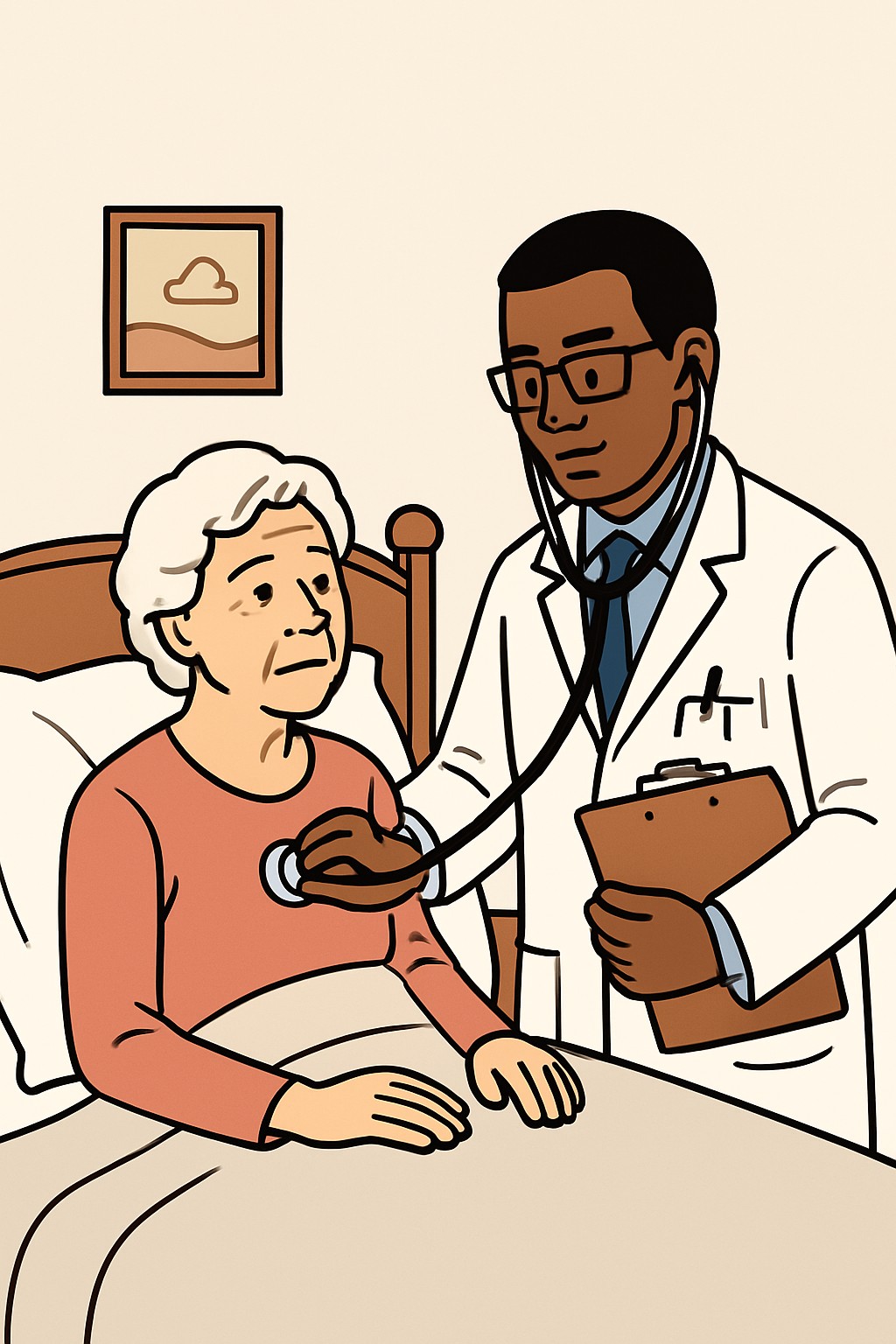
A high complexity home visit is an in-person medical evaluation done at a patient’s home for someone already known to the practice.
Overview
A high complexity home visit is an in-person medical evaluation done at a patient’s home for someone already known to the practice. Established means the patient was seen by the same practice and specialty within the last three years. High complexity refers to the level of medical decision-making. It usually involves multiple serious or unstable conditions, extensive medication review, and coordination with other services. During the visit, the clinician reviews symptoms, examines the patient, updates medicines, and may order tests or arrange in-home services.
Also known as: Home visit – established patient, high complexity, High complexity home E/M visit, In-home medical visit (established patient)
Preparation & Next Steps
Everything you need to know before and after your procedure
Before Care
- Confirm the date, time, and expected length of the home visit and provide entry instructions or building access details
- Prepare a clean, well-lit space with a stable chair or bed and a surface for the clinician’s equipment
- Gather all medication bottles, supplements, and an updated medication list with doses and schedules
- Have recent readings (blood pressure, blood sugar, weight) and device logs available if you track them
- Secure pets and reduce trip hazards by clearing walkways and removing clutter
- Have your photo ID, insurance card, and preferred pharmacy information ready
- Write your top questions, recent symptoms, and any changes since the last visit
- Keep equipment manuals, power cords, and supplies for home devices nearby
- Tell the office ahead of time about new contagious symptoms so they can bring protective gear
- Arrange for a caregiver or support person to be present if help with history or decisions is needed
After Care
- Review the visit summary and written instructions provided by the clinician
- Update your medication list with any changes and keep it in an easy-to-find place
- Schedule follow-up appointments, labs, imaging, or referrals that were ordered
- Organize home health, therapy, or equipment deliveries if recommended
- Keep wounds, devices, or dressings as instructed and store supplies safely
- Track symptoms and vital signs as requested and bring logs to the next visit
- Use the clinic phone or patient portal for questions or clarification
- Contact the clinician if symptoms worsen, new concerning symptoms appear, or side effects occur
- Check your insurance benefits for any ordered services or equipment
- Maintain a safe home setup by keeping pathways clear and equipment plugged into safe outlets
Clinical Information
Important medical details about this procedure
Indications
- Multiple chronic conditions that are unstable or hard to manage
- Severe mobility limits or homebound status
- Recent hospital or rehab discharge with complex needs
- Advanced heart, lung, kidney, or neurologic disease
- Dementia or cognitive impairment affecting care
- Frequent medication changes or polypharmacy
- Complex wound care or medical device management
- Need for care coordination with home health or hospice teams
Alternatives
- Telehealth video or phone visit when an in-person exam is not required
- Office visit if travel is possible
- Nurse or therapist home health visit for specific services
- Remote patient monitoring for vitals and symptoms
- Urgent care or emergency department for time-sensitive issues
Risks
- Limited access to immediate imaging or procedures in the home
- Miscommunication if medication bottles or records are incomplete
- Privacy concerns during conversations in shared living spaces
- Infection exposure if anyone in the home is ill
- Environmental safety issues such as poor lighting or fall hazards
- Potential out-of-pocket costs depending on insurance coverage
Contraindications
- Life-threatening symptoms that require emergency care
- Unsafe home environment for staff or patient
- Known contagious illness without proper precautions available
- Patient not previously established with the practice
- Inability to participate or consent without a needed support person
Recovery Timeline
What to expect during your recovery
There is no medical recovery period from the visit itself. Most people resume normal activities right away. Any follow-up depends on the conditions being managed.
Typical Range
Same day
Return to Work
Same day
Recovery Milestones
Resume usual daily activities at home
Review the visit summary and confirm next steps or scheduled tests
Set up home services, equipment, or monitoring if ordered
Complete labs or imaging and arrange follow-up discussion of results
Frequently Asked Questions
Common questions and expert answers about this procedure
What does high complexity mean?
What does high complexity mean?
It refers to a high level of medical decision-making, often due to multiple serious problems, extensive data review, and higher risk from testing or treatment.
Who can perform a home visit?
Who can perform a home visit?
Physicians, nurse practitioners, and physician assistants commonly perform home visits. Other team members may join for specific tasks.
How long does a home visit take?
How long does a home visit take?
Length varies by needs. High complexity visits often take longer than routine visits to review records, examine, and coordinate care.
Will tests be done at home?
Will tests be done at home?
Some basic tests can be done on site. Many labs or imaging studies are scheduled separately or arranged through mobile services when available.
Do I have to be homebound for a home visit?
Do I have to be homebound for a home visit?
Not always. Homebound status is a Medicare requirement for certain home health services, but clinician home visits may occur without it depending on practice and coverage.
How should I prepare my home?
How should I prepare my home?
Clear space, good lighting, medication bottles, device manuals, and recent logs help. Secure pets and share any building access steps in advance.
How is privacy handled?
How is privacy handled?
Clinicians aim to protect privacy. They may ask to speak in a quiet area and will follow applicable privacy rules for records.
What if my condition gets worse after the visit?
What if my condition gets worse after the visit?
Use the clinic phone or portal to report changes or new concerning symptoms so the team can advise on next steps.
References
Medical literature and sources