%20--%3e%3csvg%20version='1.0'%20id='Layer_1'%20xmlns='http://www.w3.org/2000/svg'%20xmlns:xlink='http://www.w3.org/1999/xlink'%20x='0px'%20y='0px'%20viewBox='0%200%20755.52%20814.35'%20style='enable-background:new%200%200%20755.52%20814.35;'%20xml:space='preserve'%3e%3cstyle%20type='text/css'%3e%20.st0{fill:%231ae5ce;stroke:%231ae5ce;stroke-width:7;stroke-miterlimit:10;}%20.st1{fill:%23FFFFFF;stroke:%231ae5ce;stroke-width:7;stroke-miterlimit:10;}%20.st2{fill:%231ae5ce;stroke:%23FFFFFF;stroke-width:7;stroke-miterlimit:10;}%20.st3{fill:%23FFFFFF;stroke:%23FFFFFF;stroke-width:6;stroke-miterlimit:10;}%20%3c/style%3e%3cg%20id='Dark_Logo_00000159431215648494653180000015900878925932721032_'%3e%3cpath%20id='shield_00000152259091539869183100000001926543869452564382_'%20class='st0'%20d='M711.13,173.42%20c-3.37-49.07-38.92-44.9-75.96-52.18c-67.4-13.25-130.47-34.47-192.36-63.92c-22.48-10.7-41.88-25.74-65.05-26.28%20c-23.17,0.54-42.58,15.59-65.05,26.28c-61.89,29.45-124.95,50.68-192.36,63.92c-37.04,7.28-72.59,3.11-75.96,52.18%20c-1.55,22.6,0.34,46.4,1.05,68.92c5.99,190.78,52.91,345.39,206.27,466.46c29.71,23.46,74.51,55.8,108.84,70.75%20c5.99,2.61,11.7,3.73,17.21,3.75c5.51-0.02,11.22-1.14,17.21-3.75c34.33-14.95,79.12-47.3,108.84-70.75%20c153.37-121.07,200.28-275.68,206.27-466.46C710.79,219.82,712.68,196.02,711.13,173.42z'/%3e%3cpath%20id='magnifyingglass_00000073685934697636024790000000342567780940956808_'%20class='st1'%20d='M648.78,624.21l-96.64-104.65%20c34.89-40.63,55.98-93.46,55.98-151.21c0-128.27-103.98-232.24-232.24-232.24S143.63,240.08,143.63,368.35%20s103.98,232.24,232.24,232.24c48.87,0,94.21-15.11,131.62-40.89l97.18,105.24c11.25,12.18,30.24,12.93,42.42,1.69l0,0%20C659.27,655.38,660.03,636.39,648.78,624.21z'/%3e%3ccircle%20id='ellipse_00000129904010550392394720000017056154833629780114_'%20class='st2'%20cx='375.87'%20cy='368.35'%20r='181.21'/%3e%3cpath%20id='dollarsign_00000057140127156649725250000003772530148495155891_'%20class='st3'%20d='M362.91,492.03v-23.91%20c0-2.01-1.58-3.69-3.59-3.77c-18.49-0.78-37.12-5.4-49.4-11.83c-1.75-0.92-2.53-3.01-1.76-4.84l5.87-13.89%20c0.86-2.02,3.23-2.88,5.2-1.89c12.94,6.52,30.45,11.44,49.18,11.44c26.02,0,43.6-12.73,43.6-30.43c0-17.08-14.29-27.63-41.4-36.95%20c-37.37-12.42-60.46-26.7-60.46-53.72c0-24.97,20.29-44.11,52.22-49.51c1.8-0.31,3.11-1.89,3.11-3.72v-24.35%20c0-2.09,1.69-3.78,3.78-3.78h15.16c2.09,0,3.78,1.69,3.78,3.78v22.71c0,2.01,1.58,3.67,3.58,3.77c17.85,0.92,30.88,4.75,40.61,9.1%20c1.92,0.86,2.79,3.09,1.94,5.01l-6.08,13.6c-0.85,1.91-3.09,2.77-4.99,1.91c-8.37-3.8-22.38-8.95-42.75-8.95%20c-28.21,0-38.84,14.28-38.84,26.7c0,16.15,13.56,24.22,45.44,35.4c37.74,13.04,56.79,29.19,56.79,56.82%20c0,23.85-19.05,46.23-54.78,52.3c-1.8,0.31-3.11,1.89-3.11,3.72v25.28c0,2.09-1.69,3.78-3.78,3.78h-15.53%20C364.6,495.81,362.91,494.12,362.91,492.03z'/%3e%3c/g%3e%3c/svg%3e)
Home Health Nursing Visit Evaluation Management
A home health nursing visit is when a licensed nurse comes to your home to provide skilled care.
Overview
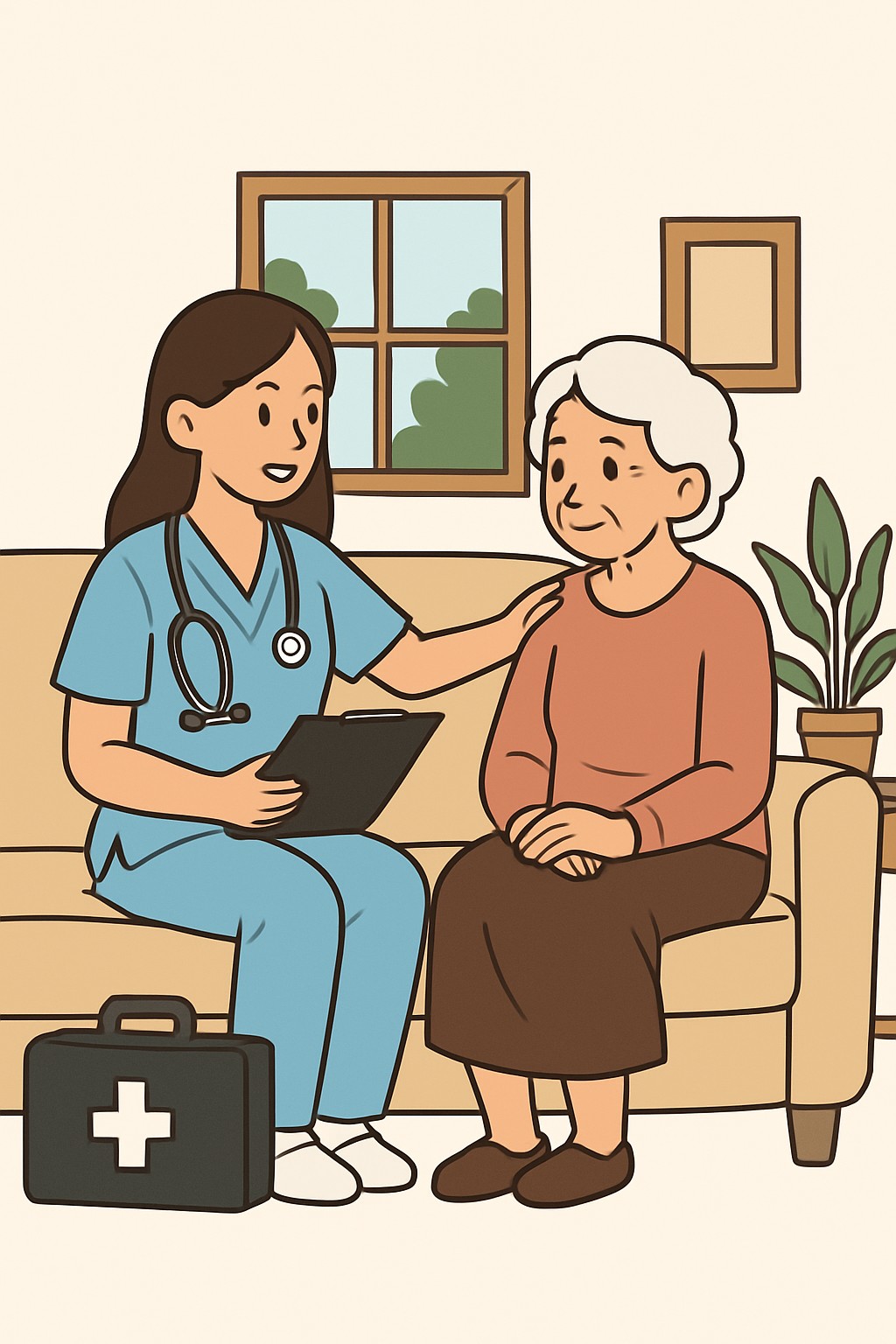
A home health nursing visit is when a licensed nurse comes to your home to provide skilled care. The nurse checks your vital signs, reviews medicines, assesses symptoms, and provides treatments such as wound care or catheter care. Education and coaching on your care plan are also a part of the visit. These visits help people manage health needs at home after an illness, surgery, or change in condition. The nurse coordinates with your prescribing clinician and other team members to support safety and recovery.
Also known as: Skilled nursing home visit, Home health nurse visit, RN home visit
Preparation & Next Steps
Everything you need to know before and after your procedure
Before Care
- Have an up-to-date list of all medicines and supplements, with doses and schedules
- Keep recent discharge papers, care plans, and test results in one place for review
- Prepare any supplies or equipment at home (such as dressings, gloves, or monitors)
- Clear a well-lit space with a clean surface for assessment and care
- Secure pets and ensure easy access to the entrance; unlock gates or elevators if needed
- Write down your top questions and any changes in symptoms since the last visit
- Have contact information for your primary clinician, pharmacy, and caregivers
- Keep logs or device readings ready (blood pressure, blood sugar, weight, oxygen levels)
- Tell the agency ahead of time about language needs so an interpreter can be arranged
- Make sure necessary utilities are working (electricity, water) for care and equipment
After Care
- Review the visit summary and care plan provided by the nurse
- Keep medicines organized and note any updates communicated to your prescriber
- Use clean hands when handling dressings, devices, or supplies
- Track daily measurements if requested (such as weight, blood pressure, or glucose)
- Maintain a simple symptom log to share at the next visit
- Restock frequently used supplies before they run low and report equipment problems
- Confirm upcoming visit times, lab draws, or therapy appointments
- Contact the agency if you notice concerning changes such as fever, spreading redness, increasing pain, new confusion, or a fall
- Keep walkways clear and dry to reduce fall risks around care areas
- Store sharps and medicines safely, away from children and pets
Clinical Information
Important medical details about this procedure
Indications
- Recent hospital or rehab discharge
- Post-surgical care and dressing changes
- Wound care and monitoring for healing
- Medication management and education
- Chronic condition monitoring (such as heart failure, COPD, diabetes)
- Catheter, drain, or tube care
- Infusion therapy support as ordered
- Education and training for patient or caregiver
Alternatives
- Clinic or primary care office visit
- Telehealth or remote monitoring
- Outpatient nursing clinic
- Skilled nursing facility or rehabilitation center
- Urgent care or emergency department for acute issues
Risks
- Infection risk during procedures like wound or IV care
- Skin irritation from adhesives or dressings
- Medication side effects or interactions
- Falls during mobility assistance or transfers
- Miscommunication about the care plan
- Privacy or confidentiality concerns in the home setting
Contraindications
- No need for skilled nursing services
- Home environment is unsafe for care delivery
- Patient declines home visits
- Lack of required utilities or space for equipment
- Active contagious illness without available precautions
Recovery Timeline
What to expect during your recovery
There is no medical recovery period from a home health nursing visit itself. Most people continue normal activities right away while following their ongoing care plan.
Typical Range
Same day
Return to Work
Same day
Recovery Milestones
Resume usual household activities as tolerated
Schedule any labs, imaging, or therapy ordered during the visit
Organize medicines and set reminders based on the updated plan
Practice taught self-care skills (such as dressing changes or monitoring) as instructed by the care team
Review progress and goals with the nurse and care team at follow-up visits
Frequently Asked Questions
Common questions and expert answers about this procedure
What does a home health nurse do during a visit?
What does a home health nurse do during a visit?
The nurse reviews your health history, checks vitals, assesses symptoms, provides skilled care like wound care or catheter care, educates you and your caregiver, and coordinates with your clinician.
How long does a home health nursing visit last?
How long does a home health nursing visit last?
Visit length varies by your needs and the agency’s plan. The first visit may take longer to review history, safety, and goals.
Who orders home health nursing visits?
Who orders home health nursing visits?
A licensed clinician such as a physician, nurse practitioner, or physician assistant typically orders and oversees the plan of care.
Can the nurse change my medications?
Can the nurse change my medications?
Nurses do not prescribe. They assess, educate, and communicate with your prescribing clinician about any needed changes.
Do I have to be homebound to receive home health?
Do I have to be homebound to receive home health?
Some insurance, including Medicare, requires that leaving home is difficult and you need skilled care. Requirements vary by program and plan.
Will I see the same nurse each time?
Will I see the same nurse each time?
Agencies try to provide continuity, but staffing and scheduling may mean you see more than one nurse.
Is telehealth used with home health nursing?
Is telehealth used with home health nursing?
Some programs use phone, video, or remote monitoring to supplement in-person visits when appropriate.
How is my privacy protected?
How is my privacy protected?
Home health agencies follow privacy laws and policies. Nurses limit sharing to those involved in your care and secure records according to regulations.
References
Medical literature and sources