%20--%3e%3csvg%20version='1.0'%20id='Layer_1'%20xmlns='http://www.w3.org/2000/svg'%20xmlns:xlink='http://www.w3.org/1999/xlink'%20x='0px'%20y='0px'%20viewBox='0%200%20755.52%20814.35'%20style='enable-background:new%200%200%20755.52%20814.35;'%20xml:space='preserve'%3e%3cstyle%20type='text/css'%3e%20.st0{fill:%231ae5ce;stroke:%231ae5ce;stroke-width:7;stroke-miterlimit:10;}%20.st1{fill:%23FFFFFF;stroke:%231ae5ce;stroke-width:7;stroke-miterlimit:10;}%20.st2{fill:%231ae5ce;stroke:%23FFFFFF;stroke-width:7;stroke-miterlimit:10;}%20.st3{fill:%23FFFFFF;stroke:%23FFFFFF;stroke-width:6;stroke-miterlimit:10;}%20%3c/style%3e%3cg%20id='Dark_Logo_00000159431215648494653180000015900878925932721032_'%3e%3cpath%20id='shield_00000152259091539869183100000001926543869452564382_'%20class='st0'%20d='M711.13,173.42%20c-3.37-49.07-38.92-44.9-75.96-52.18c-67.4-13.25-130.47-34.47-192.36-63.92c-22.48-10.7-41.88-25.74-65.05-26.28%20c-23.17,0.54-42.58,15.59-65.05,26.28c-61.89,29.45-124.95,50.68-192.36,63.92c-37.04,7.28-72.59,3.11-75.96,52.18%20c-1.55,22.6,0.34,46.4,1.05,68.92c5.99,190.78,52.91,345.39,206.27,466.46c29.71,23.46,74.51,55.8,108.84,70.75%20c5.99,2.61,11.7,3.73,17.21,3.75c5.51-0.02,11.22-1.14,17.21-3.75c34.33-14.95,79.12-47.3,108.84-70.75%20c153.37-121.07,200.28-275.68,206.27-466.46C710.79,219.82,712.68,196.02,711.13,173.42z'/%3e%3cpath%20id='magnifyingglass_00000073685934697636024790000000342567780940956808_'%20class='st1'%20d='M648.78,624.21l-96.64-104.65%20c34.89-40.63,55.98-93.46,55.98-151.21c0-128.27-103.98-232.24-232.24-232.24S143.63,240.08,143.63,368.35%20s103.98,232.24,232.24,232.24c48.87,0,94.21-15.11,131.62-40.89l97.18,105.24c11.25,12.18,30.24,12.93,42.42,1.69l0,0%20C659.27,655.38,660.03,636.39,648.78,624.21z'/%3e%3ccircle%20id='ellipse_00000129904010550392394720000017056154833629780114_'%20class='st2'%20cx='375.87'%20cy='368.35'%20r='181.21'/%3e%3cpath%20id='dollarsign_00000057140127156649725250000003772530148495155891_'%20class='st3'%20d='M362.91,492.03v-23.91%20c0-2.01-1.58-3.69-3.59-3.77c-18.49-0.78-37.12-5.4-49.4-11.83c-1.75-0.92-2.53-3.01-1.76-4.84l5.87-13.89%20c0.86-2.02,3.23-2.88,5.2-1.89c12.94,6.52,30.45,11.44,49.18,11.44c26.02,0,43.6-12.73,43.6-30.43c0-17.08-14.29-27.63-41.4-36.95%20c-37.37-12.42-60.46-26.7-60.46-53.72c0-24.97,20.29-44.11,52.22-49.51c1.8-0.31,3.11-1.89,3.11-3.72v-24.35%20c0-2.09,1.69-3.78,3.78-3.78h15.16c2.09,0,3.78,1.69,3.78,3.78v22.71c0,2.01,1.58,3.67,3.58,3.77c17.85,0.92,30.88,4.75,40.61,9.1%20c1.92,0.86,2.79,3.09,1.94,5.01l-6.08,13.6c-0.85,1.91-3.09,2.77-4.99,1.91c-8.37-3.8-22.38-8.95-42.75-8.95%20c-28.21,0-38.84,14.28-38.84,26.7c0,16.15,13.56,24.22,45.44,35.4c37.74,13.04,56.79,29.19,56.79,56.82%20c0,23.85-19.05,46.23-54.78,52.3c-1.8,0.31-3.11,1.89-3.11,3.72v25.28c0,2.09-1.69,3.78-3.78,3.78h-15.53%20C364.6,495.81,362.91,494.12,362.91,492.03z'/%3e%3c/g%3e%3c/svg%3e)
Home Health Visit (skilled nurse) Evaluation Management
A home health visit by a skilled nurse is clinical care provided in your home under a clinician-ordered plan of care.
Overview
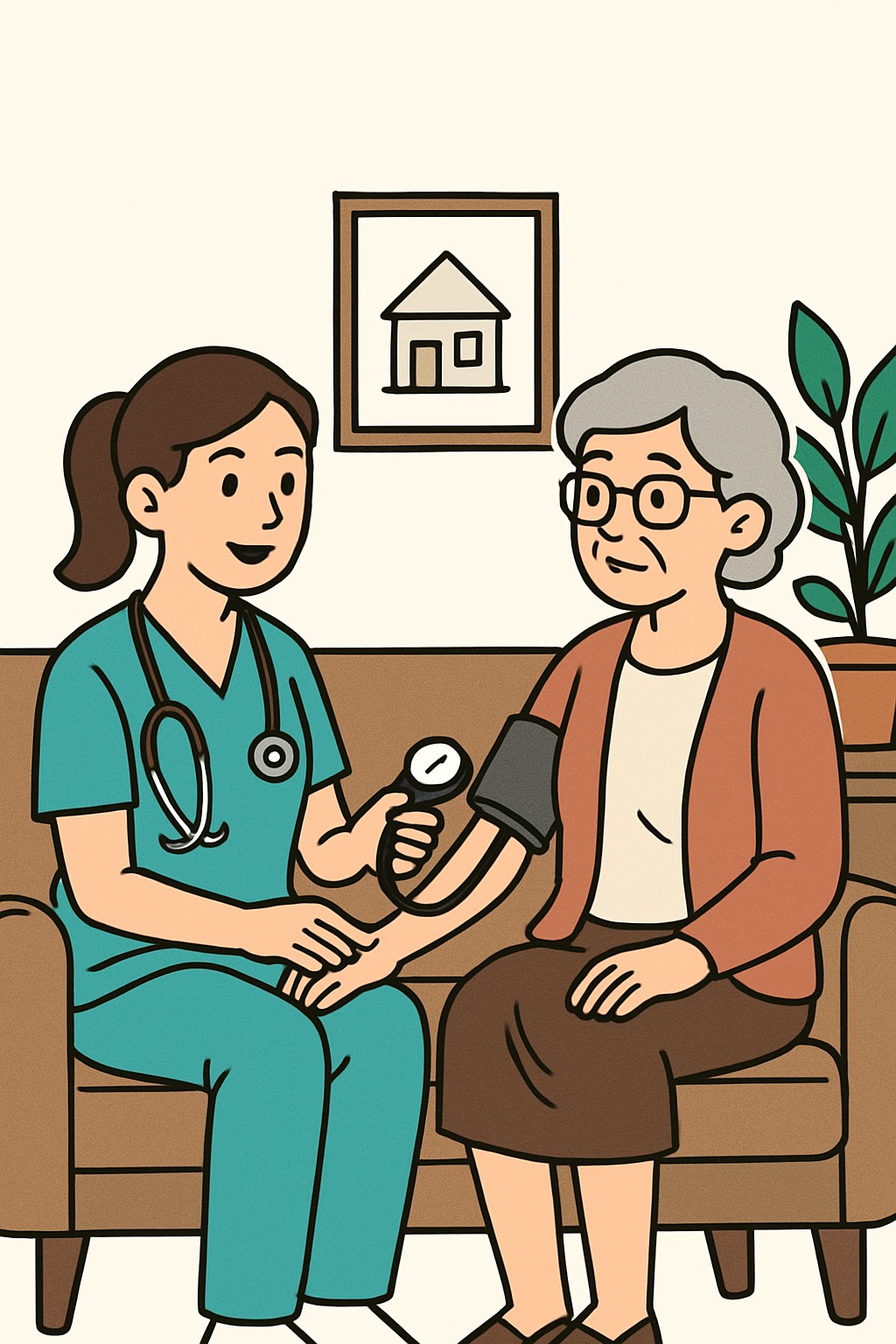
A home health visit by a skilled nurse is clinical care provided in your home under a clinician-ordered plan of care. Skilled nursing means services that must be performed by a licensed nurse, such as assessments, wound care, injections, IV therapy, and teaching. This service helps people who need short-term or intermittent nursing care at home, often after a hospital or rehab stay, a new diagnosis, or a change in condition. The nurse coordinates with your clinician and the home health agency to deliver the ordered care and monitor progress.
Also known as: Skilled nursing home visit, Home health nursing visit, RN home visit
Preparation & Next Steps
Everything you need to know before and after your procedure
Before Care
- Confirm the visit date, time window, and how long the nurse expects to be there.
- Keep a current list of all medicines and allergies, plus recent hospital or clinic paperwork.
- Prepare a clean, well-lit surface for supplies and make space for the nurse to work.
- Secure pets and reduce distractions during the visit.
- Ensure electricity, running water, and a place to wash hands are available.
- Gather any supplies or equipment already at home; leave sealed items closed unless asked.
- Have your ID, insurance information, and preferred pharmacy contact details handy.
- Arrange for a caregiver to be present if training or teaching is planned.
- Start a simple log for vitals, symptoms, and medicines if the nurse will review it.
- Provide clear entry instructions, parking details, and clear pathways to reduce tripping hazards.
After Care
- Review the written care plan or visit summary and keep it in an easy-to-find spot.
- Follow the wound or device care steps as written in the plan of care.
- Take medicines exactly as prescribed by your clinician and keep an updated medication list.
- Use a proper sharps container for needles or lancets; do not place loose sharps in household trash or recycling.
- Track symptoms, temperature, weight, or blood pressure if requested and share changes at the next visit.
- Store supplies clean and dry; tell the agency before you run low so they can restock.
- Keep scheduled visits and notify the agency if you need to reschedule or if home access changes.
- Know the agency’s after-hours phone number for urgent questions about your care.
- Contact a clinician if you notice increasing pain, redness, swelling, fever, drainage, shortness of breath, or chest discomfort.
- Arrange any follow-up appointments or lab draws that were ordered and note transportation needs.
Clinical Information
Important medical details about this procedure
Indications
- Post-surgery or wound care, including dressing changes
- Medication administration such as injections or IV antibiotics
- Monitoring after a hospital or rehab discharge
- New diagnosis or change in condition needing education and assessment
- Chronic disease management (for example, heart failure or diabetes monitoring)
- Catheter or ostomy care
- Caregiver training for complex care tasks
- Assessment of vital signs, symptoms, and response to treatment
Alternatives
- Clinic or outpatient nursing visit
- Telehealth check-in when appropriate
- Personal care or homemaker services by a home care aide (non-medical)
- Remote patient monitoring program if offered
- Urgent care or same-day clinic for acute, time-sensitive problems
Risks
- Infection at wound, catheter, or IV sites
- Bleeding or bruising with injections or blood draws
- Medication side effects or interactions
- IV or device complications
- Miscommunication about the care plan or medicines
- Falls during transfers or care tasks
- Privacy concerns in the home setting
- Scheduling delays that may interrupt care
Contraindications
- Severe or life-threatening symptoms that require emergency care
- Home environment that is unsafe for care (for example, lack of utilities or hazards)
- No clinician order or plan of care for skilled services
- Home location outside the agency’s service area
- Refusal of services by the patient or legal representative
Recovery Timeline
What to expect during your recovery
There is no recovery period from the nurse’s visit itself. Most people continue normal home activities right away. Any rest needed depends on the condition being treated.
Typical Range
Same day
Return to Work
Same day
Recovery Milestones
Resume usual at-home routines after the visit
Review the care plan and set reminders for medicines, wound care, or monitoring
Confirm follow-up appointments and supply deliveries; report notable changes at the next visit
Frequently Asked Questions
Common questions and expert answers about this procedure
What is a skilled nurse home health visit?
What is a skilled nurse home health visit?
A licensed nurse provides clinical care in your home under a clinician-ordered plan. It can include assessments, wound care, injections, IV therapy, and teaching.
Who qualifies for home health nursing?
Who qualifies for home health nursing?
Eligibility and coverage vary by payer. Medicare typically requires a clinician’s order, a need for part-time or intermittent skilled nursing or therapy, and that leaving home takes considerable effort.
What happens during the visit?
What happens during the visit?
The nurse reviews your symptoms, checks vitals, performs ordered treatments, teaches you or a caregiver, and updates the plan with your clinician as needed.
How often will the nurse come?
How often will the nurse come?
Visit frequency is set in the plan of care based on your needs and goals. It may change over time as your condition improves or changes.
Will I see the same nurse each time?
Will I see the same nurse each time?
Agencies aim for continuity, but staffing and schedules can vary. A team may share visits while following the same plan of care.
Is this the same as non-medical home care?
Is this the same as non-medical home care?
No. Skilled home health is clinical care ordered by a clinician. Personal care or homemaker services provide help with daily activities but are not skilled nursing.
Can telehealth be part of home health?
Can telehealth be part of home health?
Some agencies use phone or video for education or monitoring when appropriate and included in the plan of care. It does not replace required in-person visits.
How are costs handled?
How are costs handled?
Costs depend on your insurance or other payer, coverage rules, and whether the agency is in network. Ask your plan and the agency about benefits and any out-of-pocket amounts.
References
Medical literature and sources