%20--%3e%3csvg%20version='1.0'%20id='Layer_1'%20xmlns='http://www.w3.org/2000/svg'%20xmlns:xlink='http://www.w3.org/1999/xlink'%20x='0px'%20y='0px'%20viewBox='0%200%20755.52%20814.35'%20style='enable-background:new%200%200%20755.52%20814.35;'%20xml:space='preserve'%3e%3cstyle%20type='text/css'%3e%20.st0{fill:%231ae5ce;stroke:%231ae5ce;stroke-width:7;stroke-miterlimit:10;}%20.st1{fill:%23FFFFFF;stroke:%231ae5ce;stroke-width:7;stroke-miterlimit:10;}%20.st2{fill:%231ae5ce;stroke:%23FFFFFF;stroke-width:7;stroke-miterlimit:10;}%20.st3{fill:%23FFFFFF;stroke:%23FFFFFF;stroke-width:6;stroke-miterlimit:10;}%20%3c/style%3e%3cg%20id='Dark_Logo_00000159431215648494653180000015900878925932721032_'%3e%3cpath%20id='shield_00000152259091539869183100000001926543869452564382_'%20class='st0'%20d='M711.13,173.42%20c-3.37-49.07-38.92-44.9-75.96-52.18c-67.4-13.25-130.47-34.47-192.36-63.92c-22.48-10.7-41.88-25.74-65.05-26.28%20c-23.17,0.54-42.58,15.59-65.05,26.28c-61.89,29.45-124.95,50.68-192.36,63.92c-37.04,7.28-72.59,3.11-75.96,52.18%20c-1.55,22.6,0.34,46.4,1.05,68.92c5.99,190.78,52.91,345.39,206.27,466.46c29.71,23.46,74.51,55.8,108.84,70.75%20c5.99,2.61,11.7,3.73,17.21,3.75c5.51-0.02,11.22-1.14,17.21-3.75c34.33-14.95,79.12-47.3,108.84-70.75%20c153.37-121.07,200.28-275.68,206.27-466.46C710.79,219.82,712.68,196.02,711.13,173.42z'/%3e%3cpath%20id='magnifyingglass_00000073685934697636024790000000342567780940956808_'%20class='st1'%20d='M648.78,624.21l-96.64-104.65%20c34.89-40.63,55.98-93.46,55.98-151.21c0-128.27-103.98-232.24-232.24-232.24S143.63,240.08,143.63,368.35%20s103.98,232.24,232.24,232.24c48.87,0,94.21-15.11,131.62-40.89l97.18,105.24c11.25,12.18,30.24,12.93,42.42,1.69l0,0%20C659.27,655.38,660.03,636.39,648.78,624.21z'/%3e%3ccircle%20id='ellipse_00000129904010550392394720000017056154833629780114_'%20class='st2'%20cx='375.87'%20cy='368.35'%20r='181.21'/%3e%3cpath%20id='dollarsign_00000057140127156649725250000003772530148495155891_'%20class='st3'%20d='M362.91,492.03v-23.91%20c0-2.01-1.58-3.69-3.59-3.77c-18.49-0.78-37.12-5.4-49.4-11.83c-1.75-0.92-2.53-3.01-1.76-4.84l5.87-13.89%20c0.86-2.02,3.23-2.88,5.2-1.89c12.94,6.52,30.45,11.44,49.18,11.44c26.02,0,43.6-12.73,43.6-30.43c0-17.08-14.29-27.63-41.4-36.95%20c-37.37-12.42-60.46-26.7-60.46-53.72c0-24.97,20.29-44.11,52.22-49.51c1.8-0.31,3.11-1.89,3.11-3.72v-24.35%20c0-2.09,1.69-3.78,3.78-3.78h15.16c2.09,0,3.78,1.69,3.78,3.78v22.71c0,2.01,1.58,3.67,3.58,3.77c17.85,0.92,30.88,4.75,40.61,9.1%20c1.92,0.86,2.79,3.09,1.94,5.01l-6.08,13.6c-0.85,1.91-3.09,2.77-4.99,1.91c-8.37-3.8-22.38-8.95-42.75-8.95%20c-28.21,0-38.84,14.28-38.84,26.7c0,16.15,13.56,24.22,45.44,35.4c37.74,13.04,56.79,29.19,56.79,56.82%20c0,23.85-19.05,46.23-54.78,52.3c-1.8,0.31-3.11,1.89-3.11,3.72v25.28c0,2.09-1.69,3.78-3.78,3.78h-15.53%20C364.6,495.81,362.91,494.12,362.91,492.03z'/%3e%3c/g%3e%3c/svg%3e)
Hospital Inpatient Visit (Subsequent, High) Evaluation Management
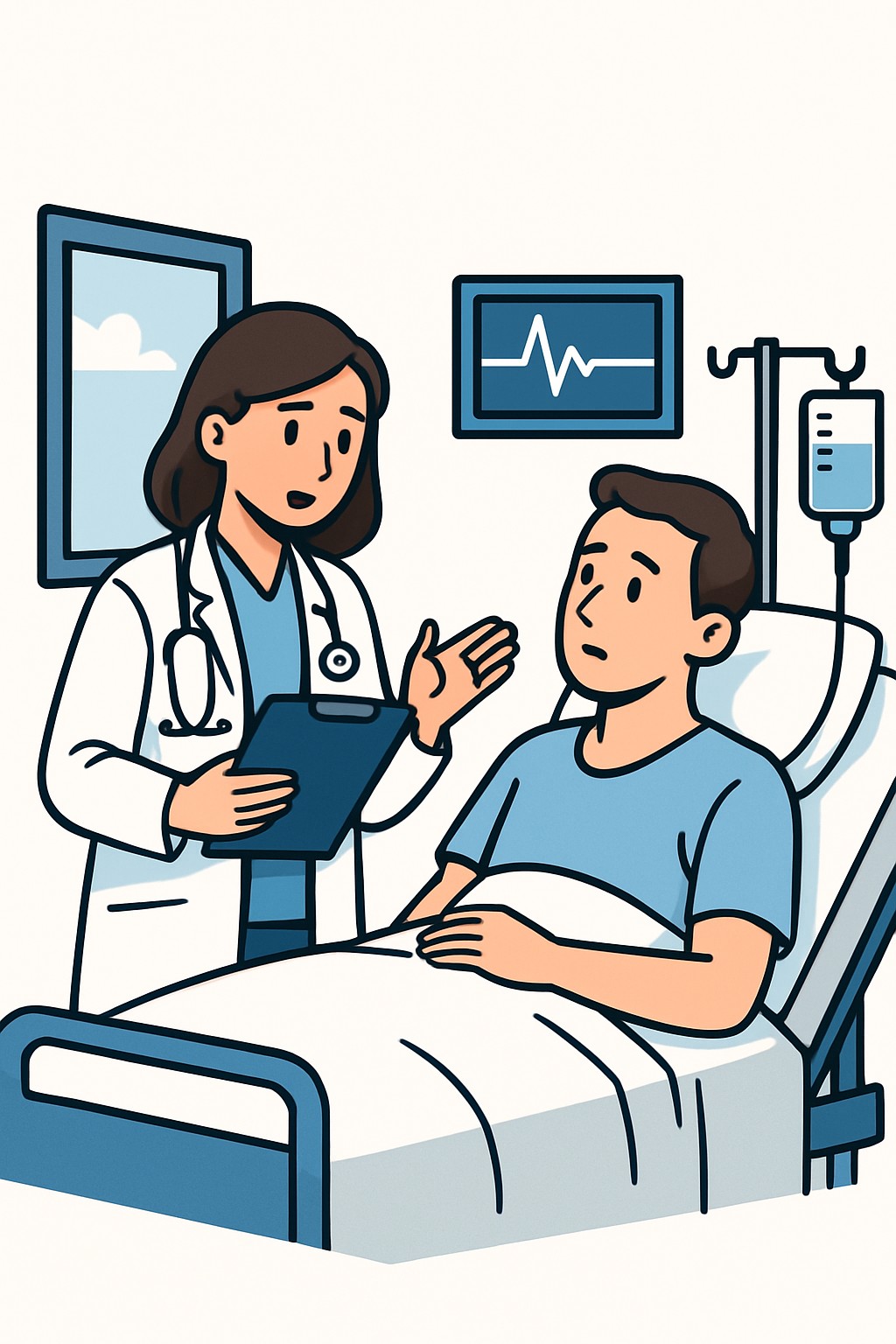
A hospital inpatient visit (subsequent, high) is a daily or follow-up evaluation for someone already admitted to the hospital.
Overview
A hospital inpatient visit (subsequent, high) is a daily or follow-up evaluation for someone already admitted to the hospital. It involves a bedside assessment, review of test results, medication and treatment updates, and coordination with the care team. High means the medical decision making is complex. The clinician addresses serious problems or risks, interprets significant data, and may make high-risk treatment decisions.
Also known as: Subsequent hospital care (high), High-complexity inpatient visit, Hospital progress note (high), Inpatient E/M high (subsequent)
Preparation & Next Steps
Everything you need to know before and after your procedure
Before Care
- Keep an up-to-date list of medicines and allergies available at the bedside or in the patient portal
- Write down the top 2–3 questions or concerns to discuss during rounds
- Note any overnight changes in symptoms, pain, breathing, or intake and output to share with the team
- Have glasses, hearing aids, communication devices, and chargers ready so you can participate
- Confirm preferred language and request an interpreter if needed
- Identify a family contact who can join by phone or in person for updates
- Make sure advance directives or healthcare proxy information is available to the care team
- Know key room information such as the call light and whiteboard where plans and goals are listed
After Care
- Review the daily plan with staff, including tests, medication changes, diet, and activity restrictions
- Keep a simple log of new medicines, stopped medicines, and any side effects to report
- Ask how to prepare for any scheduled tests or procedures and whether you need to be NPO (nothing by mouth)
- Understand any mobility or fall precautions explained by staff and how to request help
- Confirm which specialists are involved and when follow-up assessments will occur
- Clarify whom to contact on the unit for questions and how to reach them after hours while inpatient
- Tell the care team promptly about new or worsening symptoms such as chest pain, trouble breathing, confusion, severe pain, or uncontrolled bleeding
- Begin discharge planning early by confirming expected needs like home services, equipment, or follow-up appointments
Clinical Information
Important medical details about this procedure
Indications
- Complex or worsening illness during a hospital stay
- New significant symptoms or complications
- High-risk medication management or escalation of therapy
- Multiple tests or consultant input requiring integration
- Monitoring for potential organ dysfunction or rapid changes
- Care planning for conditions with significant risk of morbidity
Alternatives
- Lower-level subsequent inpatient visit when complexity is less
- Interprofessional communication without a bedside visit
- Telehealth check-in within the hospital when permitted by policy
Risks
- Miscommunication about the care plan
- Side effects from medication changes or new treatments
- Test-related risks if imaging or procedures are ordered
- Potential privacy concerns if sensitive topics are discussed in shared spaces
- Possible out-of-pocket costs depending on coverage
Contraindications
- Initial admission visit, which is billed differently
- Care that meets criteria for critical care services
- Discharge day management, which uses separate services
- Patient not admitted as an inpatient at the time of service
Recovery Timeline
What to expect during your recovery
There is no physical recovery period from the visit itself. Most people continue usual inpatient activities right away while the care plan is updated.
Typical Range
Same day
Return to Work
Same day
Recovery Milestones
Resume usual inpatient routines after the clinician visit
Complete any labs, imaging, or consults ordered during the visit
Adjust to medication changes with monitoring as directed by the team
Participate in therapy sessions or education related to the care plan
Frequently Asked Questions
Common questions and expert answers about this procedure
What does subsequent high mean?
What does subsequent high mean?
Subsequent means it is not the first hospital visit for this admission. High means the medical decision making is complex due to serious problems, data review, or high-risk treatments.
Who performs this visit?
Who performs this visit?
A physician or advanced practice clinician, such as a nurse practitioner or physician assistant, usually leads the visit and coordinates with the hospital care team.
What happens during the visit?
What happens during the visit?
The clinician reviews your status, examines you as needed, interprets new results, updates the plan and medicines, and coordinates tests or specialist input.
How long does the visit take?
How long does the visit take?
Time varies. The focus is on the complexity of decision making rather than a set number of minutes.
How is this different from critical care?
How is this different from critical care?
Critical care is for life-threatening conditions needing constant attention and intensive management. High subsequent care is complex but does not meet critical care criteria.
Can family join the discussion?
Can family join the discussion?
Yes, with your permission. They can be present in person or by phone, and an interpreter can be arranged if needed.
Will tests or procedures be done the same day?
Will tests or procedures be done the same day?
Often, tests are ordered during the visit and may occur the same day or soon after, depending on urgency and scheduling.
References
Medical literature and sources