%20--%3e%3csvg%20version='1.0'%20id='Layer_1'%20xmlns='http://www.w3.org/2000/svg'%20xmlns:xlink='http://www.w3.org/1999/xlink'%20x='0px'%20y='0px'%20viewBox='0%200%20755.52%20814.35'%20style='enable-background:new%200%200%20755.52%20814.35;'%20xml:space='preserve'%3e%3cstyle%20type='text/css'%3e%20.st0{fill:%231ae5ce;stroke:%231ae5ce;stroke-width:7;stroke-miterlimit:10;}%20.st1{fill:%23FFFFFF;stroke:%231ae5ce;stroke-width:7;stroke-miterlimit:10;}%20.st2{fill:%231ae5ce;stroke:%23FFFFFF;stroke-width:7;stroke-miterlimit:10;}%20.st3{fill:%23FFFFFF;stroke:%23FFFFFF;stroke-width:6;stroke-miterlimit:10;}%20%3c/style%3e%3cg%20id='Dark_Logo_00000159431215648494653180000015900878925932721032_'%3e%3cpath%20id='shield_00000152259091539869183100000001926543869452564382_'%20class='st0'%20d='M711.13,173.42%20c-3.37-49.07-38.92-44.9-75.96-52.18c-67.4-13.25-130.47-34.47-192.36-63.92c-22.48-10.7-41.88-25.74-65.05-26.28%20c-23.17,0.54-42.58,15.59-65.05,26.28c-61.89,29.45-124.95,50.68-192.36,63.92c-37.04,7.28-72.59,3.11-75.96,52.18%20c-1.55,22.6,0.34,46.4,1.05,68.92c5.99,190.78,52.91,345.39,206.27,466.46c29.71,23.46,74.51,55.8,108.84,70.75%20c5.99,2.61,11.7,3.73,17.21,3.75c5.51-0.02,11.22-1.14,17.21-3.75c34.33-14.95,79.12-47.3,108.84-70.75%20c153.37-121.07,200.28-275.68,206.27-466.46C710.79,219.82,712.68,196.02,711.13,173.42z'/%3e%3cpath%20id='magnifyingglass_00000073685934697636024790000000342567780940956808_'%20class='st1'%20d='M648.78,624.21l-96.64-104.65%20c34.89-40.63,55.98-93.46,55.98-151.21c0-128.27-103.98-232.24-232.24-232.24S143.63,240.08,143.63,368.35%20s103.98,232.24,232.24,232.24c48.87,0,94.21-15.11,131.62-40.89l97.18,105.24c11.25,12.18,30.24,12.93,42.42,1.69l0,0%20C659.27,655.38,660.03,636.39,648.78,624.21z'/%3e%3ccircle%20id='ellipse_00000129904010550392394720000017056154833629780114_'%20class='st2'%20cx='375.87'%20cy='368.35'%20r='181.21'/%3e%3cpath%20id='dollarsign_00000057140127156649725250000003772530148495155891_'%20class='st3'%20d='M362.91,492.03v-23.91%20c0-2.01-1.58-3.69-3.59-3.77c-18.49-0.78-37.12-5.4-49.4-11.83c-1.75-0.92-2.53-3.01-1.76-4.84l5.87-13.89%20c0.86-2.02,3.23-2.88,5.2-1.89c12.94,6.52,30.45,11.44,49.18,11.44c26.02,0,43.6-12.73,43.6-30.43c0-17.08-14.29-27.63-41.4-36.95%20c-37.37-12.42-60.46-26.7-60.46-53.72c0-24.97,20.29-44.11,52.22-49.51c1.8-0.31,3.11-1.89,3.11-3.72v-24.35%20c0-2.09,1.69-3.78,3.78-3.78h15.16c2.09,0,3.78,1.69,3.78,3.78v22.71c0,2.01,1.58,3.67,3.58,3.77c17.85,0.92,30.88,4.75,40.61,9.1%20c1.92,0.86,2.79,3.09,1.94,5.01l-6.08,13.6c-0.85,1.91-3.09,2.77-4.99,1.91c-8.37-3.8-22.38-8.95-42.75-8.95%20c-28.21,0-38.84,14.28-38.84,26.7c0,16.15,13.56,24.22,45.44,35.4c37.74,13.04,56.79,29.19,56.79,56.82%20c0,23.85-19.05,46.23-54.78,52.3c-1.8,0.31-3.11,1.89-3.11,3.72v25.28c0,2.09-1.69,3.78-3.78,3.78h-15.53%20C364.6,495.81,362.91,494.12,362.91,492.03z'/%3e%3c/g%3e%3c/svg%3e)
Hospital Inpatient Visit (Subsequent, Moderate) Evaluation Management
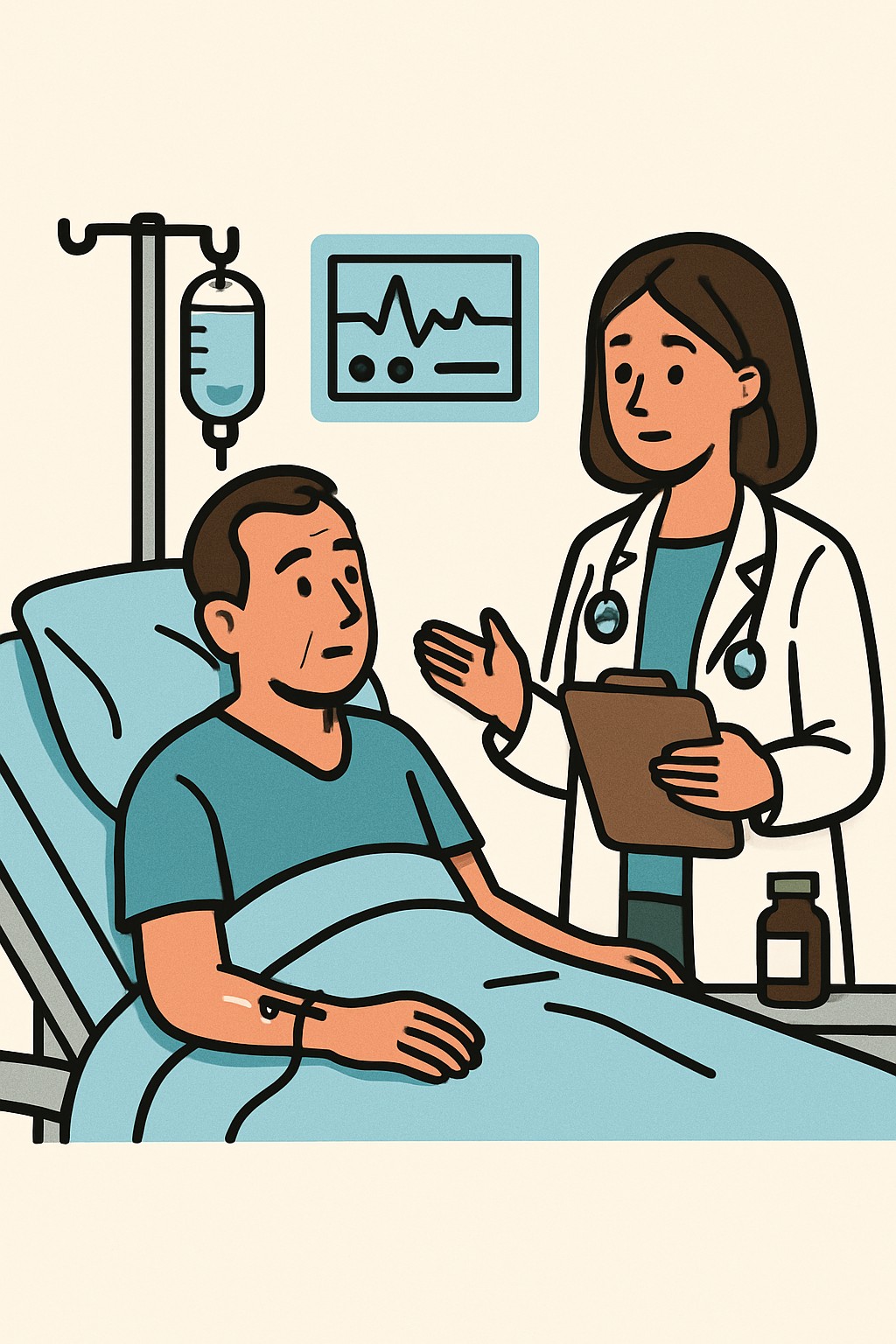
A hospital inpatient visit (subsequent, moderate) is a daily follow-up visit after you have already been admitted.
Overview
A hospital inpatient visit (subsequent, moderate) is a daily follow-up visit after you have already been admitted. A clinician reviews your status, examines you as needed, checks recent test results, updates orders, and plans next steps in your care. "Subsequent" means it is not the first hospital day. "Moderate" refers to the level of medical decision making, such as managing active problems, adjusting medicines, or ordering and interpreting tests when there is some risk or complexity.
Also known as: Inpatient follow-up visit (moderate), Hospital rounding visit (moderate), Subsequent hospital care (moderate MDM)
Preparation & Next Steps
Everything you need to know before and after your procedure
Before Care
- Keep a short list of your top questions and symptoms with when they started
- Have an up-to-date list of medicines and allergies available
- Use the room whiteboard or a notebook to track tests, results, and tasks
- Ask for an interpreter if you prefer a language other than English
- Share contact information for a caregiver who can join by phone or in person
- Keep glasses, hearing aids, or communication devices ready for the visit
- Keep advance directives or health care proxy information accessible
- Note changes in pain, breathing, sleep, appetite, or bathroom use to discuss
- Ask about timing or preparation if same-day tests or therapies are planned
After Care
- Review the visit summary and the plan for the day, including tests and medicines
- Confirm any medication changes and when they take effect
- Clarify activity, diet, or isolation precautions with the care team
- Ask who to contact with questions during off-hours while hospitalized
- Track symptoms and side effects and share updates with nursing staff
- Tell the care team promptly about worsening pain, trouble breathing, confusion, bleeding, fever, or new symptoms
- Discuss discharge plans early, including equipment, teaching, and follow-up appointments
- Arrange a support person to join teaching sessions if skills or wound care are reviewed
- Save printed handouts and add them to your personal health records
Clinical Information
Important medical details about this procedure
Indications
- Ongoing monitoring during a hospital stay
- Evaluating response to treatments or new test results
- Adjusting medicines or therapies
- New or changing symptoms while admitted
- Coordinating care among specialists
- Planning for discharge and follow-up needs
Alternatives
- Lower-complexity inpatient visit when care needs are simpler
- Higher-complexity inpatient visit when conditions are more serious
- Specialist consultation for focused issues
- Telehealth rounding or virtual consults when hospital policy allows
- Chart review and orders without a bedside encounter when appropriate
Risks
- Miscommunication about the plan or medicines
- Delays if key information or results are unavailable
- Privacy concerns if sensitive topics are discussed without desired support
- Exposure to hospital-acquired infections related to the hospital setting
- Downstream risks from new tests or treatments that may be ordered
- Potential out-of-pocket costs depending on coverage
Contraindications
- None specific; patients needing critical care are managed under different services
- Immediate procedure or resuscitation needs take priority over a routine visit
- Comfort-focused care where daily medical decision making is limited
Recovery Timeline
What to expect during your recovery
There is no medical recovery period from the visit itself. Most people continue normal hospital activities immediately after the clinician leaves.
Typical Range
Same day
Return to Work
Same day
Recovery Milestones
Resume usual hospital routines and therapies
Complete any tests or consultations ordered during the visit
Review evolving results and updated plans during daily rounds
Frequently Asked Questions
Common questions and expert answers about this procedure
What does subsequent mean in the hospital?
What does subsequent mean in the hospital?
It means a follow-up visit on a day after your initial hospital admission day.
What is moderate medical decision making?
What is moderate medical decision making?
It involves evaluating active problems, reviewing tests, and making changes with some complexity or risk, such as adjusting multiple medicines or ordering new studies.
How long does the visit take?
How long does the visit take?
Time varies. The clinician’s total time includes reviewing your chart, seeing you, coordinating with the team, and documenting the plan.
Who might see me during this visit?
Who might see me during this visit?
You may see a hospitalist physician, resident, nurse practitioner, or physician assistant. Nurses and specialists may also participate.
How often will I get these visits?
How often will I get these visits?
Typically once daily during your stay, but frequency can vary based on your condition and hospital routines.
Will tests or treatments change after the visit?
Will tests or treatments change after the visit?
They may. The clinician might order tests, adjust medicines, or request a specialist consultation based on your progress.
Can family or a caregiver join the discussion?
Can family or a caregiver join the discussion?
Often yes, in person or by phone, following hospital policies and your preferences.
How could this visit affect my bill?
How could this visit affect my bill?
Clinicians bill daily evaluation and management services. Costs depend on your coverage, network status, and any additional tests or treatments.
References
Medical literature and sources