%20--%3e%3csvg%20version='1.0'%20id='Layer_1'%20xmlns='http://www.w3.org/2000/svg'%20xmlns:xlink='http://www.w3.org/1999/xlink'%20x='0px'%20y='0px'%20viewBox='0%200%20755.52%20814.35'%20style='enable-background:new%200%200%20755.52%20814.35;'%20xml:space='preserve'%3e%3cstyle%20type='text/css'%3e%20.st0{fill:%231ae5ce;stroke:%231ae5ce;stroke-width:7;stroke-miterlimit:10;}%20.st1{fill:%23FFFFFF;stroke:%231ae5ce;stroke-width:7;stroke-miterlimit:10;}%20.st2{fill:%231ae5ce;stroke:%23FFFFFF;stroke-width:7;stroke-miterlimit:10;}%20.st3{fill:%23FFFFFF;stroke:%23FFFFFF;stroke-width:6;stroke-miterlimit:10;}%20%3c/style%3e%3cg%20id='Dark_Logo_00000159431215648494653180000015900878925932721032_'%3e%3cpath%20id='shield_00000152259091539869183100000001926543869452564382_'%20class='st0'%20d='M711.13,173.42%20c-3.37-49.07-38.92-44.9-75.96-52.18c-67.4-13.25-130.47-34.47-192.36-63.92c-22.48-10.7-41.88-25.74-65.05-26.28%20c-23.17,0.54-42.58,15.59-65.05,26.28c-61.89,29.45-124.95,50.68-192.36,63.92c-37.04,7.28-72.59,3.11-75.96,52.18%20c-1.55,22.6,0.34,46.4,1.05,68.92c5.99,190.78,52.91,345.39,206.27,466.46c29.71,23.46,74.51,55.8,108.84,70.75%20c5.99,2.61,11.7,3.73,17.21,3.75c5.51-0.02,11.22-1.14,17.21-3.75c34.33-14.95,79.12-47.3,108.84-70.75%20c153.37-121.07,200.28-275.68,206.27-466.46C710.79,219.82,712.68,196.02,711.13,173.42z'/%3e%3cpath%20id='magnifyingglass_00000073685934697636024790000000342567780940956808_'%20class='st1'%20d='M648.78,624.21l-96.64-104.65%20c34.89-40.63,55.98-93.46,55.98-151.21c0-128.27-103.98-232.24-232.24-232.24S143.63,240.08,143.63,368.35%20s103.98,232.24,232.24,232.24c48.87,0,94.21-15.11,131.62-40.89l97.18,105.24c11.25,12.18,30.24,12.93,42.42,1.69l0,0%20C659.27,655.38,660.03,636.39,648.78,624.21z'/%3e%3ccircle%20id='ellipse_00000129904010550392394720000017056154833629780114_'%20class='st2'%20cx='375.87'%20cy='368.35'%20r='181.21'/%3e%3cpath%20id='dollarsign_00000057140127156649725250000003772530148495155891_'%20class='st3'%20d='M362.91,492.03v-23.91%20c0-2.01-1.58-3.69-3.59-3.77c-18.49-0.78-37.12-5.4-49.4-11.83c-1.75-0.92-2.53-3.01-1.76-4.84l5.87-13.89%20c0.86-2.02,3.23-2.88,5.2-1.89c12.94,6.52,30.45,11.44,49.18,11.44c26.02,0,43.6-12.73,43.6-30.43c0-17.08-14.29-27.63-41.4-36.95%20c-37.37-12.42-60.46-26.7-60.46-53.72c0-24.97,20.29-44.11,52.22-49.51c1.8-0.31,3.11-1.89,3.11-3.72v-24.35%20c0-2.09,1.69-3.78,3.78-3.78h15.16c2.09,0,3.78,1.69,3.78,3.78v22.71c0,2.01,1.58,3.67,3.58,3.77c17.85,0.92,30.88,4.75,40.61,9.1%20c1.92,0.86,2.79,3.09,1.94,5.01l-6.08,13.6c-0.85,1.91-3.09,2.77-4.99,1.91c-8.37-3.8-22.38-8.95-42.75-8.95%20c-28.21,0-38.84,14.28-38.84,26.7c0,16.15,13.56,24.22,45.44,35.4c37.74,13.04,56.79,29.19,56.79,56.82%20c0,23.85-19.05,46.23-54.78,52.3c-1.8,0.31-3.11,1.89-3.11,3.72v25.28c0,2.09-1.69,3.78-3.78,3.78h-15.53%20C364.6,495.81,362.91,494.12,362.91,492.03z'/%3e%3c/g%3e%3c/svg%3e)
Initial observation care (high complexity) Evaluation Management
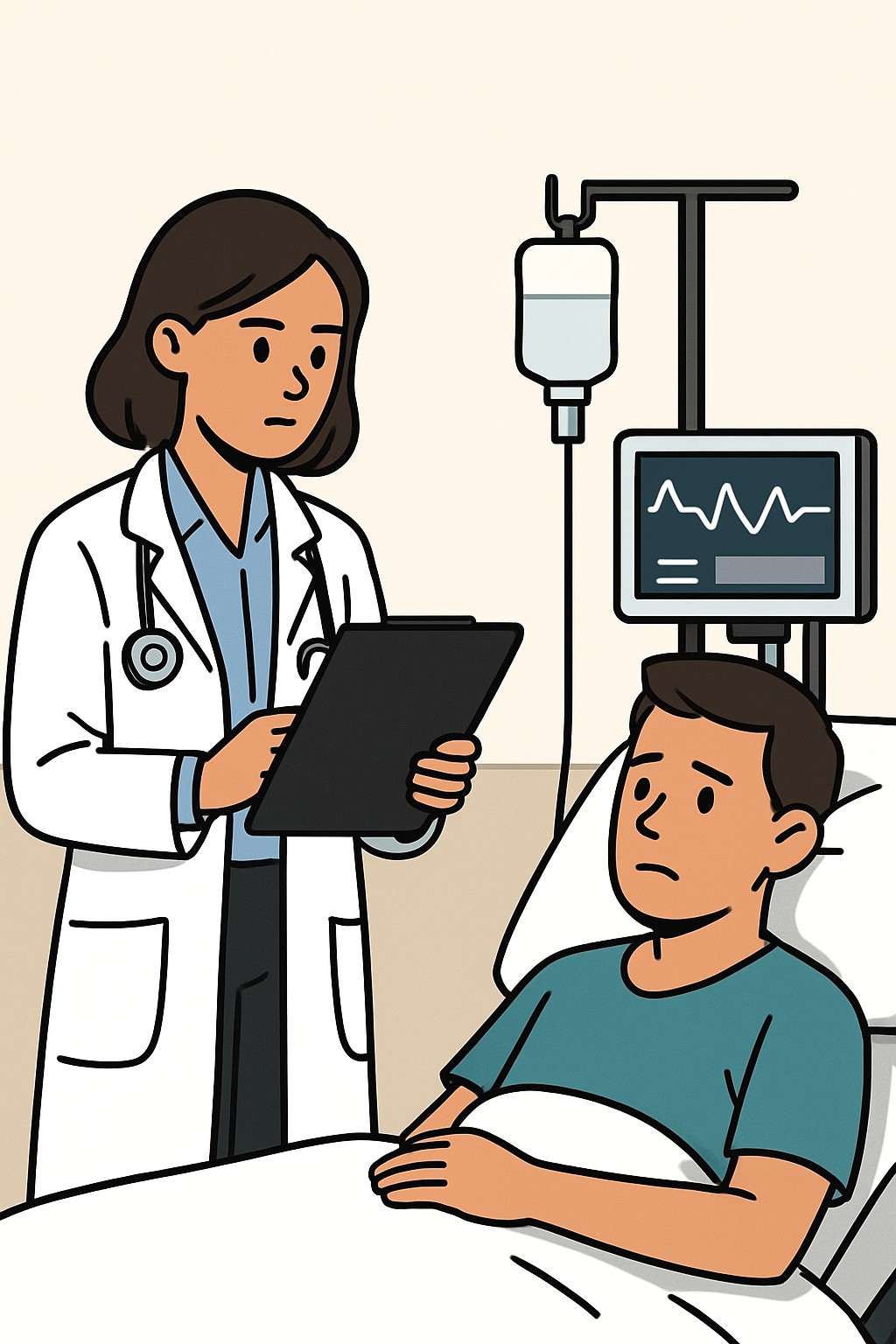
Initial observation care (high complexity) is a hospital-based evaluation and management service for patients placed in an observation unit or outpatient bed.
Overview
Initial observation care (high complexity) is a hospital-based evaluation and management service for patients placed in an observation unit or outpatient bed. A clinician assesses the condition, reviews records and test results, orders additional tests or treatments as needed, and documents the care plan. High complexity means the medical decision making is complex due to serious illness, high risk of complications, or the need to review and interpret extensive data. Observation is generally used when a patient needs monitoring and short-term treatment but may not require full inpatient admission.
Also known as: Observation admission (high complexity), Initial hospital or observation care (high MDM), Observation unit admission – high complexity
Preparation & Next Steps
Everything you need to know before and after your procedure
Before Care
- Bring a photo ID, insurance card, and any relevant referral or paperwork
- Carry an up-to-date list of all medicines and supplements, including doses and last taken time
- List allergies and prior reactions to medicines, contrast dye, or anesthesia
- Have contact information for your primary clinician, specialists, and preferred pharmacy
- Bring copies of recent labs, imaging reports, device readings, or discharge papers if available
- Arrange transportation and prepare for a possible overnight stay
- Bring essential personal items only, plus eyeglasses, hearing aids, dentures, or a CPAP device if used
- Share advance directives or a health care proxy document if you have one
- Keep a charged phone and charger; confirm how to reach your emergency contact
- Ask staff how observation status may affect coverage and billing, including copays and post-hospital services
After Care
- Review the discharge summary, diagnosis, test results, and the plan for next steps
- Keep a clear list of any medication changes and new prescriptions
- Schedule recommended follow-up visits or tests and note due dates
- Track symptoms and bring notes to your follow-up appointment
- Watch for return or worsening of the issue that led to observation
- Contact a clinician if you have new chest pain, trouble breathing, high fever, severe weakness, or confusion
- Confirm whether your stay was observation or inpatient on your paperwork for billing questions
- Keep the Medicare Outpatient Observation Notice (MOON) if you received one
- Check your insurance explanation of benefits and ask about any unexpected charges
- Resume daily activities as tolerated and increase activity gradually if you feel fatigued
Clinical Information
Important medical details about this procedure
Indications
- Chest pain being evaluated for possible heart problems
- Asthma or COPD flare needing short-term treatment and monitoring
- Dehydration requiring IV fluids and observation
- Fainting or dizziness under evaluation
- Abdominal pain needing serial exams and tests
- Irregular heart rhythms under monitoring
- Infections requiring brief IV antibiotics and reassessment
- Medication reactions under observation
Alternatives
- Emergency department evaluation with discharge and close follow-up
- Direct inpatient admission for conditions needing longer or more intensive care
- Urgent outpatient clinic evaluation if symptoms are mild and stable
- Home care with scheduled follow-up when clinically appropriate
Risks
- Hospital-related infections
- Side effects from medicines or IV treatments
- Allergic or contrast reactions from imaging
- Radiation exposure from diagnostic imaging
- Falls or sleep disruption in the hospital setting
- Out-of-pocket costs related to observation status billed as outpatient
Contraindications
- Conditions needing immediate inpatient or intensive care (for example, unstable vital signs or organ failure)
- Need for invasive monitoring or continuous high-level support not available in an observation unit
- Situations where outpatient monitoring is unsafe or inadequate
Recovery Timeline
What to expect during your recovery
There is no set recovery period from the evaluation itself. Recovery depends on the underlying condition and any tests or treatments received during observation.
Typical Range
Same day
Return to Work
Same day
Recovery Milestones
Resume routine self-care and normal light activities as your condition allows
Review discharge papers, schedule follow-ups, and complete any ordered outpatient tests
Monitor symptoms and medication effects and note questions for your clinician
Frequently Asked Questions
Common questions and expert answers about this procedure
What is initial observation care?
What is initial observation care?
It is the first hospital evaluation and care plan when you are placed in an observation unit or outpatient bed for monitoring and short-term treatment.
What does high complexity mean?
What does high complexity mean?
It means the clinician is managing serious problems or high-risk decisions and reviewing extensive data, which makes the medical decision making complex.
How long does observation usually last?
How long does observation usually last?
Observation is generally short term, often less than two midnights, but the length depends on your condition and test results.
Who will see me in observation?
Who will see me in observation?
Hospital clinicians such as hospitalists, emergency physicians, nurse practitioners, or physician assistants generally manage observation care, with consultants as needed.
Will I stay overnight?
Will I stay overnight?
Many observation stays include an overnight, but some last only several hours. The decision depends on your status and clinical needs.
How is observation billed?
How is observation billed?
Observation is an outpatient hospital service. For Medicare, this can affect copays and eligibility for some post-hospital services. You may receive a MOON notice.
What tests or treatments might I get?
What tests or treatments might I get?
Common items include blood tests, heart monitoring, imaging, IV fluids, breathing treatments, and medicines to control pain, nausea, or blood pressure.
What happens at discharge?
What happens at discharge?
You receive a summary of findings, the care plan, medication changes, and follow-up instructions, and any outpatient tests or referrals are arranged.
References
Medical literature and sources