%20--%3e%3csvg%20version='1.0'%20id='Layer_1'%20xmlns='http://www.w3.org/2000/svg'%20xmlns:xlink='http://www.w3.org/1999/xlink'%20x='0px'%20y='0px'%20viewBox='0%200%20755.52%20814.35'%20style='enable-background:new%200%200%20755.52%20814.35;'%20xml:space='preserve'%3e%3cstyle%20type='text/css'%3e%20.st0{fill:%231ae5ce;stroke:%231ae5ce;stroke-width:7;stroke-miterlimit:10;}%20.st1{fill:%23FFFFFF;stroke:%231ae5ce;stroke-width:7;stroke-miterlimit:10;}%20.st2{fill:%231ae5ce;stroke:%23FFFFFF;stroke-width:7;stroke-miterlimit:10;}%20.st3{fill:%23FFFFFF;stroke:%23FFFFFF;stroke-width:6;stroke-miterlimit:10;}%20%3c/style%3e%3cg%20id='Dark_Logo_00000159431215648494653180000015900878925932721032_'%3e%3cpath%20id='shield_00000152259091539869183100000001926543869452564382_'%20class='st0'%20d='M711.13,173.42%20c-3.37-49.07-38.92-44.9-75.96-52.18c-67.4-13.25-130.47-34.47-192.36-63.92c-22.48-10.7-41.88-25.74-65.05-26.28%20c-23.17,0.54-42.58,15.59-65.05,26.28c-61.89,29.45-124.95,50.68-192.36,63.92c-37.04,7.28-72.59,3.11-75.96,52.18%20c-1.55,22.6,0.34,46.4,1.05,68.92c5.99,190.78,52.91,345.39,206.27,466.46c29.71,23.46,74.51,55.8,108.84,70.75%20c5.99,2.61,11.7,3.73,17.21,3.75c5.51-0.02,11.22-1.14,17.21-3.75c34.33-14.95,79.12-47.3,108.84-70.75%20c153.37-121.07,200.28-275.68,206.27-466.46C710.79,219.82,712.68,196.02,711.13,173.42z'/%3e%3cpath%20id='magnifyingglass_00000073685934697636024790000000342567780940956808_'%20class='st1'%20d='M648.78,624.21l-96.64-104.65%20c34.89-40.63,55.98-93.46,55.98-151.21c0-128.27-103.98-232.24-232.24-232.24S143.63,240.08,143.63,368.35%20s103.98,232.24,232.24,232.24c48.87,0,94.21-15.11,131.62-40.89l97.18,105.24c11.25,12.18,30.24,12.93,42.42,1.69l0,0%20C659.27,655.38,660.03,636.39,648.78,624.21z'/%3e%3ccircle%20id='ellipse_00000129904010550392394720000017056154833629780114_'%20class='st2'%20cx='375.87'%20cy='368.35'%20r='181.21'/%3e%3cpath%20id='dollarsign_00000057140127156649725250000003772530148495155891_'%20class='st3'%20d='M362.91,492.03v-23.91%20c0-2.01-1.58-3.69-3.59-3.77c-18.49-0.78-37.12-5.4-49.4-11.83c-1.75-0.92-2.53-3.01-1.76-4.84l5.87-13.89%20c0.86-2.02,3.23-2.88,5.2-1.89c12.94,6.52,30.45,11.44,49.18,11.44c26.02,0,43.6-12.73,43.6-30.43c0-17.08-14.29-27.63-41.4-36.95%20c-37.37-12.42-60.46-26.7-60.46-53.72c0-24.97,20.29-44.11,52.22-49.51c1.8-0.31,3.11-1.89,3.11-3.72v-24.35%20c0-2.09,1.69-3.78,3.78-3.78h15.16c2.09,0,3.78,1.69,3.78,3.78v22.71c0,2.01,1.58,3.67,3.58,3.77c17.85,0.92,30.88,4.75,40.61,9.1%20c1.92,0.86,2.79,3.09,1.94,5.01l-6.08,13.6c-0.85,1.91-3.09,2.77-4.99,1.91c-8.37-3.8-22.38-8.95-42.75-8.95%20c-28.21,0-38.84,14.28-38.84,26.7c0,16.15,13.56,24.22,45.44,35.4c37.74,13.04,56.79,29.19,56.79,56.82%20c0,23.85-19.05,46.23-54.78,52.3c-1.8,0.31-3.11,1.89-3.11,3.72v25.28c0,2.09-1.69,3.78-3.78,3.78h-15.53%20C364.6,495.81,362.91,494.12,362.91,492.03z'/%3e%3c/g%3e%3c/svg%3e)
Microvolt T-wave assessment (cardiac risk test) Evaluation Management
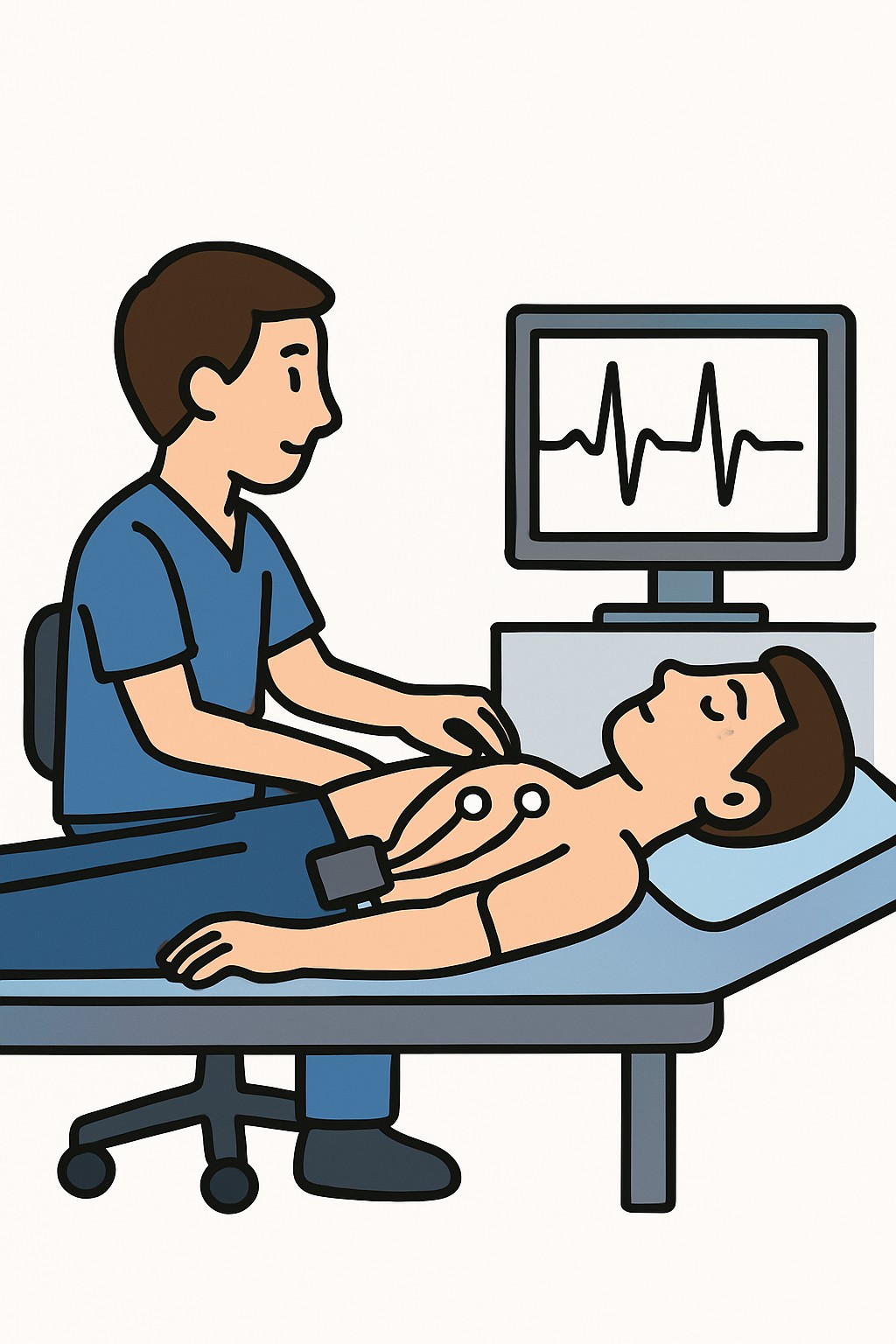
Microvolt T-wave assessment measures very small, beat-to-beat changes in the heart’s electrical recovery signal on an electrocardiogram (ECG).
Overview
Microvolt T-wave assessment measures very small, beat-to-beat changes in the heart’s electrical recovery signal on an electrocardiogram (ECG). These tiny changes are called T-wave alternans. Special equipment detects changes at the microvolt level. This test is used to help estimate the risk of dangerous heart rhythms. It is often done during controlled exercise on a treadmill or bike, or during paced heartbeats, while a computer analyzes the ECG signal.
Also known as: T-wave alternans test, Microvolt T-wave alternans, MTWA test
Preparation & Next Steps
Everything you need to know before and after your procedure
Before Care
- Confirm the test type (exercise-based or paced) and location with the scheduling team
- Follow the lab or clinician’s instructions about eating, caffeine, nicotine, and energy drinks before the test
- Ask the lab how to handle your regular medicines on the day of testing; bring an up-to-date medication list
- Wear comfortable clothing and walking shoes if an exercise treadmill or bike is planned
- Avoid lotions or oils on the chest and upper body the day of the test to help electrodes stick
- Bring a photo ID and any device information card if you have an implanted device
- Arrive a little early to check in and allow time for placing ECG electrodes
- Plan light hydration; use the restroom before the test to avoid interruptions
- Arrange transportation if your facility recommends it after exercise testing
- Bring prior ECGs or test summaries if the facility requested them
After Care
- Electrodes are removed after the test; mild skin redness or soreness usually fades soon
- Hydrate and have a light snack as needed, unless you were told otherwise by the facility
- If you completed a strenuous exercise protocol, plan easy activities for the rest of the day
- Resume regular daily activities when you feel ready
- Check how and when results will be shared (patient portal, phone call, or follow-up appointment)
- Note any chest discomfort, unusual shortness of breath, fainting, or sustained palpitations after the test and contact a clinician
- Keep adhesive residue off by gently washing the sites; avoid harsh scrubbing
- Record any symptoms you felt during the test to discuss when you review results
Clinical Information
Important medical details about this procedure
Indications
- Evaluating risk for life-threatening ventricular arrhythmias
- Risk assessment after a prior heart attack
- Cardiomyopathy or reduced left ventricular ejection fraction
- Unexplained fainting (syncope) or concerning palpitations
- Family history or suspicion of inherited rhythm disorders
- Additional risk information before consideration of an implantable defibrillator (ICD)
Alternatives
- Standard electrocardiogram (ECG)
- Ambulatory monitoring (Holter or patch monitor)
- Event monitor or implantable loop recorder
- Exercise stress test without T-wave alternans analysis
- Signal-averaged ECG
- Echocardiogram
- Cardiac MRI
- Electrophysiology study
Risks
- Skin irritation where electrodes are placed
- Fatigue, shortness of breath, or muscle soreness from exercise-based testing
- Dizziness or chest discomfort during exertion that usually improves with rest
- Rare abnormal heart rhythms during exercise testing under supervision
- Inconclusive or uninterpretable results in certain rhythms (for example, frequent ectopy or atrial fibrillation)
Contraindications
- Unstable chest pain or recent heart attack
- Severe, uncontrolled arrhythmias
- Decompensated heart failure
- Inability to exercise for an exercise-based protocol
- Conditions that prevent reliable ECG signal (for example, significant artifact or poor electrode contact)
Recovery Timeline
What to expect during your recovery
Most people have no recovery time after this noninvasive test. Mild tiredness from exercise-based testing typically resolves the same day.
Typical Range
0–1 days
Return to Work
0–1 days
Recovery Milestones
Resume light daily activities
Return to normal routines after exercise-based testing
Review results and next steps with your care team
Frequently Asked Questions
Common questions and expert answers about this procedure
What is microvolt T-wave alternans?
What is microvolt T-wave alternans?
It is a tiny beat-to-beat change in the T-wave on an ECG that can signal higher risk for dangerous heart rhythms. Specialized equipment measures these microvolt-level changes.
How is the test performed?
How is the test performed?
ECG electrodes are placed on your chest. The signal is recorded while you exercise on a treadmill or bike, or during controlled pacing. A computer looks for microvolt-level T-wave alternans.
How long does the test take?
How long does the test take?
Plan for about 30 to 60 minutes, including preparation, exercise or pacing, and recovery.
Is it painful?
Is it painful?
The test is noninvasive. You may feel exertion during exercise and brief discomfort when electrodes are removed.
Who should not have this test?
Who should not have this test?
People with unstable symptoms or those who cannot safely exercise may not be candidates for the exercise version. Certain heart rhythms can make the result hard to interpret.
What do positive, negative, or indeterminate results mean?
What do positive, negative, or indeterminate results mean?
They indicate relative risk levels for serious arrhythmias. Results are combined with your history, exam, and other tests to inform overall risk assessment.
Does this test replace other heart tests?
Does this test replace other heart tests?
No. It is one risk tool. Clinicians often use it alongside ECG, imaging, ambulatory monitors, stress testing, or other studies.
When will I get results?
When will I get results?
Timing varies by facility. Many centers share results within a few days through a portal or at a follow-up visit.
References
Medical literature and sources