%20--%3e%3csvg%20version='1.0'%20id='Layer_1'%20xmlns='http://www.w3.org/2000/svg'%20xmlns:xlink='http://www.w3.org/1999/xlink'%20x='0px'%20y='0px'%20viewBox='0%200%20755.52%20814.35'%20style='enable-background:new%200%200%20755.52%20814.35;'%20xml:space='preserve'%3e%3cstyle%20type='text/css'%3e%20.st0{fill:%231ae5ce;stroke:%231ae5ce;stroke-width:7;stroke-miterlimit:10;}%20.st1{fill:%23FFFFFF;stroke:%231ae5ce;stroke-width:7;stroke-miterlimit:10;}%20.st2{fill:%231ae5ce;stroke:%23FFFFFF;stroke-width:7;stroke-miterlimit:10;}%20.st3{fill:%23FFFFFF;stroke:%23FFFFFF;stroke-width:6;stroke-miterlimit:10;}%20%3c/style%3e%3cg%20id='Dark_Logo_00000159431215648494653180000015900878925932721032_'%3e%3cpath%20id='shield_00000152259091539869183100000001926543869452564382_'%20class='st0'%20d='M711.13,173.42%20c-3.37-49.07-38.92-44.9-75.96-52.18c-67.4-13.25-130.47-34.47-192.36-63.92c-22.48-10.7-41.88-25.74-65.05-26.28%20c-23.17,0.54-42.58,15.59-65.05,26.28c-61.89,29.45-124.95,50.68-192.36,63.92c-37.04,7.28-72.59,3.11-75.96,52.18%20c-1.55,22.6,0.34,46.4,1.05,68.92c5.99,190.78,52.91,345.39,206.27,466.46c29.71,23.46,74.51,55.8,108.84,70.75%20c5.99,2.61,11.7,3.73,17.21,3.75c5.51-0.02,11.22-1.14,17.21-3.75c34.33-14.95,79.12-47.3,108.84-70.75%20c153.37-121.07,200.28-275.68,206.27-466.46C710.79,219.82,712.68,196.02,711.13,173.42z'/%3e%3cpath%20id='magnifyingglass_00000073685934697636024790000000342567780940956808_'%20class='st1'%20d='M648.78,624.21l-96.64-104.65%20c34.89-40.63,55.98-93.46,55.98-151.21c0-128.27-103.98-232.24-232.24-232.24S143.63,240.08,143.63,368.35%20s103.98,232.24,232.24,232.24c48.87,0,94.21-15.11,131.62-40.89l97.18,105.24c11.25,12.18,30.24,12.93,42.42,1.69l0,0%20C659.27,655.38,660.03,636.39,648.78,624.21z'/%3e%3ccircle%20id='ellipse_00000129904010550392394720000017056154833629780114_'%20class='st2'%20cx='375.87'%20cy='368.35'%20r='181.21'/%3e%3cpath%20id='dollarsign_00000057140127156649725250000003772530148495155891_'%20class='st3'%20d='M362.91,492.03v-23.91%20c0-2.01-1.58-3.69-3.59-3.77c-18.49-0.78-37.12-5.4-49.4-11.83c-1.75-0.92-2.53-3.01-1.76-4.84l5.87-13.89%20c0.86-2.02,3.23-2.88,5.2-1.89c12.94,6.52,30.45,11.44,49.18,11.44c26.02,0,43.6-12.73,43.6-30.43c0-17.08-14.29-27.63-41.4-36.95%20c-37.37-12.42-60.46-26.7-60.46-53.72c0-24.97,20.29-44.11,52.22-49.51c1.8-0.31,3.11-1.89,3.11-3.72v-24.35%20c0-2.09,1.69-3.78,3.78-3.78h15.16c2.09,0,3.78,1.69,3.78,3.78v22.71c0,2.01,1.58,3.67,3.58,3.77c17.85,0.92,30.88,4.75,40.61,9.1%20c1.92,0.86,2.79,3.09,1.94,5.01l-6.08,13.6c-0.85,1.91-3.09,2.77-4.99,1.91c-8.37-3.8-22.38-8.95-42.75-8.95%20c-28.21,0-38.84,14.28-38.84,26.7c0,16.15,13.56,24.22,45.44,35.4c37.74,13.04,56.79,29.19,56.79,56.82%20c0,23.85-19.05,46.23-54.78,52.3c-1.8,0.31-3.11,1.89-3.11,3.72v25.28c0,2.09-1.69,3.78-3.78,3.78h-15.53%20C364.6,495.81,362.91,494.12,362.91,492.03z'/%3e%3c/g%3e%3c/svg%3e)
Observation care discharge day management Evaluation Management
Observation care discharge day management is the clinician service on the day you leave a hospital observation stay.
Overview
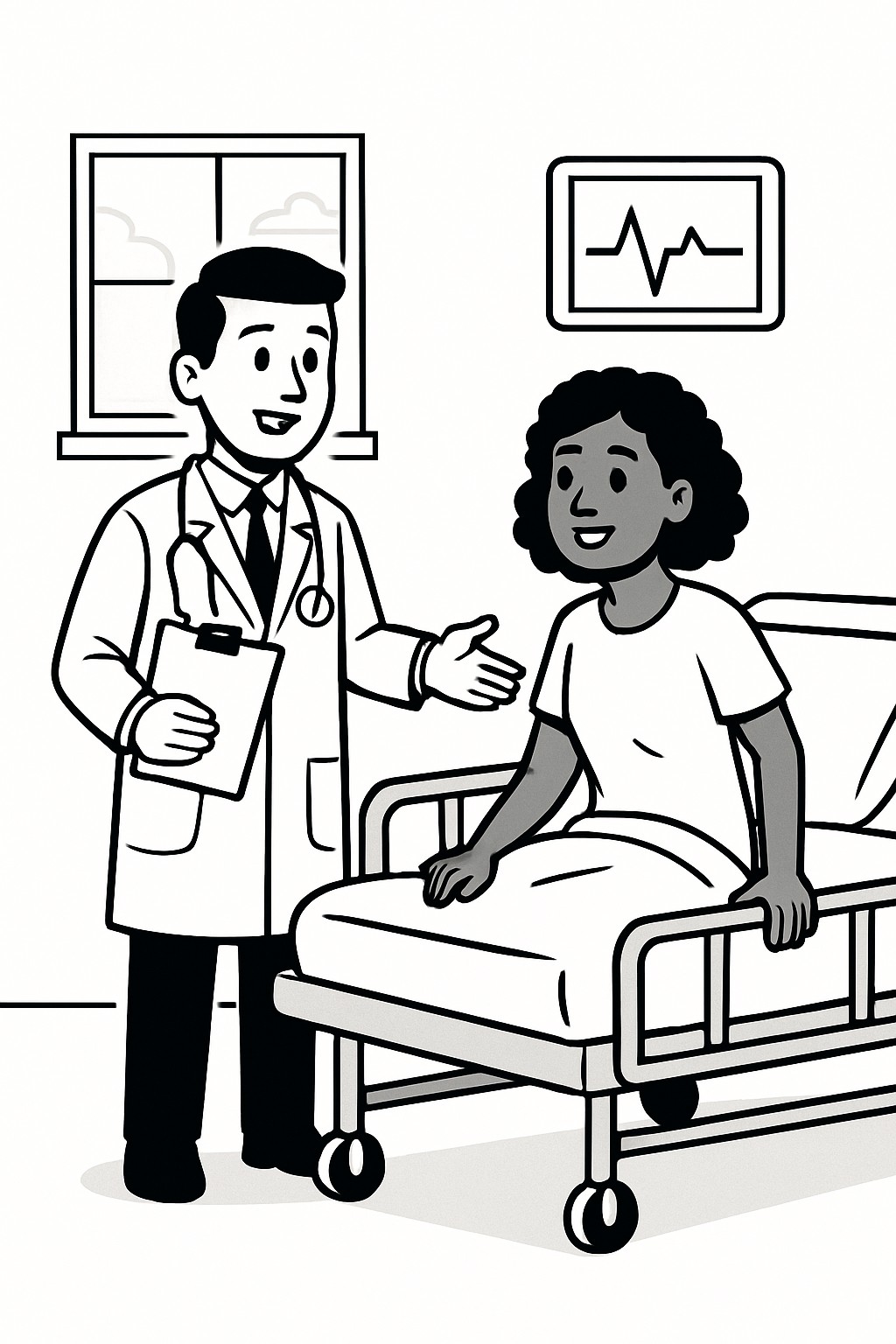
Observation care discharge day management is the clinician service on the day you leave a hospital observation stay. Observation care is short-term monitoring and testing in the hospital without being admitted as an inpatient. During this visit, the clinician reviews your hospital course, checks your current condition, reconciles medicines, explains results and home care instructions, arranges follow-up, and completes discharge paperwork. Prescriptions and referrals may be sent to your pharmacy and clinics.
Also known as: Observation discharge, Observation status discharge, Observation discharge management
Preparation & Next Steps
Everything you need to know before and after your procedure
Before Care
- Keep a short list of questions about your diagnosis, medicines, activity, and follow-up
- Have a current medication list, including doses and supplements, to compare with discharge instructions
- Confirm your preferred pharmacy name, address, and phone number
- Arrange a safe ride home and home support for the first day if needed
- Share allergies and prior reactions to medicines with the care team
- Make sure the hospital has your correct phone number and emergency contact
- Identify any home equipment you use (for example, inhalers, CPAP, glucometer) and bring or note settings
- Ask about work or school notes if documentation is needed
- Request an interpreter if you prefer to review instructions in another language
After Care
- Review your written discharge instructions and keep them in an easy-to-find place
- Use one updated medication list and follow the schedule provided; ask the clinic if anything is unclear
- Pick up new prescriptions and confirm how they fit with your existing medicines
- Know who to contact for questions during business hours and after hours
- Schedule follow-up appointments and any ordered labs or imaging
- Monitor symptoms and write down any changes, side effects, or concerns
- Follow activity guidance provided at discharge and increase as allowed
- Keep hydration, nutrition, and rest on track unless told otherwise by your care team
- Contact a clinician if you notice new, worsening, or concerning symptoms after going home
Clinical Information
Important medical details about this procedure
Indications
- Completion of short-term monitoring for chest pain or possible heart issues
- Improvement after asthma, COPD flare, or breathing problems
- Stabilization after dehydration, fainting, or fluid/electrolyte imbalance
- Observation after a procedure or treatment with stable findings
- Monitoring for medication side effects with improvement
- Evaluation of suspected infection with stable condition for home care
Alternatives
- Continued observation stay for more monitoring
- Admission as an inpatient for ongoing treatment
- Discharge directly from the emergency department without observation
- Outpatient clinic follow-up when a hospital stay is not needed
Risks
- Confusion about new or stopped medicines
- Missed or unclear follow-up plans
- Symptoms returning or getting worse after going home
- Readmission if problems are not resolved
- Billing differences between observation (outpatient) and inpatient status
Contraindications
- Unstable vital signs or ongoing need for hospital-level monitoring
- New abnormal findings that require inpatient admission
- Need for treatments at the hospital that are not available at home (for example, continuous IV medicines)
Recovery Timeline
What to expect during your recovery
There is no medical recovery period from the discharge visit itself. Recovery depends on the illness or reason for observation. Many people return to usual routines as allowed by their condition and instructions.
Typical Range
Same day
Return to Work
Same day
Recovery Milestones
Resume basic self-care and light activity as tolerated
Fill prescriptions and set up follow-up appointments
Complete ordered labs or imaging if scheduled
Attend follow-up visit to review recovery and next steps
Frequently Asked Questions
Common questions and expert answers about this procedure
What is hospital observation status?
What is hospital observation status?
It is short-term hospital care to monitor and test your condition without admitting you as an inpatient. It often lasts less than 24–48 hours.
What happens during observation discharge day management?
What happens during observation discharge day management?
A clinician reviews your stay, checks your condition, explains results, updates your medication list, gives home instructions, and arranges follow-up.
How long does the discharge process take?
How long does the discharge process take?
Timing varies by hospital workflow and your needs. It includes discussion, paperwork, prescriptions, and coordination of follow-up.
Who performs this service?
Who performs this service?
A physician or other qualified health professional involved in your care completes the discharge evaluation and documentation.
Is this the same as an inpatient discharge?
Is this the same as an inpatient discharge?
The steps are similar, but observation is an outpatient hospital status. Policies and billing can differ from inpatient discharges.
Will I get new prescriptions?
Will I get new prescriptions?
Prescriptions may be provided if needed. The clinician will reconcile your home medicines and explain any changes.
What documents should I receive?
What documents should I receive?
You typically receive a discharge summary or instructions, a medication list, follow-up appointments, and contact information for questions.
Why does observation vs inpatient status matter?
Why does observation vs inpatient status matter?
Status can affect coverage and cost sharing. Your hospital should explain your status and provide required notices.
References
Medical literature and sources