%20--%3e%3csvg%20version='1.0'%20id='Layer_1'%20xmlns='http://www.w3.org/2000/svg'%20xmlns:xlink='http://www.w3.org/1999/xlink'%20x='0px'%20y='0px'%20viewBox='0%200%20755.52%20814.35'%20style='enable-background:new%200%200%20755.52%20814.35;'%20xml:space='preserve'%3e%3cstyle%20type='text/css'%3e%20.st0{fill:%231ae5ce;stroke:%231ae5ce;stroke-width:7;stroke-miterlimit:10;}%20.st1{fill:%23FFFFFF;stroke:%231ae5ce;stroke-width:7;stroke-miterlimit:10;}%20.st2{fill:%231ae5ce;stroke:%23FFFFFF;stroke-width:7;stroke-miterlimit:10;}%20.st3{fill:%23FFFFFF;stroke:%23FFFFFF;stroke-width:6;stroke-miterlimit:10;}%20%3c/style%3e%3cg%20id='Dark_Logo_00000159431215648494653180000015900878925932721032_'%3e%3cpath%20id='shield_00000152259091539869183100000001926543869452564382_'%20class='st0'%20d='M711.13,173.42%20c-3.37-49.07-38.92-44.9-75.96-52.18c-67.4-13.25-130.47-34.47-192.36-63.92c-22.48-10.7-41.88-25.74-65.05-26.28%20c-23.17,0.54-42.58,15.59-65.05,26.28c-61.89,29.45-124.95,50.68-192.36,63.92c-37.04,7.28-72.59,3.11-75.96,52.18%20c-1.55,22.6,0.34,46.4,1.05,68.92c5.99,190.78,52.91,345.39,206.27,466.46c29.71,23.46,74.51,55.8,108.84,70.75%20c5.99,2.61,11.7,3.73,17.21,3.75c5.51-0.02,11.22-1.14,17.21-3.75c34.33-14.95,79.12-47.3,108.84-70.75%20c153.37-121.07,200.28-275.68,206.27-466.46C710.79,219.82,712.68,196.02,711.13,173.42z'/%3e%3cpath%20id='magnifyingglass_00000073685934697636024790000000342567780940956808_'%20class='st1'%20d='M648.78,624.21l-96.64-104.65%20c34.89-40.63,55.98-93.46,55.98-151.21c0-128.27-103.98-232.24-232.24-232.24S143.63,240.08,143.63,368.35%20s103.98,232.24,232.24,232.24c48.87,0,94.21-15.11,131.62-40.89l97.18,105.24c11.25,12.18,30.24,12.93,42.42,1.69l0,0%20C659.27,655.38,660.03,636.39,648.78,624.21z'/%3e%3ccircle%20id='ellipse_00000129904010550392394720000017056154833629780114_'%20class='st2'%20cx='375.87'%20cy='368.35'%20r='181.21'/%3e%3cpath%20id='dollarsign_00000057140127156649725250000003772530148495155891_'%20class='st3'%20d='M362.91,492.03v-23.91%20c0-2.01-1.58-3.69-3.59-3.77c-18.49-0.78-37.12-5.4-49.4-11.83c-1.75-0.92-2.53-3.01-1.76-4.84l5.87-13.89%20c0.86-2.02,3.23-2.88,5.2-1.89c12.94,6.52,30.45,11.44,49.18,11.44c26.02,0,43.6-12.73,43.6-30.43c0-17.08-14.29-27.63-41.4-36.95%20c-37.37-12.42-60.46-26.7-60.46-53.72c0-24.97,20.29-44.11,52.22-49.51c1.8-0.31,3.11-1.89,3.11-3.72v-24.35%20c0-2.09,1.69-3.78,3.78-3.78h15.16c2.09,0,3.78,1.69,3.78,3.78v22.71c0,2.01,1.58,3.67,3.58,3.77c17.85,0.92,30.88,4.75,40.61,9.1%20c1.92,0.86,2.79,3.09,1.94,5.01l-6.08,13.6c-0.85,1.91-3.09,2.77-4.99,1.91c-8.37-3.8-22.38-8.95-42.75-8.95%20c-28.21,0-38.84,14.28-38.84,26.7c0,16.15,13.56,24.22,45.44,35.4c37.74,13.04,56.79,29.19,56.79,56.82%20c0,23.85-19.05,46.23-54.78,52.3c-1.8,0.31-3.11,1.89-3.11,3.72v25.28c0,2.09-1.69,3.78-3.78,3.78h-15.53%20C364.6,495.81,362.91,494.12,362.91,492.03z'/%3e%3c/g%3e%3c/svg%3e)
Observation care discharge (same day) Evaluation Management
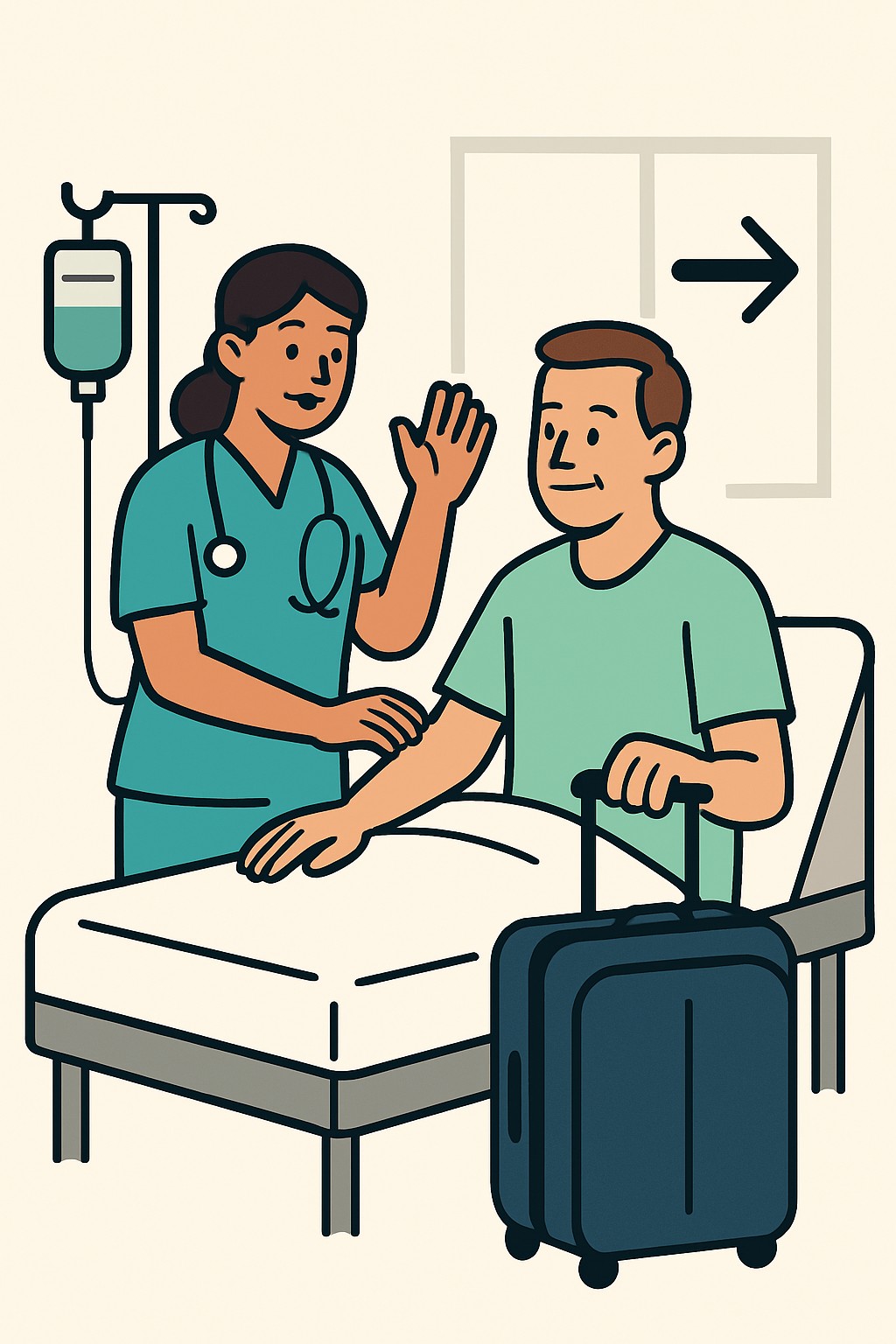
Observation care discharge (same day) means you were monitored and treated in the hospital as an outpatient and were well enough to go home on the same calendar day.
Overview
Observation care discharge (same day) means you were monitored and treated in the hospital as an outpatient and were well enough to go home on the same calendar day. Observation care is used when your condition needs short-term monitoring, tests, or treatment to decide if you need inpatient admission. During observation, staff check your vital signs, run tests, and give treatments such as IV fluids or medicines. At discharge, you receive instructions, prescriptions if needed, and plans for follow-up.
Also known as: Observation discharge, Same-day observation discharge, Observation status discharge
Preparation & Next Steps
Everything you need to know before and after your procedure
Before Care
- Confirm you have a safe ride home and someone to help if needed the first night
- Review the discharge instructions with staff and ask about activity, diet, and work limits
- Understand which medicines to start, stop, or continue, and how to take them
- Know the warning signs that mean you should contact a clinician
- Ask when and how test results will be shared (portal, phone, or follow-up visit)
- Get a written list of follow-up appointments or scheduling instructions
- Verify your preferred pharmacy is on file for any prescriptions
- Request a work or school note if needed
- Ask whom to call after hours if questions come up
- Make sure you have copies of key paperwork or access to the patient portal
After Care
- Keep your discharge paperwork in an easy-to-find place and review it at home
- Take medicines exactly as listed on your discharge instructions
- Fill new prescriptions promptly and bring questions to the pharmacy or clinic
- Resume light daily activities as you feel able, within any limits you were given
- Stay hydrated, eat simple meals, and rest as your condition allows
- Track symptoms in a short log, including timing and triggers, to discuss at follow-up
- Arrange and attend follow-up visits or tests by the suggested date
- Use the patient portal or clinic phone for questions or clarifications
- Contact a clinician if symptoms return, worsen, or new concerning symptoms appear (for example, chest pain, trouble breathing, high fever, confusion, heavy bleeding)
- Keep receipts and paperwork in case your insurer asks for details about the visit
Clinical Information
Important medical details about this procedure
Indications
- Chest pain evaluation without clear heart attack
- Asthma or COPD flare that improves with treatment
- Dehydration needing IV fluids
- Abdominal pain while labs and imaging are reviewed
- Concussion or head injury observation
- Side effects from medicines that improve with monitoring
- Short-term monitoring after a procedure or treatment
Alternatives
- Emergency department discharge with home instructions
- Admission to inpatient hospital care
- Return visit to clinic or urgent care within 24–48 hours
- Telehealth follow-up when appropriate
Risks
- Symptoms may return or get worse after leaving
- Need to return to the hospital for further care
- Adverse effects from medicines given during the visit
- Missed or delayed diagnosis despite initial tests
- Out-of-pocket costs related to outpatient observation status
Contraindications
- Unstable vital signs or rapidly worsening condition
- Problems that require inpatient-level monitoring or treatment
- Need for services at home that are not available or safe to arrange the same day
Recovery Timeline
What to expect during your recovery
Many people resume normal routines within a day or two after a same-day observation discharge. The timeline depends on the reason you were observed and how symptoms change.
Typical Range
0–2 days
Return to Work
Same day
Recovery Milestones
Review discharge instructions and pick up prescriptions
Resume light daily activities as comfortable within any limits given
Complete follow-up call or visit if it was recommended
Frequently Asked Questions
Common questions and expert answers about this procedure
What is observation care?
What is observation care?
It is outpatient hospital care for short-term monitoring, testing, and treatment to decide if you need inpatient admission.
How long does observation usually last?
How long does observation usually last?
It is generally short term. Medicare guidance notes observation is usually less than 24 hours and rarely more than 48 hours.
Why is this billed as outpatient?
Why is this billed as outpatient?
Observation is considered outpatient hospital care. Different insurance rules and cost sharing can apply compared with inpatient care.
What happens at discharge?
What happens at discharge?
Staff review your diagnosis or working diagnosis, medicines, activity and diet guidance, warning signs, and follow-up plans. You may get prescriptions and copies of your results.
Can I drive myself home?
Can I drive myself home?
Ask the team. If you received sedation, strong pain medicine, or feel weak or dizzy, you may need someone else to drive.
Will I get a notice about my status?
Will I get a notice about my status?
Hospitals give Medicare patients a written notice explaining outpatient observation status and how it affects costs.
Do I need follow-up after discharge?
Do I need follow-up after discharge?
Often a phone call or visit is planned within a few days to review results, symptoms, and next steps.
What if my symptoms come back?
What if my symptoms come back?
Use the contact information in your discharge papers to reach the clinic or hospital, and let them know your symptoms changed.
References
Medical literature and sources