%20--%3e%3csvg%20version='1.0'%20id='Layer_1'%20xmlns='http://www.w3.org/2000/svg'%20xmlns:xlink='http://www.w3.org/1999/xlink'%20x='0px'%20y='0px'%20viewBox='0%200%20755.52%20814.35'%20style='enable-background:new%200%200%20755.52%20814.35;'%20xml:space='preserve'%3e%3cstyle%20type='text/css'%3e%20.st0{fill:%231ae5ce;stroke:%231ae5ce;stroke-width:7;stroke-miterlimit:10;}%20.st1{fill:%23FFFFFF;stroke:%231ae5ce;stroke-width:7;stroke-miterlimit:10;}%20.st2{fill:%231ae5ce;stroke:%23FFFFFF;stroke-width:7;stroke-miterlimit:10;}%20.st3{fill:%23FFFFFF;stroke:%23FFFFFF;stroke-width:6;stroke-miterlimit:10;}%20%3c/style%3e%3cg%20id='Dark_Logo_00000159431215648494653180000015900878925932721032_'%3e%3cpath%20id='shield_00000152259091539869183100000001926543869452564382_'%20class='st0'%20d='M711.13,173.42%20c-3.37-49.07-38.92-44.9-75.96-52.18c-67.4-13.25-130.47-34.47-192.36-63.92c-22.48-10.7-41.88-25.74-65.05-26.28%20c-23.17,0.54-42.58,15.59-65.05,26.28c-61.89,29.45-124.95,50.68-192.36,63.92c-37.04,7.28-72.59,3.11-75.96,52.18%20c-1.55,22.6,0.34,46.4,1.05,68.92c5.99,190.78,52.91,345.39,206.27,466.46c29.71,23.46,74.51,55.8,108.84,70.75%20c5.99,2.61,11.7,3.73,17.21,3.75c5.51-0.02,11.22-1.14,17.21-3.75c34.33-14.95,79.12-47.3,108.84-70.75%20c153.37-121.07,200.28-275.68,206.27-466.46C710.79,219.82,712.68,196.02,711.13,173.42z'/%3e%3cpath%20id='magnifyingglass_00000073685934697636024790000000342567780940956808_'%20class='st1'%20d='M648.78,624.21l-96.64-104.65%20c34.89-40.63,55.98-93.46,55.98-151.21c0-128.27-103.98-232.24-232.24-232.24S143.63,240.08,143.63,368.35%20s103.98,232.24,232.24,232.24c48.87,0,94.21-15.11,131.62-40.89l97.18,105.24c11.25,12.18,30.24,12.93,42.42,1.69l0,0%20C659.27,655.38,660.03,636.39,648.78,624.21z'/%3e%3ccircle%20id='ellipse_00000129904010550392394720000017056154833629780114_'%20class='st2'%20cx='375.87'%20cy='368.35'%20r='181.21'/%3e%3cpath%20id='dollarsign_00000057140127156649725250000003772530148495155891_'%20class='st3'%20d='M362.91,492.03v-23.91%20c0-2.01-1.58-3.69-3.59-3.77c-18.49-0.78-37.12-5.4-49.4-11.83c-1.75-0.92-2.53-3.01-1.76-4.84l5.87-13.89%20c0.86-2.02,3.23-2.88,5.2-1.89c12.94,6.52,30.45,11.44,49.18,11.44c26.02,0,43.6-12.73,43.6-30.43c0-17.08-14.29-27.63-41.4-36.95%20c-37.37-12.42-60.46-26.7-60.46-53.72c0-24.97,20.29-44.11,52.22-49.51c1.8-0.31,3.11-1.89,3.11-3.72v-24.35%20c0-2.09,1.69-3.78,3.78-3.78h15.16c2.09,0,3.78,1.69,3.78,3.78v22.71c0,2.01,1.58,3.67,3.58,3.77c17.85,0.92,30.88,4.75,40.61,9.1%20c1.92,0.86,2.79,3.09,1.94,5.01l-6.08,13.6c-0.85,1.91-3.09,2.77-4.99,1.91c-8.37-3.8-22.38-8.95-42.75-8.95%20c-28.21,0-38.84,14.28-38.84,26.7c0,16.15,13.56,24.22,45.44,35.4c37.74,13.04,56.79,29.19,56.79,56.82%20c0,23.85-19.05,46.23-54.78,52.3c-1.8,0.31-3.11,1.89-3.11,3.72v25.28c0,2.09-1.69,3.78-3.78,3.78h-15.53%20C364.6,495.81,362.91,494.12,362.91,492.03z'/%3e%3c/g%3e%3c/svg%3e)
Office Visit – New Patient (High Complexity) Evaluation Management
A high complexity new patient office visit is an in-person appointment for someone who has not been seen in the same practice and specialty within the last three years.
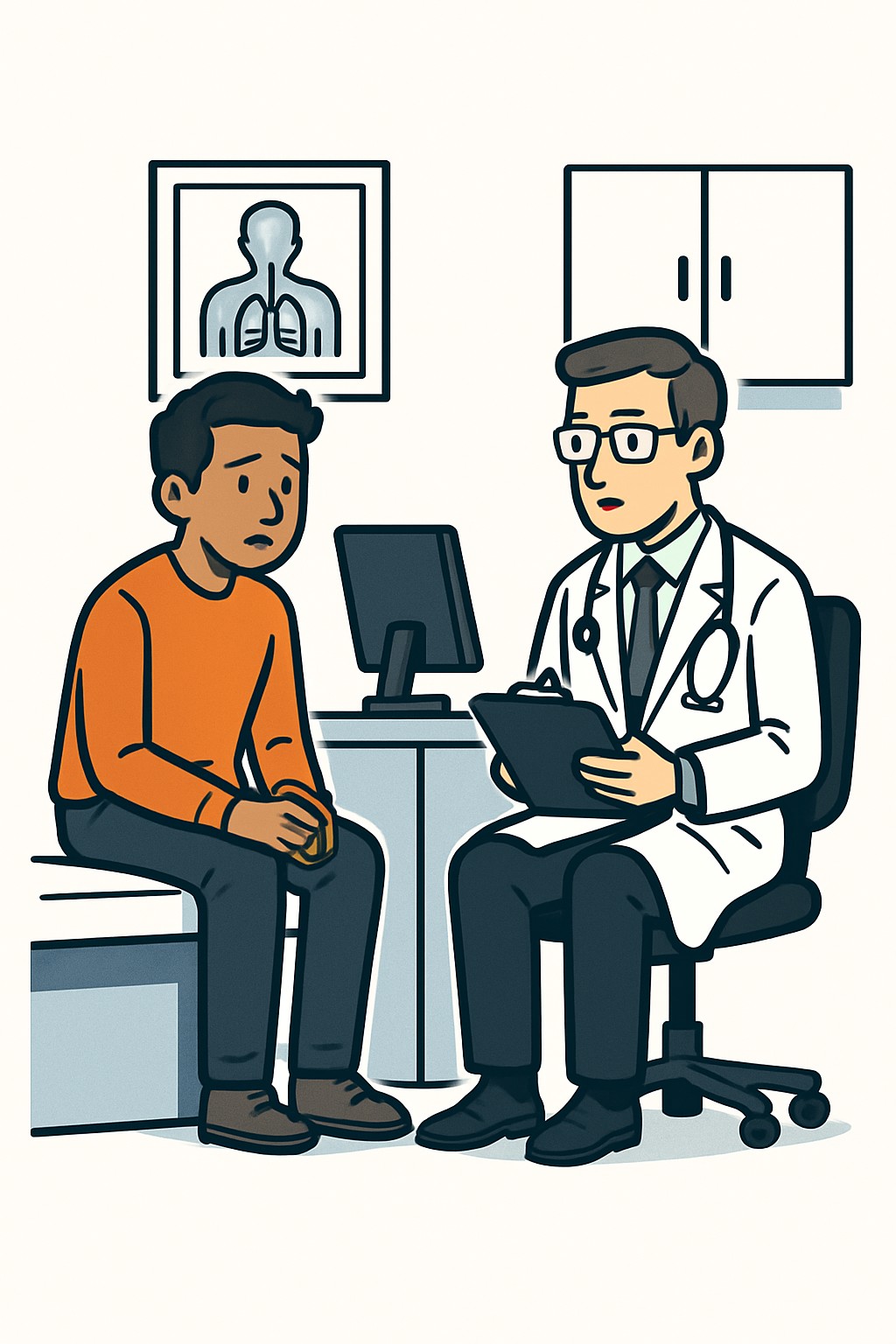
Overview
A high complexity new patient office visit is an in-person appointment for someone who has not been seen in the same practice and specialty within the last three years. It involves an in-depth review of your health concerns, medical history, medicines, and any records you bring. Clinicians typically perform a focused exam, review multiple data sources, and address serious or complicated issues. The visit often includes planning tests, referrals, or treatments when the medical decision-making is complex.
Also known as: New patient high complexity visit, Comprehensive new patient exam, High-complexity E/M new patient
Preparation & Next Steps
Everything you need to know before and after your procedure
Before Care
- Bring a photo ID, insurance card, and a payment method if a copay applies
- Complete new patient forms and arrive early to confirm contact and pharmacy details
- Prepare a concise timeline of your symptoms, triggers, and prior treatments
- Bring a current list of all medicines and supplements with doses and schedules
- Carry key medical records such as recent labs, imaging, procedure summaries, and discharge notes
- List allergies and prior reactions to medicines, contrast dyes, or vaccines
- Know your personal and family history of major conditions and surgeries
- Bring device logs if relevant (for example, glucose meter or blood pressure readings)
- Have your referral paperwork and specialist contact information if applicable
- Request language or accessibility support from the clinic if needed
After Care
- Review the visit summary and plan in your patient portal or handouts
- Fill prescribed medicines and follow the instructions provided by your clinician
- Schedule ordered labs, imaging, or specialist referrals and note any prep steps
- Set reminders for follow-up appointments or timelines discussed during the visit
- Track symptoms, side effects, and responses to treatment in a simple log
- Use secure messaging or call the clinic to clarify instructions or next steps
- Keep copies of new test results and reports with your personal health records
- Update your medication list to reflect any changes
- Contact the clinic if symptoms change, new concerns arise, or you have trouble accessing tests
- Check your insurance benefits for ordered services to understand potential costs
Clinical Information
Important medical details about this procedure
Indications
- Multiple or serious symptoms that need careful evaluation
- Complex medical history or multiple ongoing conditions
- Review of extensive outside records, labs, or imaging
- Coordination of care with several specialists
- Decisions that may involve higher risk tests or treatments
Alternatives
- Telehealth visit when an in-person exam is not required
- Secure portal message for basic questions or simple follow-up
- Urgent care for minor, time-sensitive issues when appropriate
Risks
- Limited time may not resolve every concern in one visit
- Miscommunication if goals and next steps are not clear
- Incidental findings from tests may lead to more evaluations
- Potential out-of-pocket costs depending on coverage and ordered services
- Privacy risks if using unsecured devices or networks for digital communications
Contraindications
- Severe or life-threatening symptoms that require emergency care
- Highly contagious illness without notifying the clinic before arrival
- Inability to communicate or provide history when a needed support person is unavailable
Recovery Timeline
What to expect during your recovery
There is no medical recovery period for a standard office visit. Most people return to normal activities immediately after leaving the clinic.
Typical Range
Same day
Return to Work
Same day
Recovery Milestones
Resume normal daily activities
Complete any same-day or next-day labs if ordered
Review results and confirm follow-up plan via portal or phone
Frequently Asked Questions
Common questions and expert answers about this procedure
What does high complexity mean for a new patient visit?
What does high complexity mean for a new patient visit?
It refers to complex medical decision-making based on the number and seriousness of problems, the amount of data reviewed, and the risk of tests or treatments.
How long does this visit usually take?
How long does this visit usually take?
Time varies. High complexity often involves more review and coordination, but the actual duration depends on your needs and the clinic’s workflow.
What makes someone a new patient?
What makes someone a new patient?
You are considered new if you have not been seen by a clinician of the same specialty in the same group practice within the past three years.
What happens during the visit?
What happens during the visit?
The clinician reviews your concerns and history, examines you as needed, looks at prior records and tests, discusses options, and may order further testing or referrals.
Can this be done by telehealth?
Can this be done by telehealth?
Some complex discussions can start by video or phone, but an in-person exam may be needed to fully evaluate certain conditions.
Will I need tests or referrals?
Will I need tests or referrals?
Possibly. Depending on findings, the clinician may order labs, imaging, or refer you to specialists to complete the evaluation.
Who might I see at the clinic?
Who might I see at the clinic?
You may see a physician, nurse practitioner, or physician assistant. Nurses and other team members may help with intake, records, and coordination.
How much will it cost?
How much will it cost?
Costs depend on your insurance, network status, and any tests or referrals. High complexity coding may have higher charges. Ask the clinic and check your benefits.