%20--%3e%3csvg%20version='1.0'%20id='Layer_1'%20xmlns='http://www.w3.org/2000/svg'%20xmlns:xlink='http://www.w3.org/1999/xlink'%20x='0px'%20y='0px'%20viewBox='0%200%20755.52%20814.35'%20style='enable-background:new%200%200%20755.52%20814.35;'%20xml:space='preserve'%3e%3cstyle%20type='text/css'%3e%20.st0{fill:%231ae5ce;stroke:%231ae5ce;stroke-width:7;stroke-miterlimit:10;}%20.st1{fill:%23FFFFFF;stroke:%231ae5ce;stroke-width:7;stroke-miterlimit:10;}%20.st2{fill:%231ae5ce;stroke:%23FFFFFF;stroke-width:7;stroke-miterlimit:10;}%20.st3{fill:%23FFFFFF;stroke:%23FFFFFF;stroke-width:6;stroke-miterlimit:10;}%20%3c/style%3e%3cg%20id='Dark_Logo_00000159431215648494653180000015900878925932721032_'%3e%3cpath%20id='shield_00000152259091539869183100000001926543869452564382_'%20class='st0'%20d='M711.13,173.42%20c-3.37-49.07-38.92-44.9-75.96-52.18c-67.4-13.25-130.47-34.47-192.36-63.92c-22.48-10.7-41.88-25.74-65.05-26.28%20c-23.17,0.54-42.58,15.59-65.05,26.28c-61.89,29.45-124.95,50.68-192.36,63.92c-37.04,7.28-72.59,3.11-75.96,52.18%20c-1.55,22.6,0.34,46.4,1.05,68.92c5.99,190.78,52.91,345.39,206.27,466.46c29.71,23.46,74.51,55.8,108.84,70.75%20c5.99,2.61,11.7,3.73,17.21,3.75c5.51-0.02,11.22-1.14,17.21-3.75c34.33-14.95,79.12-47.3,108.84-70.75%20c153.37-121.07,200.28-275.68,206.27-466.46C710.79,219.82,712.68,196.02,711.13,173.42z'/%3e%3cpath%20id='magnifyingglass_00000073685934697636024790000000342567780940956808_'%20class='st1'%20d='M648.78,624.21l-96.64-104.65%20c34.89-40.63,55.98-93.46,55.98-151.21c0-128.27-103.98-232.24-232.24-232.24S143.63,240.08,143.63,368.35%20s103.98,232.24,232.24,232.24c48.87,0,94.21-15.11,131.62-40.89l97.18,105.24c11.25,12.18,30.24,12.93,42.42,1.69l0,0%20C659.27,655.38,660.03,636.39,648.78,624.21z'/%3e%3ccircle%20id='ellipse_00000129904010550392394720000017056154833629780114_'%20class='st2'%20cx='375.87'%20cy='368.35'%20r='181.21'/%3e%3cpath%20id='dollarsign_00000057140127156649725250000003772530148495155891_'%20class='st3'%20d='M362.91,492.03v-23.91%20c0-2.01-1.58-3.69-3.59-3.77c-18.49-0.78-37.12-5.4-49.4-11.83c-1.75-0.92-2.53-3.01-1.76-4.84l5.87-13.89%20c0.86-2.02,3.23-2.88,5.2-1.89c12.94,6.52,30.45,11.44,49.18,11.44c26.02,0,43.6-12.73,43.6-30.43c0-17.08-14.29-27.63-41.4-36.95%20c-37.37-12.42-60.46-26.7-60.46-53.72c0-24.97,20.29-44.11,52.22-49.51c1.8-0.31,3.11-1.89,3.11-3.72v-24.35%20c0-2.09,1.69-3.78,3.78-3.78h15.16c2.09,0,3.78,1.69,3.78,3.78v22.71c0,2.01,1.58,3.67,3.58,3.77c17.85,0.92,30.88,4.75,40.61,9.1%20c1.92,0.86,2.79,3.09,1.94,5.01l-6.08,13.6c-0.85,1.91-3.09,2.77-4.99,1.91c-8.37-3.8-22.38-8.95-42.75-8.95%20c-28.21,0-38.84,14.28-38.84,26.7c0,16.15,13.56,24.22,45.44,35.4c37.74,13.04,56.79,29.19,56.79,56.82%20c0,23.85-19.05,46.23-54.78,52.3c-1.8,0.31-3.11,1.89-3.11,3.72v25.28c0,2.09-1.69,3.78-3.78,3.78h-15.53%20C364.6,495.81,362.91,494.12,362.91,492.03z'/%3e%3c/g%3e%3c/svg%3e)
Office Visit – New Patient (Low) Evaluation Management
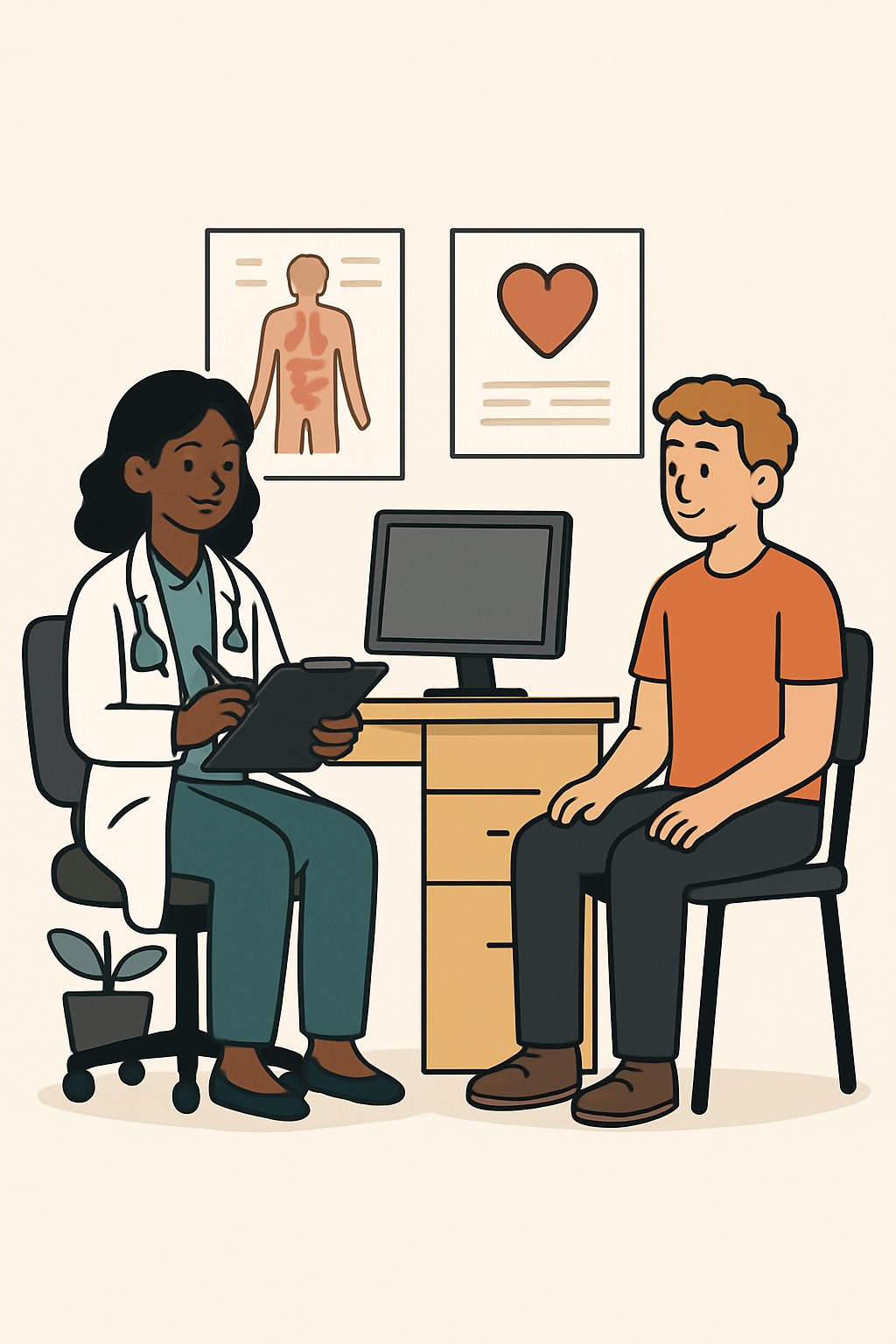
A new patient office visit (low) is a first-time appointment at a clinic or with a clinician you have not seen in the same specialty and group within the past three years.
Overview
A new patient office visit (low) is a first-time appointment at a clinic or with a clinician you have not seen in the same specialty and group within the past three years. "Low" describes a straightforward visit with a focused history and exam and low-complexity medical decision making. This visit is used to discuss your main concerns, review your past health and medicines, check vital signs, and plan next steps. Basic tests or vaccines may be ordered if needed, and referrals can be arranged.
Also known as: New patient visit, Initial visit, First-time appointment, Low complexity new patient visit
Preparation & Next Steps
Everything you need to know before and after your procedure
Before Care
- Bring a photo ID, insurance card, and a payment method if a copay applies
- Prepare a current list of all medicines and supplements, including doses and schedules
- Gather key medical records such as immunizations, recent labs or imaging, and prior diagnoses if available
- Write your top 2–3 concerns with when symptoms started and what makes them better or worse
- List allergies and any prior reactions to medicines or vaccines
- Know your pharmacy name, address, and phone number
- Complete new patient forms and consent paperwork; arrive a bit early for check-in
- Check if your insurance requires a referral or prior authorization for the visit
- Consider bringing a support person if communication, memory, or mobility is a concern
- Follow any specific clinic instructions, such as fasting for labs if requested
After Care
- Review the visit summary in your patient portal and note the agreed next steps
- Fill any prescribed medicines and follow the instructions provided by your clinician
- Schedule ordered labs, imaging, vaccines, or referrals and note locations and dates
- Track symptoms and side effects in a simple log to discuss at follow-up
- Ask the clinic how to transfer outside records if they were not received
- Use secure messaging or the clinic phone to ask clarifying questions
- Confirm the timing of any follow-up visit if discussed
- Update your personal medication list with any changes
- Contact the clinic about new or worsening concerning symptoms
- Check your insurance benefits for ordered tests to understand potential costs
Clinical Information
Important medical details about this procedure
Indications
- Establishing care at a new clinic or with a new clinician
- Evaluation of new, non-urgent symptoms
- Review of medical history, allergies, and current medicines
- Requests for basic screenings, vaccines, or simple forms
- Referrals to specialists or community services
- Transfer of care from another practice
Alternatives
- Telehealth visit when allowed by state rules and clinic policy
- Secure portal message for simple questions or record requests
- Nurse advice line for basic guidance
- Retail clinic or urgent care for minor, time-sensitive issues
Risks
- Limited time may not address every concern in one visit
- Miscommunication if goals and next steps are unclear
- Potential out-of-pocket costs, especially for added tests or vaccines
- Privacy risks when using unsecured devices, networks, or email
- Delays in care if outside records are not available
Contraindications
- Severe or life-threatening symptoms that need emergency care
- Serious injuries needing immediate evaluation
- Highly contagious illness without coordinating clinic precautions
- Inability to participate in the visit without a required support person or interpreter
Recovery Timeline
What to expect during your recovery
There is no medical recovery period for a standard office visit. Most people resume normal activities right away.
Typical Range
Same day
Return to Work
Same day
Recovery Milestones
Resume normal daily activities
Complete any same-day or next-day labs, vaccines, or forms if ordered
Set up or update your patient portal and request outside records transfer
Review results and confirm the follow-up plan via portal or phone
Frequently Asked Questions
Common questions and expert answers about this procedure
What does new patient mean?
What does new patient mean?
It generally means you have not seen a clinician in the same group and specialty within the past 3 years, so your records are not already established there.
What does low mean for this visit?
What does low mean for this visit?
It reflects a straightforward visit with a focused history and exam and low-complexity medical decision making. It does not guarantee a set time or services.
How long will the visit take?
How long will the visit take?
Time varies by clinic, concerns, and documentation. Plan extra time for check-in and new patient forms.
What should I bring to the appointment?
What should I bring to the appointment?
Bring your ID, insurance card, medication list, allergies, recent test results, and pharmacy details. Written questions help keep the visit focused.
Can a new patient visit be done by telehealth?
Can a new patient visit be done by telehealth?
Some first visits can be virtual depending on the issue, state rules, and clinic policy. A physical exam or procedures may require an in-person visit.
Will I get tests or vaccines during the visit?
Will I get tests or vaccines during the visit?
You may have basic labs or vaccines the same day, or they may be scheduled later, depending on your concerns and clinic capabilities.
Who might I see at the clinic?
Who might I see at the clinic?
You may see a physician, nurse practitioner, or physician assistant. Nursing staff often collect vitals and help with intake.
What affects the cost of this visit?
What affects the cost of this visit?
Costs depend on your insurance plan, network status, visit complexity, and any added services like tests, vaccines, or procedures.
References
Medical literature and sources