%20--%3e%3csvg%20version='1.0'%20id='Layer_1'%20xmlns='http://www.w3.org/2000/svg'%20xmlns:xlink='http://www.w3.org/1999/xlink'%20x='0px'%20y='0px'%20viewBox='0%200%20755.52%20814.35'%20style='enable-background:new%200%200%20755.52%20814.35;'%20xml:space='preserve'%3e%3cstyle%20type='text/css'%3e%20.st0{fill:%231ae5ce;stroke:%231ae5ce;stroke-width:7;stroke-miterlimit:10;}%20.st1{fill:%23FFFFFF;stroke:%231ae5ce;stroke-width:7;stroke-miterlimit:10;}%20.st2{fill:%231ae5ce;stroke:%23FFFFFF;stroke-width:7;stroke-miterlimit:10;}%20.st3{fill:%23FFFFFF;stroke:%23FFFFFF;stroke-width:6;stroke-miterlimit:10;}%20%3c/style%3e%3cg%20id='Dark_Logo_00000159431215648494653180000015900878925932721032_'%3e%3cpath%20id='shield_00000152259091539869183100000001926543869452564382_'%20class='st0'%20d='M711.13,173.42%20c-3.37-49.07-38.92-44.9-75.96-52.18c-67.4-13.25-130.47-34.47-192.36-63.92c-22.48-10.7-41.88-25.74-65.05-26.28%20c-23.17,0.54-42.58,15.59-65.05,26.28c-61.89,29.45-124.95,50.68-192.36,63.92c-37.04,7.28-72.59,3.11-75.96,52.18%20c-1.55,22.6,0.34,46.4,1.05,68.92c5.99,190.78,52.91,345.39,206.27,466.46c29.71,23.46,74.51,55.8,108.84,70.75%20c5.99,2.61,11.7,3.73,17.21,3.75c5.51-0.02,11.22-1.14,17.21-3.75c34.33-14.95,79.12-47.3,108.84-70.75%20c153.37-121.07,200.28-275.68,206.27-466.46C710.79,219.82,712.68,196.02,711.13,173.42z'/%3e%3cpath%20id='magnifyingglass_00000073685934697636024790000000342567780940956808_'%20class='st1'%20d='M648.78,624.21l-96.64-104.65%20c34.89-40.63,55.98-93.46,55.98-151.21c0-128.27-103.98-232.24-232.24-232.24S143.63,240.08,143.63,368.35%20s103.98,232.24,232.24,232.24c48.87,0,94.21-15.11,131.62-40.89l97.18,105.24c11.25,12.18,30.24,12.93,42.42,1.69l0,0%20C659.27,655.38,660.03,636.39,648.78,624.21z'/%3e%3ccircle%20id='ellipse_00000129904010550392394720000017056154833629780114_'%20class='st2'%20cx='375.87'%20cy='368.35'%20r='181.21'/%3e%3cpath%20id='dollarsign_00000057140127156649725250000003772530148495155891_'%20class='st3'%20d='M362.91,492.03v-23.91%20c0-2.01-1.58-3.69-3.59-3.77c-18.49-0.78-37.12-5.4-49.4-11.83c-1.75-0.92-2.53-3.01-1.76-4.84l5.87-13.89%20c0.86-2.02,3.23-2.88,5.2-1.89c12.94,6.52,30.45,11.44,49.18,11.44c26.02,0,43.6-12.73,43.6-30.43c0-17.08-14.29-27.63-41.4-36.95%20c-37.37-12.42-60.46-26.7-60.46-53.72c0-24.97,20.29-44.11,52.22-49.51c1.8-0.31,3.11-1.89,3.11-3.72v-24.35%20c0-2.09,1.69-3.78,3.78-3.78h15.16c2.09,0,3.78,1.69,3.78,3.78v22.71c0,2.01,1.58,3.67,3.58,3.77c17.85,0.92,30.88,4.75,40.61,9.1%20c1.92,0.86,2.79,3.09,1.94,5.01l-6.08,13.6c-0.85,1.91-3.09,2.77-4.99,1.91c-8.37-3.8-22.38-8.95-42.75-8.95%20c-28.21,0-38.84,14.28-38.84,26.7c0,16.15,13.56,24.22,45.44,35.4c37.74,13.04,56.79,29.19,56.79,56.82%20c0,23.85-19.05,46.23-54.78,52.3c-1.8,0.31-3.11,1.89-3.11,3.72v25.28c0,2.09-1.69,3.78-3.78,3.78h-15.53%20C364.6,495.81,362.91,494.12,362.91,492.03z'/%3e%3c/g%3e%3c/svg%3e)
Pediatric critical care - initial 60 min Evaluation Management
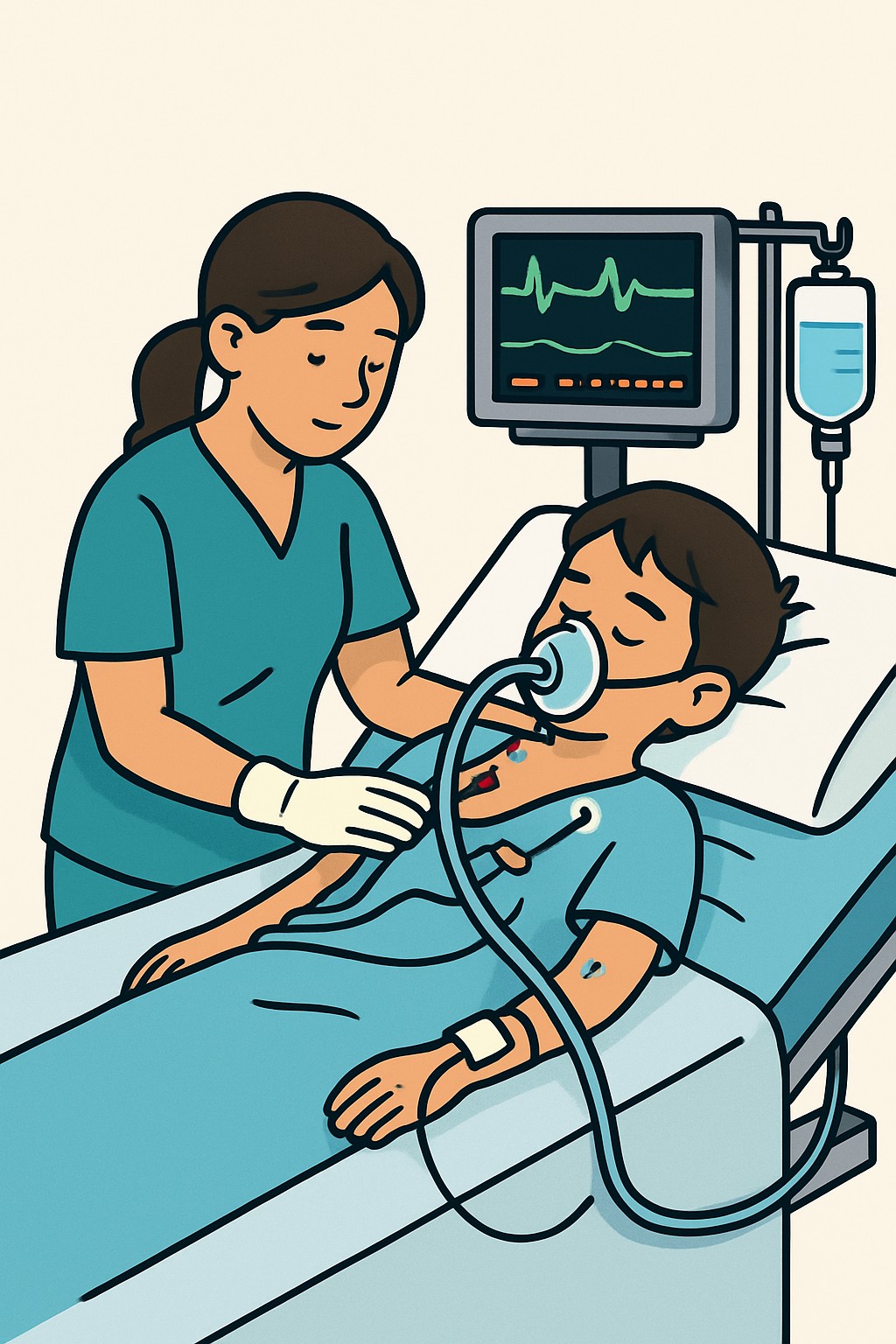
Pediatric critical care is specialized, high-level care for a child with life-threatening illness or injury.
Overview
Pediatric critical care is specialized, high-level care for a child with life-threatening illness or injury. The initial 60 minutes refers to the first hour of continuous, focused critical care provided by an intensive care team. During this period, clinicians assess and stabilize airway, breathing, and circulation, start monitoring, order urgent tests, and begin treatments. The location is usually a pediatric intensive care unit (PICU), but it can start in an emergency department or during transport.
Also known as: PICU initial critical care, Initial pediatric ICU care, Initial 60 minutes pediatric critical care
Preparation & Next Steps
Everything you need to know before and after your procedure
Before Care
- Bring parent or guardian ID and any custody or guardianship documents if available
- Carry a current list of the child's medicines, doses, allergies, and immunizations
- Share the child's baseline health conditions and recent illnesses or surgeries
- Provide contact details for the child's primary clinician, specialists, and pharmacy
- Identify a family point person for updates and decision sharing
- Be ready to give consent for tests, procedures, or blood products if asked
- Ask about visitation, overnight stay, and infection control rules
- Label small personal items; hospitals may limit belongings in the ICU
- Tell staff about any implanted devices or home equipment the child uses
- Confirm what can travel with the child if transport or transfer is planned
After Care
- Review daily care plans and summaries provided by the ICU team
- Keep an up-to-date list of new medicines started and why they were used
- Ask about activity limits, feeding plans, and school or daycare timelines
- Know who to contact 24/7 for questions after transfer or discharge
- Keep copies of discharge paperwork, test results, and imaging reports
- Confirm how to get prescriptions filled and arrange refills if needed
- Verify home equipment, supplies, and training before leaving the hospital
- Attend scheduled follow-up visits with primary and specialty clinicians
- Contact a clinician if new or worsening symptoms appear after discharge
- Use provided education materials about devices, wound care, or line care
Clinical Information
Important medical details about this procedure
Indications
- Severe breathing problems or respiratory failure
- Shock from dehydration, blood loss, allergy, or infection
- Sepsis or severe infection
- Serious injuries or trauma
- Uncontrolled seizures or status epilepticus
- Diabetic ketoacidosis with complications
- Postoperative monitoring after major surgery
- Heart rhythm or circulation instability
- Organ failure or need for life support
Alternatives
- General pediatric ward care for stable conditions
- Intermediate or step-down unit monitoring
- Emergency department observation when appropriate
- Outpatient management for mild illness
- Palliative care focus when goals of care prioritize comfort
Risks
- Complications from breathing tubes or ventilators (breathing machines)
- Infection from IV lines, catheters, or procedures
- Medication side effects or reactions
- Delirium or confusion related to illness, pain, or sedation
- Pressure injuries from limited movement
- Radiation exposure from imaging tests
- Emotional stress for the child and family
Contraindications
- Not used for conditions that are stable enough for routine ward care
- Level of care may be adjusted if a higher-level center is needed
Recovery Timeline
What to expect during your recovery
Timing varies widely and depends on the child's condition, treatments, and response to care. The initial 60 minutes is part of early stabilization, not a full recovery period.
Typical Range
Same day
Return to Work
Same day
Recovery Milestones
Family orientation to ICU routines, monitors, and equipment
Ongoing evaluation and stabilization in the ICU; timing varies by condition
Transition planning to a step-down unit or ward when stable
Frequently Asked Questions
Common questions and expert answers about this procedure
What is pediatric critical care initial 60 minutes?
What is pediatric critical care initial 60 minutes?
It is the first hour of continuous, high-level care by ICU-trained clinicians for a critically ill or injured child, focused on stabilization and urgent treatment.
Who provides this care?
Who provides this care?
Physicians trained in pediatric critical care lead the team with nurses, respiratory therapists, pharmacists, and other specialists.
Where does it happen?
Where does it happen?
Usually in a pediatric intensive care unit. It can begin in an emergency department, during transport, or in another inpatient area if an ICU bed is pending.
What happens during the first hour?
What happens during the first hour?
The team assesses airway, breathing, and circulation; places monitors and IV lines; orders urgent tests; begins medicines or breathing support; and communicates updates.
Does this always mean ICU admission?
Does this always mean ICU admission?
Many children who need critical care are admitted to the ICU, but some are stabilized and then transferred or observed elsewhere based on their condition.
How is this service billed?
How is this service billed?
Critical care is time-based professional work with continuous attention and complex decision-making. Some procedures and tests may be billed separately under standard rules.
Can parents stay with the child?
Can parents stay with the child?
Many PICUs support family presence and participation. Specific visitation and overnight policies vary by hospital.
What tests or procedures are common?
What tests or procedures are common?
Blood tests, cultures, X-rays or ultrasound, IV lines, breathing support, and medicines to support blood pressure or treat infection are common when needed.
References
Medical literature and sources