%20--%3e%3csvg%20version='1.0'%20id='Layer_1'%20xmlns='http://www.w3.org/2000/svg'%20xmlns:xlink='http://www.w3.org/1999/xlink'%20x='0px'%20y='0px'%20viewBox='0%200%20755.52%20814.35'%20style='enable-background:new%200%200%20755.52%20814.35;'%20xml:space='preserve'%3e%3cstyle%20type='text/css'%3e%20.st0{fill:%231ae5ce;stroke:%231ae5ce;stroke-width:7;stroke-miterlimit:10;}%20.st1{fill:%23FFFFFF;stroke:%231ae5ce;stroke-width:7;stroke-miterlimit:10;}%20.st2{fill:%231ae5ce;stroke:%23FFFFFF;stroke-width:7;stroke-miterlimit:10;}%20.st3{fill:%23FFFFFF;stroke:%23FFFFFF;stroke-width:6;stroke-miterlimit:10;}%20%3c/style%3e%3cg%20id='Dark_Logo_00000159431215648494653180000015900878925932721032_'%3e%3cpath%20id='shield_00000152259091539869183100000001926543869452564382_'%20class='st0'%20d='M711.13,173.42%20c-3.37-49.07-38.92-44.9-75.96-52.18c-67.4-13.25-130.47-34.47-192.36-63.92c-22.48-10.7-41.88-25.74-65.05-26.28%20c-23.17,0.54-42.58,15.59-65.05,26.28c-61.89,29.45-124.95,50.68-192.36,63.92c-37.04,7.28-72.59,3.11-75.96,52.18%20c-1.55,22.6,0.34,46.4,1.05,68.92c5.99,190.78,52.91,345.39,206.27,466.46c29.71,23.46,74.51,55.8,108.84,70.75%20c5.99,2.61,11.7,3.73,17.21,3.75c5.51-0.02,11.22-1.14,17.21-3.75c34.33-14.95,79.12-47.3,108.84-70.75%20c153.37-121.07,200.28-275.68,206.27-466.46C710.79,219.82,712.68,196.02,711.13,173.42z'/%3e%3cpath%20id='magnifyingglass_00000073685934697636024790000000342567780940956808_'%20class='st1'%20d='M648.78,624.21l-96.64-104.65%20c34.89-40.63,55.98-93.46,55.98-151.21c0-128.27-103.98-232.24-232.24-232.24S143.63,240.08,143.63,368.35%20s103.98,232.24,232.24,232.24c48.87,0,94.21-15.11,131.62-40.89l97.18,105.24c11.25,12.18,30.24,12.93,42.42,1.69l0,0%20C659.27,655.38,660.03,636.39,648.78,624.21z'/%3e%3ccircle%20id='ellipse_00000129904010550392394720000017056154833629780114_'%20class='st2'%20cx='375.87'%20cy='368.35'%20r='181.21'/%3e%3cpath%20id='dollarsign_00000057140127156649725250000003772530148495155891_'%20class='st3'%20d='M362.91,492.03v-23.91%20c0-2.01-1.58-3.69-3.59-3.77c-18.49-0.78-37.12-5.4-49.4-11.83c-1.75-0.92-2.53-3.01-1.76-4.84l5.87-13.89%20c0.86-2.02,3.23-2.88,5.2-1.89c12.94,6.52,30.45,11.44,49.18,11.44c26.02,0,43.6-12.73,43.6-30.43c0-17.08-14.29-27.63-41.4-36.95%20c-37.37-12.42-60.46-26.7-60.46-53.72c0-24.97,20.29-44.11,52.22-49.51c1.8-0.31,3.11-1.89,3.11-3.72v-24.35%20c0-2.09,1.69-3.78,3.78-3.78h15.16c2.09,0,3.78,1.69,3.78,3.78v22.71c0,2.01,1.58,3.67,3.58,3.77c17.85,0.92,30.88,4.75,40.61,9.1%20c1.92,0.86,2.79,3.09,1.94,5.01l-6.08,13.6c-0.85,1.91-3.09,2.77-4.99,1.91c-8.37-3.8-22.38-8.95-42.75-8.95%20c-28.21,0-38.84,14.28-38.84,26.7c0,16.15,13.56,24.22,45.44,35.4c37.74,13.04,56.79,29.19,56.79,56.82%20c0,23.85-19.05,46.23-54.78,52.3c-1.8,0.31-3.11,1.89-3.11,3.72v25.28c0,2.09-1.69,3.78-3.78,3.78h-15.53%20C364.6,495.81,362.91,494.12,362.91,492.03z'/%3e%3c/g%3e%3c/svg%3e)
Physical Exam (New patient - 40-60 years old) Evaluation Management
A new patient physical exam for adults aged 40 to 60 is a preventive visit to review your health history, lifestyle, medicines, and family risks.
Overview
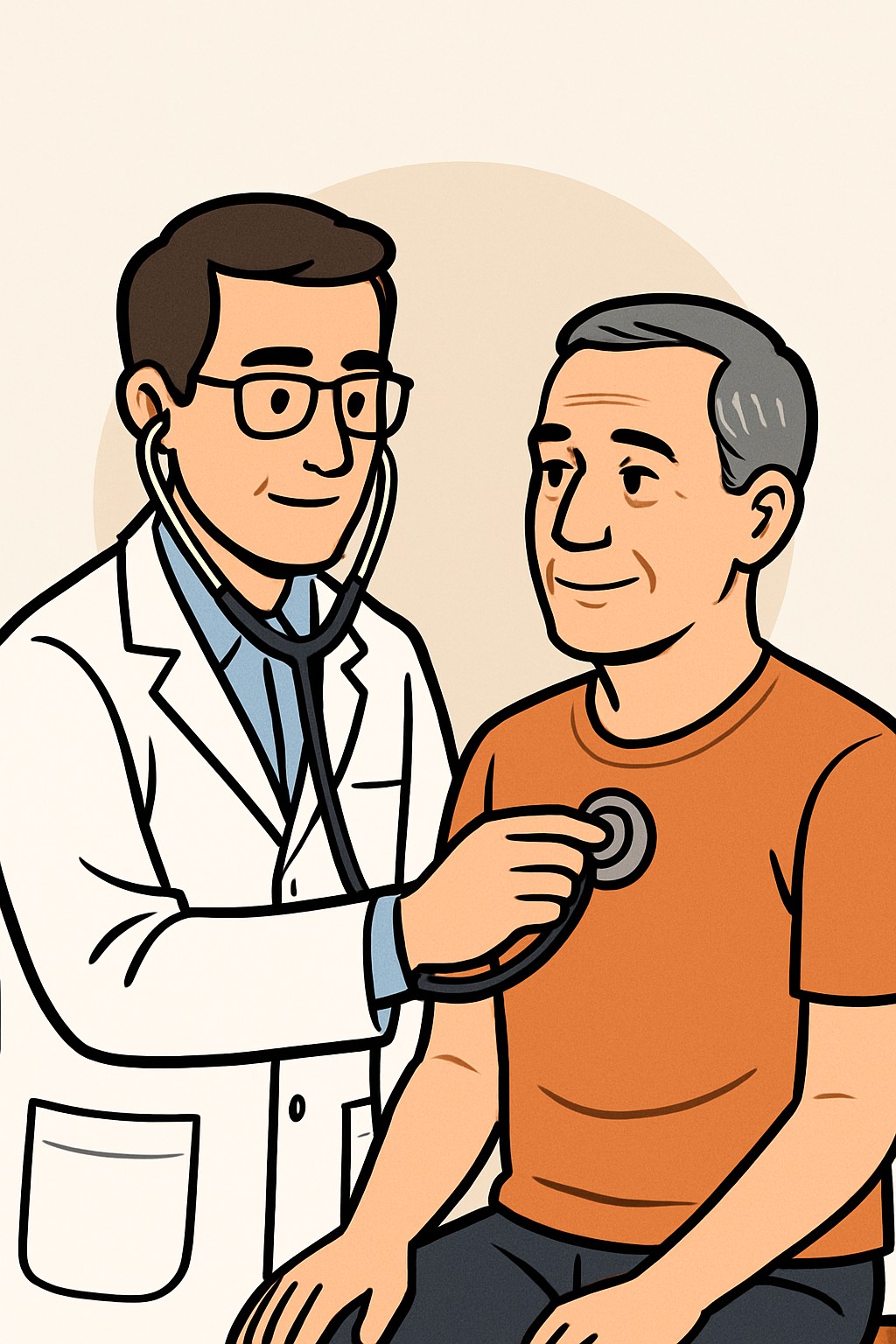
A new patient physical exam for adults aged 40 to 60 is a preventive visit to review your health history, lifestyle, medicines, and family risks. The clinician records vital signs, does a head-to-toe exam, and updates your chart. This visit focuses on prevention and early detection. It may include counseling on nutrition, activity, sleep, and safety, vaccine review, and discussion of age-appropriate screening tests. Basic labs or imaging may be ordered based on your history and risk factors.
Also known as: Annual physical, Preventive exam, Well checkup
Preparation & Next Steps
Everything you need to know before and after your procedure
Before Care
- Bring a photo ID, insurance card, and a payment method if a copay applies
- Carry an up-to-date list of all medicines and supplements, with doses and timing
- Write down top concerns and key questions you want to cover
- Bring your immunization record and any recent test or imaging results if available
- Know your personal and family history, including major conditions and ages of onset
- Wear comfortable clothing that allows the clinician to check vitals and examine you
- Confirm clinic instructions about fasting if blood tests are planned
- Arrive a bit early to complete forms and confirm preferred pharmacy information
- Check your benefits to understand what preventive services are covered
- Update or enroll in the patient portal to view summaries and results
After Care
- Review the visit summary and screening plan in your patient portal
- Complete any ordered labs, imaging, or referrals as scheduled
- Update your personal medication list with any changes made at the visit
- Schedule follow-up appointments for results review or preventive screenings
- Track any vaccine side effects such as arm soreness and report unexpected reactions to the clinic
- Adopt agreed lifestyle steps and use reminders to support them
- Store copies of test results and vaccination records in a safe place
- Contact the clinic if new or worsening symptoms appear after the visit
- Verify coverage and any costs for ordered tests with your insurer
- Use secure messaging or phone to ask clarifying questions about next steps
Clinical Information
Important medical details about this procedure
Indications
- Establishing care with a new primary care clinician
- Routine preventive health check
- Updating vaccines and screening plans
- Baseline evaluation of blood pressure, weight, and health risks
- Review of family history and personal risk factors
- Discussion of lifestyle goals and wellness planning
Alternatives
- Problem-focused visit for a specific concern
- Telehealth preventive discussion when a physical exam is not required
- Community or workplace screening events for limited tests
Risks
- Minor discomfort from exams, vaccines, or blood draws
- Incidental findings that may need more tests
- Anxiety related to test results
- Privacy concerns if records are shared outside secure systems
- Out-of-pocket costs for services not covered as preventive care
- False reassurance if symptoms develop after the visit
Contraindications
- Severe or life-threatening symptoms that need emergency care
- Highly contagious illness without notifying the clinic in advance
- Inability to participate in an exam without needed support or accommodations
Recovery Timeline
What to expect during your recovery
There is no medical recovery period for a routine physical exam. Most people return to normal activities right away. If blood is drawn or vaccines are given, mild soreness can occur briefly.
Typical Range
Same day
Return to Work
Same day
Recovery Milestones
Resume normal daily activities and work
Complete same-day or next-day labs if ordered
Review results via portal or phone and schedule follow-up if needed
Frequently Asked Questions
Common questions and expert answers about this procedure
What happens during this physical exam?
What happens during this physical exam?
The clinician reviews your history and medicines, checks vital signs, performs a head-to-toe exam, updates vaccines, and discusses age-appropriate screenings.
Do I need to fast before the visit?
Do I need to fast before the visit?
Only if the clinic tells you fasting labs are planned. Some tests can be done without fasting.
Can I discuss a specific problem during the exam?
Can I discuss a specific problem during the exam?
You can bring up concerns. If a detailed workup is needed, the clinic may schedule a separate problem-focused visit.
How often should adults 40 to 60 get a physical?
How often should adults 40 to 60 get a physical?
Many people have a yearly preventive visit. The timing of screenings depends on personal risk factors and guidelines.
What screenings are commonly discussed for ages 40 to 60?
What screenings are commonly discussed for ages 40 to 60?
Blood pressure, cholesterol, diabetes risk, colorectal cancer, breast or cervical cancer where applicable, and others based on your risks.
Who can perform the exam?
Who can perform the exam?
Primary care clinicians such as physicians, nurse practitioners, or physician assistants commonly perform physical exams.
Are vaccines part of this visit?
Are vaccines part of this visit?
Yes, the clinician reviews your vaccine history and may recommend vaccines based on age, risks, and the CDC schedule.
Will insurance cover this visit?
Will insurance cover this visit?
Many plans cover preventive services, but coverage varies by plan and what is done. Check your benefits and ask the clinic about possible charges.