%20--%3e%3csvg%20version='1.0'%20id='Layer_1'%20xmlns='http://www.w3.org/2000/svg'%20xmlns:xlink='http://www.w3.org/1999/xlink'%20x='0px'%20y='0px'%20viewBox='0%200%20755.52%20814.35'%20style='enable-background:new%200%200%20755.52%20814.35;'%20xml:space='preserve'%3e%3cstyle%20type='text/css'%3e%20.st0{fill:%231ae5ce;stroke:%231ae5ce;stroke-width:7;stroke-miterlimit:10;}%20.st1{fill:%23FFFFFF;stroke:%231ae5ce;stroke-width:7;stroke-miterlimit:10;}%20.st2{fill:%231ae5ce;stroke:%23FFFFFF;stroke-width:7;stroke-miterlimit:10;}%20.st3{fill:%23FFFFFF;stroke:%23FFFFFF;stroke-width:6;stroke-miterlimit:10;}%20%3c/style%3e%3cg%20id='Dark_Logo_00000159431215648494653180000015900878925932721032_'%3e%3cpath%20id='shield_00000152259091539869183100000001926543869452564382_'%20class='st0'%20d='M711.13,173.42%20c-3.37-49.07-38.92-44.9-75.96-52.18c-67.4-13.25-130.47-34.47-192.36-63.92c-22.48-10.7-41.88-25.74-65.05-26.28%20c-23.17,0.54-42.58,15.59-65.05,26.28c-61.89,29.45-124.95,50.68-192.36,63.92c-37.04,7.28-72.59,3.11-75.96,52.18%20c-1.55,22.6,0.34,46.4,1.05,68.92c5.99,190.78,52.91,345.39,206.27,466.46c29.71,23.46,74.51,55.8,108.84,70.75%20c5.99,2.61,11.7,3.73,17.21,3.75c5.51-0.02,11.22-1.14,17.21-3.75c34.33-14.95,79.12-47.3,108.84-70.75%20c153.37-121.07,200.28-275.68,206.27-466.46C710.79,219.82,712.68,196.02,711.13,173.42z'/%3e%3cpath%20id='magnifyingglass_00000073685934697636024790000000342567780940956808_'%20class='st1'%20d='M648.78,624.21l-96.64-104.65%20c34.89-40.63,55.98-93.46,55.98-151.21c0-128.27-103.98-232.24-232.24-232.24S143.63,240.08,143.63,368.35%20s103.98,232.24,232.24,232.24c48.87,0,94.21-15.11,131.62-40.89l97.18,105.24c11.25,12.18,30.24,12.93,42.42,1.69l0,0%20C659.27,655.38,660.03,636.39,648.78,624.21z'/%3e%3ccircle%20id='ellipse_00000129904010550392394720000017056154833629780114_'%20class='st2'%20cx='375.87'%20cy='368.35'%20r='181.21'/%3e%3cpath%20id='dollarsign_00000057140127156649725250000003772530148495155891_'%20class='st3'%20d='M362.91,492.03v-23.91%20c0-2.01-1.58-3.69-3.59-3.77c-18.49-0.78-37.12-5.4-49.4-11.83c-1.75-0.92-2.53-3.01-1.76-4.84l5.87-13.89%20c0.86-2.02,3.23-2.88,5.2-1.89c12.94,6.52,30.45,11.44,49.18,11.44c26.02,0,43.6-12.73,43.6-30.43c0-17.08-14.29-27.63-41.4-36.95%20c-37.37-12.42-60.46-26.7-60.46-53.72c0-24.97,20.29-44.11,52.22-49.51c1.8-0.31,3.11-1.89,3.11-3.72v-24.35%20c0-2.09,1.69-3.78,3.78-3.78h15.16c2.09,0,3.78,1.69,3.78,3.78v22.71c0,2.01,1.58,3.67,3.58,3.77c17.85,0.92,30.88,4.75,40.61,9.1%20c1.92,0.86,2.79,3.09,1.94,5.01l-6.08,13.6c-0.85,1.91-3.09,2.77-4.99,1.91c-8.37-3.8-22.38-8.95-42.75-8.95%20c-28.21,0-38.84,14.28-38.84,26.7c0,16.15,13.56,24.22,45.44,35.4c37.74,13.04,56.79,29.19,56.79,56.82%20c0,23.85-19.05,46.23-54.78,52.3c-1.8,0.31-3.11,1.89-3.11,3.72v25.28c0,2.09-1.69,3.78-3.78,3.78h-15.53%20C364.6,495.81,362.91,494.12,362.91,492.03z'/%3e%3c/g%3e%3c/svg%3e)
Physiologic data analysis (remote monitoring) Evaluation Management
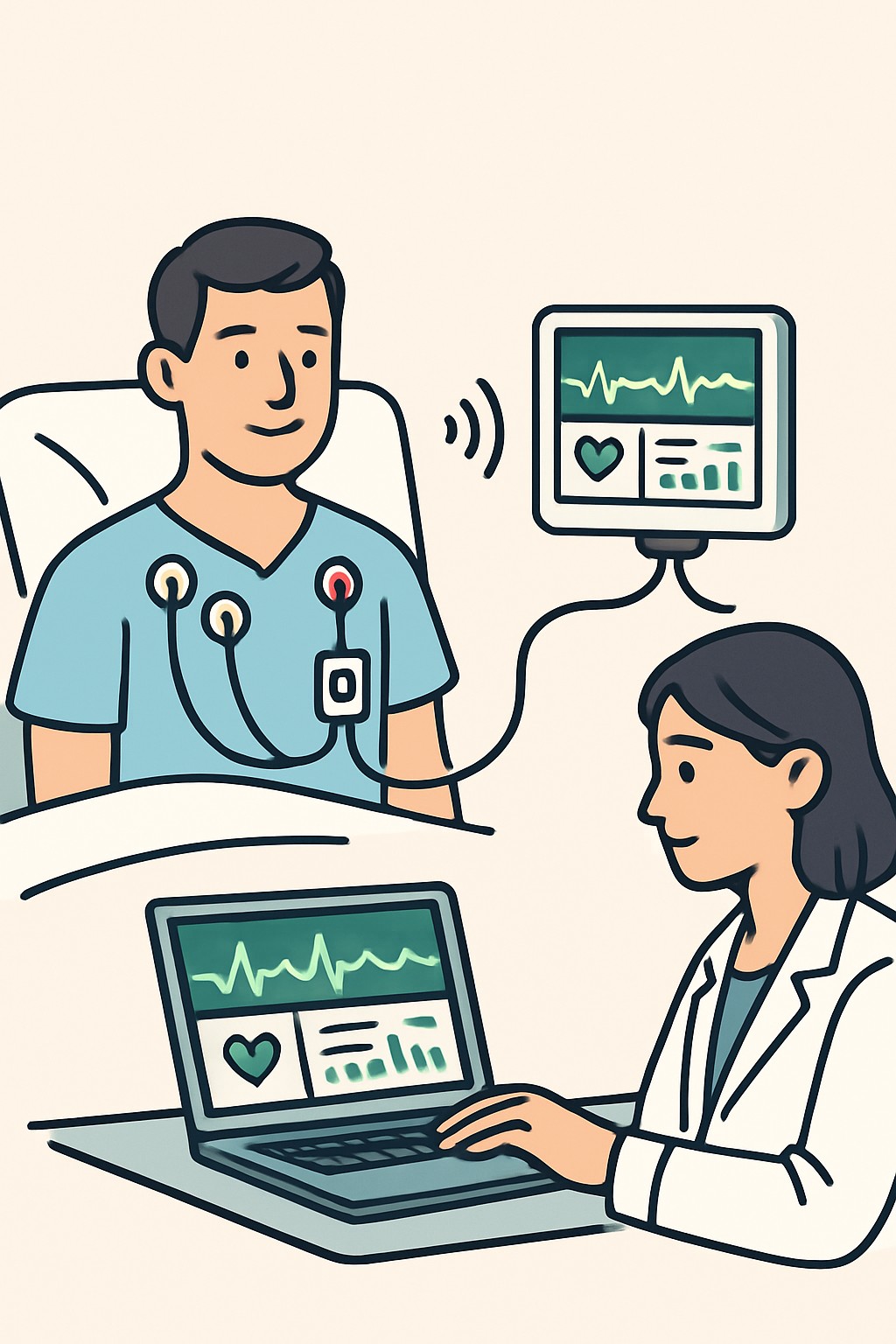
Physiologic data analysis (remote monitoring) means a clinician reviews health measurements that are collected at home and sent electronically.
Overview
Physiologic data analysis (remote monitoring) means a clinician reviews health measurements that are collected at home and sent electronically. Physiologic data are body measurements such as heart rate, blood pressure, weight, oxygen level, and blood glucose. Programs like this help track health trends between visits. They can support care for chronic conditions, recovery after a hospital stay, or short-term checks when a new treatment starts.
Also known as: Remote patient monitoring data analysis, RPM data analysis, Remote physiologic data interpretation
Preparation & Next Steps
Everything you need to know before and after your procedure
Before Care
- Confirm which measurements are collected and how they are sent (cellular hub, Bluetooth, or Wi-Fi).
- Review the program consent and privacy notice so you understand data use.
- Set up the device account, pair the device if needed, and send a test reading.
- Check that your home has enough cellular or Wi-Fi signal where you will use the device.
- Charge devices fully and keep chargers or spare batteries in a set place.
- Decide on a daily routine time for readings if your program uses scheduled measurements.
- Keep a simple symptom log to add context to the numbers when requested.
- Save the clinic contact information and device vendor technical support number.
- Ask how alerts work, typical response times, and preferred ways to reach the care team.
- Store extra supplies (patches, cuffs, sensors) in a clean, dry place.
After Care
- Use the device as instructed by the manufacturer or program materials.
- Keep sensors, cuffs, and skin clean and dry; replace disposable parts as labeled.
- Check that data uploads are successful and that the device stays paired or connected.
- Keep the device charged and cables organized to avoid damage.
- Record symptoms, activity changes, or new over-the-counter products to share with your care team.
- Respond to messages or calls from the care team regarding your readings.
- Report device problems or skin irritation to the device vendor or clinic.
- Do not share your login; use secure connections and keep software up to date.
- Attend scheduled follow-up visits (virtual or in person) to review trends.
- Contact a clinician if you notice concerning symptoms or device alerts as described by your program.
Clinical Information
Important medical details about this procedure
Indications
- High blood pressure (hypertension)
- Heart failure or heart rhythm concerns
- Chronic lung disease with oxygen monitoring
- Diabetes with connected glucose data
- Weight monitoring after fluid buildup
- Post-surgery or post-hospital recovery check-ins
- Monitoring during medicine changes that affect vital signs
- Sleep or breathing pattern tracking when ordered
Alternatives
- In-person vital sign checks at a clinic
- Self-monitoring with a paper or digital log
- Periodic phone check-ins without connected devices
- Home health nurse visits
- Ambulatory or Holter monitoring for limited periods
Risks
- Data gaps or lost connection can reduce accuracy
- False alarms or missed alerts
- Skin irritation from patches or sensors
- Battery failure or device malfunction
- Privacy and security risks if accounts are not protected
- Possible out-of-pocket costs for devices or services
Contraindications
- No reliable access to power, cellular, or internet service
- Inability to use or wear the device safely without support
- Active skin problems at the sensor site when a wearable is needed
- Use of devices not intended for the required measurement
Recovery Timeline
What to expect during your recovery
There is no medical recovery period. Most people continue normal activities while readings are collected and reviewed. There may be a short learning period to get comfortable with the device.
Typical Range
Same day
Return to Work
Same day
Recovery Milestones
Complete device setup and send a successful test reading
Use the device at the scheduled times without assistance
Confirm data is transmitting and review first trend summary with the care team
Settle into routine monitoring and periodic feedback
Frequently Asked Questions
Common questions and expert answers about this procedure
What is physiologic data analysis in remote monitoring?
What is physiologic data analysis in remote monitoring?
A clinician reviews health numbers that you send from home through a connected device to look for trends and changes between visits.
What kinds of data can be monitored?
What kinds of data can be monitored?
Common examples are blood pressure, heart rate, weight, oxygen level, blood glucose, temperature, and breathing rate.
Who reviews my data and how often?
Who reviews my data and how often?
A physician or qualified health professional reviews it on a defined schedule. Many programs also use alerts to flag readings that need quicker attention.
Do I need internet or a smartphone?
Do I need internet or a smartphone?
Some devices send data through a cellular hub and do not need a smartphone or home internet. Others use Bluetooth with a phone or Wi-Fi.
Will this replace office visits?
Will this replace office visits?
It usually complements routine care. In-person or telehealth visits may still be needed for exams, tests, or treatment changes.
What happens if there is an alert?
What happens if there is an alert?
Programs define thresholds for alerts. The care team may message or call you, or advise next steps based on the program's response plan.
How is my data protected?
How is my data protected?
Health programs follow privacy and security rules. Protect your account with strong passwords and do not share your login.
Are there costs?
Are there costs?
Costs vary by program, device, and insurance benefits. Ask about device fees, service charges, and any data plan needs.
References
Medical literature and sources