%20--%3e%3csvg%20version='1.0'%20id='Layer_1'%20xmlns='http://www.w3.org/2000/svg'%20xmlns:xlink='http://www.w3.org/1999/xlink'%20x='0px'%20y='0px'%20viewBox='0%200%20755.52%20814.35'%20style='enable-background:new%200%200%20755.52%20814.35;'%20xml:space='preserve'%3e%3cstyle%20type='text/css'%3e%20.st0{fill:%231ae5ce;stroke:%231ae5ce;stroke-width:7;stroke-miterlimit:10;}%20.st1{fill:%23FFFFFF;stroke:%231ae5ce;stroke-width:7;stroke-miterlimit:10;}%20.st2{fill:%231ae5ce;stroke:%23FFFFFF;stroke-width:7;stroke-miterlimit:10;}%20.st3{fill:%23FFFFFF;stroke:%23FFFFFF;stroke-width:6;stroke-miterlimit:10;}%20%3c/style%3e%3cg%20id='Dark_Logo_00000159431215648494653180000015900878925932721032_'%3e%3cpath%20id='shield_00000152259091539869183100000001926543869452564382_'%20class='st0'%20d='M711.13,173.42%20c-3.37-49.07-38.92-44.9-75.96-52.18c-67.4-13.25-130.47-34.47-192.36-63.92c-22.48-10.7-41.88-25.74-65.05-26.28%20c-23.17,0.54-42.58,15.59-65.05,26.28c-61.89,29.45-124.95,50.68-192.36,63.92c-37.04,7.28-72.59,3.11-75.96,52.18%20c-1.55,22.6,0.34,46.4,1.05,68.92c5.99,190.78,52.91,345.39,206.27,466.46c29.71,23.46,74.51,55.8,108.84,70.75%20c5.99,2.61,11.7,3.73,17.21,3.75c5.51-0.02,11.22-1.14,17.21-3.75c34.33-14.95,79.12-47.3,108.84-70.75%20c153.37-121.07,200.28-275.68,206.27-466.46C710.79,219.82,712.68,196.02,711.13,173.42z'/%3e%3cpath%20id='magnifyingglass_00000073685934697636024790000000342567780940956808_'%20class='st1'%20d='M648.78,624.21l-96.64-104.65%20c34.89-40.63,55.98-93.46,55.98-151.21c0-128.27-103.98-232.24-232.24-232.24S143.63,240.08,143.63,368.35%20s103.98,232.24,232.24,232.24c48.87,0,94.21-15.11,131.62-40.89l97.18,105.24c11.25,12.18,30.24,12.93,42.42,1.69l0,0%20C659.27,655.38,660.03,636.39,648.78,624.21z'/%3e%3ccircle%20id='ellipse_00000129904010550392394720000017056154833629780114_'%20class='st2'%20cx='375.87'%20cy='368.35'%20r='181.21'/%3e%3cpath%20id='dollarsign_00000057140127156649725250000003772530148495155891_'%20class='st3'%20d='M362.91,492.03v-23.91%20c0-2.01-1.58-3.69-3.59-3.77c-18.49-0.78-37.12-5.4-49.4-11.83c-1.75-0.92-2.53-3.01-1.76-4.84l5.87-13.89%20c0.86-2.02,3.23-2.88,5.2-1.89c12.94,6.52,30.45,11.44,49.18,11.44c26.02,0,43.6-12.73,43.6-30.43c0-17.08-14.29-27.63-41.4-36.95%20c-37.37-12.42-60.46-26.7-60.46-53.72c0-24.97,20.29-44.11,52.22-49.51c1.8-0.31,3.11-1.89,3.11-3.72v-24.35%20c0-2.09,1.69-3.78,3.78-3.78h15.16c2.09,0,3.78,1.69,3.78,3.78v22.71c0,2.01,1.58,3.67,3.58,3.77c17.85,0.92,30.88,4.75,40.61,9.1%20c1.92,0.86,2.79,3.09,1.94,5.01l-6.08,13.6c-0.85,1.91-3.09,2.77-4.99,1.91c-8.37-3.8-22.38-8.95-42.75-8.95%20c-28.21,0-38.84,14.28-38.84,26.7c0,16.15,13.56,24.22,45.44,35.4c37.74,13.04,56.79,29.19,56.79,56.82%20c0,23.85-19.05,46.23-54.78,52.3c-1.8,0.31-3.11,1.89-3.11,3.72v25.28c0,2.09-1.69,3.78-3.78,3.78h-15.53%20C364.6,495.81,362.91,494.12,362.91,492.03z'/%3e%3c/g%3e%3c/svg%3e)
Self-care/home management training (15 min) Evaluation Management
Self-care/home management training is a timed therapy service, usually provided by occupational therapy, that teaches skills for daily activities and safe living at home.
Overview
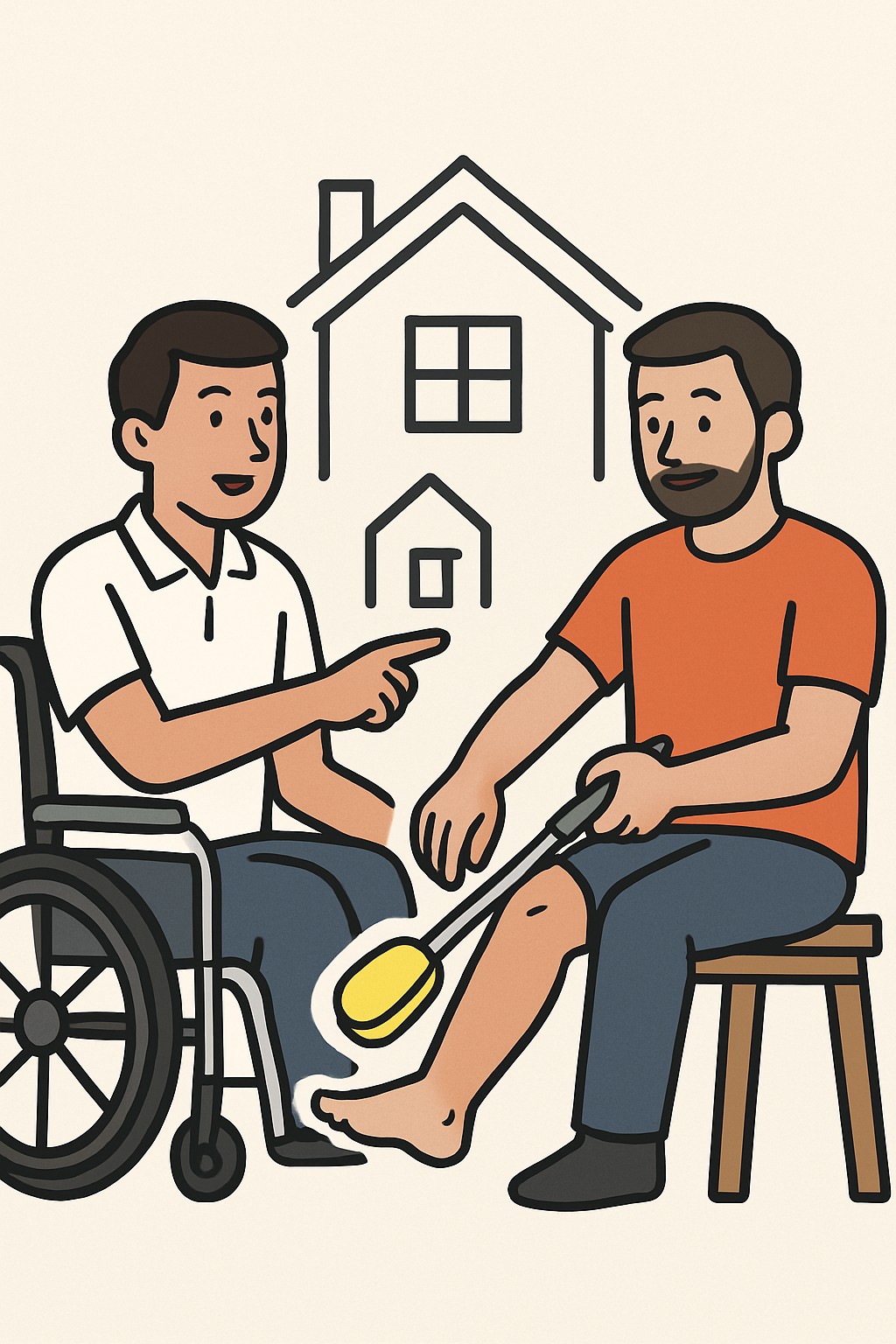
Self-care/home management training is a timed therapy service, usually provided by occupational therapy, that teaches skills for daily activities and safe living at home. It focuses on activities of daily living (ADLs) like bathing, dressing, toileting, and eating, and instrumental activities of daily living (IADLs) like cooking, cleaning, and managing medicines. The 15-minute unit means time spent in direct one-on-one training. Sessions may include practicing tasks, learning adaptive techniques, trying assistive devices, and planning safer ways to do routine activities.
Also known as: ADL training, Self-care training, Home management training, OT self-care session
Preparation & Next Steps
Everything you need to know before and after your procedure
Before Care
- Bring a list of daily tasks that are hard and when problems happen
- Wear comfortable clothing and shoes that are easy to move in
- Bring current assistive devices or splints you already use
- Carry an up-to-date list of medicines and any allergies
- Share any recent therapy or hospital discharge summaries if available
- Confirm whether a referral or prior authorization is required by your plan
- Plan transportation and allow extra time for paperwork and setup
- Ask the clinic if photos or measurements of your home setup would help
- Consider having a family member or caregiver join for training if appropriate
After Care
- Practice the techniques as instructed by your therapy team using safe, short sessions
- Use adaptive equipment only as taught and keep written instructions handy
- Keep a simple log of what methods worked, pain levels, and any barriers
- Adjust your home setup as recommended to reduce tripping and strain
- Clean, check, and store devices or splints as directed by the manufacturer
- Schedule recommended follow-up sessions and bring your practice log
- Coordinate with caregivers so everyone uses the same techniques
- Contact a clinician if you notice worsening pain, dizziness, falls, or skin breakdown
- Ask about repairs or replacements if equipment becomes worn or unsafe
Clinical Information
Important medical details about this procedure
Indications
- Difficulty with bathing, dressing, grooming, or toileting
- Challenges preparing meals, doing housekeeping, or managing medicines
- Recovery after stroke, surgery, injury, or hospitalization
- Arthritis, chronic pain, or limited mobility affecting daily tasks
- Neurologic conditions such as multiple sclerosis, Parkinsons disease, or brain injury
- Cognitive changes that affect organization and safety at home
- Aging-related changes that increase fall risk or reduce independence
- Need for training to use assistive devices or adaptive equipment
Alternatives
- Educational handouts or videos on daily living techniques
- Caregiver training or community-based classes
- Telehealth education for selected topics
- Home health aide or personal care services
- Physical therapy focused on mobility and balance
- Environmental modifications by a contractor or specialist
Risks
- Muscle soreness or fatigue after practice
- Temporary increase in pain or stiffness
- Dizziness or loss of balance during tasks
- Skin irritation or pressure from braces or splints
- Frustration or stress while learning new methods
- Device misuse if instructions are misunderstood
Contraindications
- Unstable medical condition or vital signs
- Uncontrolled severe pain or acute illness
- Activity restrictions that limit safe participation
- High fall risk without proper support in place
- Severe agitation or confusion without supervision
Recovery Timeline
What to expect during your recovery
There is usually no medical recovery period from a 15-minute training session. Most people resume normal activities right away, though mild fatigue or soreness can occur.
Typical Range
Same day
Return to Work
Same day
Recovery Milestones
Resume normal daily activities
Practice 1–2 new techniques for short periods with rests
Integrate any recommended device or setup change into routine tasks
Review progress and barriers at the next scheduled therapy visit
Frequently Asked Questions
Common questions and expert answers about this procedure
What is self-care/home management training?
What is self-care/home management training?
A timed therapy service that teaches safe, efficient ways to do daily tasks like bathing, dressing, toileting, meal prep, and managing medicines.
Why is it billed in 15-minute units?
Why is it billed in 15-minute units?
It is a timed service. Each unit reflects about 15 minutes of one-on-one training. The number of units per visit varies based on the plan for that day.
Who provides this training?
Who provides this training?
It is commonly provided by occupational therapists or occupational therapy assistants. In some cases, physical therapy teams may address related skills.
What happens during a session?
What happens during a session?
The therapist assesses your goals, demonstrates techniques, practices tasks with you, fits or adjusts devices if needed, and suggests safer ways to set up your home.
Do I need special equipment?
Do I need special equipment?
Sometimes. Items like reachers, shower chairs, or pill organizers may help. The therapist may suggest options and show how to use them.
Is this done at home or in a clinic?
Is this done at home or in a clinic?
Both settings are used. Home visits focus on your actual space. Clinic visits use simulated setups and equipment.
Are there risks?
Are there risks?
Risks are usually low, such as mild soreness, fatigue, or dizziness. Safety measures are used and activities are adjusted as needed.
How many sessions will I need?
How many sessions will I need?
The number depends on your goals, condition, and progress. The therapy plan is reviewed and updated over time.
References
Medical literature and sources