%20--%3e%3csvg%20version='1.0'%20id='Layer_1'%20xmlns='http://www.w3.org/2000/svg'%20xmlns:xlink='http://www.w3.org/1999/xlink'%20x='0px'%20y='0px'%20viewBox='0%200%20755.52%20814.35'%20style='enable-background:new%200%200%20755.52%20814.35;'%20xml:space='preserve'%3e%3cstyle%20type='text/css'%3e%20.st0{fill:%231ae5ce;stroke:%231ae5ce;stroke-width:7;stroke-miterlimit:10;}%20.st1{fill:%23FFFFFF;stroke:%231ae5ce;stroke-width:7;stroke-miterlimit:10;}%20.st2{fill:%231ae5ce;stroke:%23FFFFFF;stroke-width:7;stroke-miterlimit:10;}%20.st3{fill:%23FFFFFF;stroke:%23FFFFFF;stroke-width:6;stroke-miterlimit:10;}%20%3c/style%3e%3cg%20id='Dark_Logo_00000159431215648494653180000015900878925932721032_'%3e%3cpath%20id='shield_00000152259091539869183100000001926543869452564382_'%20class='st0'%20d='M711.13,173.42%20c-3.37-49.07-38.92-44.9-75.96-52.18c-67.4-13.25-130.47-34.47-192.36-63.92c-22.48-10.7-41.88-25.74-65.05-26.28%20c-23.17,0.54-42.58,15.59-65.05,26.28c-61.89,29.45-124.95,50.68-192.36,63.92c-37.04,7.28-72.59,3.11-75.96,52.18%20c-1.55,22.6,0.34,46.4,1.05,68.92c5.99,190.78,52.91,345.39,206.27,466.46c29.71,23.46,74.51,55.8,108.84,70.75%20c5.99,2.61,11.7,3.73,17.21,3.75c5.51-0.02,11.22-1.14,17.21-3.75c34.33-14.95,79.12-47.3,108.84-70.75%20c153.37-121.07,200.28-275.68,206.27-466.46C710.79,219.82,712.68,196.02,711.13,173.42z'/%3e%3cpath%20id='magnifyingglass_00000073685934697636024790000000342567780940956808_'%20class='st1'%20d='M648.78,624.21l-96.64-104.65%20c34.89-40.63,55.98-93.46,55.98-151.21c0-128.27-103.98-232.24-232.24-232.24S143.63,240.08,143.63,368.35%20s103.98,232.24,232.24,232.24c48.87,0,94.21-15.11,131.62-40.89l97.18,105.24c11.25,12.18,30.24,12.93,42.42,1.69l0,0%20C659.27,655.38,660.03,636.39,648.78,624.21z'/%3e%3ccircle%20id='ellipse_00000129904010550392394720000017056154833629780114_'%20class='st2'%20cx='375.87'%20cy='368.35'%20r='181.21'/%3e%3cpath%20id='dollarsign_00000057140127156649725250000003772530148495155891_'%20class='st3'%20d='M362.91,492.03v-23.91%20c0-2.01-1.58-3.69-3.59-3.77c-18.49-0.78-37.12-5.4-49.4-11.83c-1.75-0.92-2.53-3.01-1.76-4.84l5.87-13.89%20c0.86-2.02,3.23-2.88,5.2-1.89c12.94,6.52,30.45,11.44,49.18,11.44c26.02,0,43.6-12.73,43.6-30.43c0-17.08-14.29-27.63-41.4-36.95%20c-37.37-12.42-60.46-26.7-60.46-53.72c0-24.97,20.29-44.11,52.22-49.51c1.8-0.31,3.11-1.89,3.11-3.72v-24.35%20c0-2.09,1.69-3.78,3.78-3.78h15.16c2.09,0,3.78,1.69,3.78,3.78v22.71c0,2.01,1.58,3.67,3.58,3.77c17.85,0.92,30.88,4.75,40.61,9.1%20c1.92,0.86,2.79,3.09,1.94,5.01l-6.08,13.6c-0.85,1.91-3.09,2.77-4.99,1.91c-8.37-3.8-22.38-8.95-42.75-8.95%20c-28.21,0-38.84,14.28-38.84,26.7c0,16.15,13.56,24.22,45.44,35.4c37.74,13.04,56.79,29.19,56.79,56.82%20c0,23.85-19.05,46.23-54.78,52.3c-1.8,0.31-3.11,1.89-3.11,3.72v25.28c0,2.09-1.69,3.78-3.78,3.78h-15.53%20C364.6,495.81,362.91,494.12,362.91,492.03z'/%3e%3c/g%3e%3c/svg%3e)
Subsequent nursing facility care - high complexity Evaluation Management
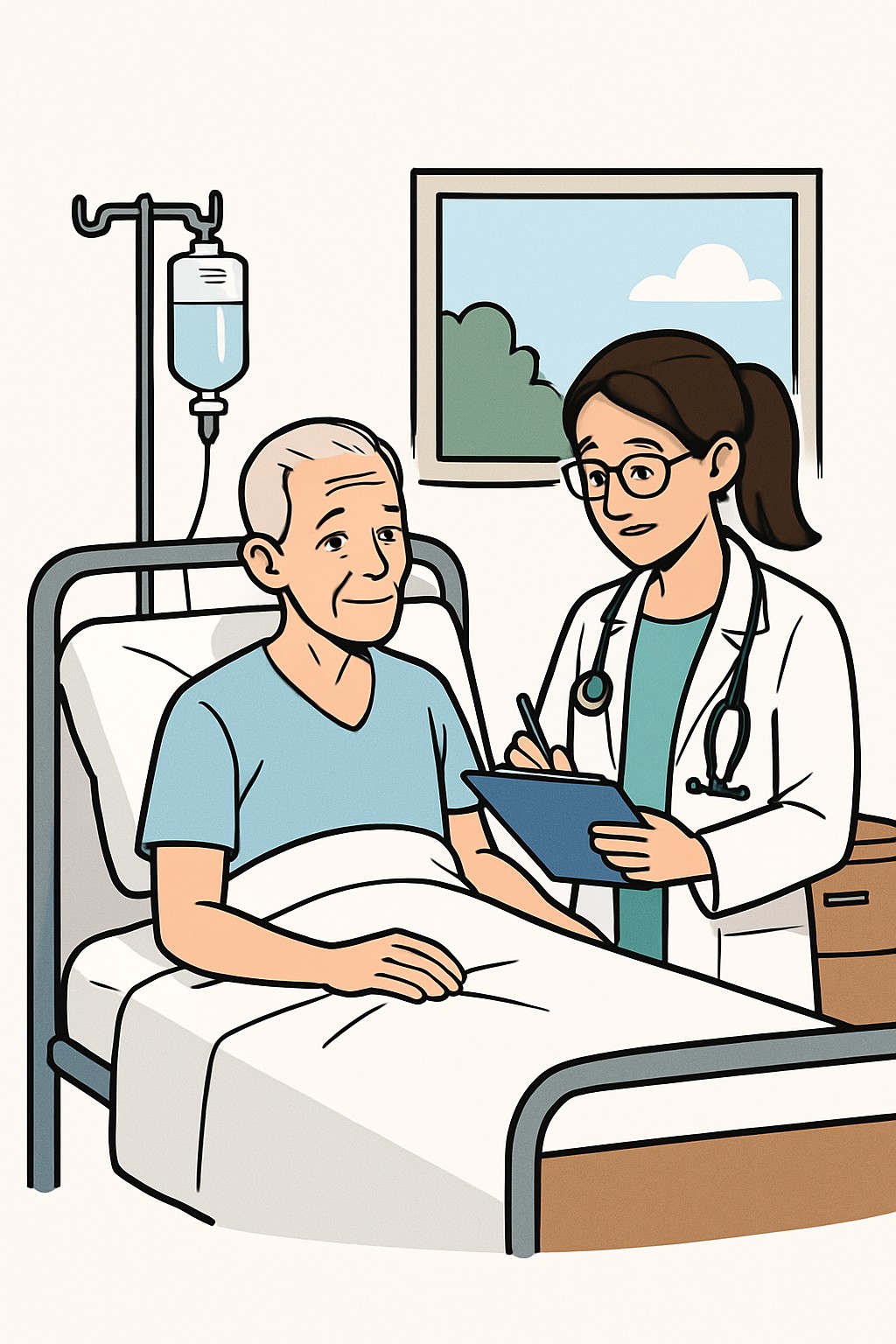
This is a follow-up medical evaluation in a nursing facility such as a skilled nursing facility or nursing home.
Overview
This is a follow-up medical evaluation in a nursing facility such as a skilled nursing facility or nursing home. It occurs after the initial visit and focuses on assessing current health status, reviewing new or ongoing issues, and updating the care plan. High complexity describes the level of medical decision making. It generally means the clinician is addressing serious or unstable problems, reviewing extensive data, managing treatments with higher risk, and coordinating care with the facility team and other clinicians.
Also known as: High complexity SNF follow-up visit, Nursing home follow-up visit (high complexity), Subsequent nursing facility E/M - high MDM
Preparation & Next Steps
Everything you need to know before and after your procedure
Before Care
- Have an up-to-date list of all medicines, doses, and allergies available at the bedside or nurse station
- Gather recent symptom logs such as vitals, weights, blood sugar readings, pain scores, or behavior notes
- Keep copies of recent hospital discharge papers, test results, and specialist notes in the facility chart
- Bring hearing aids, glasses, and communication devices so concerns can be discussed clearly
- Identify a preferred contact person and ensure consent forms allow the team to share updates
- Prepare a short list of top questions and goals for the visit
- Ensure advance directives or medical orders for life-sustaining treatment are on file if available
- Let staff know about new over-the-counter medicines or supplements started since the last visit
- Confirm the pharmacy on record for any prescription updates
- Ask the facility about interpreter services if language or hearing support is needed
After Care
- Review the updated care plan and medication list recorded by the facility
- Confirm any new orders for labs, imaging, therapy, or consultations are scheduled
- Monitor for side effects after medication changes and inform nursing staff of concerns
- Track symptoms such as pain, breathing, swelling, fever, confusion, or falls and report changes
- Clarify wound, catheter, or device care steps with nursing staff if applicable
- Know who to contact at the facility for questions during daytime and after hours
- Use the patient portal or facility contact process to request clarifications
- Note the expected timing of the next evaluation or check-in
- Ensure care partners or family are updated according to the resident’s preferences
- Contact the facility clinician or nurse if sudden confusion, chest pain, trouble breathing, high fever, new weakness, or uncontrolled pain occurs
Clinical Information
Important medical details about this procedure
Indications
- Worsening or unstable chronic conditions
- New acute symptoms or complications during a facility stay
- Complex medication changes or monitoring of high-risk drugs
- Post-hospital discharge reviews and transition of care
- Multiple conditions requiring extensive coordination
- Significant changes in function, behavior, or cognition
- Advance care planning discussions tied to complex medical needs
Alternatives
- Lower complexity subsequent nursing facility visit when the situation is simpler
- Care team conference without a clinician face-to-face visit when appropriate
- Telehealth follow-up if allowed by facility policy and payer rules
- Transfer to urgent care or hospital when higher-level care is needed
Risks
- Medication adjustments may cause side effects or interactions
- Miscommunication can lead to confusion about the care plan
- Delayed diagnosis if symptoms change after the visit
- Potential out-of-pocket costs depending on coverage
- Privacy risks when discussing health information in shared spaces
Contraindications
- Severe or life-threatening symptoms that require emergency care
- Resident not located in a nursing facility setting
- Infection control restrictions that prevent in-person evaluation without proper precautions
Recovery Timeline
What to expect during your recovery
There is no medical recovery period for this type of visit. Most residents continue their usual routine immediately after the evaluation.
Typical Range
Same day
Return to Work
Same day
Recovery Milestones
Resume normal facility activities
Complete any same-day or next-day tests if ordered
Review test results and confirm follow-up plan with the care team
Frequently Asked Questions
Common questions and expert answers about this procedure
What does subsequent nursing facility care mean?
What does subsequent nursing facility care mean?
It is a follow-up evaluation in a nursing facility after the initial visit. The clinician checks current issues, examines the resident as needed, and updates the care plan.
What makes this visit high complexity?
What makes this visit high complexity?
High complexity generally involves serious or unstable conditions, extensive data review, higher risk treatments, or significant care coordination.
Who performs this visit?
Who performs this visit?
Physicians, nurse practitioners, or physician assistants typically provide these evaluations in coordination with the facility care team.
What happens during the visit?
What happens during the visit?
The clinician reviews recent events, examines the resident as needed, adjusts medicines or treatments, orders tests if needed, and updates the care plan with staff.
How long does the visit take?
How long does the visit take?
Time varies based on the resident’s needs and the amount of coordination required. Documentation and care team communication add to total time.
Can family or caregivers be involved?
Can family or caregivers be involved?
Many facilities encourage involving the resident’s chosen contacts, with permission, to help share concerns and understand the plan.
Are tests or imaging done during this visit?
Are tests or imaging done during this visit?
Tests are not routine but may be ordered when needed. Many are performed at the facility or scheduled externally.
Can this be done by telehealth?
Can this be done by telehealth?
In some situations telehealth is allowed, depending on facility policies, clinical needs, and payer rules.
References
Medical literature and sources