%20--%3e%3csvg%20version='1.0'%20id='Layer_1'%20xmlns='http://www.w3.org/2000/svg'%20xmlns:xlink='http://www.w3.org/1999/xlink'%20x='0px'%20y='0px'%20viewBox='0%200%20755.52%20814.35'%20style='enable-background:new%200%200%20755.52%20814.35;'%20xml:space='preserve'%3e%3cstyle%20type='text/css'%3e%20.st0{fill:%231ae5ce;stroke:%231ae5ce;stroke-width:7;stroke-miterlimit:10;}%20.st1{fill:%23FFFFFF;stroke:%231ae5ce;stroke-width:7;stroke-miterlimit:10;}%20.st2{fill:%231ae5ce;stroke:%23FFFFFF;stroke-width:7;stroke-miterlimit:10;}%20.st3{fill:%23FFFFFF;stroke:%23FFFFFF;stroke-width:6;stroke-miterlimit:10;}%20%3c/style%3e%3cg%20id='Dark_Logo_00000159431215648494653180000015900878925932721032_'%3e%3cpath%20id='shield_00000152259091539869183100000001926543869452564382_'%20class='st0'%20d='M711.13,173.42%20c-3.37-49.07-38.92-44.9-75.96-52.18c-67.4-13.25-130.47-34.47-192.36-63.92c-22.48-10.7-41.88-25.74-65.05-26.28%20c-23.17,0.54-42.58,15.59-65.05,26.28c-61.89,29.45-124.95,50.68-192.36,63.92c-37.04,7.28-72.59,3.11-75.96,52.18%20c-1.55,22.6,0.34,46.4,1.05,68.92c5.99,190.78,52.91,345.39,206.27,466.46c29.71,23.46,74.51,55.8,108.84,70.75%20c5.99,2.61,11.7,3.73,17.21,3.75c5.51-0.02,11.22-1.14,17.21-3.75c34.33-14.95,79.12-47.3,108.84-70.75%20c153.37-121.07,200.28-275.68,206.27-466.46C710.79,219.82,712.68,196.02,711.13,173.42z'/%3e%3cpath%20id='magnifyingglass_00000073685934697636024790000000342567780940956808_'%20class='st1'%20d='M648.78,624.21l-96.64-104.65%20c34.89-40.63,55.98-93.46,55.98-151.21c0-128.27-103.98-232.24-232.24-232.24S143.63,240.08,143.63,368.35%20s103.98,232.24,232.24,232.24c48.87,0,94.21-15.11,131.62-40.89l97.18,105.24c11.25,12.18,30.24,12.93,42.42,1.69l0,0%20C659.27,655.38,660.03,636.39,648.78,624.21z'/%3e%3ccircle%20id='ellipse_00000129904010550392394720000017056154833629780114_'%20class='st2'%20cx='375.87'%20cy='368.35'%20r='181.21'/%3e%3cpath%20id='dollarsign_00000057140127156649725250000003772530148495155891_'%20class='st3'%20d='M362.91,492.03v-23.91%20c0-2.01-1.58-3.69-3.59-3.77c-18.49-0.78-37.12-5.4-49.4-11.83c-1.75-0.92-2.53-3.01-1.76-4.84l5.87-13.89%20c0.86-2.02,3.23-2.88,5.2-1.89c12.94,6.52,30.45,11.44,49.18,11.44c26.02,0,43.6-12.73,43.6-30.43c0-17.08-14.29-27.63-41.4-36.95%20c-37.37-12.42-60.46-26.7-60.46-53.72c0-24.97,20.29-44.11,52.22-49.51c1.8-0.31,3.11-1.89,3.11-3.72v-24.35%20c0-2.09,1.69-3.78,3.78-3.78h15.16c2.09,0,3.78,1.69,3.78,3.78v22.71c0,2.01,1.58,3.67,3.58,3.77c17.85,0.92,30.88,4.75,40.61,9.1%20c1.92,0.86,2.79,3.09,1.94,5.01l-6.08,13.6c-0.85,1.91-3.09,2.77-4.99,1.91c-8.37-3.8-22.38-8.95-42.75-8.95%20c-28.21,0-38.84,14.28-38.84,26.7c0,16.15,13.56,24.22,45.44,35.4c37.74,13.04,56.79,29.19,56.79,56.82%20c0,23.85-19.05,46.23-54.78,52.3c-1.8,0.31-3.11,1.89-3.11,3.72v25.28c0,2.09-1.69,3.78-3.78,3.78h-15.53%20C364.6,495.81,362.91,494.12,362.91,492.03z'/%3e%3c/g%3e%3c/svg%3e)
Subsequent nursing facility visit (high complexity) Evaluation Management
A subsequent nursing facility visit (high complexity) is a follow-up evaluation in a skilled nursing facility or other nursing facility.
Overview
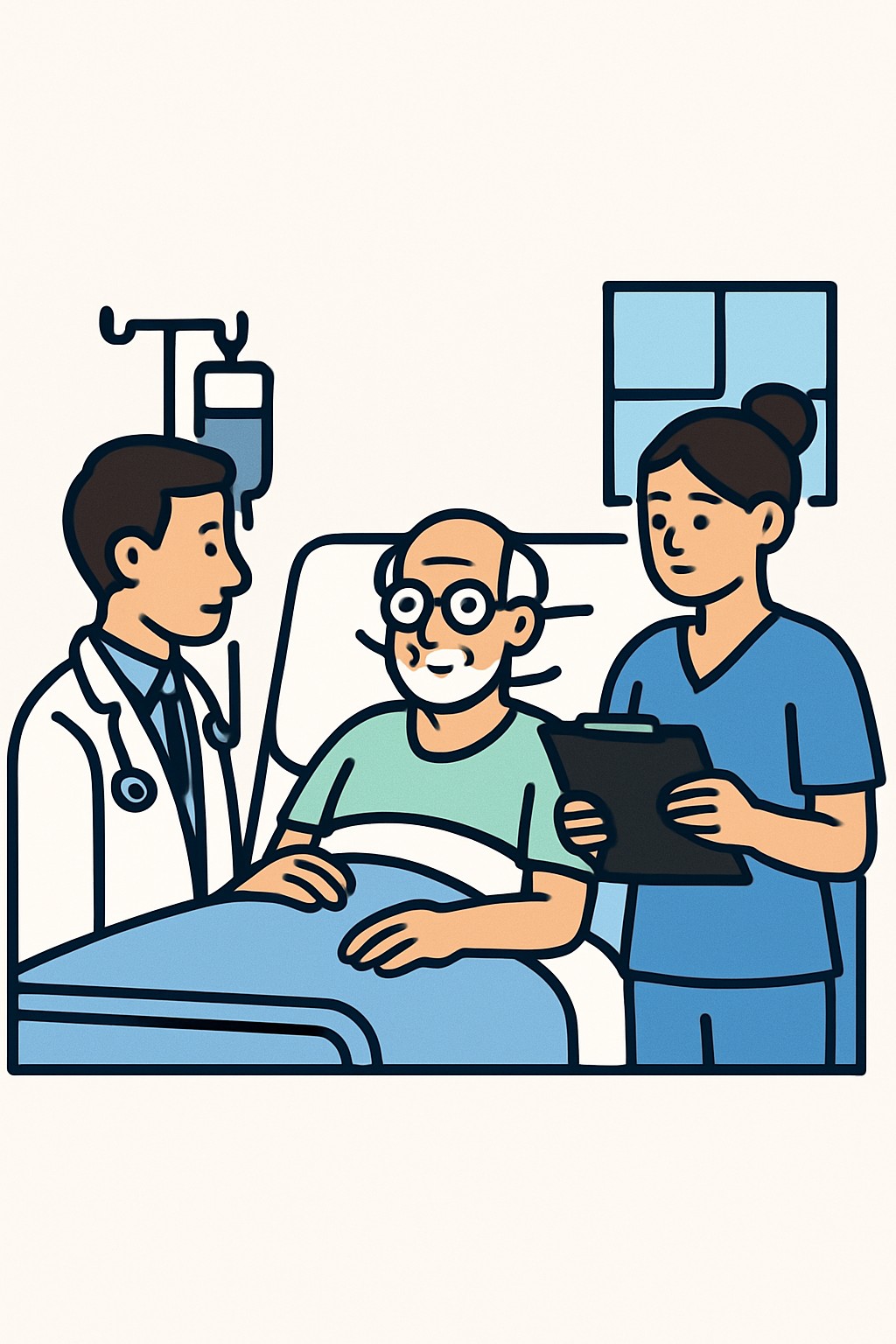
A subsequent nursing facility visit (high complexity) is a follow-up evaluation in a skilled nursing facility or other nursing facility. A clinician reviews your current conditions, examines you, updates the care plan, and coordinates with nursing staff and therapists. High complexity refers to the level of medical decision making. It often involves multiple serious problems, extensive data review, or higher risk treatments. The visit may be selected based on the complexity of decisions or total clinician time on the date of the encounter.
Also known as: Nursing facility follow-up visit, SNF follow-up, Long-term care follow-up
Preparation & Next Steps
Everything you need to know before and after your procedure
Before Care
- Have an up-to-date list of all medicines and supplements with doses and times
- Prepare your top concerns and a brief timeline of symptoms or changes
- Ensure allergies and prior reactions are clearly listed in the facility record
- Have recent vitals, weights, glucose logs, and therapy notes available
- Keep hospital discharge papers or recent test results ready for review
- Make advance directives, POLST, or power of attorney documents available
- Have eyeglasses, hearing aids, and communication devices charged and on hand
- Confirm your preferred pharmacy and contact information with staff
- Ask facility staff to have your medication administration record accessible
- Arrange for a family member or caregiver to join in person or by phone if desired
After Care
- Review the visit summary and new orders with nursing staff
- Follow the updated care plan, including any therapy or activity changes
- Use the facility process to obtain and administer new or changed medicines
- Complete any ordered labs or imaging when scheduled
- Track symptoms and side effects and report changes to the care team
- Keep wound, catheter, or device care as directed by the care plan
- Confirm any referrals and schedule follow-up visits as planned
- Update personal records and advance care planning documents if changed
- Use the patient portal or facility communication channels for questions
- Notify the clinician or facility staff if severe or unexpected symptoms occur
Clinical Information
Important medical details about this procedure
Indications
- Ongoing management of multiple or serious conditions in a nursing facility
- New or worsening symptoms after a hospital stay or recent change in status
- Medication reconciliation and adjustments for complex regimens
- Care plan updates for rehabilitation, wound care, or infection treatment
- Monitoring for complications after surgery or acute illness
- Coordination with therapy, nursing, or specialty services
- Goals-of-care discussions and advance care planning
- Evaluation of falls, delirium, or sudden functional decline
Alternatives
- Telehealth follow-up when permitted and clinically appropriate
- Primary care clinic visit if the resident can safely travel
- Home visit or domiciliary visit in other residential settings
- Nurse assessment with clinician phone or video consultation
- Hospital evaluation for urgent or severe problems
Risks
- Miscommunication if goals and next steps are not clearly documented
- Limited onsite diagnostics compared with a hospital setting
- Medication changes may lead to side effects or interactions
- Delayed diagnosis if symptoms change after the visit
- Privacy concerns in shared rooms or common areas
- Potential out-of-pocket costs depending on coverage and services
Contraindications
- Life-threatening symptoms needing emergency or hospital care
- Highly contagious illness without appropriate infection control measures in place
- Lack of a required decision-maker when consent is needed and the resident lacks capacity
- Refusal of evaluation by the resident
Recovery Timeline
What to expect during your recovery
There is no medical recovery period from the visit itself. Most residents continue their usual facility activities right away while care plan changes take effect.
Typical Range
Same day
Return to Work
Same day
Recovery Milestones
Resume normal daily activities in the facility
Complete any same-day or next-day labs if ordered
Review results and care plan updates with the care team
Frequently Asked Questions
Common questions and expert answers about this procedure
What is a subsequent nursing facility visit?
What is a subsequent nursing facility visit?
It is a follow-up evaluation in a nursing facility where a clinician checks your status, reviews medicines and tests, and updates the care plan.
What does high complexity mean?
What does high complexity mean?
High complexity refers to medical decision making with multiple serious problems, extensive data review, or higher risk treatments, as described in national E/M guidance.
Who performs this visit?
Who performs this visit?
Physicians, nurse practitioners, physician assistants, or clinical nurse specialists may perform it, depending on state law, facility policy, and credentials.
How long does the visit take?
How long does the visit take?
Time varies. The visit level can be chosen by medical decision making or by total clinician time spent on the date of the encounter.
Can family or caregivers join?
Can family or caregivers join?
Yes. Many facilities allow a support person to join in person or by phone to help with history and care planning.
Are tests or procedures included?
Are tests or procedures included?
The clinician may order tests or procedures. These services are arranged separately and may have separate charges.
Can this visit be done by telehealth?
Can this visit be done by telehealth?
Some follow-ups may be done by telehealth when allowed by federal and state rules and when the facility can support it.
How often are follow-up visits in a nursing facility?
How often are follow-up visits in a nursing facility?
Frequency depends on medical needs, regulatory requirements, and clinician judgment. Some residents need more frequent follow-up than others.
References
Medical literature and sources