%20--%3e%3csvg%20version='1.0'%20id='Layer_1'%20xmlns='http://www.w3.org/2000/svg'%20xmlns:xlink='http://www.w3.org/1999/xlink'%20x='0px'%20y='0px'%20viewBox='0%200%20755.52%20814.35'%20style='enable-background:new%200%200%20755.52%20814.35;'%20xml:space='preserve'%3e%3cstyle%20type='text/css'%3e%20.st0{fill:%231ae5ce;stroke:%231ae5ce;stroke-width:7;stroke-miterlimit:10;}%20.st1{fill:%23FFFFFF;stroke:%231ae5ce;stroke-width:7;stroke-miterlimit:10;}%20.st2{fill:%231ae5ce;stroke:%23FFFFFF;stroke-width:7;stroke-miterlimit:10;}%20.st3{fill:%23FFFFFF;stroke:%23FFFFFF;stroke-width:6;stroke-miterlimit:10;}%20%3c/style%3e%3cg%20id='Dark_Logo_00000159431215648494653180000015900878925932721032_'%3e%3cpath%20id='shield_00000152259091539869183100000001926543869452564382_'%20class='st0'%20d='M711.13,173.42%20c-3.37-49.07-38.92-44.9-75.96-52.18c-67.4-13.25-130.47-34.47-192.36-63.92c-22.48-10.7-41.88-25.74-65.05-26.28%20c-23.17,0.54-42.58,15.59-65.05,26.28c-61.89,29.45-124.95,50.68-192.36,63.92c-37.04,7.28-72.59,3.11-75.96,52.18%20c-1.55,22.6,0.34,46.4,1.05,68.92c5.99,190.78,52.91,345.39,206.27,466.46c29.71,23.46,74.51,55.8,108.84,70.75%20c5.99,2.61,11.7,3.73,17.21,3.75c5.51-0.02,11.22-1.14,17.21-3.75c34.33-14.95,79.12-47.3,108.84-70.75%20c153.37-121.07,200.28-275.68,206.27-466.46C710.79,219.82,712.68,196.02,711.13,173.42z'/%3e%3cpath%20id='magnifyingglass_00000073685934697636024790000000342567780940956808_'%20class='st1'%20d='M648.78,624.21l-96.64-104.65%20c34.89-40.63,55.98-93.46,55.98-151.21c0-128.27-103.98-232.24-232.24-232.24S143.63,240.08,143.63,368.35%20s103.98,232.24,232.24,232.24c48.87,0,94.21-15.11,131.62-40.89l97.18,105.24c11.25,12.18,30.24,12.93,42.42,1.69l0,0%20C659.27,655.38,660.03,636.39,648.78,624.21z'/%3e%3ccircle%20id='ellipse_00000129904010550392394720000017056154833629780114_'%20class='st2'%20cx='375.87'%20cy='368.35'%20r='181.21'/%3e%3cpath%20id='dollarsign_00000057140127156649725250000003772530148495155891_'%20class='st3'%20d='M362.91,492.03v-23.91%20c0-2.01-1.58-3.69-3.59-3.77c-18.49-0.78-37.12-5.4-49.4-11.83c-1.75-0.92-2.53-3.01-1.76-4.84l5.87-13.89%20c0.86-2.02,3.23-2.88,5.2-1.89c12.94,6.52,30.45,11.44,49.18,11.44c26.02,0,43.6-12.73,43.6-30.43c0-17.08-14.29-27.63-41.4-36.95%20c-37.37-12.42-60.46-26.7-60.46-53.72c0-24.97,20.29-44.11,52.22-49.51c1.8-0.31,3.11-1.89,3.11-3.72v-24.35%20c0-2.09,1.69-3.78,3.78-3.78h15.16c2.09,0,3.78,1.69,3.78,3.78v22.71c0,2.01,1.58,3.67,3.58,3.77c17.85,0.92,30.88,4.75,40.61,9.1%20c1.92,0.86,2.79,3.09,1.94,5.01l-6.08,13.6c-0.85,1.91-3.09,2.77-4.99,1.91c-8.37-3.8-22.38-8.95-42.75-8.95%20c-28.21,0-38.84,14.28-38.84,26.7c0,16.15,13.56,24.22,45.44,35.4c37.74,13.04,56.79,29.19,56.79,56.82%20c0,23.85-19.05,46.23-54.78,52.3c-1.8,0.31-3.11,1.89-3.11,3.72v25.28c0,2.09-1.69,3.78-3.78,3.78h-15.53%20C364.6,495.81,362.91,494.12,362.91,492.03z'/%3e%3c/g%3e%3c/svg%3e)
Telemedicine consult - initial (online evaluation) Evaluation Management
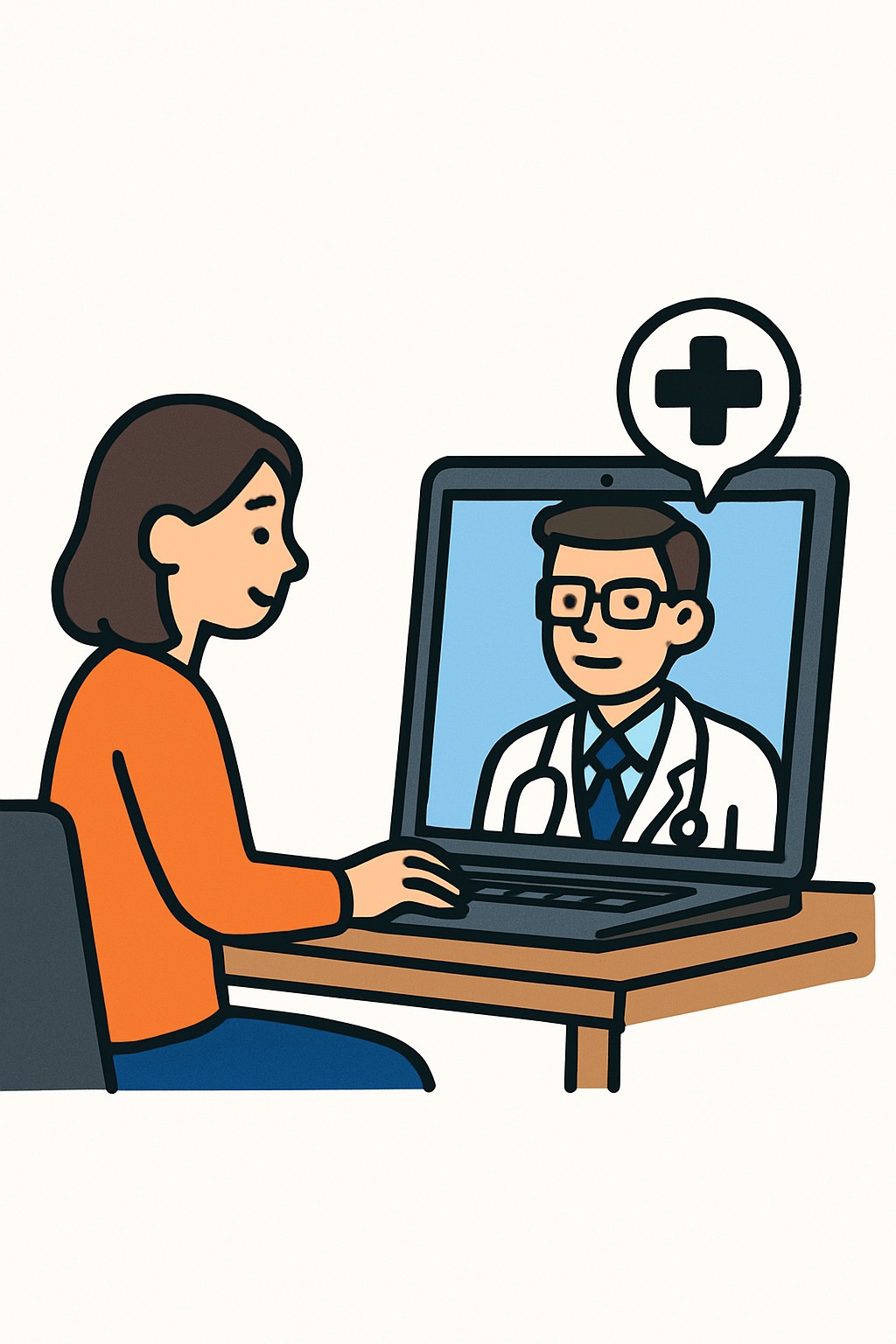
An initial telemedicine consult is a first-time video or phone visit with a clinician.
Overview
An initial telemedicine consult is a first-time video or phone visit with a clinician. You discuss your concerns, medical history, medicines, and goals. The clinician may do a limited visual exam over video, review records, and create a plan. This type of visit is used for many non-urgent issues, counseling, and care planning when an in-person exam is not required right away. It can lead to tests, prescriptions when allowed, or an in-person visit if needed.
Also known as: Initial telehealth visit, New patient telemedicine consultation, Online medical evaluation (initial), Virtual visit - new patient
Preparation & Next Steps
Everything you need to know before and after your procedure
Before Care
- Confirm the clinic’s telehealth platform, create your account, and complete any e-check-in steps
- Test your internet connection, camera, microphone, and speakers; have a charger or power source ready
- Choose a quiet, private, well-lit space where you will not be interrupted
- Have your photo ID, insurance card, and preferred pharmacy name and phone number available
- Prepare a current list of medicines and supplements with doses and any allergies
- Write down your top 2–3 concerns with timing, triggers, and what helps or worsens symptoms
- Gather recent vital signs if you can (temperature, blood pressure, heart rate, weight) using home devices
- Upload or have ready any relevant photos or data (for example, a rash photo or glucose readings)
- Review your coverage for telehealth benefits and any out-of-pocket costs
- Set up a backup plan (phone number for the clinic) in case video connection fails
After Care
- Review the visit summary in your portal and note the plan and follow-up steps
- Arrange any labs, imaging, or referrals that were ordered
- Fill prescriptions as directed by your clinician and read the pharmacy information sheet
- Track your symptoms and any side effects to discuss at follow-up
- Use secure messaging or call the clinic to clarify questions about the plan
- Confirm how and when results will be shared and whether another visit is needed
- Keep copies of visit notes and test orders in your personal health records
- Check your insurance explanation of benefits and statements for accuracy
- Protect your privacy by logging out of the telehealth app and locking your device
- Contact the clinic if symptoms worsen, new concerning symptoms appear, or technical barriers prevent you from following the plan
Clinical Information
Important medical details about this procedure
Indications
- New non-urgent symptoms such as cough, rash, or mild pain
- Initial evaluation for mental health concerns
- Medication review and counseling
- Chronic condition check-in when a hands-on exam is not required
- Review of test results and planning next steps
- Care coordination and referrals
- Lifestyle counseling such as nutrition or sleep
- Infectious symptoms when staying home is preferred
Alternatives
- In-person office visit
- Urgent care center for time-sensitive but non-emergency issues
- Nurse advice line
- Secure portal message for simple questions
- Asynchronous e-visit or online questionnaire when available
Risks
- Limited physical exam may miss certain signs
- Technical problems with video, audio, or internet
- Privacy or data security concerns if devices or networks are not secure
- Miscommunication without in-person cues
- Follow-up in-person visit or testing may still be needed
- Location or licensure limits may affect service availability
Contraindications
- Severe or life-threatening symptoms requiring emergency care
- Problems that clearly need a hands-on exam or procedure
- Inability to use a private, safe space or appropriate technology
- Need for certain on-site tests or imaging the same day
- Licensure or location limits that prevent care across state lines
Recovery Timeline
What to expect during your recovery
There is no medical recovery period after an initial telemedicine consult. Most people continue normal activities right away. Some follow-up tasks like tests or scheduling may occur in the next few days.
Typical Range
Same day
Return to Work
Same day
Recovery Milestones
Resume normal daily activities
Complete lab or imaging scheduling if ordered
Review results and confirm next steps via portal or phone
Frequently Asked Questions
Common questions and expert answers about this procedure
What happens during an initial telemedicine consult?
What happens during an initial telemedicine consult?
You discuss your symptoms, history, and medicines. The clinician may do a limited visual exam by video, review records, and outline a plan that may include tests, referrals, or follow-up.
What technology do I need?
What technology do I need?
A smartphone, tablet, or computer with camera, microphone, and reliable internet. Some clinics require a specific app or patient portal login.
Can prescriptions be provided in a telemedicine visit?
Can prescriptions be provided in a telemedicine visit?
Many medicines can be prescribed when appropriate. Certain controlled substances have federal and state rules; in some cases an in-person evaluation is required.
Is a telemedicine visit secure?
Is a telemedicine visit secure?
Clinics use platforms designed to protect health information. Using a private space, secure network, and updated device adds another layer of protection.
Will insurance cover an initial telehealth visit?
Will insurance cover an initial telehealth visit?
Coverage varies by plan and state. Many public and private plans cover telehealth, but copays and limits can differ.
Do I need to be in the same state as the clinician?
Do I need to be in the same state as the clinician?
Often yes. Clinicians usually must be licensed where the patient is located at the time of the visit, with some exceptions.
What if the video fails?
What if the video fails?
Clinics often switch to a phone call or reschedule. Keep your phone nearby and the clinic’s number handy.
Can telemedicine handle emergencies?
Can telemedicine handle emergencies?
Telemedicine is not for life-threatening symptoms. Emergency conditions are typically handled in person.
References
Medical literature and sources