%20--%3e%3csvg%20version='1.0'%20id='Layer_1'%20xmlns='http://www.w3.org/2000/svg'%20xmlns:xlink='http://www.w3.org/1999/xlink'%20x='0px'%20y='0px'%20viewBox='0%200%20755.52%20814.35'%20style='enable-background:new%200%200%20755.52%20814.35;'%20xml:space='preserve'%3e%3cstyle%20type='text/css'%3e%20.st0{fill:%231ae5ce;stroke:%231ae5ce;stroke-width:7;stroke-miterlimit:10;}%20.st1{fill:%23FFFFFF;stroke:%231ae5ce;stroke-width:7;stroke-miterlimit:10;}%20.st2{fill:%231ae5ce;stroke:%23FFFFFF;stroke-width:7;stroke-miterlimit:10;}%20.st3{fill:%23FFFFFF;stroke:%23FFFFFF;stroke-width:6;stroke-miterlimit:10;}%20%3c/style%3e%3cg%20id='Dark_Logo_00000159431215648494653180000015900878925932721032_'%3e%3cpath%20id='shield_00000152259091539869183100000001926543869452564382_'%20class='st0'%20d='M711.13,173.42%20c-3.37-49.07-38.92-44.9-75.96-52.18c-67.4-13.25-130.47-34.47-192.36-63.92c-22.48-10.7-41.88-25.74-65.05-26.28%20c-23.17,0.54-42.58,15.59-65.05,26.28c-61.89,29.45-124.95,50.68-192.36,63.92c-37.04,7.28-72.59,3.11-75.96,52.18%20c-1.55,22.6,0.34,46.4,1.05,68.92c5.99,190.78,52.91,345.39,206.27,466.46c29.71,23.46,74.51,55.8,108.84,70.75%20c5.99,2.61,11.7,3.73,17.21,3.75c5.51-0.02,11.22-1.14,17.21-3.75c34.33-14.95,79.12-47.3,108.84-70.75%20c153.37-121.07,200.28-275.68,206.27-466.46C710.79,219.82,712.68,196.02,711.13,173.42z'/%3e%3cpath%20id='magnifyingglass_00000073685934697636024790000000342567780940956808_'%20class='st1'%20d='M648.78,624.21l-96.64-104.65%20c34.89-40.63,55.98-93.46,55.98-151.21c0-128.27-103.98-232.24-232.24-232.24S143.63,240.08,143.63,368.35%20s103.98,232.24,232.24,232.24c48.87,0,94.21-15.11,131.62-40.89l97.18,105.24c11.25,12.18,30.24,12.93,42.42,1.69l0,0%20C659.27,655.38,660.03,636.39,648.78,624.21z'/%3e%3ccircle%20id='ellipse_00000129904010550392394720000017056154833629780114_'%20class='st2'%20cx='375.87'%20cy='368.35'%20r='181.21'/%3e%3cpath%20id='dollarsign_00000057140127156649725250000003772530148495155891_'%20class='st3'%20d='M362.91,492.03v-23.91%20c0-2.01-1.58-3.69-3.59-3.77c-18.49-0.78-37.12-5.4-49.4-11.83c-1.75-0.92-2.53-3.01-1.76-4.84l5.87-13.89%20c0.86-2.02,3.23-2.88,5.2-1.89c12.94,6.52,30.45,11.44,49.18,11.44c26.02,0,43.6-12.73,43.6-30.43c0-17.08-14.29-27.63-41.4-36.95%20c-37.37-12.42-60.46-26.7-60.46-53.72c0-24.97,20.29-44.11,52.22-49.51c1.8-0.31,3.11-1.89,3.11-3.72v-24.35%20c0-2.09,1.69-3.78,3.78-3.78h15.16c2.09,0,3.78,1.69,3.78,3.78v22.71c0,2.01,1.58,3.67,3.58,3.77c17.85,0.92,30.88,4.75,40.61,9.1%20c1.92,0.86,2.79,3.09,1.94,5.01l-6.08,13.6c-0.85,1.91-3.09,2.77-4.99,1.91c-8.37-3.8-22.38-8.95-42.75-8.95%20c-28.21,0-38.84,14.28-38.84,26.7c0,16.15,13.56,24.22,45.44,35.4c37.74,13.04,56.79,29.19,56.79,56.82%20c0,23.85-19.05,46.23-54.78,52.3c-1.8,0.31-3.11,1.89-3.11,3.72v25.28c0,2.09-1.69,3.78-3.78,3.78h-15.53%20C364.6,495.81,362.91,494.12,362.91,492.03z'/%3e%3c/g%3e%3c/svg%3e)
Appendectomy (Laparoscopic) General Surgery
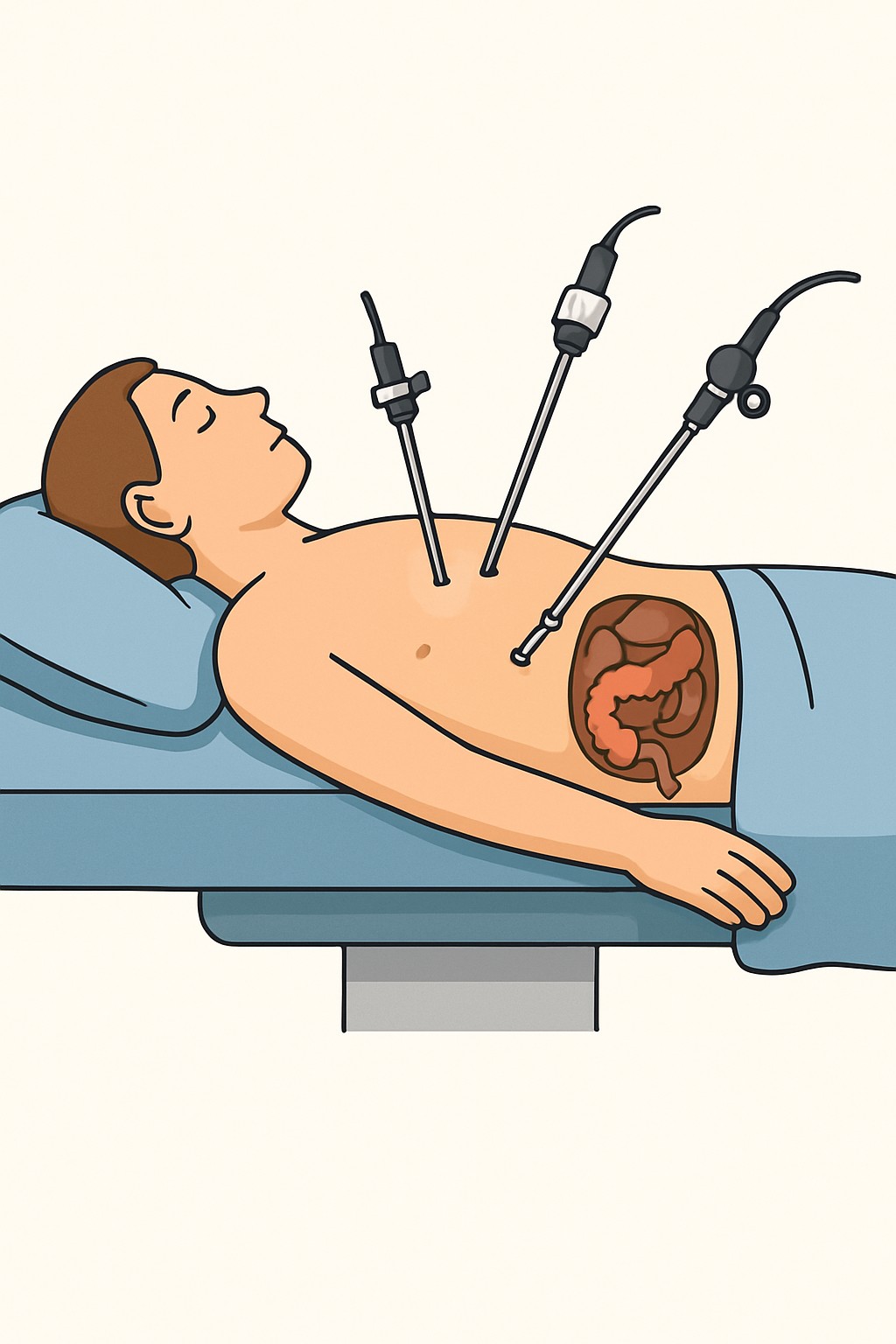
A laparoscopic appendectomy is surgery to remove the appendix using several small cuts.
Overview
A laparoscopic appendectomy is surgery to remove the appendix using several small cuts. A tiny camera and slender tools are placed through these cuts to see and remove the appendix. Laparoscopic means the surgeon works with a camera inside the belly rather than making one large incision. This approach is commonly used because it typically leads to smaller scars and a shorter hospital stay compared with an open surgery. It is done to treat appendicitis, which is inflammation or infection of the appendix.
Also known as: Laparoscopic appendectomy, Minimally invasive appendectomy, Keyhole appendectomy
Preparation & Next Steps
Everything you need to know before and after your procedure
Before Care
- Bring a current list of medicines and allergies, including over-the-counter drugs and supplements
- Tell the team about blood thinners, diabetes medicines, or implanted devices
- Follow the fasting instructions provided for anesthesia
- Arrange an adult to drive you home and stay with you the first night if advised
- Complete any requested labs or imaging before surgery
- Shower as instructed; avoid lotions, perfumes, and heavy makeup on surgery day
- Remove jewelry, piercings, and nail polish before arrival
- Wear loose, comfortable clothing and bring your ID and insurance card
- Confirm your preferred pharmacy for any prescriptions
- Plan time off work and light help at home during the first few days
After Care
- Take pain medicine only as instructed on the label or by your care team
- Walk short distances several times a day to promote circulation and reduce stiffness
- Keep incisions clean and dry; change dressings as directed
- Avoid soaking incisions in a bath, hot tub, or pool until cleared by your clinician
- Resume light meals and fluids as tolerated to avoid nausea and constipation
- Avoid heavy lifting and strenuous activity until your clinician says it is safe
- Use a pillow to support your belly when coughing or sneezing for comfort
- Finish any prescribed antibiotics unless told otherwise by your clinician
- Schedule and attend follow-up to review healing and pathology results
- Contact a clinician if you develop fever, worsening belly pain, redness or pus at incisions, repeated vomiting, chest pain, shortness of breath, or inability to pass gas or stool
Clinical Information
Important medical details about this procedure
Indications
- Acute appendicitis confirmed by symptoms and imaging
- Strong suspicion of appendicitis after evaluation
- Recurrent appendicitis
- Appendiceal abscess or phlegmon after initial stabilization
Alternatives
- Antibiotics and observation for selected uncomplicated appendicitis
- Open appendectomy
- Image-guided drainage of an abscess with delayed surgery
- Watchful waiting with close follow-up in specific cases
Risks
- Bleeding
- Infection at the incision or inside the abdomen
- Injury to nearby organs such as bowel, bladder, or blood vessels
- Adverse reaction to anesthesia
- Blood clots in the legs or lungs
- Hernia at an incision site
- Conversion to open surgery if needed for safety
Contraindications
- Inability to tolerate general anesthesia
- Uncorrected bleeding disorder
- Severe cardiopulmonary instability
- Extensive abdominal adhesions that make laparoscopy unsafe
Recovery Timeline
What to expect during your recovery
Most people start light activity within a few days after a laparoscopic appendectomy and feel close to normal within 1 to 2 weeks. Recovery may take longer if the appendix burst or if there were complications.
Typical Range
7–14 days
Return to Work
7–14 days
Recovery Milestones
Sit up and walk short distances with assistance as needed
Transition to oral pain medicine and regular diet as tolerated
Shower with incision care; do light household tasks
Return to desk or school activities if energy allows and duties are not strenuous
Gradually increase exercise; avoid heavy lifting until cleared by your clinician
Frequently Asked Questions
Common questions and expert answers about this procedure
What is a laparoscopic appendectomy?
What is a laparoscopic appendectomy?
It is removal of the appendix using small cuts, a camera, and thin instruments. The surgeon watches a video screen to operate.
How many incisions are used?
How many incisions are used?
Usually 3 small incisions. The exact number and size can vary based on your anatomy and the surgical plan.
Will I be asleep for the surgery?
Will I be asleep for the surgery?
Yes, it is typically done under general anesthesia so you are asleep and feel no pain during the procedure.
How long does the surgery take?
How long does the surgery take?
Many laparoscopic appendectomies take less than an hour once started. Times vary based on inflammation and other factors.
How long will I stay in the hospital?
How long will I stay in the hospital?
Many people go home the same day or after an overnight stay. A burst appendix or complications can mean a longer stay.
Can surgery change to an open procedure?
Can surgery change to an open procedure?
Yes. If vision is limited or safety is a concern, the surgeon may make a larger incision to complete the operation.
Can appendicitis be treated with antibiotics instead of surgery?
Can appendicitis be treated with antibiotics instead of surgery?
Some uncomplicated cases are managed first with antibiotics and close follow-up. Many people still choose or later need surgery.
What happens to the removed appendix?
What happens to the removed appendix?
It is usually sent to a lab for pathology testing to confirm the diagnosis.
References
Medical literature and sources