%20--%3e%3csvg%20version='1.0'%20id='Layer_1'%20xmlns='http://www.w3.org/2000/svg'%20xmlns:xlink='http://www.w3.org/1999/xlink'%20x='0px'%20y='0px'%20viewBox='0%200%20755.52%20814.35'%20style='enable-background:new%200%200%20755.52%20814.35;'%20xml:space='preserve'%3e%3cstyle%20type='text/css'%3e%20.st0{fill:%231ae5ce;stroke:%231ae5ce;stroke-width:7;stroke-miterlimit:10;}%20.st1{fill:%23FFFFFF;stroke:%231ae5ce;stroke-width:7;stroke-miterlimit:10;}%20.st2{fill:%231ae5ce;stroke:%23FFFFFF;stroke-width:7;stroke-miterlimit:10;}%20.st3{fill:%23FFFFFF;stroke:%23FFFFFF;stroke-width:6;stroke-miterlimit:10;}%20%3c/style%3e%3cg%20id='Dark_Logo_00000159431215648494653180000015900878925932721032_'%3e%3cpath%20id='shield_00000152259091539869183100000001926543869452564382_'%20class='st0'%20d='M711.13,173.42%20c-3.37-49.07-38.92-44.9-75.96-52.18c-67.4-13.25-130.47-34.47-192.36-63.92c-22.48-10.7-41.88-25.74-65.05-26.28%20c-23.17,0.54-42.58,15.59-65.05,26.28c-61.89,29.45-124.95,50.68-192.36,63.92c-37.04,7.28-72.59,3.11-75.96,52.18%20c-1.55,22.6,0.34,46.4,1.05,68.92c5.99,190.78,52.91,345.39,206.27,466.46c29.71,23.46,74.51,55.8,108.84,70.75%20c5.99,2.61,11.7,3.73,17.21,3.75c5.51-0.02,11.22-1.14,17.21-3.75c34.33-14.95,79.12-47.3,108.84-70.75%20c153.37-121.07,200.28-275.68,206.27-466.46C710.79,219.82,712.68,196.02,711.13,173.42z'/%3e%3cpath%20id='magnifyingglass_00000073685934697636024790000000342567780940956808_'%20class='st1'%20d='M648.78,624.21l-96.64-104.65%20c34.89-40.63,55.98-93.46,55.98-151.21c0-128.27-103.98-232.24-232.24-232.24S143.63,240.08,143.63,368.35%20s103.98,232.24,232.24,232.24c48.87,0,94.21-15.11,131.62-40.89l97.18,105.24c11.25,12.18,30.24,12.93,42.42,1.69l0,0%20C659.27,655.38,660.03,636.39,648.78,624.21z'/%3e%3ccircle%20id='ellipse_00000129904010550392394720000017056154833629780114_'%20class='st2'%20cx='375.87'%20cy='368.35'%20r='181.21'/%3e%3cpath%20id='dollarsign_00000057140127156649725250000003772530148495155891_'%20class='st3'%20d='M362.91,492.03v-23.91%20c0-2.01-1.58-3.69-3.59-3.77c-18.49-0.78-37.12-5.4-49.4-11.83c-1.75-0.92-2.53-3.01-1.76-4.84l5.87-13.89%20c0.86-2.02,3.23-2.88,5.2-1.89c12.94,6.52,30.45,11.44,49.18,11.44c26.02,0,43.6-12.73,43.6-30.43c0-17.08-14.29-27.63-41.4-36.95%20c-37.37-12.42-60.46-26.7-60.46-53.72c0-24.97,20.29-44.11,52.22-49.51c1.8-0.31,3.11-1.89,3.11-3.72v-24.35%20c0-2.09,1.69-3.78,3.78-3.78h15.16c2.09,0,3.78,1.69,3.78,3.78v22.71c0,2.01,1.58,3.67,3.58,3.77c17.85,0.92,30.88,4.75,40.61,9.1%20c1.92,0.86,2.79,3.09,1.94,5.01l-6.08,13.6c-0.85,1.91-3.09,2.77-4.99,1.91c-8.37-3.8-22.38-8.95-42.75-8.95%20c-28.21,0-38.84,14.28-38.84,26.7c0,16.15,13.56,24.22,45.44,35.4c37.74,13.04,56.79,29.19,56.79,56.82%20c0,23.85-19.05,46.23-54.78,52.3c-1.8,0.31-3.11,1.89-3.11,3.72v25.28c0,2.09-1.69,3.78-3.78,3.78h-15.53%20C364.6,495.81,362.91,494.12,362.91,492.03z'/%3e%3c/g%3e%3c/svg%3e)
Bariatric Surgery (Gastric bypass/sleeve) General Surgery
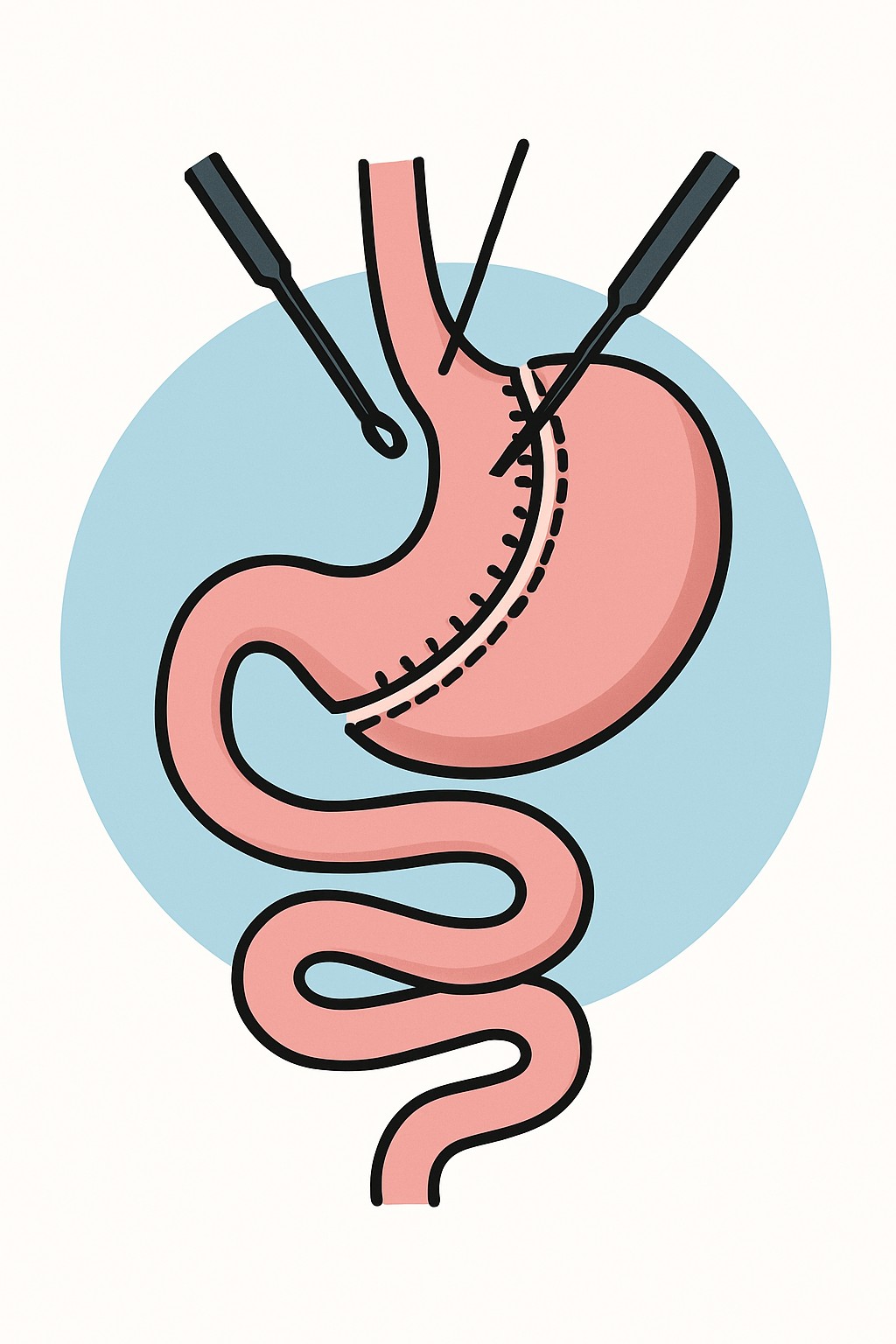
Bariatric surgery includes operations that help with weight loss by changing the stomach and, in some cases, how food moves through the intestines.
Overview
Bariatric surgery includes operations that help with weight loss by changing the stomach and, in some cases, how food moves through the intestines. Two common types are gastric bypass (Roux-en-Y) and sleeve gastrectomy. Gastric bypass creates a small stomach pouch and reroutes part of the small intestine. Sleeve gastrectomy removes a large portion of the stomach to form a narrow tube or sleeve. These surgeries can lead to meaningful weight loss and may improve conditions linked to obesity, such as type 2 diabetes, sleep apnea, high blood pressure, and fatty liver disease. Most procedures are minimally invasive (laparoscopic), with small incisions and a short hospital stay.
Also known as: Gastric bypass, Sleeve gastrectomy, Weight-loss surgery, Metabolic surgery
Preparation & Next Steps
Everything you need to know before and after your procedure
Before Care
- Complete a multidisciplinary evaluation (surgery, nutrition, behavioral health, and medical review).
- Provide a full list of medicines and supplements; discuss allergies and prior surgeries.
- Expect pre-op testing as ordered (for example, labs, ECG, sleep apnea assessment, imaging).
- Stop tobacco and nicotine products per program guidance to reduce complications.
- Follow any pre-op diet plan provided to help shrink the liver and prepare for surgery.
- Arrange transportation home and reliable help for daily tasks for the first few days.
- Pack any needed medical devices you use (for example, CPAP) and comfortable clothing.
- Follow fasting instructions for food and liquids before anesthesia as directed.
- Ask which medicines to take or hold on the morning of surgery, including blood thinners and diabetes medicines.
- Plan time off work, childcare, and pet care for the recovery period.
After Care
- Start short, frequent walks as allowed to support circulation and reduce blood clot risk.
- Keep incisions clean and dry; follow instructions about dressings and showering; avoid soaking until cleared.
- Sip fluids slowly throughout the day to stay hydrated; avoid sugary or carbonated drinks.
- Advance from clear liquids to pureed or soft foods only as directed by your care team.
- Take prescribed medicines and vitamin/mineral supplements exactly as instructed.
- Use deep-breathing exercises or an incentive spirometer if provided.
- Avoid lifting heavy objects or strenuous activity until your clinician says it is safe.
- Resume CPAP during sleep if you have obstructive sleep apnea.
- Track fluid intake, protein sources, and symptoms to discuss at follow-up visits.
- Contact a clinician for fever, worsening belly or chest pain, shortness of breath, leg swelling, persistent vomiting, black or bloody stools, or signs of dehydration (such as dizziness or very dark urine).
Clinical Information
Important medical details about this procedure
Indications
- Severe obesity (commonly BMI ≥ 40)
- BMI ≥ 35 with obesity-related conditions (for example, type 2 diabetes, obstructive sleep apnea, hypertension)
- Obesity not improved with structured diet, physical activity, and medical therapy
- Complications of obesity affecting daily function or health risks
Alternatives
- Intensive lifestyle programs (nutrition, physical activity, behavioral support)
- Prescription weight-loss medicines
- Medical nutrition therapy with a registered dietitian
- Behavioral therapy and counseling
- Medically supervised meal-replacement programs
- Endoscopic weight-loss procedures (for example, intragastric balloon, endoscopic sleeve) when available
Risks
- Bleeding, infection, or blood clots
- Leaks at staple or connection sites
- Strictures or ulcers
- Anesthesia complications
- Nausea, vomiting, or dehydration
- Dumping syndrome (rapid food movement causing cramping, diarrhea, or dizziness)
- Nutrient and vitamin deficiencies (for example, iron, B12, folate, calcium, vitamin D)
- Gallstones after rapid weight loss
- GERD or heartburn (can persist or worsen after sleeve in some people)
- Weight regain over time
Contraindications
- Inability to participate in long-term follow-up and nutrition monitoring
- Untreated substance use disorder
- Unmanaged severe psychiatric illness or active eating disorder
- Medical conditions that make anesthesia or surgery too risky
- Pregnancy at the time of surgery
Recovery Timeline
What to expect during your recovery
Most people stay in the hospital 1–3 days and increase activity over the next several weeks. Many return to desk work in 2–4 weeks, with heavier activity taking longer.
Typical Range
14–42 days
Return to Work
14–28 days
Recovery Milestones
Walk short distances several times per day
Follow liquid diet stages and focus on hydration
Advance to pureed or soft foods if approved by the care team
Return to desk work if energy and pain control allow
Gradually resume more strenuous activity if cleared
Frequently Asked Questions
Common questions and expert answers about this procedure
What is the difference between gastric bypass and sleeve?
What is the difference between gastric bypass and sleeve?
Gastric bypass creates a small stomach pouch and reroutes part of the small intestine. Sleeve gastrectomy removes most of the stomach to form a tube. Both limit food intake and affect hunger hormones.
How is the surgery performed?
How is the surgery performed?
Most procedures are done laparoscopically with small incisions under general anesthesia. Hospital stay is usually short.
Will I need vitamins after surgery?
Will I need vitamins after surgery?
Long-term vitamin and mineral supplements are commonly recommended, along with periodic blood tests to check levels.
How soon can I return to work?
How soon can I return to work?
Many people return to desk work in about 2–4 weeks. Jobs with heavy physical activity may take longer.
What side effects can happen early on?
What side effects can happen early on?
Nausea, vomiting, fatigue, and changes in bowel habits can occur. Some people experience dumping syndrome, especially after high-sugar foods.
Can surgery improve diabetes or sleep apnea?
Can surgery improve diabetes or sleep apnea?
Weight loss and hormonal changes after surgery can improve conditions like type 2 diabetes and obstructive sleep apnea.
Is pregnancy safe after bariatric surgery?
Is pregnancy safe after bariatric surgery?
Many programs advise delaying pregnancy until weight and nutrition stabilize and after discussion with your care team.
References
Medical literature and sources