%20--%3e%3csvg%20version='1.0'%20id='Layer_1'%20xmlns='http://www.w3.org/2000/svg'%20xmlns:xlink='http://www.w3.org/1999/xlink'%20x='0px'%20y='0px'%20viewBox='0%200%20755.52%20814.35'%20style='enable-background:new%200%200%20755.52%20814.35;'%20xml:space='preserve'%3e%3cstyle%20type='text/css'%3e%20.st0{fill:%231ae5ce;stroke:%231ae5ce;stroke-width:7;stroke-miterlimit:10;}%20.st1{fill:%23FFFFFF;stroke:%231ae5ce;stroke-width:7;stroke-miterlimit:10;}%20.st2{fill:%231ae5ce;stroke:%23FFFFFF;stroke-width:7;stroke-miterlimit:10;}%20.st3{fill:%23FFFFFF;stroke:%23FFFFFF;stroke-width:6;stroke-miterlimit:10;}%20%3c/style%3e%3cg%20id='Dark_Logo_00000159431215648494653180000015900878925932721032_'%3e%3cpath%20id='shield_00000152259091539869183100000001926543869452564382_'%20class='st0'%20d='M711.13,173.42%20c-3.37-49.07-38.92-44.9-75.96-52.18c-67.4-13.25-130.47-34.47-192.36-63.92c-22.48-10.7-41.88-25.74-65.05-26.28%20c-23.17,0.54-42.58,15.59-65.05,26.28c-61.89,29.45-124.95,50.68-192.36,63.92c-37.04,7.28-72.59,3.11-75.96,52.18%20c-1.55,22.6,0.34,46.4,1.05,68.92c5.99,190.78,52.91,345.39,206.27,466.46c29.71,23.46,74.51,55.8,108.84,70.75%20c5.99,2.61,11.7,3.73,17.21,3.75c5.51-0.02,11.22-1.14,17.21-3.75c34.33-14.95,79.12-47.3,108.84-70.75%20c153.37-121.07,200.28-275.68,206.27-466.46C710.79,219.82,712.68,196.02,711.13,173.42z'/%3e%3cpath%20id='magnifyingglass_00000073685934697636024790000000342567780940956808_'%20class='st1'%20d='M648.78,624.21l-96.64-104.65%20c34.89-40.63,55.98-93.46,55.98-151.21c0-128.27-103.98-232.24-232.24-232.24S143.63,240.08,143.63,368.35%20s103.98,232.24,232.24,232.24c48.87,0,94.21-15.11,131.62-40.89l97.18,105.24c11.25,12.18,30.24,12.93,42.42,1.69l0,0%20C659.27,655.38,660.03,636.39,648.78,624.21z'/%3e%3ccircle%20id='ellipse_00000129904010550392394720000017056154833629780114_'%20class='st2'%20cx='375.87'%20cy='368.35'%20r='181.21'/%3e%3cpath%20id='dollarsign_00000057140127156649725250000003772530148495155891_'%20class='st3'%20d='M362.91,492.03v-23.91%20c0-2.01-1.58-3.69-3.59-3.77c-18.49-0.78-37.12-5.4-49.4-11.83c-1.75-0.92-2.53-3.01-1.76-4.84l5.87-13.89%20c0.86-2.02,3.23-2.88,5.2-1.89c12.94,6.52,30.45,11.44,49.18,11.44c26.02,0,43.6-12.73,43.6-30.43c0-17.08-14.29-27.63-41.4-36.95%20c-37.37-12.42-60.46-26.7-60.46-53.72c0-24.97,20.29-44.11,52.22-49.51c1.8-0.31,3.11-1.89,3.11-3.72v-24.35%20c0-2.09,1.69-3.78,3.78-3.78h15.16c2.09,0,3.78,1.69,3.78,3.78v22.71c0,2.01,1.58,3.67,3.58,3.77c17.85,0.92,30.88,4.75,40.61,9.1%20c1.92,0.86,2.79,3.09,1.94,5.01l-6.08,13.6c-0.85,1.91-3.09,2.77-4.99,1.91c-8.37-3.8-22.38-8.95-42.75-8.95%20c-28.21,0-38.84,14.28-38.84,26.7c0,16.15,13.56,24.22,45.44,35.4c37.74,13.04,56.79,29.19,56.79,56.82%20c0,23.85-19.05,46.23-54.78,52.3c-1.8,0.31-3.11,1.89-3.11,3.72v25.28c0,2.09-1.69,3.78-3.78,3.78h-15.53%20C364.6,495.81,362.91,494.12,362.91,492.03z'/%3e%3c/g%3e%3c/svg%3e)
Colectomy (Partial colon resection) General Surgery
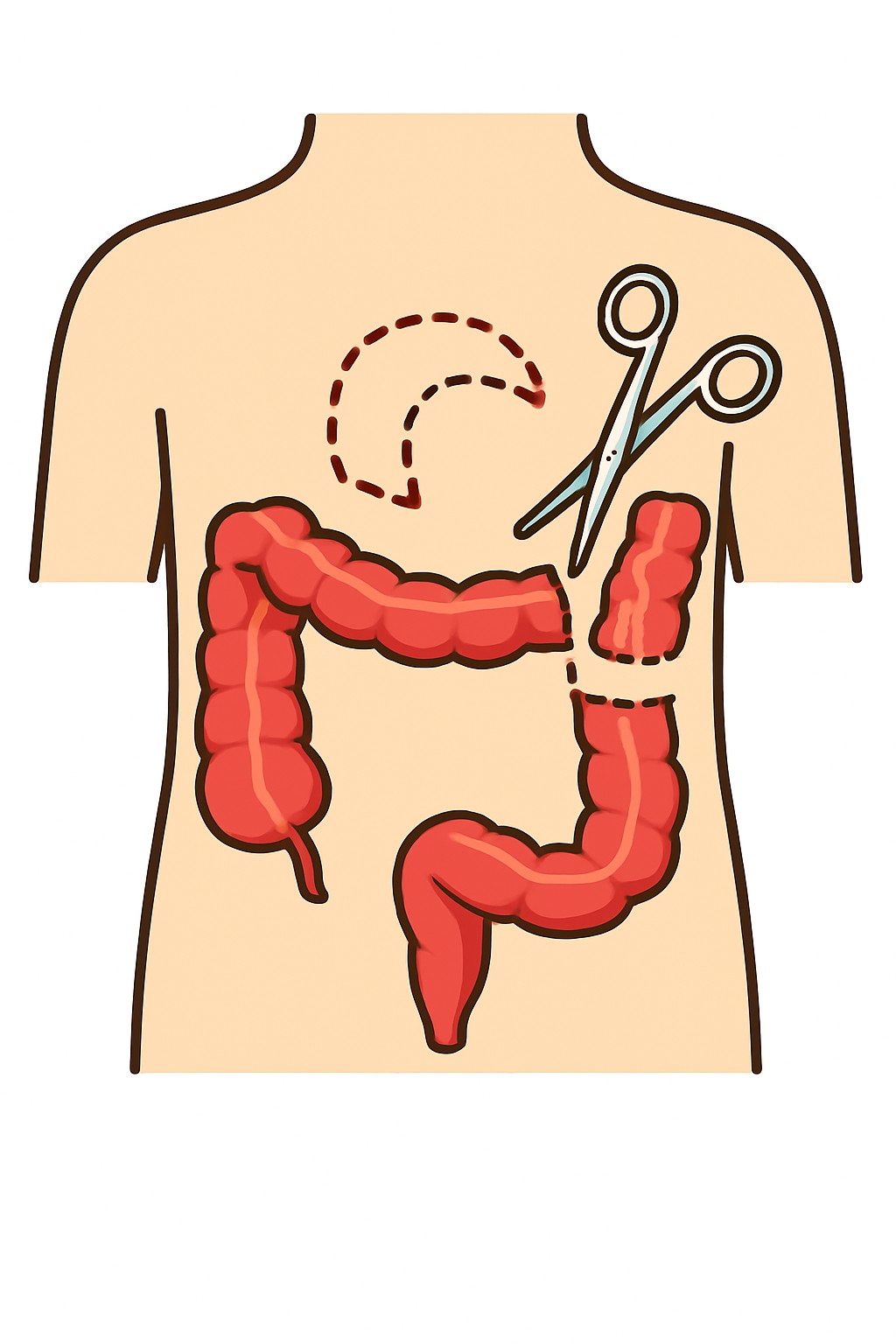
A colectomy is surgery to remove a diseased part of the colon (large intestine).
Overview
A colectomy is surgery to remove a diseased part of the colon (large intestine). In a partial colectomy, only the affected segment is taken out, and the healthy ends are usually joined back together. This may be done through several small cuts with a camera (laparoscopic or robotic) or through one larger cut (open surgery). It is done to treat conditions that damage or block the colon, such as colon cancer, diverticulitis with complications, large polyps that cannot be removed by colonoscopy, bowel obstruction, or some cases of inflammatory bowel disease. In some situations, a temporary or permanent ostomy (an opening on the abdomen for stool) may be needed.
Also known as: Partial colectomy, Hemicolectomy, Segmental colectomy, Colon resection, Bowel resection
Preparation & Next Steps
Everything you need to know before and after your procedure
Before Care
- Complete pre-op evaluation such as lab tests, ECG, and imaging if ordered
- Discuss laparoscopic vs open approach, possible ostomy, and pain control options
- Follow any bowel prep and diet instructions from the surgical team
- Review all medicines, including blood thinners and supplements, for possible holds
- Do not eat or drink as instructed before anesthesia
- Stop smoking or vaping as early as possible to support healing
- Arrange a ride home and help with daily tasks for the first days after discharge
- Ask about ostomy marking and education if there is a chance of an ostomy
- Pack essentials for the hospital such as ID, insurance card, and CPAP if used
- Confirm who to contact for questions and how results will be shared
After Care
- Keep incisions clean and dry; follow the team’s instructions for showering and dressing changes
- Take pain medicines only as directed and use non-medicine comfort measures like walking and splinting the incision when coughing
- Walk several times a day to help prevent blood clots and support bowel recovery
- Start with liquids and advance your diet as instructed; drink plenty of fluids unless told otherwise
- Avoid heavy lifting or strenuous activity until your surgical team clears you
- Care for any drains or an ostomy as instructed; track output if asked
- Watch for signs of infection such as fever, spreading redness, worsening pain, or pus at the incision and contact a clinician if they occur
- Call the surgical team if you have increasing abdominal pain, swelling, repeated vomiting, chest pain, shortness of breath, leg swelling, or you cannot pass gas or stool
- Keep a simple log of bowel habits, pain levels, and any concerns to review at follow-up
- Attend scheduled follow-up to check healing and review the pathology report
Clinical Information
Important medical details about this procedure
Indications
- Colon cancer or high-risk precancerous polyps
- Complicated diverticulitis (abscess, fistula, perforation, recurrent attacks)
- Bowel obstruction
- Inflammatory bowel disease affecting the colon
- Bleeding from the colon that does not respond to other treatments
- Ischemic colitis or colon injury
- Colon volvulus or twisted segment of bowel
Alternatives
- Watchful waiting for mild symptoms when appropriate
- Medicines for diverticulitis or inflammatory bowel disease
- Endoscopic removal of polyps when feasible
- Endoscopic stent for some obstructions
- Percutaneous drainage of abscess
- Chemotherapy and radiation in selected cancer cases per oncology plan
Risks
- Bleeding or need for transfusion
- Infection at the incision or inside the abdomen
- Leak where the colon is rejoined (anastomotic leak)
- Injury to nearby organs or nerves
- Blood clots in the legs or lungs
- Pneumonia or breathing problems
- Temporary bowel slowdown or blockage (ileus)
- Incisional hernia
- Adhesions that could cause later bowel obstruction
- Need for a temporary or permanent ostomy
- Conversion from minimally invasive to open surgery
Contraindications
- Inability to tolerate general anesthesia due to serious medical issues
- Uncontrolled bleeding or clotting problems not corrected before surgery
- Severe heart or lung disease not optimized for elective surgery
- Active infection or dehydration requiring stabilization first
- Extensive scarring or severe inflammation that may limit minimally invasive approach
Recovery Timeline
What to expect during your recovery
Hospital stay is often several days. Most people ease back into normal routines over a few weeks, with full recovery commonly taking 4 to 8 weeks depending on the approach and overall health.
Typical Range
28–56 days
Return to Work
14–56 days
Recovery Milestones
Sit up, stand, and take short walks with assistance
Pass gas and transition from liquids to soft foods as tolerated
Light household tasks; most staples or sutures removed if present
Desk work or classes if not physically demanding
Gradual return to usual activities; avoid heavy lifting until cleared
Frequently Asked Questions
Common questions and expert answers about this procedure
Is this done laparoscopically or open?
Is this done laparoscopically or open?
Many partial colectomies are done through small incisions with a camera. Some cases need an open incision. The approach depends on your condition, anatomy, and the surgeon’s plan.
Will I need an ostomy?
Will I need an ostomy?
Some people need a temporary or permanent ostomy depending on where the colon is removed, how healthy the tissue is, and the reason for surgery. The surgical team discusses this ahead of time when possible.
How long will I stay in the hospital?
How long will I stay in the hospital?
A typical stay is about 3 to 7 days, depending on the surgical approach and recovery milestones such as pain control, walking, and bowel function.
What anesthesia is used?
What anesthesia is used?
General anesthesia is used so you are asleep and do not feel pain during the operation. Numbing medicines and other pain-control methods may be added.
What will bowel habits be like after surgery?
What will bowel habits be like after surgery?
Stools may be more frequent or looser at first. Bowel patterns often settle over weeks to months as the body adjusts.
When can I eat normally again?
When can I eat normally again?
Most people start with liquids and advance as bowel function returns. A gentle diet may be used for a short time and then broadened as tolerated.
Will the removed tissue be tested?
Will the removed tissue be tested?
Yes. The specimen is examined by a pathologist. The report helps confirm the diagnosis and guide any further treatment.
What are common reasons this surgery is needed?
What are common reasons this surgery is needed?
Colon cancer, complicated diverticulitis, large polyps not removable by colonoscopy, bowel obstruction, and certain inflammatory conditions.
References
Medical literature and sources