%20--%3e%3csvg%20version='1.0'%20id='Layer_1'%20xmlns='http://www.w3.org/2000/svg'%20xmlns:xlink='http://www.w3.org/1999/xlink'%20x='0px'%20y='0px'%20viewBox='0%200%20755.52%20814.35'%20style='enable-background:new%200%200%20755.52%20814.35;'%20xml:space='preserve'%3e%3cstyle%20type='text/css'%3e%20.st0{fill:%231ae5ce;stroke:%231ae5ce;stroke-width:7;stroke-miterlimit:10;}%20.st1{fill:%23FFFFFF;stroke:%231ae5ce;stroke-width:7;stroke-miterlimit:10;}%20.st2{fill:%231ae5ce;stroke:%23FFFFFF;stroke-width:7;stroke-miterlimit:10;}%20.st3{fill:%23FFFFFF;stroke:%23FFFFFF;stroke-width:6;stroke-miterlimit:10;}%20%3c/style%3e%3cg%20id='Dark_Logo_00000159431215648494653180000015900878925932721032_'%3e%3cpath%20id='shield_00000152259091539869183100000001926543869452564382_'%20class='st0'%20d='M711.13,173.42%20c-3.37-49.07-38.92-44.9-75.96-52.18c-67.4-13.25-130.47-34.47-192.36-63.92c-22.48-10.7-41.88-25.74-65.05-26.28%20c-23.17,0.54-42.58,15.59-65.05,26.28c-61.89,29.45-124.95,50.68-192.36,63.92c-37.04,7.28-72.59,3.11-75.96,52.18%20c-1.55,22.6,0.34,46.4,1.05,68.92c5.99,190.78,52.91,345.39,206.27,466.46c29.71,23.46,74.51,55.8,108.84,70.75%20c5.99,2.61,11.7,3.73,17.21,3.75c5.51-0.02,11.22-1.14,17.21-3.75c34.33-14.95,79.12-47.3,108.84-70.75%20c153.37-121.07,200.28-275.68,206.27-466.46C710.79,219.82,712.68,196.02,711.13,173.42z'/%3e%3cpath%20id='magnifyingglass_00000073685934697636024790000000342567780940956808_'%20class='st1'%20d='M648.78,624.21l-96.64-104.65%20c34.89-40.63,55.98-93.46,55.98-151.21c0-128.27-103.98-232.24-232.24-232.24S143.63,240.08,143.63,368.35%20s103.98,232.24,232.24,232.24c48.87,0,94.21-15.11,131.62-40.89l97.18,105.24c11.25,12.18,30.24,12.93,42.42,1.69l0,0%20C659.27,655.38,660.03,636.39,648.78,624.21z'/%3e%3ccircle%20id='ellipse_00000129904010550392394720000017056154833629780114_'%20class='st2'%20cx='375.87'%20cy='368.35'%20r='181.21'/%3e%3cpath%20id='dollarsign_00000057140127156649725250000003772530148495155891_'%20class='st3'%20d='M362.91,492.03v-23.91%20c0-2.01-1.58-3.69-3.59-3.77c-18.49-0.78-37.12-5.4-49.4-11.83c-1.75-0.92-2.53-3.01-1.76-4.84l5.87-13.89%20c0.86-2.02,3.23-2.88,5.2-1.89c12.94,6.52,30.45,11.44,49.18,11.44c26.02,0,43.6-12.73,43.6-30.43c0-17.08-14.29-27.63-41.4-36.95%20c-37.37-12.42-60.46-26.7-60.46-53.72c0-24.97,20.29-44.11,52.22-49.51c1.8-0.31,3.11-1.89,3.11-3.72v-24.35%20c0-2.09,1.69-3.78,3.78-3.78h15.16c2.09,0,3.78,1.69,3.78,3.78v22.71c0,2.01,1.58,3.67,3.58,3.77c17.85,0.92,30.88,4.75,40.61,9.1%20c1.92,0.86,2.79,3.09,1.94,5.01l-6.08,13.6c-0.85,1.91-3.09,2.77-4.99,1.91c-8.37-3.8-22.38-8.95-42.75-8.95%20c-28.21,0-38.84,14.28-38.84,26.7c0,16.15,13.56,24.22,45.44,35.4c37.74,13.04,56.79,29.19,56.79,56.82%20c0,23.85-19.05,46.23-54.78,52.3c-1.8,0.31-3.11,1.89-3.11,3.72v25.28c0,2.09-1.69,3.78-3.78,3.78h-15.53%20C364.6,495.81,362.91,494.12,362.91,492.03z'/%3e%3c/g%3e%3c/svg%3e)
Excision of soft tissue tumor (e.g. lipoma) General Surgery
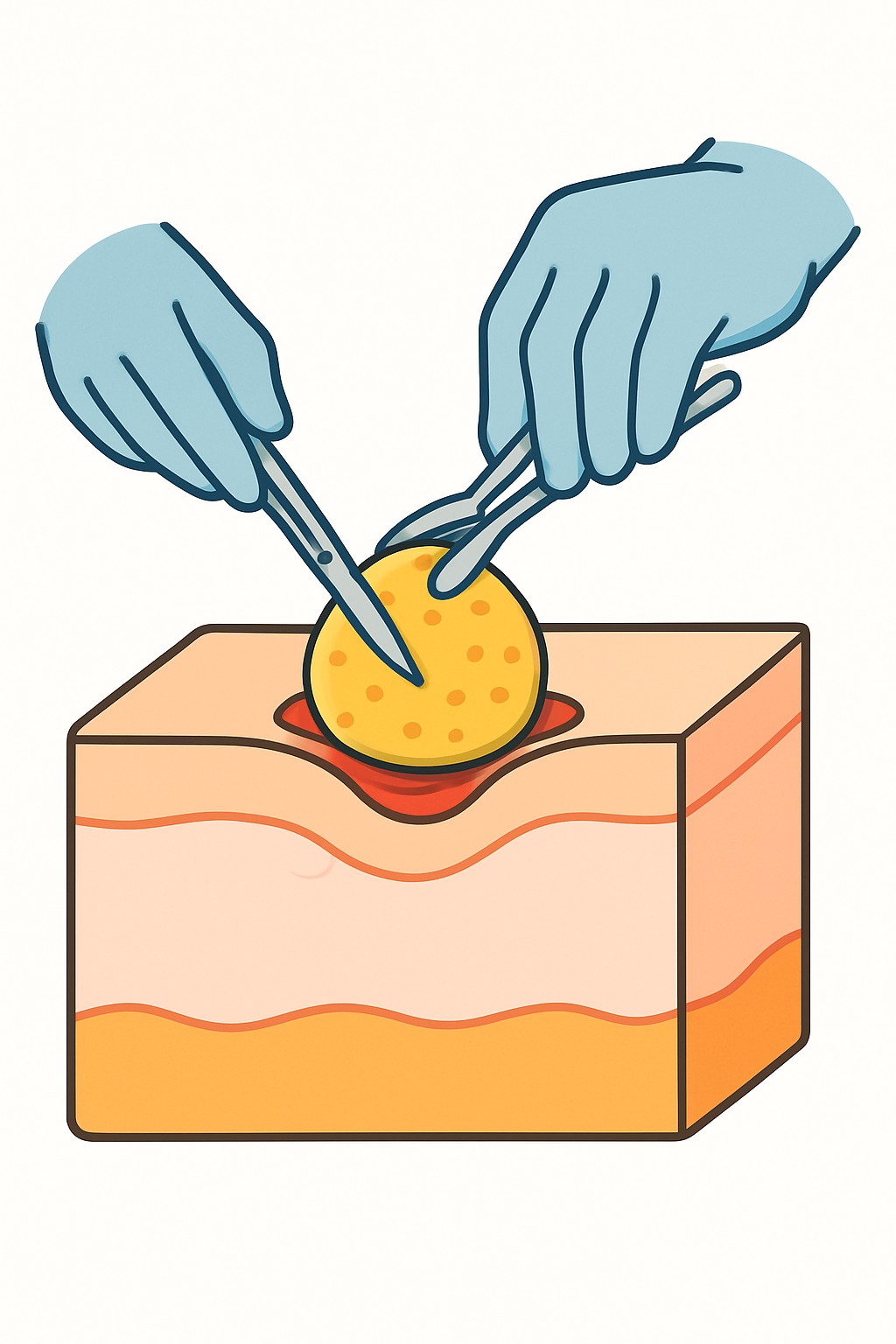
Excision of a soft tissue tumor is a procedure to remove a lump that grows in the tissue under the skin or within muscle.
Overview
Excision of a soft tissue tumor is a procedure to remove a lump that grows in the tissue under the skin or within muscle. Common benign examples include lipomas, which are soft, fatty tumors. This is usually an outpatient procedure. Many small, shallow masses can be removed with local anesthesia in a clinic or ambulatory surgery center. The tissue is typically sent to a lab to confirm the diagnosis.
Also known as: Lipoma removal, Soft tissue mass excision, Subcutaneous mass excision
Preparation & Next Steps
Everything you need to know before and after your procedure
Before Care
- Share a full list of medicines and supplements, including blood thinners and herbal products.
- Ask how the mass will be evaluated (imaging or biopsy) if it is large, deep, or growing quickly.
- Confirm the anesthesia plan and follow any fasting instructions if sedation or general anesthesia is planned.
- Arrange a ride home if you will receive sedation or pain medicine that affects alertness.
- Bring prior imaging reports, photos of changes over time, and any biopsy results.
- Do not shave the area; shower the day before or morning of surgery and wear loose, comfortable clothing.
- Tell the team about allergies, prior reactions to anesthesia, and implanted devices.
- Plan time off from heavy lifting or strenuous activity for a short period after the procedure.
- Ask how and when you will receive the pathology report and who to contact with questions.
After Care
- Keep the dressing clean and dry as instructed; change it only as directed by your care team.
- Protect the incision from soaking (baths, pools, hot tubs) until it has sealed and you are cleared to do so.
- Shower gently when allowed; pat the area dry and avoid rubbing the incision.
- Use pain relief as instructed on the discharge plan; avoid driving or alcohol if you received sedation.
- Limit heavy lifting, strenuous exercise, or stretching that pulls on the incision until it heals.
- If you were given a compression wrap or binder, wear it as instructed to reduce swelling.
- Watch for increasing redness, warmth, pus-like drainage, fever, worsening pain, numbness, or bleeding that does not stop with gentle pressure, and contact a clinician if these occur.
- Confirm when stitches or staples will be removed (often 7 to 14 days, depending on location).
- Review the pathology result in your portal or by phone, and schedule follow-up to discuss next steps.
- After the wound has healed, protect the scar from sun exposure and discuss scar care options if desired.
Clinical Information
Important medical details about this procedure
Indications
- Painful or tender mass
- Mass that is enlarging
- Uncertain diagnosis after exam or imaging
- Limitation of movement or pressure on nearby structures
- Recurrent irritation, infection, or ulceration of overlying skin
- Cosmetic concerns or interference with clothing or equipment
Alternatives
- Observation with periodic exam
- Imaging and/or needle biopsy to clarify diagnosis
- Liposuction for selected soft, superficial lipomas
- Watchful waiting if the mass is stable and not bothersome
Risks
- Bleeding or hematoma
- Infection
- Scarring or keloid formation
- Fluid collection (seroma)
- Injury to nearby nerves or vessels causing numbness or weakness
- Recurrence if tissue remains
- Anesthesia-related effects such as nausea or drowsiness
Contraindications
- Active skin infection at or near the site
- Uncorrected bleeding or clotting problems
- Medical instability that increases anesthesia risk
- Features suspicious for sarcoma that require an oncologic approach
Recovery Timeline
What to expect during your recovery
Most people resume light daily activities within a few days. Soreness and bruising usually improve over the first week. Incision healing commonly takes 1 to 2 weeks; larger or deeper excisions may take longer.
Typical Range
7–14 days
Return to Work
1–14 days
Recovery Milestones
Walk and do light self-care as tolerated
Return to desk or school tasks if pain is controlled and no sedation effects remain
Increase light activity such as short walks; avoid pulling on the incision
Suture or staple removal and gradual return to routine activities
Resume strenuous work or sports if the wound is healed and you are cleared
Frequently Asked Questions
Common questions and expert answers about this procedure
What happens during the procedure?
What happens during the procedure?
After cleaning and numbing the area, the clinician makes an incision, removes the mass, controls bleeding, and closes the incision with stitches or adhesive. The tissue is usually sent to a lab for analysis.
Will I be awake?
Will I be awake?
Many small, superficial masses are removed with local anesthesia while you are awake. Larger, deeper, or sensitive locations may be done with sedation or general anesthesia.
How long does removal take?
How long does removal take?
Time varies by size and location. Small lipomas often take less than an hour, while larger or deep masses can take longer.
Will there be a scar?
Will there be a scar?
Yes. Any incision leaves a scar. Its size and appearance depend on the mass, skin type, location, and healing. Scar care can begin after the wound has healed.
Will the mass be tested?
Will the mass be tested?
Yes, the specimen is typically examined by a pathologist to confirm the diagnosis and check the margins when relevant.
Can the mass come back?
Can the mass come back?
Recurrence can happen if tissue remains or if you form multiple lipomas over time. Complete removal lowers the chance of the same mass returning.
Is liposuction an option for lipomas?
Is liposuction an option for lipomas?
For selected soft, superficial lipomas, liposuction may be used to reduce scarring. It may have a higher chance of leaving some tissue behind compared with open excision.
Do all lumps need imaging or biopsy first?
Do all lumps need imaging or biopsy first?
Masses that are deep, rapidly growing, or larger than about 5 cm often need imaging and specialist evaluation to rule out sarcoma. Stable, small, superficial lipomas may not.
References
Medical literature and sources