%20--%3e%3csvg%20version='1.0'%20id='Layer_1'%20xmlns='http://www.w3.org/2000/svg'%20xmlns:xlink='http://www.w3.org/1999/xlink'%20x='0px'%20y='0px'%20viewBox='0%200%20755.52%20814.35'%20style='enable-background:new%200%200%20755.52%20814.35;'%20xml:space='preserve'%3e%3cstyle%20type='text/css'%3e%20.st0{fill:%231ae5ce;stroke:%231ae5ce;stroke-width:7;stroke-miterlimit:10;}%20.st1{fill:%23FFFFFF;stroke:%231ae5ce;stroke-width:7;stroke-miterlimit:10;}%20.st2{fill:%231ae5ce;stroke:%23FFFFFF;stroke-width:7;stroke-miterlimit:10;}%20.st3{fill:%23FFFFFF;stroke:%23FFFFFF;stroke-width:6;stroke-miterlimit:10;}%20%3c/style%3e%3cg%20id='Dark_Logo_00000159431215648494653180000015900878925932721032_'%3e%3cpath%20id='shield_00000152259091539869183100000001926543869452564382_'%20class='st0'%20d='M711.13,173.42%20c-3.37-49.07-38.92-44.9-75.96-52.18c-67.4-13.25-130.47-34.47-192.36-63.92c-22.48-10.7-41.88-25.74-65.05-26.28%20c-23.17,0.54-42.58,15.59-65.05,26.28c-61.89,29.45-124.95,50.68-192.36,63.92c-37.04,7.28-72.59,3.11-75.96,52.18%20c-1.55,22.6,0.34,46.4,1.05,68.92c5.99,190.78,52.91,345.39,206.27,466.46c29.71,23.46,74.51,55.8,108.84,70.75%20c5.99,2.61,11.7,3.73,17.21,3.75c5.51-0.02,11.22-1.14,17.21-3.75c34.33-14.95,79.12-47.3,108.84-70.75%20c153.37-121.07,200.28-275.68,206.27-466.46C710.79,219.82,712.68,196.02,711.13,173.42z'/%3e%3cpath%20id='magnifyingglass_00000073685934697636024790000000342567780940956808_'%20class='st1'%20d='M648.78,624.21l-96.64-104.65%20c34.89-40.63,55.98-93.46,55.98-151.21c0-128.27-103.98-232.24-232.24-232.24S143.63,240.08,143.63,368.35%20s103.98,232.24,232.24,232.24c48.87,0,94.21-15.11,131.62-40.89l97.18,105.24c11.25,12.18,30.24,12.93,42.42,1.69l0,0%20C659.27,655.38,660.03,636.39,648.78,624.21z'/%3e%3ccircle%20id='ellipse_00000129904010550392394720000017056154833629780114_'%20class='st2'%20cx='375.87'%20cy='368.35'%20r='181.21'/%3e%3cpath%20id='dollarsign_00000057140127156649725250000003772530148495155891_'%20class='st3'%20d='M362.91,492.03v-23.91%20c0-2.01-1.58-3.69-3.59-3.77c-18.49-0.78-37.12-5.4-49.4-11.83c-1.75-0.92-2.53-3.01-1.76-4.84l5.87-13.89%20c0.86-2.02,3.23-2.88,5.2-1.89c12.94,6.52,30.45,11.44,49.18,11.44c26.02,0,43.6-12.73,43.6-30.43c0-17.08-14.29-27.63-41.4-36.95%20c-37.37-12.42-60.46-26.7-60.46-53.72c0-24.97,20.29-44.11,52.22-49.51c1.8-0.31,3.11-1.89,3.11-3.72v-24.35%20c0-2.09,1.69-3.78,3.78-3.78h15.16c2.09,0,3.78,1.69,3.78,3.78v22.71c0,2.01,1.58,3.67,3.58,3.77c17.85,0.92,30.88,4.75,40.61,9.1%20c1.92,0.86,2.79,3.09,1.94,5.01l-6.08,13.6c-0.85,1.91-3.09,2.77-4.99,1.91c-8.37-3.8-22.38-8.95-42.75-8.95%20c-28.21,0-38.84,14.28-38.84,26.7c0,16.15,13.56,24.22,45.44,35.4c37.74,13.04,56.79,29.19,56.79,56.82%20c0,23.85-19.05,46.23-54.78,52.3c-1.8,0.31-3.11,1.89-3.11,3.72v25.28c0,2.09-1.69,3.78-3.78,3.78h-15.53%20C364.6,495.81,362.91,494.12,362.91,492.03z'/%3e%3c/g%3e%3c/svg%3e)
Laparoscopic adhesiolysis (bowel obstruction relief) General Surgery
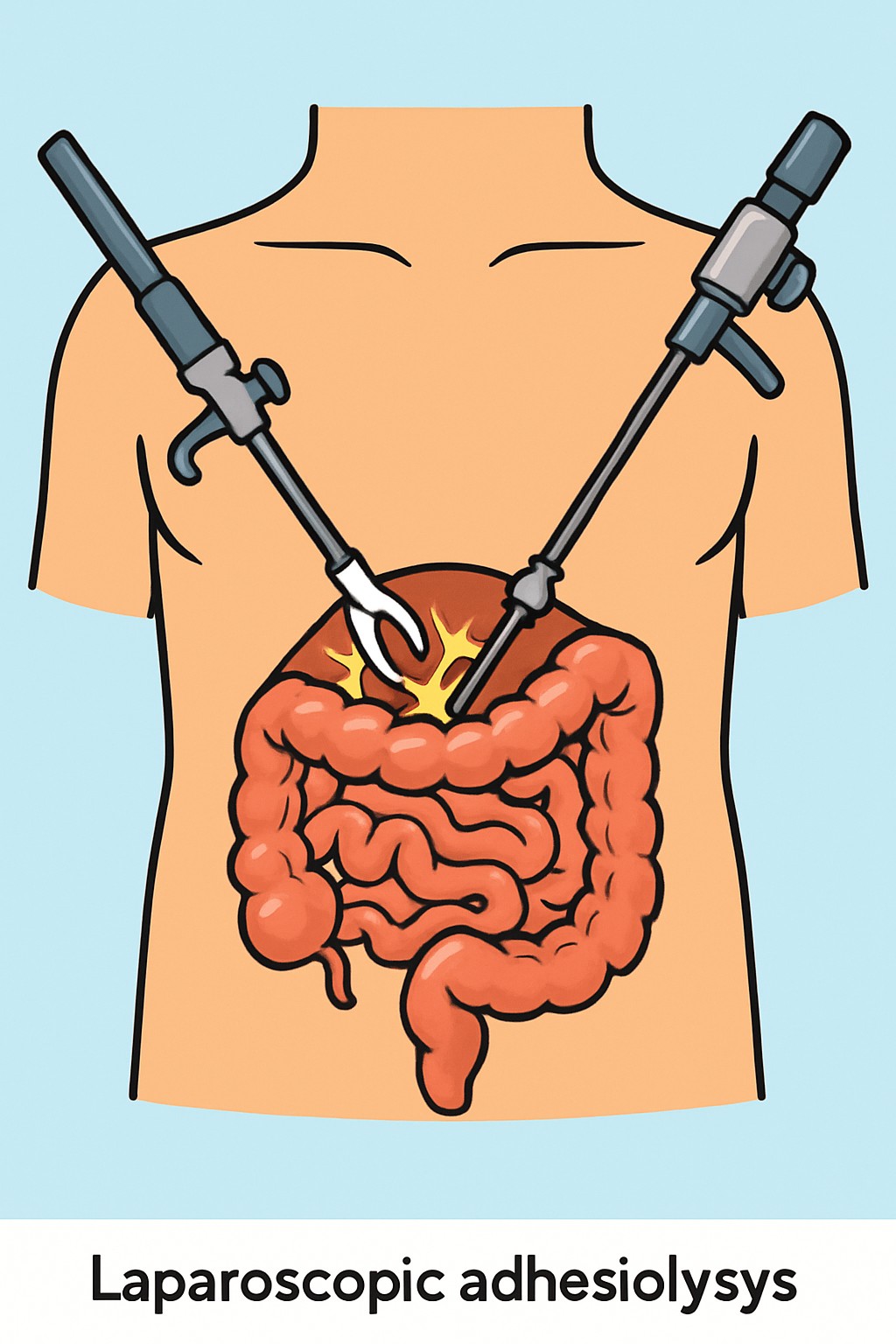
Laparoscopic adhesiolysis is a minimally invasive surgery that uses small incisions and a camera to cut bands of scar tissue called adhesions.
Overview
Laparoscopic adhesiolysis is a minimally invasive surgery that uses small incisions and a camera to cut bands of scar tissue called adhesions. Adhesions can form after prior surgery, infection, or inflammation and may cause the bowel to kink or stick, leading to a blockage. When an adhesive blockage does not settle with non-surgical care or there are signs that the bowel is at risk, surgery may be used to release the tight bands and restore the flow of gas and stool. In some cases, part of the bowel may need repair or removal if it is injured or not healthy.
Also known as: Laparoscopic lysis of adhesions, Laparoscopic LOA, Laparoscopic adhesiolysis for SBO
Preparation & Next Steps
Everything you need to know before and after your procedure
Before Care
- Expect evaluation with labs and imaging; a CT scan often helps locate a blockage and plan surgery
- Review your medicines with the team; they will advise about blood thinners and diabetes medicines
- Follow facility fasting instructions for anesthesia
- A nasogastric tube (a thin tube through the nose into the stomach) may be used to decompress the bowel before surgery
- Discuss consent, including the possibility of bowel repair or resection and a temporary stoma if needed
- Bring prior operative reports and recent imaging if available
- Tell the team about allergies, implanted devices, and prior reactions to anesthesia
- Arrange a ride home and help with daily tasks for the first day or two
- Confirm work, school, and leave paperwork needs with the care team
After Care
- Keep incision sites clean and dry as instructed; watch for redness, warmth, drainage, or opening
- Use pain medicines as directed by your care team; avoid driving while taking prescription pain medicines
- Walk several times a day to reduce blood clot risk and help bowel function return
- Advance your diet as instructed; start with clear liquids and add foods as nausea and bloating improve
- Track bowel function, including passing gas and stool; gentle movement and fluids can help prevent constipation
- Avoid heavy lifting and strenuous activity until cleared by your care team; increase activity gradually
- Contact your care team for fever, worsening belly pain, persistent vomiting, a swollen belly, inability to pass gas or stool, chest pain, shortness of breath, or concerning wound changes
- Schedule and attend follow-up to review recovery and any pathology or operative findings
- Know how to reach the team after hours for urgent concerns
Clinical Information
Important medical details about this procedure
Indications
- Adhesive small bowel obstruction confirmed or strongly suspected
- Recurrent episodes of small bowel obstruction affecting eating or hydration
- Failure of nonoperative management (bowel rest, IV fluids, nasogastric tube)
- Imaging showing a transition point consistent with adhesions
- Concern for bowel compromise where timely relief is needed
Alternatives
- Nonoperative management with IV fluids, bowel rest, and a nasogastric tube under monitoring
- Open adhesiolysis through a larger incision
- Observation with symptom control when an obstruction resolves without surgery
Risks
- Injury to the intestine or other organs, possibly requiring repair or resection
- Bleeding or need for transfusion
- Infection, including surgical site infection
- Postoperative ileus (temporary slowing of bowel function)
- Conversion to open surgery
- Hernia at incision sites
- Blood clots in the legs or lungs
- Anesthesia-related problems
- Adhesions and obstruction can recur
Contraindications
- Hemodynamic instability or shock
- Diffuse peritonitis or bowel perforation where an open approach may be preferred
- Severe abdominal distension limiting safe laparoscopy
- Uncorrected bleeding disorders
- Severe cardiopulmonary disease that does not tolerate general anesthesia and insufflation
Recovery Timeline
What to expect during your recovery
Recovery after laparoscopic adhesiolysis varies. Many people stay in the hospital for several days and resume light daily activities within 1 to 3 weeks, longer if the bowel needed repair or complications occur.
Typical Range
7–21 days
Return to Work
7–21 days
Recovery Milestones
Sit up, get out of bed with assistance, and take short walks
Pass gas and begin return of bowel function
Advance diet from liquids as tolerated per team guidance
Drive when you are off prescription pain medicines and feel comfortable turning and braking
Increase activity and lifting gradually as cleared by your care team
Frequently Asked Questions
Common questions and expert answers about this procedure
What is laparoscopic adhesiolysis and how does it relieve a blockage?
What is laparoscopic adhesiolysis and how does it relieve a blockage?
The surgeon uses small incisions and a camera to cut scar tissue bands that are kinking or tethering the bowel. Releasing those bands can restore the normal passage of gas and stool.
How is laparoscopy different from open surgery for adhesions?
How is laparoscopy different from open surgery for adhesions?
Laparoscopy uses small incisions, which may mean less pain and faster recovery for selected patients. If visibility is poor or it is not safe, the surgeon may switch to an open incision.
Will all adhesions be removed?
Will all adhesions be removed?
Usually only the adhesions causing the blockage are treated. Removing every adhesion can add risk and does not guarantee that new adhesions will not form.
Could part of the bowel be removed or a stoma be needed?
Could part of the bowel be removed or a stoma be needed?
If the bowel is injured or not healthy, a segment may be removed. In some cases a temporary stoma (an opening on the belly for stool) may be created.
How long is the hospital stay?
How long is the hospital stay?
Many people stay several days, depending on bowel function, pain control, and whether a repair or resection was required.
When can I start eating and drinking?
When can I start eating and drinking?
Liquids are usually started first and the diet is advanced as bowel function returns and nausea improves, following the care team’s plan.
Can the obstruction come back?
Can the obstruction come back?
Yes. Adhesions can reform over time, and some people have recurrent episodes even after surgery.
What are the main risks of this surgery?
What are the main risks of this surgery?
Risks include bowel injury, bleeding, infection, blood clots, slow return of bowel function, conversion to open surgery, and recurrence of adhesions.
References
Medical literature and sources