%20--%3e%3csvg%20version='1.0'%20id='Layer_1'%20xmlns='http://www.w3.org/2000/svg'%20xmlns:xlink='http://www.w3.org/1999/xlink'%20x='0px'%20y='0px'%20viewBox='0%200%20755.52%20814.35'%20style='enable-background:new%200%200%20755.52%20814.35;'%20xml:space='preserve'%3e%3cstyle%20type='text/css'%3e%20.st0{fill:%231ae5ce;stroke:%231ae5ce;stroke-width:7;stroke-miterlimit:10;}%20.st1{fill:%23FFFFFF;stroke:%231ae5ce;stroke-width:7;stroke-miterlimit:10;}%20.st2{fill:%231ae5ce;stroke:%23FFFFFF;stroke-width:7;stroke-miterlimit:10;}%20.st3{fill:%23FFFFFF;stroke:%23FFFFFF;stroke-width:6;stroke-miterlimit:10;}%20%3c/style%3e%3cg%20id='Dark_Logo_00000159431215648494653180000015900878925932721032_'%3e%3cpath%20id='shield_00000152259091539869183100000001926543869452564382_'%20class='st0'%20d='M711.13,173.42%20c-3.37-49.07-38.92-44.9-75.96-52.18c-67.4-13.25-130.47-34.47-192.36-63.92c-22.48-10.7-41.88-25.74-65.05-26.28%20c-23.17,0.54-42.58,15.59-65.05,26.28c-61.89,29.45-124.95,50.68-192.36,63.92c-37.04,7.28-72.59,3.11-75.96,52.18%20c-1.55,22.6,0.34,46.4,1.05,68.92c5.99,190.78,52.91,345.39,206.27,466.46c29.71,23.46,74.51,55.8,108.84,70.75%20c5.99,2.61,11.7,3.73,17.21,3.75c5.51-0.02,11.22-1.14,17.21-3.75c34.33-14.95,79.12-47.3,108.84-70.75%20c153.37-121.07,200.28-275.68,206.27-466.46C710.79,219.82,712.68,196.02,711.13,173.42z'/%3e%3cpath%20id='magnifyingglass_00000073685934697636024790000000342567780940956808_'%20class='st1'%20d='M648.78,624.21l-96.64-104.65%20c34.89-40.63,55.98-93.46,55.98-151.21c0-128.27-103.98-232.24-232.24-232.24S143.63,240.08,143.63,368.35%20s103.98,232.24,232.24,232.24c48.87,0,94.21-15.11,131.62-40.89l97.18,105.24c11.25,12.18,30.24,12.93,42.42,1.69l0,0%20C659.27,655.38,660.03,636.39,648.78,624.21z'/%3e%3ccircle%20id='ellipse_00000129904010550392394720000017056154833629780114_'%20class='st2'%20cx='375.87'%20cy='368.35'%20r='181.21'/%3e%3cpath%20id='dollarsign_00000057140127156649725250000003772530148495155891_'%20class='st3'%20d='M362.91,492.03v-23.91%20c0-2.01-1.58-3.69-3.59-3.77c-18.49-0.78-37.12-5.4-49.4-11.83c-1.75-0.92-2.53-3.01-1.76-4.84l5.87-13.89%20c0.86-2.02,3.23-2.88,5.2-1.89c12.94,6.52,30.45,11.44,49.18,11.44c26.02,0,43.6-12.73,43.6-30.43c0-17.08-14.29-27.63-41.4-36.95%20c-37.37-12.42-60.46-26.7-60.46-53.72c0-24.97,20.29-44.11,52.22-49.51c1.8-0.31,3.11-1.89,3.11-3.72v-24.35%20c0-2.09,1.69-3.78,3.78-3.78h15.16c2.09,0,3.78,1.69,3.78,3.78v22.71c0,2.01,1.58,3.67,3.58,3.77c17.85,0.92,30.88,4.75,40.61,9.1%20c1.92,0.86,2.79,3.09,1.94,5.01l-6.08,13.6c-0.85,1.91-3.09,2.77-4.99,1.91c-8.37-3.8-22.38-8.95-42.75-8.95%20c-28.21,0-38.84,14.28-38.84,26.7c0,16.15,13.56,24.22,45.44,35.4c37.74,13.04,56.79,29.19,56.79,56.82%20c0,23.85-19.05,46.23-54.78,52.3c-1.8,0.31-3.11,1.89-3.11,3.72v25.28c0,2.09-1.69,3.78-3.78,3.78h-15.53%20C364.6,495.81,362.91,494.12,362.91,492.03z'/%3e%3c/g%3e%3c/svg%3e)
Laparoscopic appendectomy General Surgery
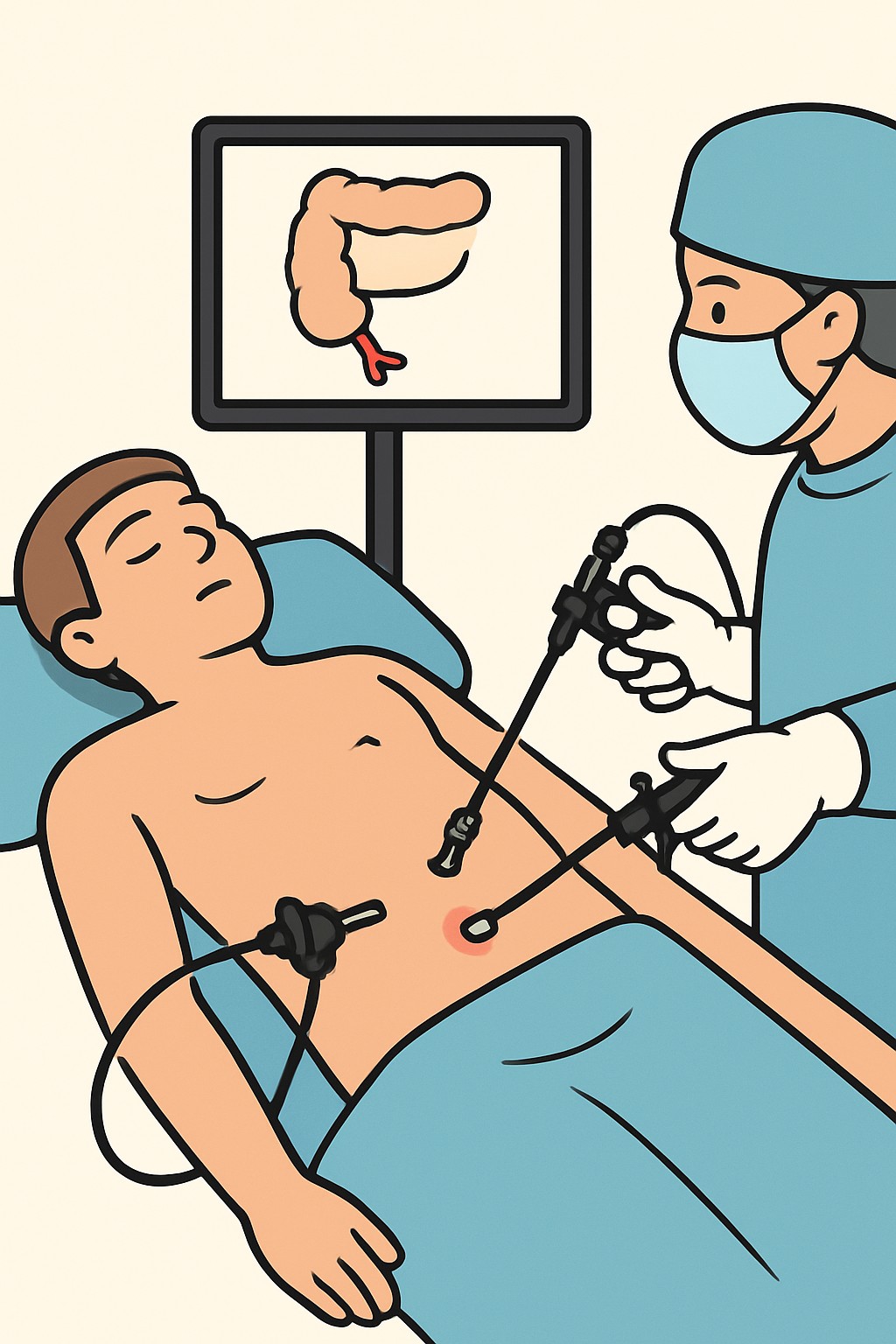
A laparoscopic appendectomy is a minimally invasive surgery to remove the appendix using several small cuts in the abdomen.
Overview
A laparoscopic appendectomy is a minimally invasive surgery to remove the appendix using several small cuts in the abdomen. A tiny camera and special tools are used to see and remove the appendix. This procedure is commonly done to treat appendicitis, which is swelling and infection of the appendix. Many people go home the same day or after an overnight stay. Recovery is often quicker than with an open surgery, but plans vary based on your condition.
Also known as: Lap appendectomy, Keyhole appendectomy
Preparation & Next Steps
Everything you need to know before and after your procedure
Before Care
- Follow the surgical team’s instructions about fasting before anesthesia
- Review which medicines, supplements, or blood thinners to pause or take the day of surgery
- Arrange a responsible adult for transportation and help at home the first day
- Complete any requested labs, urine tests, pregnancy test, or imaging
- Shower the night before or morning of surgery as instructed; avoid lotions at incision sites
- Bring a list of current medicines, allergies, and prior surgeries
- Wear comfortable clothing and leave valuables at home
- Confirm arrival time, location, and check-in details with the facility
- Tell the team about any new fever, cough, or illness before the procedure
After Care
- Walk short distances as advised to help circulation and bowel function
- Keep incisions clean and dry; follow instructions for dressing changes and showering
- Take prescribed pain medicines only as directed by your care team
- Avoid heavy lifting and strenuous activity until the team says it is safe
- Eat light meals at first and drink fluids; advance your diet as tolerated
- Watch for increasing redness, swelling, drainage, fever, or worsening pain at the incision
- Use a pillow to support your abdomen when coughing or sneezing
- Resume driving only when you are off narcotic pain medicines and can move comfortably
- Attend scheduled follow-up to review healing and any biopsy results
- Contact your surgical team if you notice fever, persistent vomiting, chest pain, trouble breathing, or spreading abdominal pain
Clinical Information
Important medical details about this procedure
Indications
- Acute appendicitis (inflamed appendix)
- Suspected appendicitis with imaging or exam findings
- Ruptured appendix after stabilization
- Recurrent appendicitis after prior non-surgical treatment
- Appendiceal mass or abscess after drainage (interval appendectomy)
Alternatives
- Antibiotic treatment for selected uncomplicated appendicitis
- Open appendectomy (single larger incision)
- Percutaneous drainage of an abscess with delayed surgery
- Observation with serial exams and imaging in selected cases
Risks
- Bleeding or infection
- Injury to bowel, bladder, or blood vessels
- Anesthesia-related problems
- Conversion to open surgery if needed
- Blood clots
- Hernia at an incision site
- Abscess or leak if the appendix has ruptured
- Adhesions that could cause bowel blockage later
Contraindications
- Inability to tolerate general anesthesia or laparoscopic gas insufflation
- Uncorrected bleeding disorder
- Unstable vital signs requiring a different approach
- Severe abdominal wall infection at planned incision sites
Recovery Timeline
What to expect during your recovery
Most people are up and walking the day of surgery and return to light activities within several days. Full recovery often takes 1 to 3 weeks, depending on the severity of appendicitis and the type of work you do.
Typical Range
7–21 days
Return to Work
3–14 days
Recovery Milestones
Sit up and walk short distances with support
Do light daily activities at home
Return to school or desk work if comfortable
Increase walking and routine activities
Resume most activities; avoid heavy lifting until cleared
Frequently Asked Questions
Common questions and expert answers about this procedure
What is the difference between laparoscopic and open appendectomy?
What is the difference between laparoscopic and open appendectomy?
Laparoscopic uses several small cuts and a camera; open uses one larger cut. Laparoscopic often leads to smaller scars and faster recovery, but either approach may be used based on your condition.
How long does the surgery take?
How long does the surgery take?
Many laparoscopic appendectomies take about 30 to 90 minutes, but timing varies with inflammation, rupture, and prior surgeries.
Will I stay overnight?
Will I stay overnight?
Some people go home the same day. Others stay one night, especially after a late surgery, significant infection, or if monitoring is needed.
Can you switch to open surgery if needed?
Can you switch to open surgery if needed?
Yes. If visibility is poor or there is heavy scarring or bleeding, the surgeon may convert to an open procedure for safety.
Will I need antibiotics?
Will I need antibiotics?
Antibiotics are commonly given around the time of surgery. People with a ruptured appendix often need a longer course.
What activity limits are common after surgery?
What activity limits are common after surgery?
Light walking is encouraged early. Bending, heavy lifting, and strenuous exercise are usually limited for a short time until cleared.
What scars should I expect?
What scars should I expect?
Most laparoscopic procedures use three or four small incisions. Scars usually fade over time but vary by person.
References
Medical literature and sources