%20--%3e%3csvg%20version='1.0'%20id='Layer_1'%20xmlns='http://www.w3.org/2000/svg'%20xmlns:xlink='http://www.w3.org/1999/xlink'%20x='0px'%20y='0px'%20viewBox='0%200%20755.52%20814.35'%20style='enable-background:new%200%200%20755.52%20814.35;'%20xml:space='preserve'%3e%3cstyle%20type='text/css'%3e%20.st0{fill:%231ae5ce;stroke:%231ae5ce;stroke-width:7;stroke-miterlimit:10;}%20.st1{fill:%23FFFFFF;stroke:%231ae5ce;stroke-width:7;stroke-miterlimit:10;}%20.st2{fill:%231ae5ce;stroke:%23FFFFFF;stroke-width:7;stroke-miterlimit:10;}%20.st3{fill:%23FFFFFF;stroke:%23FFFFFF;stroke-width:6;stroke-miterlimit:10;}%20%3c/style%3e%3cg%20id='Dark_Logo_00000159431215648494653180000015900878925932721032_'%3e%3cpath%20id='shield_00000152259091539869183100000001926543869452564382_'%20class='st0'%20d='M711.13,173.42%20c-3.37-49.07-38.92-44.9-75.96-52.18c-67.4-13.25-130.47-34.47-192.36-63.92c-22.48-10.7-41.88-25.74-65.05-26.28%20c-23.17,0.54-42.58,15.59-65.05,26.28c-61.89,29.45-124.95,50.68-192.36,63.92c-37.04,7.28-72.59,3.11-75.96,52.18%20c-1.55,22.6,0.34,46.4,1.05,68.92c5.99,190.78,52.91,345.39,206.27,466.46c29.71,23.46,74.51,55.8,108.84,70.75%20c5.99,2.61,11.7,3.73,17.21,3.75c5.51-0.02,11.22-1.14,17.21-3.75c34.33-14.95,79.12-47.3,108.84-70.75%20c153.37-121.07,200.28-275.68,206.27-466.46C710.79,219.82,712.68,196.02,711.13,173.42z'/%3e%3cpath%20id='magnifyingglass_00000073685934697636024790000000342567780940956808_'%20class='st1'%20d='M648.78,624.21l-96.64-104.65%20c34.89-40.63,55.98-93.46,55.98-151.21c0-128.27-103.98-232.24-232.24-232.24S143.63,240.08,143.63,368.35%20s103.98,232.24,232.24,232.24c48.87,0,94.21-15.11,131.62-40.89l97.18,105.24c11.25,12.18,30.24,12.93,42.42,1.69l0,0%20C659.27,655.38,660.03,636.39,648.78,624.21z'/%3e%3ccircle%20id='ellipse_00000129904010550392394720000017056154833629780114_'%20class='st2'%20cx='375.87'%20cy='368.35'%20r='181.21'/%3e%3cpath%20id='dollarsign_00000057140127156649725250000003772530148495155891_'%20class='st3'%20d='M362.91,492.03v-23.91%20c0-2.01-1.58-3.69-3.59-3.77c-18.49-0.78-37.12-5.4-49.4-11.83c-1.75-0.92-2.53-3.01-1.76-4.84l5.87-13.89%20c0.86-2.02,3.23-2.88,5.2-1.89c12.94,6.52,30.45,11.44,49.18,11.44c26.02,0,43.6-12.73,43.6-30.43c0-17.08-14.29-27.63-41.4-36.95%20c-37.37-12.42-60.46-26.7-60.46-53.72c0-24.97,20.29-44.11,52.22-49.51c1.8-0.31,3.11-1.89,3.11-3.72v-24.35%20c0-2.09,1.69-3.78,3.78-3.78h15.16c2.09,0,3.78,1.69,3.78,3.78v22.71c0,2.01,1.58,3.67,3.58,3.77c17.85,0.92,30.88,4.75,40.61,9.1%20c1.92,0.86,2.79,3.09,1.94,5.01l-6.08,13.6c-0.85,1.91-3.09,2.77-4.99,1.91c-8.37-3.8-22.38-8.95-42.75-8.95%20c-28.21,0-38.84,14.28-38.84,26.7c0,16.15,13.56,24.22,45.44,35.4c37.74,13.04,56.79,29.19,56.79,56.82%20c0,23.85-19.05,46.23-54.78,52.3c-1.8,0.31-3.11,1.89-3.11,3.72v25.28c0,2.09-1.69,3.78-3.78,3.78h-15.53%20C364.6,495.81,362.91,494.12,362.91,492.03z'/%3e%3c/g%3e%3c/svg%3e)
Open appendectomy (appendix removal - open surgery) General Surgery
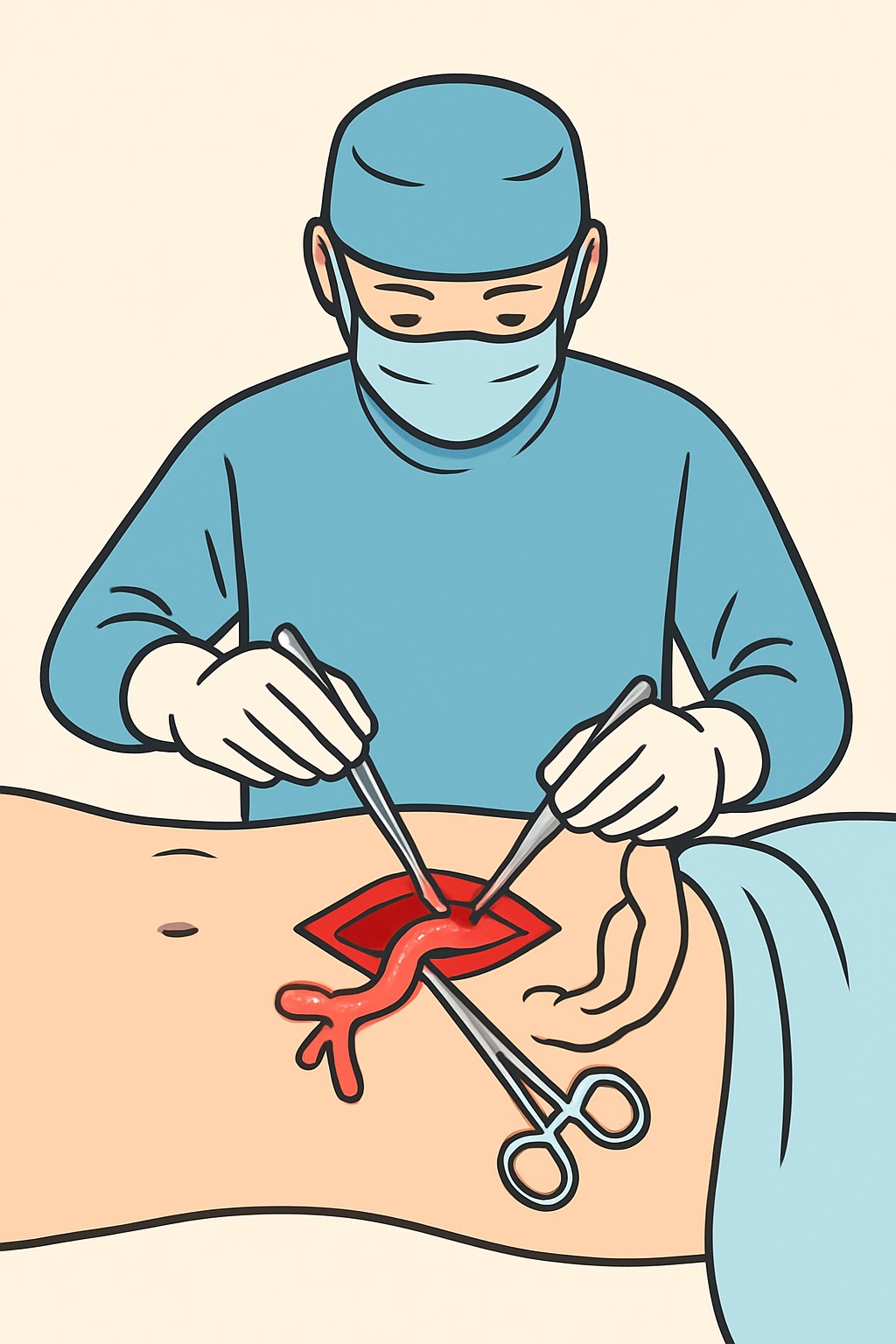
An open appendectomy is surgery to remove the appendix through a single incision in the lower right abdomen.
Overview
An open appendectomy is surgery to remove the appendix through a single incision in the lower right abdomen. It is done under general anesthesia. The surgeon identifies and removes the appendix and closes the incision with sutures or staples. This approach may be chosen when the appendix has ruptured, there is an abscess, there is significant scarring, or when laparoscopy is not suitable. Removing the appendix treats appendicitis and helps prevent complications like infection inside the abdomen.
Also known as: Appendectomy (open), Open appendix removal, Appendix surgery open
Preparation & Next Steps
Everything you need to know before and after your procedure
Before Care
- Expect evaluation with labs and imaging such as ultrasound or CT to confirm appendicitis
- Follow hospital fasting instructions before anesthesia, including when to stop food and liquids
- Bring a current list of medicines and allergies; include blood thinners and supplements
- Ask how to handle blood thinners, diabetes medicines, and inhalers before surgery
- Arrange a ride home and help for the first day after anesthesia
- Do not shave the surgical area at home; the team will prepare the skin if needed
- Remove jewelry and nail polish; wear loose, comfortable clothing
- Bring a photo ID, insurance card, and any medical devices you use, such as a CPAP
- Tell the team about prior anesthesia reactions, sleep apnea, or bleeding disorders
- Confirm a preferred pharmacy and an emergency contact for updates
After Care
- Keep the incision clean and dry as instructed; change dressings only as directed
- You may be able to shower after a short period; avoid soaking the incision until cleared
- Take prescribed medicines as directed by your care team; do not drive while taking opioids
- Walk several times a day to support circulation and help prevent blood clots
- Use deep breathing or an incentive spirometer if provided to protect lung function
- Eat small, easy-to-digest meals and drink fluids; ask about options if constipation occurs
- Avoid heavy lifting and strenuous activity until your surgical team says it is safe
- Check the incision daily for increasing redness, swelling, warmth, drainage, or opening
- Contact your care team if you have fever, worsening belly pain, vomiting, or inability to pass gas or stool
- Attend follow-up to review healing, pathology results, and activity guidance
Clinical Information
Important medical details about this procedure
Indications
- Acute appendicitis
- Perforated or gangrenous appendix
- Appendiceal abscess or phlegmon
- Failure of nonoperative management with antibiotics
- When laparoscopic surgery is not appropriate
Alternatives
- Laparoscopic appendectomy
- Antibiotic treatment for select uncomplicated appendicitis
- Image-guided abscess drainage with possible interval appendectomy later
Risks
- Infection at the incision or inside the abdomen
- Bleeding
- Injury to nearby organs or blood vessels
- Blood clots
- Hernia at the incision site
- Adhesions or bowel obstruction later
- Anesthesia reactions
Contraindications
- Uncorrected bleeding problems
- Severe medical instability until stabilized
- Known inability to tolerate general anesthesia
Recovery Timeline
What to expect during your recovery
Recovery after an open appendectomy is usually longer than after a laparoscopic procedure. Many people resume light activity in about 1 to 2 weeks and return toward normal activities over 4 to 6 weeks, depending on the situation.
Typical Range
14–42 days
Return to Work
14–28 days
Recovery Milestones
Out of bed and short walks with assistance as needed
Shower if allowed by incision care plan; increase walking time
Light daily activities; brief errands; avoid heavy lifting
Return to desk work or school if pain is controlled and no heavy activity is required
Gradually add heavier household tasks; continue to avoid strenuous exercise
Resume strenuous exercise or heavy labor when cleared by your surgical team
Frequently Asked Questions
Common questions and expert answers about this procedure
What is the difference between open and laparoscopic appendectomy?
What is the difference between open and laparoscopic appendectomy?
Open surgery uses one larger incision in the lower right abdomen. Laparoscopic surgery uses several small incisions with a camera. Open surgery may be chosen when there is rupture, abscess, or extensive scarring.
How long is the hospital stay?
How long is the hospital stay?
Many people go home within 1 to 3 days. A longer stay may be needed if the appendix ruptured or if antibiotics and drains are required.
Will I have a drain?
Will I have a drain?
A drain may be placed if there is significant infection or an abscess. It is usually removed when drainage decreases and the team decides it is safe.
What will the scar look like?
What will the scar look like?
You will have a single incision on the lower right abdomen. Over time it usually fades, but appearance varies with skin type, healing, and sun exposure.
When can I eat after surgery?
When can I eat after surgery?
Clear liquids are often started first and then solid foods are added as bowel function returns and nausea improves.
Can appendicitis be treated with antibiotics only?
Can appendicitis be treated with antibiotics only?
Some uncomplicated cases can be managed with antibiotics, but many people still need surgery, and antibiotics are standard when rupture or abscess is present.
What happens after the appendix is removed?
What happens after the appendix is removed?
You can live a normal life without the appendix. The removed tissue is typically sent to a lab for examination.
When can I return to sports or heavy work?
When can I return to sports or heavy work?
Strenuous activity is usually restricted for several weeks after open surgery. Your surgical team will give timing based on healing and job or sport demands.
References
Medical literature and sources