%20--%3e%3csvg%20version='1.0'%20id='Layer_1'%20xmlns='http://www.w3.org/2000/svg'%20xmlns:xlink='http://www.w3.org/1999/xlink'%20x='0px'%20y='0px'%20viewBox='0%200%20755.52%20814.35'%20style='enable-background:new%200%200%20755.52%20814.35;'%20xml:space='preserve'%3e%3cstyle%20type='text/css'%3e%20.st0{fill:%231ae5ce;stroke:%231ae5ce;stroke-width:7;stroke-miterlimit:10;}%20.st1{fill:%23FFFFFF;stroke:%231ae5ce;stroke-width:7;stroke-miterlimit:10;}%20.st2{fill:%231ae5ce;stroke:%23FFFFFF;stroke-width:7;stroke-miterlimit:10;}%20.st3{fill:%23FFFFFF;stroke:%23FFFFFF;stroke-width:6;stroke-miterlimit:10;}%20%3c/style%3e%3cg%20id='Dark_Logo_00000159431215648494653180000015900878925932721032_'%3e%3cpath%20id='shield_00000152259091539869183100000001926543869452564382_'%20class='st0'%20d='M711.13,173.42%20c-3.37-49.07-38.92-44.9-75.96-52.18c-67.4-13.25-130.47-34.47-192.36-63.92c-22.48-10.7-41.88-25.74-65.05-26.28%20c-23.17,0.54-42.58,15.59-65.05,26.28c-61.89,29.45-124.95,50.68-192.36,63.92c-37.04,7.28-72.59,3.11-75.96,52.18%20c-1.55,22.6,0.34,46.4,1.05,68.92c5.99,190.78,52.91,345.39,206.27,466.46c29.71,23.46,74.51,55.8,108.84,70.75%20c5.99,2.61,11.7,3.73,17.21,3.75c5.51-0.02,11.22-1.14,17.21-3.75c34.33-14.95,79.12-47.3,108.84-70.75%20c153.37-121.07,200.28-275.68,206.27-466.46C710.79,219.82,712.68,196.02,711.13,173.42z'/%3e%3cpath%20id='magnifyingglass_00000073685934697636024790000000342567780940956808_'%20class='st1'%20d='M648.78,624.21l-96.64-104.65%20c34.89-40.63,55.98-93.46,55.98-151.21c0-128.27-103.98-232.24-232.24-232.24S143.63,240.08,143.63,368.35%20s103.98,232.24,232.24,232.24c48.87,0,94.21-15.11,131.62-40.89l97.18,105.24c11.25,12.18,30.24,12.93,42.42,1.69l0,0%20C659.27,655.38,660.03,636.39,648.78,624.21z'/%3e%3ccircle%20id='ellipse_00000129904010550392394720000017056154833629780114_'%20class='st2'%20cx='375.87'%20cy='368.35'%20r='181.21'/%3e%3cpath%20id='dollarsign_00000057140127156649725250000003772530148495155891_'%20class='st3'%20d='M362.91,492.03v-23.91%20c0-2.01-1.58-3.69-3.59-3.77c-18.49-0.78-37.12-5.4-49.4-11.83c-1.75-0.92-2.53-3.01-1.76-4.84l5.87-13.89%20c0.86-2.02,3.23-2.88,5.2-1.89c12.94,6.52,30.45,11.44,49.18,11.44c26.02,0,43.6-12.73,43.6-30.43c0-17.08-14.29-27.63-41.4-36.95%20c-37.37-12.42-60.46-26.7-60.46-53.72c0-24.97,20.29-44.11,52.22-49.51c1.8-0.31,3.11-1.89,3.11-3.72v-24.35%20c0-2.09,1.69-3.78,3.78-3.78h15.16c2.09,0,3.78,1.69,3.78,3.78v22.71c0,2.01,1.58,3.67,3.58,3.77c17.85,0.92,30.88,4.75,40.61,9.1%20c1.92,0.86,2.79,3.09,1.94,5.01l-6.08,13.6c-0.85,1.91-3.09,2.77-4.99,1.91c-8.37-3.8-22.38-8.95-42.75-8.95%20c-28.21,0-38.84,14.28-38.84,26.7c0,16.15,13.56,24.22,45.44,35.4c37.74,13.04,56.79,29.19,56.79,56.82%20c0,23.85-19.05,46.23-54.78,52.3c-1.8,0.31-3.11,1.89-3.11,3.72v25.28c0,2.09-1.69,3.78-3.78,3.78h-15.53%20C364.6,495.81,362.91,494.12,362.91,492.03z'/%3e%3c/g%3e%3c/svg%3e)
PICC line insertion (peripheral central catheter) General Surgery
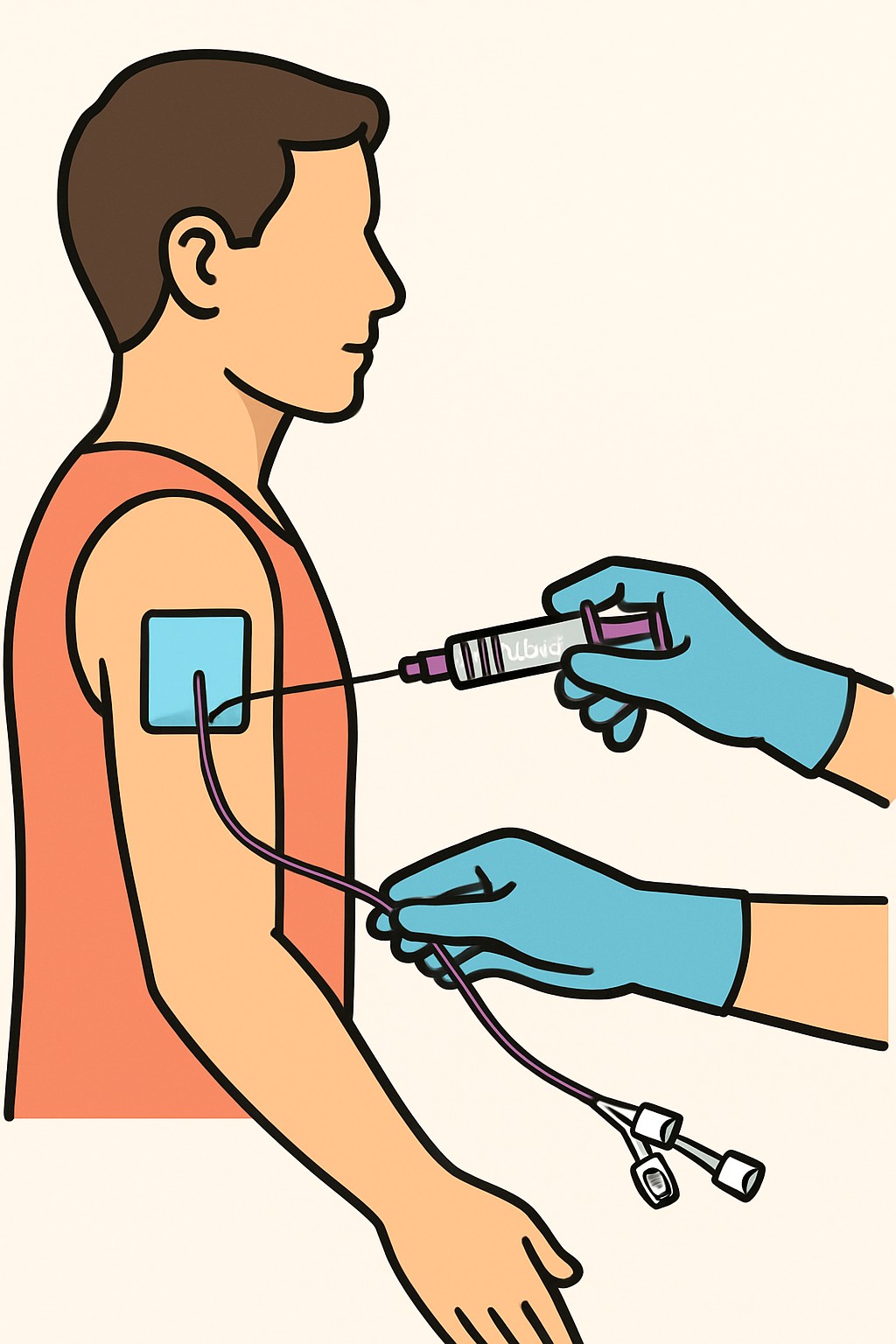
A PICC line is a long, thin tube placed in a vein of the upper arm and guided to a large vein near the heart.
Overview
A PICC line is a long, thin tube placed in a vein of the upper arm and guided to a large vein near the heart. PICC stands for peripherally inserted central catheter. The tip rests in a central vein so medicines can be given safely over days to months. PICC lines are used when frequent IV access is needed, when medicines could irritate small veins, or when long-term treatment is planned. Placement is usually done by a trained nurse, radiology team, or clinician using ultrasound to guide the catheter into the vein.
Also known as: PICC placement, PICC line placement, Peripherally inserted central catheter insertion
Preparation & Next Steps
Everything you need to know before and after your procedure
Before Care
- Bring an updated list of your medicines and allergies, including blood thinners and supplements
- Expect an arm exam and ultrasound to choose the best vein
- Eating is usually allowed, but follow any clinic instructions if sedation is planned
- Wear a loose short-sleeve top to allow easy access to the upper arm
- Plan for an hour or more for placement and post-insertion checks
- Ask about driving restrictions if any sedating medicine will be used
- Confirm which arm is preferred for insertion and note any prior surgeries or devices
- The team may review vaccination and infection history to reduce infection risk
- Imaging or an ECG-based system is typically used to confirm catheter tip position
After Care
- Keep the dressing clean, dry, and tightly sealed; do not submerge the site in water
- Cover the site for showers as directed and change the dressing if it becomes wet or loose
- Limit heavy lifting and repetitive arm motions on the PICC side at first
- Do not let blood pressure cuffs or blood draws be done on the PICC arm unless directed
- Make sure the line is secured to prevent pulling or kinking
- Follow the flushing and cap change schedule provided by your care team
- Watch for redness, swelling, pain, drainage, fever, leaking, or difficulty flushing and notify a clinician if these occur
- If the line appears to move, break, or will not flush, stop using it and contact the care team
- Attend regular dressing changes, typically every 7 days or sooner if soiled or loose
- Carry a list or card stating you have a PICC line, especially when traveling or seeking care
Clinical Information
Important medical details about this procedure
Indications
- Long-term IV antibiotics
- Chemotherapy or other IV medicines
- Total parenteral nutrition (TPN)
- Difficult IV access with frequent blood draws
- IV therapies that can irritate small veins
- Need for reliable IV access for several weeks or longer
Alternatives
- Peripheral IV catheter for short-term use
- Midline catheter for intermediate use
- Implanted port (port-a-cath)
- Tunneled central venous catheter (for example, Hickman)
- Non-tunneled central venous catheter
- Oral or subcutaneous medicines when appropriate
Risks
- Infection of the bloodstream or insertion site
- Bleeding or bruising
- Blood clot in the arm vein
- Catheter blockage or kinking
- Catheter movement or accidental removal
- Skin irritation or allergic reaction to dressings
- Air embolism if the line is open to air
- Abnormal heart rhythm during guidewire placement
- Nerve irritation or pain near the insertion site
- Lung injury is uncommon with PICCs compared to chest central lines
Contraindications
- Active skin infection at the planned insertion site
- Known clot or severe narrowing in the arm veins
- Uncontrolled bleeding disorder
- Severe allergy to catheter materials or antiseptics
- Need to preserve arm veins in advanced kidney disease for future dialysis access
- Inability to keep the catheter clean and secured without support
Recovery Timeline
What to expect during your recovery
Most people return to normal light activities within 1 to 3 days. Soreness or bruising at the arm can occur for a few days. Heavier arm use is often limited early on to protect the line.
Typical Range
0–3 days
Return to Work
0–2 days
Recovery Milestones
Use the arm for light activities; keep dressing clean and dry
Resume most daily tasks; avoid soaking the site and protect during showers
Avoid heavy lifting over about 10 lb (4.5 kg) with the PICC arm
Increase activity as tolerated while keeping line secured and dressing changes on schedule
Use the PICC for treatments as instructed; report any signs of infection or blockage
Frequently Asked Questions
Common questions and expert answers about this procedure
What is a PICC line?
What is a PICC line?
It is a long IV catheter placed in a vein of the upper arm and advanced to a large central vein so medicines and nutrition can be given safely over time.
How is the PICC placed?
How is the PICC placed?
The clinician numbs the skin, uses ultrasound to enter a vein, threads the catheter, and confirms the tip position with imaging or an ECG-based system.
Will I be awake during the procedure?
Will I be awake during the procedure?
Yes. Local anesthetic is used to numb the area. Mild calming medicine may be offered in some settings.
How long can a PICC stay in?
How long can a PICC stay in?
PICC lines are designed for weeks to months of use when they remain functional and free of infection.
Can I shower or swim with a PICC?
Can I shower or swim with a PICC?
Showering is usually allowed with a waterproof cover and intact dressing. Do not swim or submerge the site.
Can blood be drawn from a PICC line?
Can blood be drawn from a PICC line?
Yes, blood can often be drawn through the PICC if the line functions well and facility policy allows.
How is placement confirmed?
How is placement confirmed?
The tip location is confirmed by a chest X-ray or by an ECG-based tip confirmation system.
Who changes the dressing and flushes the line?
Who changes the dressing and flushes the line?
A trained nurse or clinician does scheduled dressing changes and flushes. Home care may be arranged when needed.
References
Medical literature and sources