%20--%3e%3csvg%20version='1.0'%20id='Layer_1'%20xmlns='http://www.w3.org/2000/svg'%20xmlns:xlink='http://www.w3.org/1999/xlink'%20x='0px'%20y='0px'%20viewBox='0%200%20755.52%20814.35'%20style='enable-background:new%200%200%20755.52%20814.35;'%20xml:space='preserve'%3e%3cstyle%20type='text/css'%3e%20.st0{fill:%231ae5ce;stroke:%231ae5ce;stroke-width:7;stroke-miterlimit:10;}%20.st1{fill:%23FFFFFF;stroke:%231ae5ce;stroke-width:7;stroke-miterlimit:10;}%20.st2{fill:%231ae5ce;stroke:%23FFFFFF;stroke-width:7;stroke-miterlimit:10;}%20.st3{fill:%23FFFFFF;stroke:%23FFFFFF;stroke-width:6;stroke-miterlimit:10;}%20%3c/style%3e%3cg%20id='Dark_Logo_00000159431215648494653180000015900878925932721032_'%3e%3cpath%20id='shield_00000152259091539869183100000001926543869452564382_'%20class='st0'%20d='M711.13,173.42%20c-3.37-49.07-38.92-44.9-75.96-52.18c-67.4-13.25-130.47-34.47-192.36-63.92c-22.48-10.7-41.88-25.74-65.05-26.28%20c-23.17,0.54-42.58,15.59-65.05,26.28c-61.89,29.45-124.95,50.68-192.36,63.92c-37.04,7.28-72.59,3.11-75.96,52.18%20c-1.55,22.6,0.34,46.4,1.05,68.92c5.99,190.78,52.91,345.39,206.27,466.46c29.71,23.46,74.51,55.8,108.84,70.75%20c5.99,2.61,11.7,3.73,17.21,3.75c5.51-0.02,11.22-1.14,17.21-3.75c34.33-14.95,79.12-47.3,108.84-70.75%20c153.37-121.07,200.28-275.68,206.27-466.46C710.79,219.82,712.68,196.02,711.13,173.42z'/%3e%3cpath%20id='magnifyingglass_00000073685934697636024790000000342567780940956808_'%20class='st1'%20d='M648.78,624.21l-96.64-104.65%20c34.89-40.63,55.98-93.46,55.98-151.21c0-128.27-103.98-232.24-232.24-232.24S143.63,240.08,143.63,368.35%20s103.98,232.24,232.24,232.24c48.87,0,94.21-15.11,131.62-40.89l97.18,105.24c11.25,12.18,30.24,12.93,42.42,1.69l0,0%20C659.27,655.38,660.03,636.39,648.78,624.21z'/%3e%3ccircle%20id='ellipse_00000129904010550392394720000017056154833629780114_'%20class='st2'%20cx='375.87'%20cy='368.35'%20r='181.21'/%3e%3cpath%20id='dollarsign_00000057140127156649725250000003772530148495155891_'%20class='st3'%20d='M362.91,492.03v-23.91%20c0-2.01-1.58-3.69-3.59-3.77c-18.49-0.78-37.12-5.4-49.4-11.83c-1.75-0.92-2.53-3.01-1.76-4.84l5.87-13.89%20c0.86-2.02,3.23-2.88,5.2-1.89c12.94,6.52,30.45,11.44,49.18,11.44c26.02,0,43.6-12.73,43.6-30.43c0-17.08-14.29-27.63-41.4-36.95%20c-37.37-12.42-60.46-26.7-60.46-53.72c0-24.97,20.29-44.11,52.22-49.51c1.8-0.31,3.11-1.89,3.11-3.72v-24.35%20c0-2.09,1.69-3.78,3.78-3.78h15.16c2.09,0,3.78,1.69,3.78,3.78v22.71c0,2.01,1.58,3.67,3.58,3.77c17.85,0.92,30.88,4.75,40.61,9.1%20c1.92,0.86,2.79,3.09,1.94,5.01l-6.08,13.6c-0.85,1.91-3.09,2.77-4.99,1.91c-8.37-3.8-22.38-8.95-42.75-8.95%20c-28.21,0-38.84,14.28-38.84,26.7c0,16.15,13.56,24.22,45.44,35.4c37.74,13.04,56.79,29.19,56.79,56.82%20c0,23.85-19.05,46.23-54.78,52.3c-1.8,0.31-3.11,1.89-3.11,3.72v25.28c0,2.09-1.69,3.78-3.78,3.78h-15.53%20C364.6,495.81,362.91,494.12,362.91,492.03z'/%3e%3c/g%3e%3c/svg%3e)
Port-a-Cath Insertion (Implantable IV Port) General Surgery
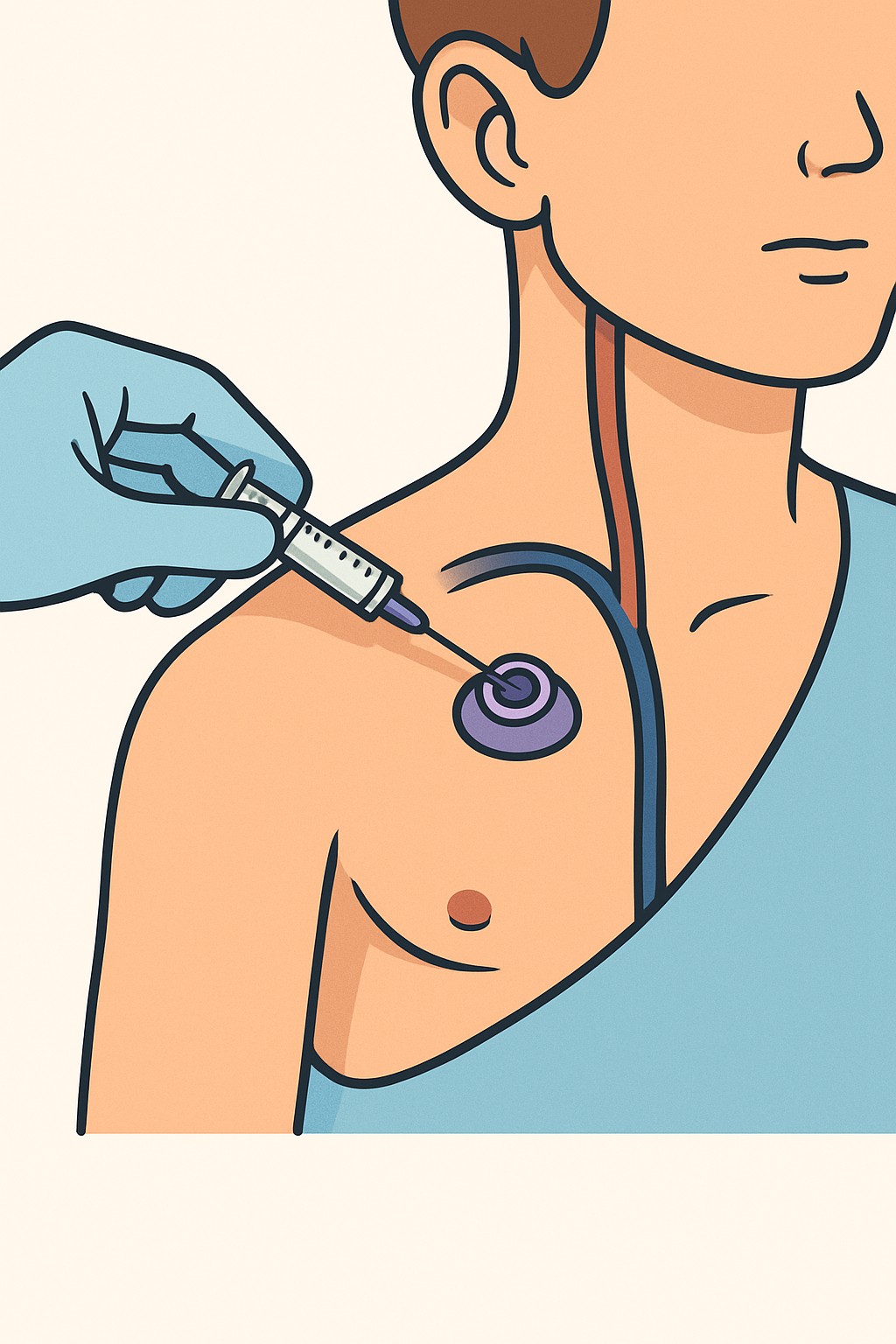
A Port-a-Cath, also called an implantable IV port, is a small device placed under the skin, usually in the upper chest.
Overview
A Port-a-Cath, also called an implantable IV port, is a small device placed under the skin, usually in the upper chest. A thin tube (catheter) runs from the port into a large vein. Clinicians can access the port with a special needle to give medicines, fluids, or nutrition, and to draw blood. Ports are used when repeated IV access is needed over weeks to years. They help avoid frequent needle sticks in small veins and can be easier to keep clean than external catheters because the port sits fully under the skin.
Also known as: Implanted port placement, Mediport insertion, Venous access port insertion, IV port placement, Port placement
Preparation & Next Steps
Everything you need to know before and after your procedure
Before Care
- Confirm the appointment location, arrival time, and how long you will be there
- Bring a photo ID, insurance card, and a list of current medicines and allergies
- Ask the care team about managing blood thinners or antiplatelet medicines before the procedure
- Complete any requested labs or imaging and arrange pre-authorization if needed
- Follow any fasting instructions if sedation is planned and arrange a responsible adult to drive you home
- Shower the night before or morning of the procedure; avoid lotions, powders, or oils on the chest and neck
- Wear loose, comfortable clothing with a top that opens at the front
- Remove jewelry near the neck and chest area before arrival
- Share any prior issues with anesthesia, sedation, or line placements with the team
- Confirm which side of the chest is preferred for placement if you have a pacemaker, infusion pump, or other devices
After Care
- Keep the dressing clean and dry as instructed and protect the site during bathing
- Expect mild soreness or bruising at the site for a few days; use pain relief as advised by your care team
- Avoid heavy lifting, strenuous exercise, or repetitive overhead arm movements on the side of the port until cleared
- Do not submerge the site (baths, pools, hot tubs) until the incision has healed
- Watch for redness, swelling, warmth, drainage, fever, increasing pain, or difficulty breathing and contact your clinician if these occur
- Know that the port is accessed using a special needle; only trained staff should access or flush the port
- Carry your port identification card and share that you have a port before imaging, procedures, or blood draws
- Schedule follow-up or the first use of the port as directed by the care team
- If the port is not used regularly, ask about a maintenance flush schedule to help prevent blockage
- Protect the area from friction or pressure from seatbelts, backpack straps, or sports gear while healing
Clinical Information
Important medical details about this procedure
Indications
- Long-term chemotherapy or immunotherapy
- Frequent blood draws or IV treatments
- Long courses of IV antibiotics
- Total parenteral nutrition (TPN)
- Poor or difficult peripheral IV access
- Need for reliable central venous access
Alternatives
- Peripherally inserted central catheter (PICC line)
- Tunneled central venous catheter (e.g., Hickman or Broviac)
- Midline catheter for intermediate-term access
- Short-term peripheral IV cannulas
- Non-IV options when suitable (oral or subcutaneous medicines)
Risks
- Infection at the skin or in the bloodstream
- Bleeding or bruising
- Injury to nearby artery, vein, or nerve
- Collapsed lung (pneumothorax) or blood around lung (hemothorax)
- Catheter malposition or migration
- Blood clot in the vein or catheter blockage
- Air embolism
- Pain, swelling, or skin irritation at the site
- Allergic reaction to materials or medicines used
- Port rotation, flipping, or device malfunction that may need revision
- Small scar and exposure to low-dose imaging during placement
Contraindications
- Active bloodstream infection
- Uncontrolled bleeding problems
- Skin infection over the planned insertion site
- Known allergy to device materials not manageable with alternatives
- Severe obstruction of central veins that prevents placement
Recovery Timeline
What to expect during your recovery
Most people have mild soreness for 1 to 3 days and return to light activities within a few days. The incision typically heals over 1 to 2 weeks, and the port can remain in place for months to years if needed.
Typical Range
2–7 days
Return to Work
1–3 days
Recovery Milestones
Walk and do light self-care; expect mild chest or neck soreness
Resume desk work and light daily activities as comfortable
Increase routine activities; avoid strenuous upper body exertion
Incision generally well-healed; many people resume most activities if cleared
Frequently Asked Questions
Common questions and expert answers about this procedure
What is a Port-a-Cath and how does it work?
What is a Port-a-Cath and how does it work?
It is a small port placed under the skin and connected to a large vein. A special needle goes through the skin into the port to give medicines or draw blood.
How is the port inserted?
How is the port inserted?
A clinician makes a small incision, creates a pocket under the skin, threads a catheter into a large vein, and connects it to the port. Imaging is often used to guide and confirm placement.
Will I be awake during the procedure?
Will I be awake during the procedure?
Most placements use local anesthetic to numb the area, sometimes with light sedation. The approach depends on the setting and your health status.
When can the port be used?
When can the port be used?
Ports are often usable soon after placement once position is confirmed. The exact timing depends on the care plan.
How long can a port stay in?
How long can a port stay in?
Ports are designed for long-term use and can stay in for months to years. They are removed when no longer needed or if problems occur.
Can I shower, swim, or exercise with a port?
Can I shower, swim, or exercise with a port?
Showering is usually allowed after the incision heals; swimming and contact sports are often delayed until healing is complete. Ask your care team for timing based on your plan.
How is the port maintained?
How is the port maintained?
When not in regular use, ports are typically flushed on a schedule to help prevent blockage. Only trained staff should access or flush the port.
What problems should I watch for?
What problems should I watch for?
Contact your clinician if you notice fever, chills, redness, swelling, drainage, increasing pain, arm or neck swelling, or sudden shortness of breath.