%20--%3e%3csvg%20version='1.0'%20id='Layer_1'%20xmlns='http://www.w3.org/2000/svg'%20xmlns:xlink='http://www.w3.org/1999/xlink'%20x='0px'%20y='0px'%20viewBox='0%200%20755.52%20814.35'%20style='enable-background:new%200%200%20755.52%20814.35;'%20xml:space='preserve'%3e%3cstyle%20type='text/css'%3e%20.st0{fill:%231ae5ce;stroke:%231ae5ce;stroke-width:7;stroke-miterlimit:10;}%20.st1{fill:%23FFFFFF;stroke:%231ae5ce;stroke-width:7;stroke-miterlimit:10;}%20.st2{fill:%231ae5ce;stroke:%23FFFFFF;stroke-width:7;stroke-miterlimit:10;}%20.st3{fill:%23FFFFFF;stroke:%23FFFFFF;stroke-width:6;stroke-miterlimit:10;}%20%3c/style%3e%3cg%20id='Dark_Logo_00000159431215648494653180000015900878925932721032_'%3e%3cpath%20id='shield_00000152259091539869183100000001926543869452564382_'%20class='st0'%20d='M711.13,173.42%20c-3.37-49.07-38.92-44.9-75.96-52.18c-67.4-13.25-130.47-34.47-192.36-63.92c-22.48-10.7-41.88-25.74-65.05-26.28%20c-23.17,0.54-42.58,15.59-65.05,26.28c-61.89,29.45-124.95,50.68-192.36,63.92c-37.04,7.28-72.59,3.11-75.96,52.18%20c-1.55,22.6,0.34,46.4,1.05,68.92c5.99,190.78,52.91,345.39,206.27,466.46c29.71,23.46,74.51,55.8,108.84,70.75%20c5.99,2.61,11.7,3.73,17.21,3.75c5.51-0.02,11.22-1.14,17.21-3.75c34.33-14.95,79.12-47.3,108.84-70.75%20c153.37-121.07,200.28-275.68,206.27-466.46C710.79,219.82,712.68,196.02,711.13,173.42z'/%3e%3cpath%20id='magnifyingglass_00000073685934697636024790000000342567780940956808_'%20class='st1'%20d='M648.78,624.21l-96.64-104.65%20c34.89-40.63,55.98-93.46,55.98-151.21c0-128.27-103.98-232.24-232.24-232.24S143.63,240.08,143.63,368.35%20s103.98,232.24,232.24,232.24c48.87,0,94.21-15.11,131.62-40.89l97.18,105.24c11.25,12.18,30.24,12.93,42.42,1.69l0,0%20C659.27,655.38,660.03,636.39,648.78,624.21z'/%3e%3ccircle%20id='ellipse_00000129904010550392394720000017056154833629780114_'%20class='st2'%20cx='375.87'%20cy='368.35'%20r='181.21'/%3e%3cpath%20id='dollarsign_00000057140127156649725250000003772530148495155891_'%20class='st3'%20d='M362.91,492.03v-23.91%20c0-2.01-1.58-3.69-3.59-3.77c-18.49-0.78-37.12-5.4-49.4-11.83c-1.75-0.92-2.53-3.01-1.76-4.84l5.87-13.89%20c0.86-2.02,3.23-2.88,5.2-1.89c12.94,6.52,30.45,11.44,49.18,11.44c26.02,0,43.6-12.73,43.6-30.43c0-17.08-14.29-27.63-41.4-36.95%20c-37.37-12.42-60.46-26.7-60.46-53.72c0-24.97,20.29-44.11,52.22-49.51c1.8-0.31,3.11-1.89,3.11-3.72v-24.35%20c0-2.09,1.69-3.78,3.78-3.78h15.16c2.09,0,3.78,1.69,3.78,3.78v22.71c0,2.01,1.58,3.67,3.58,3.77c17.85,0.92,30.88,4.75,40.61,9.1%20c1.92,0.86,2.79,3.09,1.94,5.01l-6.08,13.6c-0.85,1.91-3.09,2.77-4.99,1.91c-8.37-3.8-22.38-8.95-42.75-8.95%20c-28.21,0-38.84,14.28-38.84,26.7c0,16.15,13.56,24.22,45.44,35.4c37.74,13.04,56.79,29.19,56.79,56.82%20c0,23.85-19.05,46.23-54.78,52.3c-1.8,0.31-3.11,1.89-3.11,3.72v25.28c0,2.09-1.69,3.78-3.78,3.78h-15.53%20C364.6,495.81,362.91,494.12,362.91,492.03z'/%3e%3c/g%3e%3c/svg%3e)
Renal Dialysis (per session) General Surgery
Renal dialysis is a treatment that filters wastes and extra fluid from the blood when the kidneys cannot.
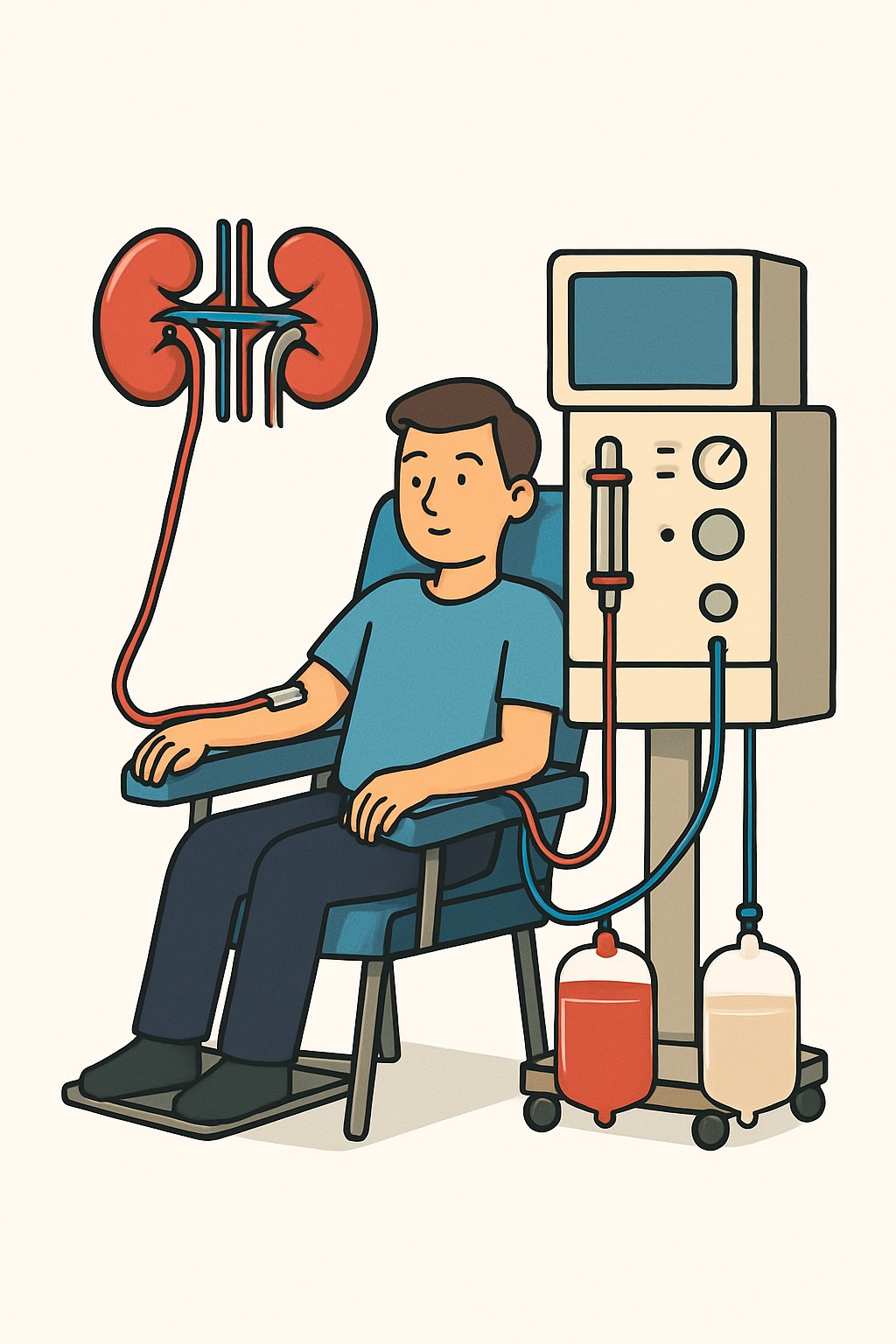
Overview
Renal dialysis is a treatment that filters wastes and extra fluid from the blood when the kidneys cannot. A session is one treatment visit. Dialysis can be done by hemodialysis, where blood is cleaned by a machine using a filter called a dialyzer, or by peritoneal dialysis, which uses the lining of the abdomen and a sterile fluid to filter the blood. Dialysis sessions help control fluid balance and the levels of salts and waste products, which may ease symptoms such as swelling, tiredness, or shortness of breath. A hemodialysis session uses a vascular access (a fistula, graft, or catheter) to move blood to and from the machine; peritoneal dialysis uses a soft tube placed in the abdomen.
Also known as: Dialysis treatment, Hemodialysis session, HD treatment, Peritoneal dialysis exchange, PD exchange
Preparation & Next Steps
Everything you need to know before and after your procedure
Before Care
- Bring a photo ID, insurance card, and an up-to-date list of medicines and allergies
- Arrive on time and plan transportation, as a session can take several hours
- Wear comfortable clothing with sleeves that roll up and allow access to your arm or catheter
- Keep the access area clean and tell the staff about redness, warmth, drainage, swelling, or pain
- Follow the clinic’s instructions on eating and which medicines to take before treatment
- Do not scratch, rub, or bump the access area; avoid tight clothing or jewelry on that limb
- Note your current symptoms and any recent medicine changes to discuss with staff
- Bring eyeglasses, reading material, or headphones for comfort if allowed by the clinic
- Confirm your next appointments and how to reach the unit if you are running late
After Care
- Keep the access dressing clean and dry as instructed by the dialysis unit
- Check the access for redness, warmth, swelling, drainage, or persistent pain and contact the clinic with concerns
- Watch for prolonged bleeding from needle sites or the catheter site and notify the clinic
- Stand up slowly after treatment to reduce dizziness or lightheadedness
- Plan for rest, fluids, and meals based on your kidney diet and fluid plan from your care team
- Record your post-dialysis weight and how you feel if you track this information
- Protect the access arm from heavy pressure, tight sleeves, or jewelry
- Review any medicine timing changes that apply on treatment days per your clinic’s plan
- Confirm the date and time of your next session and any lab tests or vaccinations due
Clinical Information
Important medical details about this procedure
Indications
- End-stage kidney disease from chronic kidney disease
- Severe loss of kidney function with symptoms or lab changes
- Acute kidney injury with buildup of waste or fluid
- High potassium not controlled by other treatments
- Fluid overload causing swelling or breathing trouble
- Symptoms from toxin buildup such as nausea, itch, or confusion
Alternatives
- Peritoneal dialysis at home
- Home hemodialysis with different schedules
- Kidney transplant
- Conservative kidney management without dialysis
- Continuous renal replacement therapy in an intensive care unit
Risks
- Low blood pressure during or after treatment
- Muscle cramps
- Headache, nausea, or vomiting
- Infection at the access site or in the bloodstream
- Bleeding or bruising from needles or catheter
- Access clotting or poor blood flow
- Allergic or sensitivity reaction to the dialyzer or sterilizing agents
- Fatigue or dizziness after treatment
Recovery Timeline
What to expect during your recovery
Most people can do light activities the same day, though tiredness is common after treatment. Energy often improves within 1 to 2 days.
Typical Range
0–2 days
Return to Work
0–2 days
Recovery Milestones
Do light activities and short walks if you feel well
Return to routine daily tasks or desk work as tolerated
Keep the access dressing clean and dry and monitor for bleeding, redness, or swelling
Gradually resume exercise and heavier tasks as energy returns
Frequently Asked Questions
Common questions and expert answers about this procedure
What happens during a dialysis session?
What happens during a dialysis session?
Hemodialysis moves blood through a filter to remove waste and fluid, then returns it to your body. Peritoneal dialysis fills the abdomen with a sterile fluid that absorbs waste and is then drained.
How long does each session take?
How long does each session take?
In-center hemodialysis often lasts about 3 to 5 hours. Peritoneal dialysis is done as multiple daytime exchanges that take about 30 to 40 minutes each, or overnight using a machine.
How often are treatments scheduled?
How often are treatments scheduled?
Many people receive in-center hemodialysis three times per week. Home hemodialysis schedules vary. Peritoneal dialysis is typically done every day.
Will needles be used?
Will needles be used?
Hemodialysis with a fistula or graft uses two small needles during each session. A catheter is sometimes used instead. Peritoneal dialysis uses a soft tube in the abdomen and no needles for exchanges.
What side effects are common after a session?
What side effects are common after a session?
Tiredness, low blood pressure, cramps, headache, or nausea can occur. Access problems or infection can happen and should be reported to the clinic.
Can I eat or take medicines before dialysis?
Can I eat or take medicines before dialysis?
Follow your clinic’s instructions. Some medicines are timed around dialysis, and food or fluid rules may apply for safety and comfort.
Can I work or drive after dialysis?
Can I work or drive after dialysis?
Many people can, especially with desk work, but some feel tired or lightheaded after treatment. Plan your day based on how you usually feel after sessions.
References
Medical literature and sources